New York Stock Exchange (NYSE)
New York, USA · Established 1792
This site requires authorization to access.
To request access, contact
william.goetzmann@yale.edu
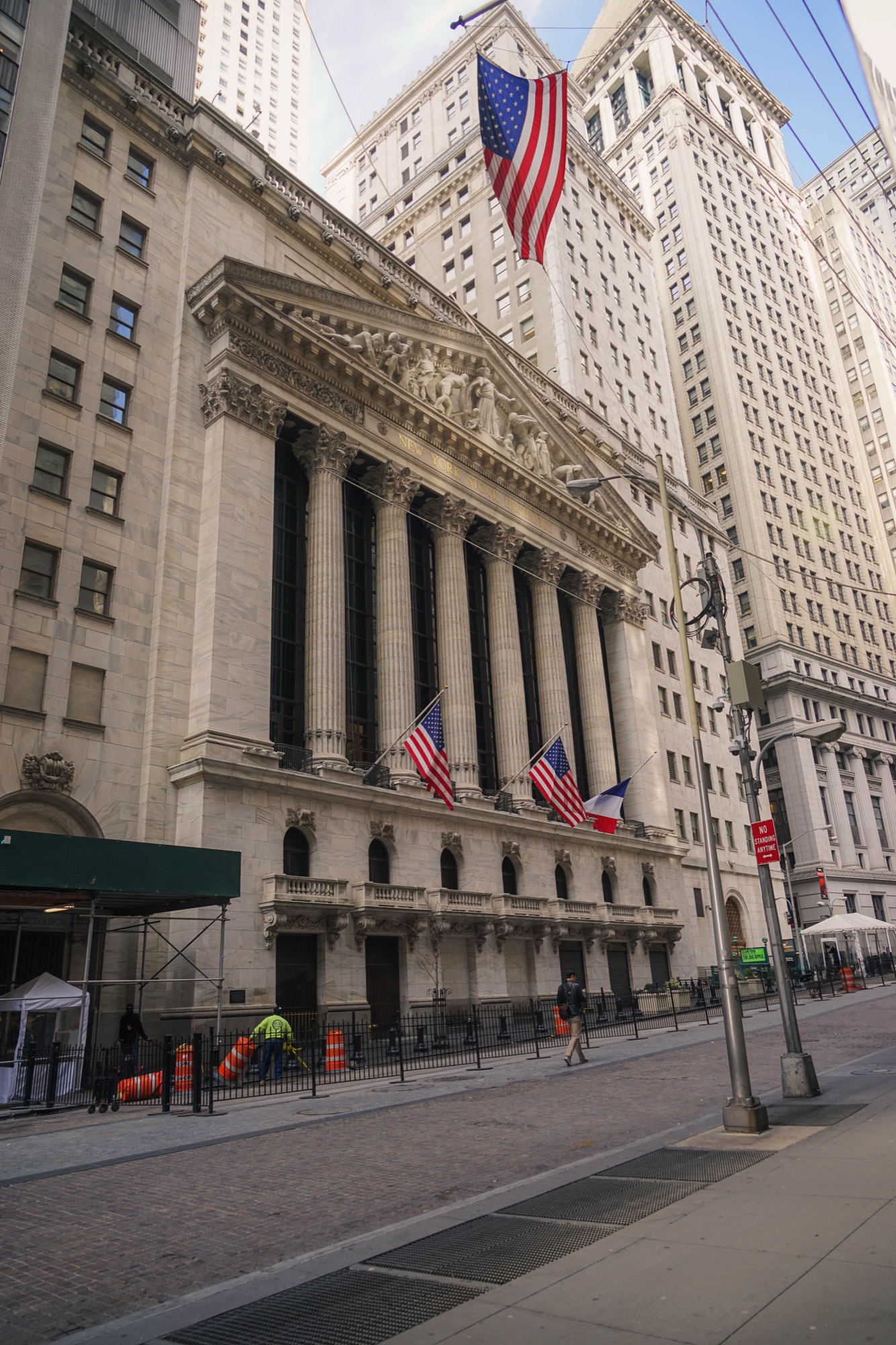
The current New York Stock Exchange building at 18 Broad Street was designed by architect George B. Post and completed in 1903, replacing an 1865 predecessor on the same site designed by John Kellum. Post won the commission through an invited competition among eight leading architects, judged under the guidance of Professor William Ware of Columbia University. His Neoclassical design, executed in white Georgia marble, presents a monumental facade dominated by six fluted Corinthian columns rising above a rusticated base. The building's most remarkable engineering feat is its 72-foot-high trading floor — called “the Board Room” — left entirely free of internal columns thanks to two pairs of steel trusses spanning the ceiling and carrying the weight of the upper stories. Immense windows, roughly 50 feet high, flooded the room with natural light. The building incorporated pneumatic tube systems, telephone connections, and early air conditioning. Between 1920 and 1922, the firm of Trowbridge and Livingston designed a 23-story annex at 11 Wall Street in a harmonious Neoclassical style. The complex was designated a National Historic Landmark on June 2, 1978, and a New York City landmark in 1985.
The building's crowning artistic element is the pediment sculpture group titled “Integrity Protecting the Works of Man,” conceived by George B. Post and executed by sculptor John Quincy Adams Ward, with completion by Paul Wayland Bartlett. The central figure is Integrity, a classically robed woman wearing the winged cap of Hermes, her arms extended outward. Flanking figures represent Agriculture (a man bearing a sack of grain, a woman with a distaff), Mining (two crouching men examining a rock), and Mechanical Production and Invention. The original marble figures, weighing 90 tons, were installed in 1904 but deteriorated within decades. In 1936, they were replaced with copper-sheet replicas over an iron skeleton — the same repoussé technique used for the Statue of Liberty — painted white to simulate marble. Inside, the trading floor features paneled Georgian marble walls, a gilded coffered ceiling, and arches supported by flat pilasters with white and gold ornamentation.
The NYSE building commands 18 Broad Street at its intersection with Wall Street, the magnetic center of the Financial District. Directly to the north stands Federal Hall National Memorial (1833–1842), originally the U.S. Custom House and later the Sub-Treasury. Diagonally opposite at 23 Wall Street rises the former J.P. Morgan and Company headquarters (1914, also by Trowbridge and Livingston), its limestone facade still scarred with shrapnel marks from the unsolved September 16, 1920 Wall Street bombing that killed more than 30 people. The narrow canyon of Broad Street — its irregular, curving plan a living fossil of colonial New Amsterdam — amplifies the monumental effect of Post's columned facade. The ensemble of these buildings around the intersection of Wall, Broad, and Nassau streets creates what amounts to an outdoor civic room, a forum of American capitalism where classical architectural language was deliberately employed to project permanence, legitimacy, and power.
The institutional history begins on May 17, 1792, when twenty-four brokers signed the Buttonwood Agreement beneath a sycamore tree near 68 Wall Street, pledging to trade securities only among themselves and to charge uniform commissions. This compact arose from the Panic of 1792 — America's first securities crash — triggered when former Treasury official William Duer attempted to corner the market in Bank of the United States stock. The brokers moved indoors to the Tontine Coffee House and in 1817 formalized as the New York Stock and Exchange Board. After the Civil War, volumes surged as more than 300 stocks and bonds were listed. The Exchange occupied its Kellum-designed building at 10–12 Broad Street from 1865 until Post's new building opened on April 23, 1903. The trading floor witnessed the crash of October 1929 — when 16.4 million shares traded on Black Tuesday — and Black Monday on October 19, 1987, when the Dow fell 22.6 percent in a single session, the worst percentage drop in its history.
The earliest securities traded were five-percent U.S. government bonds issued to fund Revolutionary War debts and shares in the Bank of New York and the First Bank of the United States. Railroad securities transformed the Exchange in the mid-nineteenth century, as lines like the Erie and the New York Central raised enormous capital. In 1867, Edward A. Calahan invented the stock ticker, revolutionizing market communications. On the trading floor, the specialist system emerged: individual members maintained orderly markets in specific stocks, standing at designated posts and matching orders through open outcry. By the early twentieth century, industrial equities — steel, oil, manufacturing — dominated volume.
Images will be added as the project develops. Photographs by Larry Ng and from research sources.