New Orleans Cotton Exchange
New Orleans, USA · Established 1871

This site requires authorization to access.
To request access, contact
william.goetzmann@yale.edu
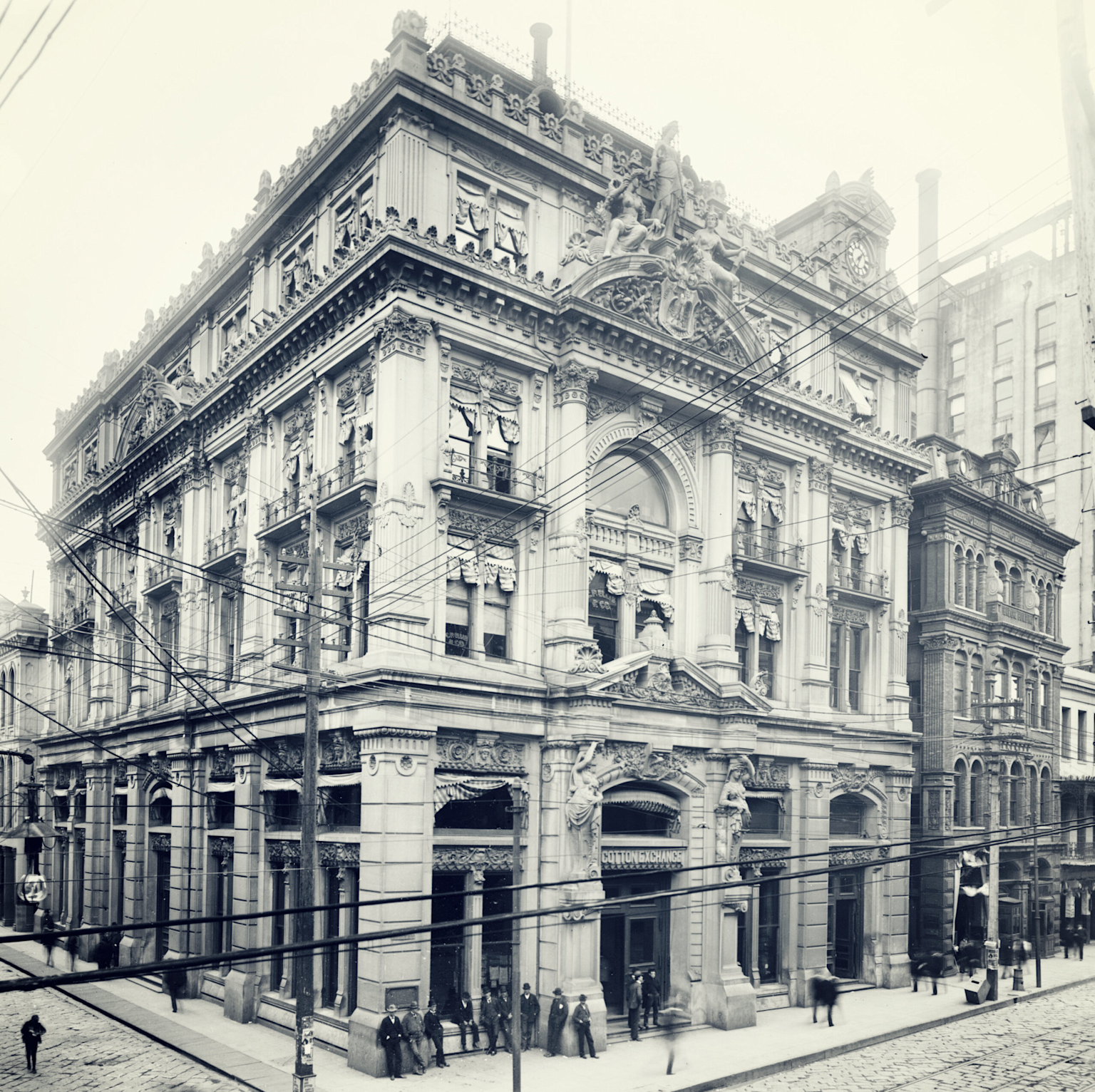
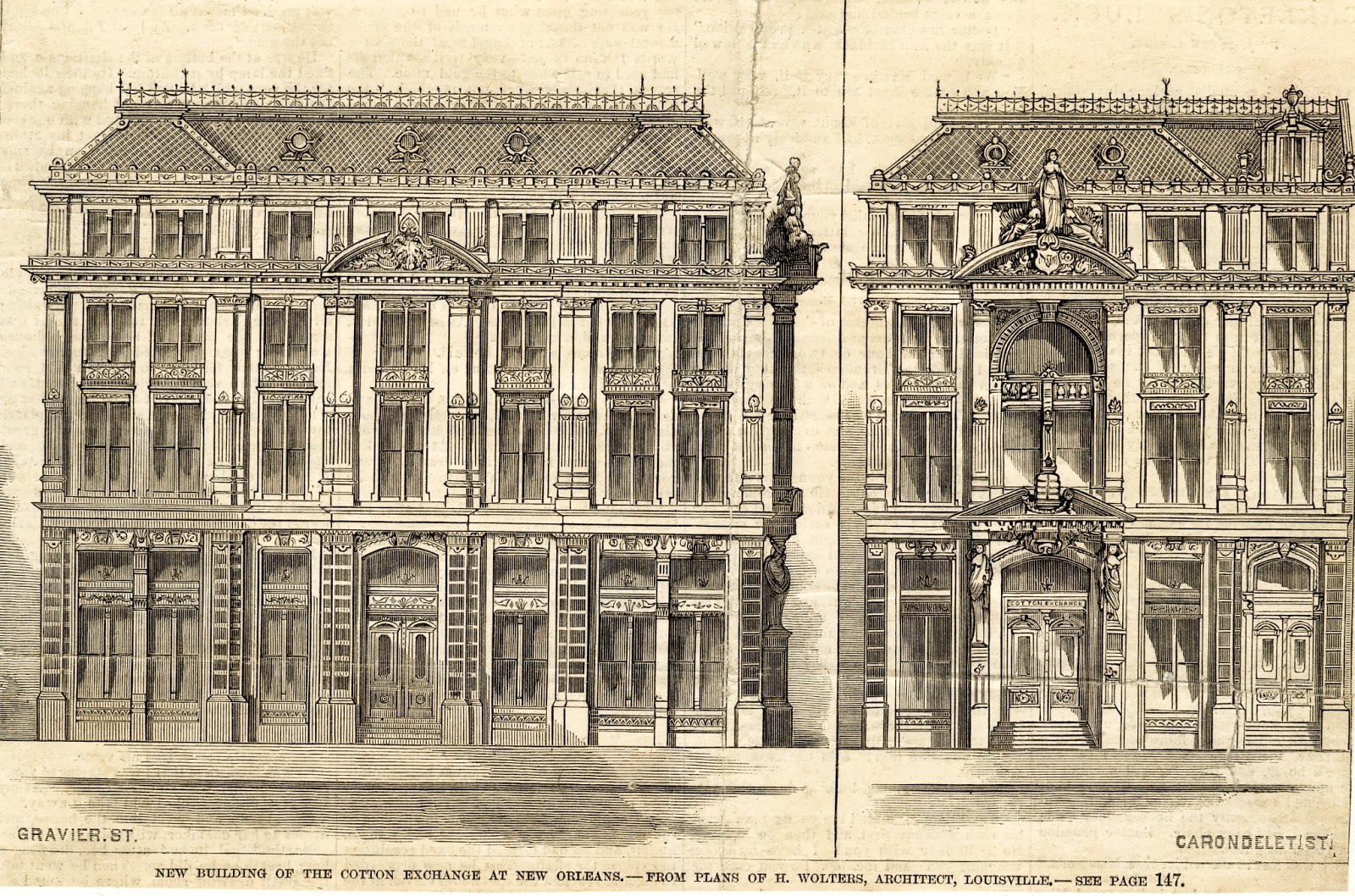
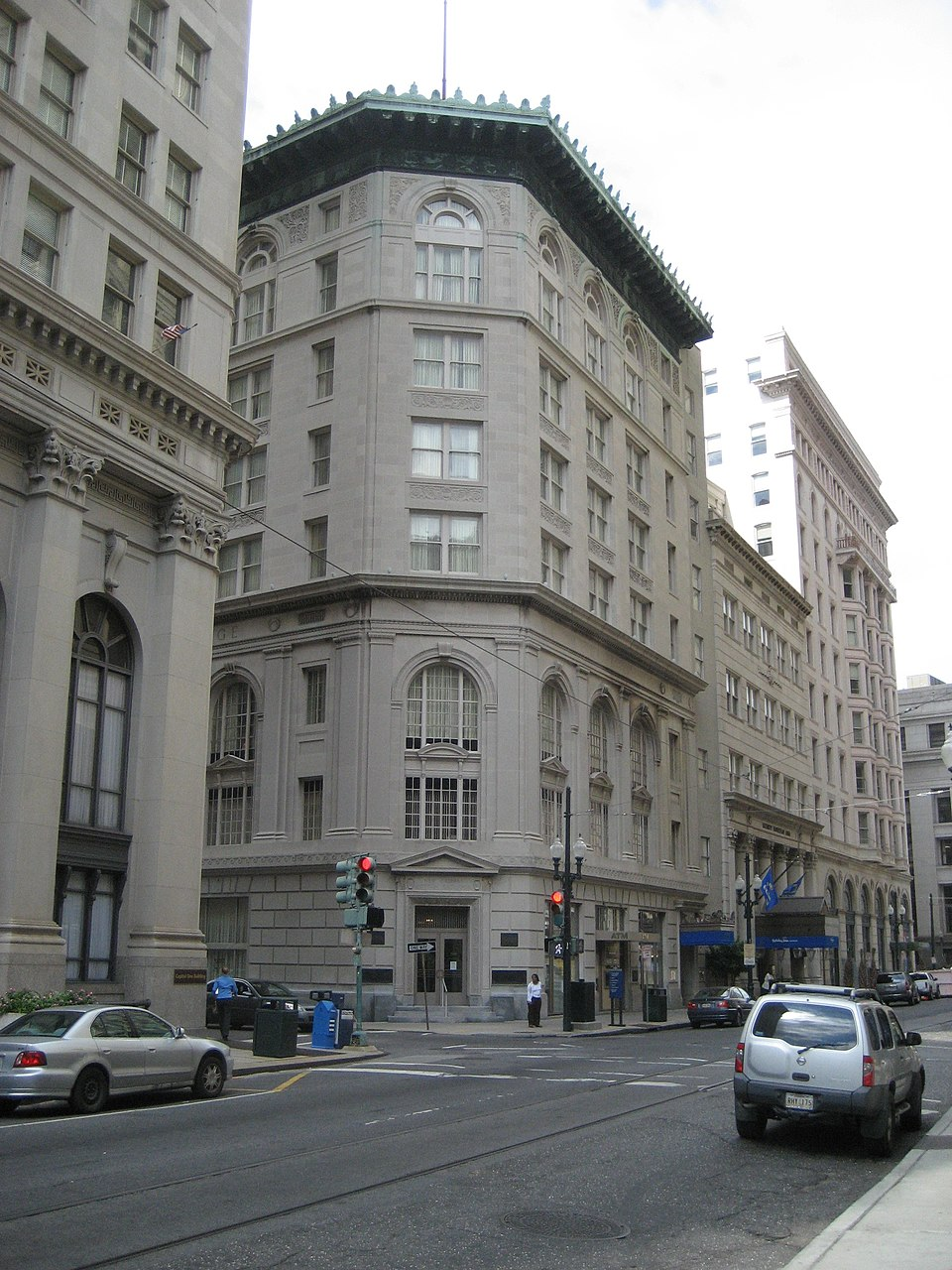
The New Orleans Cotton Exchange occupied three successive buildings at the corner of Carondelet and Gravier Streets. After initially conducting business in rented rooms, the Exchange commissioned its first purpose-built structure in 1881. The architect Henry Wolters of Louisville, a German-born designer trained at the Technische Hochschule in Charlottenburg and the École des Beaux-Arts in Paris, created a lavish four-story edifice reaching ninety-seven feet at its highest point, with James Freret—another Beaux-Arts alumnus—serving as supervising architect. Completed in May 1883 at a cost of $380,000, the building blended Second Empire, Renaissance, and Italianate elements, its Indiana limestone facade crowded with ornamental detailing including Corinthian pilasters, corbels, and delicate plaster palmettes. The interior Exchange Room featured Corinthian columns, gold ceiling medallions, fresco murals, and a central fountain around which trading took place. By 1920, structural problems traceable to the lack of foundational pilings forced demolition. The cornerstone for the third and final building was laid on the Exchange’s fiftieth anniversary in 1921. Designed by the prominent New Orleans firm Favrot and Livaudais in the style of a Renaissance palazzo, this eight-story steel-frame structure cost $1,222,520. The National Park Service designated it a National Historic Landmark in 1977, as documented in the NPS National Historic Landmark nomination form (NPS Form 10-300, 1977). After the Exchange closed in 1964 and the building passed through various owners, it was converted into a hotel—first the Cotton Exchange Hotel, then an AC Hotel by Marriott in 2014, the first AC Hotel property in the United States. The renovation, which coordinated with the Louisiana State Historic Preservation Office, won the AIA Louisiana Design Award of Merit for Historic Preservation in 2015, preserving the original vault, marble walls, and terrazzo floors.
The 1883 Wolters building was an extraordinary showcase of decorative sculpture. Two monumental caryatids—bare from the waist up, columnar below—flanked the main entrance, supporting the entablature above the door. Three allegorical statues representing Agriculture, Commerce, and Industry crowned the facade, tying the building’s ornamentation directly to its mercantile purpose. When the building was demolished around 1920, several sculptural elements survived: the caryatids were relocated to the entrance of the Weiblen Marble and Granite Works at 116 City Park Avenue, where they remain today, while the allegorical figures of Peace, Agriculture, and Industry were reportedly installed at Metairie Cemetery, though they were later lost to vandalism. The most celebrated artistic work associated with the New Orleans cotton trade is Edgar Degas’s painting A Cotton Office in New Orleans (1873), which depicts the office of his uncle Michel Musson’s cotton brokerage firm. Marilyn R. Brown, in Degas and the Business of Art: A Cotton Office in New Orleans (Penn State University Press, 1994), calls it “one of the most significant images of nineteenth-century capitalism,” in part because it was the first painting by an Impressionist to be purchased by a museum—the Musée des Beaux-Arts in Pau, France, acquired it in 1878 for 2,000 francs. A more recent scholarly treatment, published in The Art Bulletin (Vol. 102, No. 3, 2020), links Degas’s cotton office paintings to his broader meditation on the global circulation of commodities and people between the Old and New Worlds. The Harvard Art Museums hold a related preparatory work, Cotton Merchants in New Orleans, extending the painting’s scholarly significance. Period photographs held by the Library of Congress, taken by the Detroit Publishing Company between 1890 and 1901, document the ornate exterior of the 1883 building in its prime.
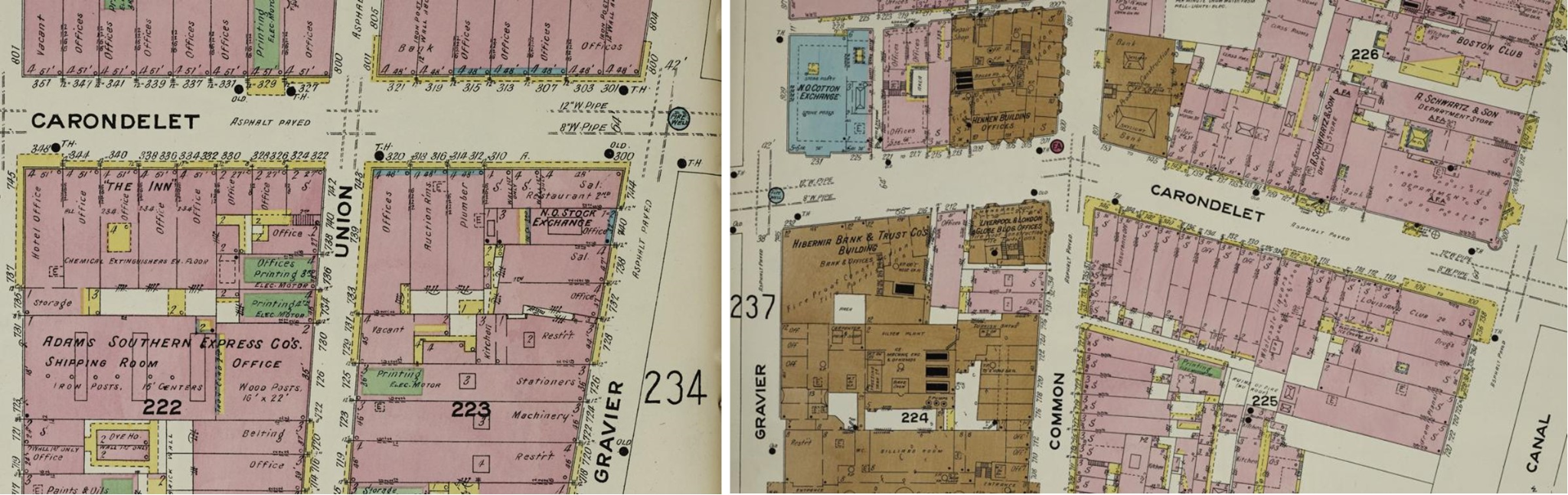
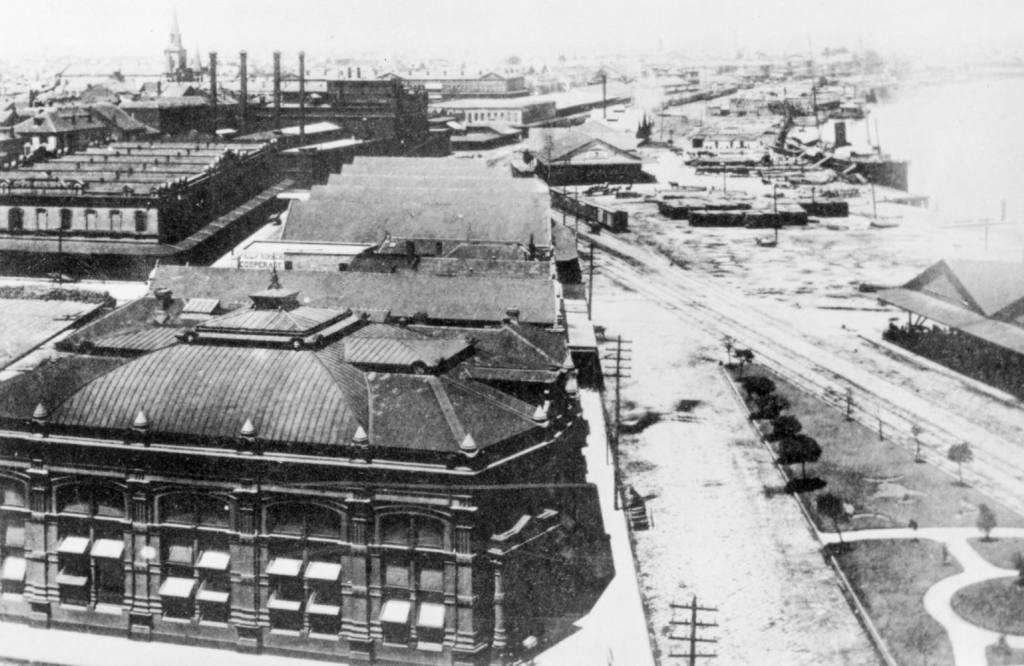
The Cotton Exchange stood at the intersection of Carondelet and Gravier Streets in what was known as “the cotton district” or “the Wall Street of New Orleans.” By 1854, some forty-six of the city’s 147 cotton firms had addresses on Carondelet Street, with another twenty-four on Gravier, meaning roughly ninety percent of the city’s professional cotton concerns were situated within a four-by-four-block area centered on this intersection. Before the Exchange was built, most cotton business had been conducted in the open air along Carondelet or in informal saloons that styled themselves “exchanges.” The Exchange’s location placed it at the heart of the Central Business District, adjacent to the French Quarter and within easy reach of the Mississippi River wharves where cotton bales arrived from upriver plantations via steamboat. As Walter Johnson demonstrates in River of Dark Dreams: Slavery and Empire in the Cotton Kingdom (Harvard University Press, 2013), the Mississippi Valley cotton trade made New Orleans one of the wealthiest cities in antebellum America, and by 1860 some thirty-five hundred vessels were steaming in and out of its port, carrying cargo worth $220 million annually. The Carondelet Street corridor housed not only cotton factors and brokers but also banks, insurance companies, and the Federal Reserve Bank of Atlanta’s New Orleans branch, forming a dense financial ecosystem. The Exchange’s successive buildings served as architectural landmarks that anchored this commercial district for nearly a century.
Eighteen New Orleans businessmen—cotton buyers, factors, brokers, and bankers—founded the New Orleans Cotton Exchange in January 1871, at a time when one-third of the entire American cotton crop passed through New Orleans. As L. Tuffly Ellis documents in “The New Orleans Cotton Exchange: The Formative Years, 1871–1880” (Journal of Southern History, Vol. 39, No. 4, November 1973), the Exchange opened for business on February 20, 1871, at the corner of Gravier and Carondelet Streets. Its founding was partly a response to the New York Cotton Exchange, which had opened in 1870; New Orleans merchants feared that centralized trading in New York would disadvantage sellers and sought to modernize their own operations. The Exchange’s constitution, adopted January 24, 1871, stated its purposes as establishing “just and equitable principles, uniform usages, rules and regulations, and standards for classification” governing all transactions in the cotton trade. The organization quickly grew in influence, and its advanced business methods—as Sven Beckert explores in Empire of Cotton: A Global History (Knopf, 2014)—enabled New Orleans to regain its position as the world’s primary spot market for cotton and to become a leading futures market, outranked only by Liverpool and New York. The Exchange weathered the Panic of 1873, navigated post-Reconstruction economic volatility, and in 1909 implemented a centralized agency for grading contract cotton, a significant regulatory innovation that David Pinzur analyzes in “Making the Grade: Infrastructural Semiotics and Derivative Market Outcomes on the Chicago Board of Trade and New Orleans Cotton Exchange, 1856–1909” (Economy and Society, Vol. 45, 2016). By the mid-twentieth century, however, declining Southern cotton production, federal price supports, and government regulation steadily undermined the Exchange’s relevance. The Agricultural Act of 1964 set a price of 30 cents per pound for domestic growers, effectively eradicating the futures market. The Exchange closed on July 9, 1964; its last president, C. Layton Merritt, told the Dallas Morning News, “We cede our role in the market place to the Secretary of Agriculture, the cooperatives, and history.” In 1962, the Exchange had already sold its landmark building to the Universal Drilling Company. The institutional records, spanning 1871–1979 and comprising 72 boxes and 336 volumes, are preserved in the Louisiana Research Collection at Tulane University’s Howard-Tilton Memorial Library.
The New Orleans Cotton Exchange was established primarily as a centralized marketplace for raw cotton—both spot and futures transactions. Cotton factors, a powerful class of intermediaries, accepted cotton on consignment from planters throughout the Mississippi Valley and sold it at the best obtainable prices, while also supplying plantation equipment and providing financial services. The Exchange brought order to what had been a highly speculative and erratic pricing system by providing a centralized trading floor where participants could obtain reliable information about market conditions and prices. Trading committees were organized around specific functions: membership, information and statistics, trade, classification and quotations, finance, credits, and books. A distinctive feature of the New Orleans market, as David Pinzur demonstrates in his doctoral dissertation Building Futures Markets: Infrastructure and Outcome on the Chicago Board of Trade and New Orleans Cotton Exchange, 1856–1916 (University of California, San Diego, 2016), was its grading system: cotton in New Orleans maintained its physical form and was graded through antagonistic negotiation at the point of exchange, with “scalemen” loading bales onto scales while pulling lint samples for classers who graded by color, cleanliness, and fiber length. This produced grades that were reliable but expensive guides to cotton quality, which in turn fostered stable hedging trades rather than the volatile speculation characteristic of the Chicago grain pits. The Exchange also dealt in cottonseed oil and related by-products. Its constitution emphasized the standardization of classification according to “uniform usages, rules and regulations,” and its grading standards helped shape what eventually became the Universal Cotton Standards of the United States, administered by the U.S. Department of Agriculture. At its peak, the Exchange handled transactions involving roughly one-third of the American cotton crop, making it one of the most consequential commodity exchanges in the Western Hemisphere.