Louisiana Sugar Exchange
New Orleans, USA · Established 1882

This site requires authorization to access.
To request access, contact
william.goetzmann@yale.edu
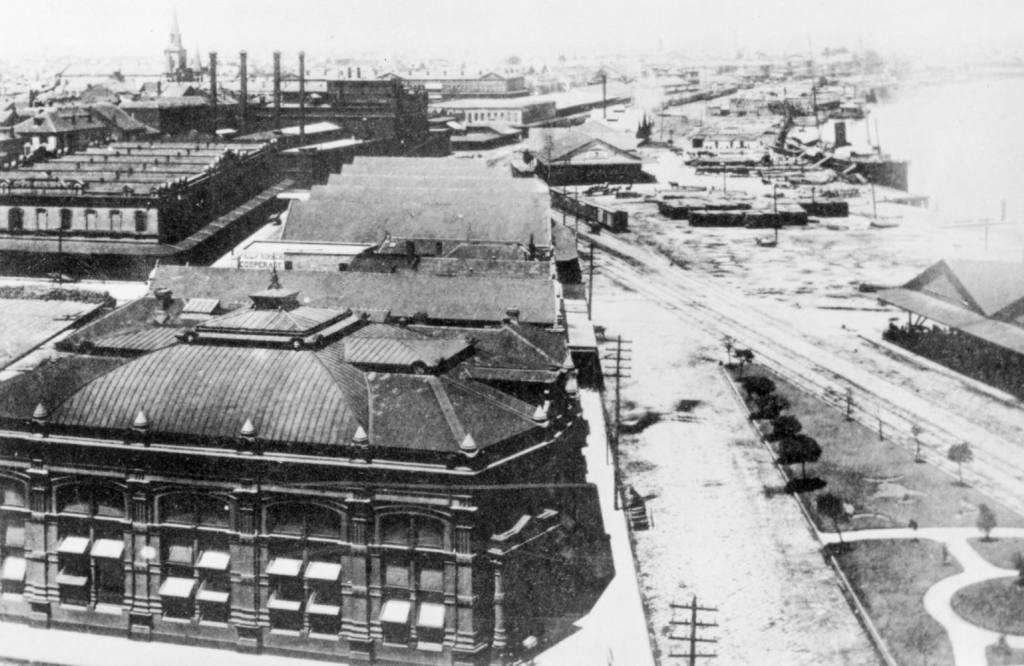
The Louisiana Sugar Exchange building, erected at the northwest corner of North Front and Bienville Streets in the heart of New Orleans’s sugar district, was designed by James Freret, the first native-born New Orleans architect to achieve national prominence. As documented by the 64 Parishes encyclopedia entry on Freret (Know Louisiana, Cultural Vistas), he trained before the Civil War in the atelier of Charles-Auguste Questel at the École des Beaux-Arts in Paris—one of the first Americans to study there—before returning to serve in the Confederate Army’s engineering corps. After the war, Freret opened his own practice and became, as the American Architect and Building News noted upon his death in 1897, “one of the most distinguished architects of the South.” His design for the Sugar Exchange, constructed by builder Joseph R. Turck at a cost of $52,000 between July 1883 and June 1884, was a two-story Beaux Arts gem featuring triptych walls on the front and rear facades, floor-to-ceiling plate glass windows on three sides, a prominent clock set within the riverfront pediment, and dramatic exterior columns. The building’s crowning feature was a skylighted dome rising sixty-five feet above the main trading hall, supported by four massive fluted Ionic columns fashioned around solid pine timber cores. The main hall itself measured sixty by one hundred feet, as recorded in the Historic American Buildings Survey documentation (HABS No. LA-1110, Library of Congress). A wing on the northeast side housed conference rooms, a telegraph office, a reading room, and a museum of sugar-making machinery. Richard Campanella, geographer at the Tulane School of Architecture, described the building’s unusual entrance on Clay Street as “a canopy-covered doorway in the indentation between the hexagonally shaped main hall on the upper side, and the rectangular office section on the lower side” (Preservation in Print, February 2018). Sold in 1941 to the Construction and General Laborers union for $13,520, the building served as a meeting hall for Laborers Local Union 689 until, by autumn 1963, it had fallen into ruinous condition. The National Park Service dispatched photographer Dan Leyrer to document it under the Historic American Buildings Survey before it was demolished in the summer and winter of 1963. Today the site is a parking lot adjacent to Woldenberg Riverfront Park.
The interior decorative program of the Louisiana Sugar Exchange was defined by the monumental Beaux Arts vocabulary that Freret absorbed during his Parisian training. The four fluted Ionic columns that rose from the trading hall floor to support the great dome were each adorned with carved interpretations of tropical foliage, as noted in the Preservation Resource Center’s account of the building (PRCNO, “The Louisiana Sugar & Rice Exchange, 1884–1963”). These ornamental capitals drew on motifs appropriate to the sugar trade—cane leaves and subtropical vegetation—transforming structural elements into thematic decoration. The sixty-five-foot dome, pierced by a skylight that flooded the hall with natural light, created the soaring interior volume that contemporaries described as a commercial “palace,” a term echoed by journalist Mike Scott in his account of the building for nola.com (2022). The main hall’s plate glass windows on three sides further amplified the luminous quality of the trading space. Within this hall, sugar samples were displayed for buyers who would taste-test them before agreeing on purchases—the physical act of commodity assessment thus integrated into the architecture of the room. The building also housed a museum of sugar-making machinery, a feature that doubled as both educational exhibit and decorative display of the industry’s technological apparatus. The HABS photographs taken by Dan Leyrer in August 1963, now held at the Library of Congress, capture fragmentary glimpses of the interior during demolition, showing the stripped columns and the skeletal dome structure—haunting records of the ornamental program that once animated this lost commercial space.
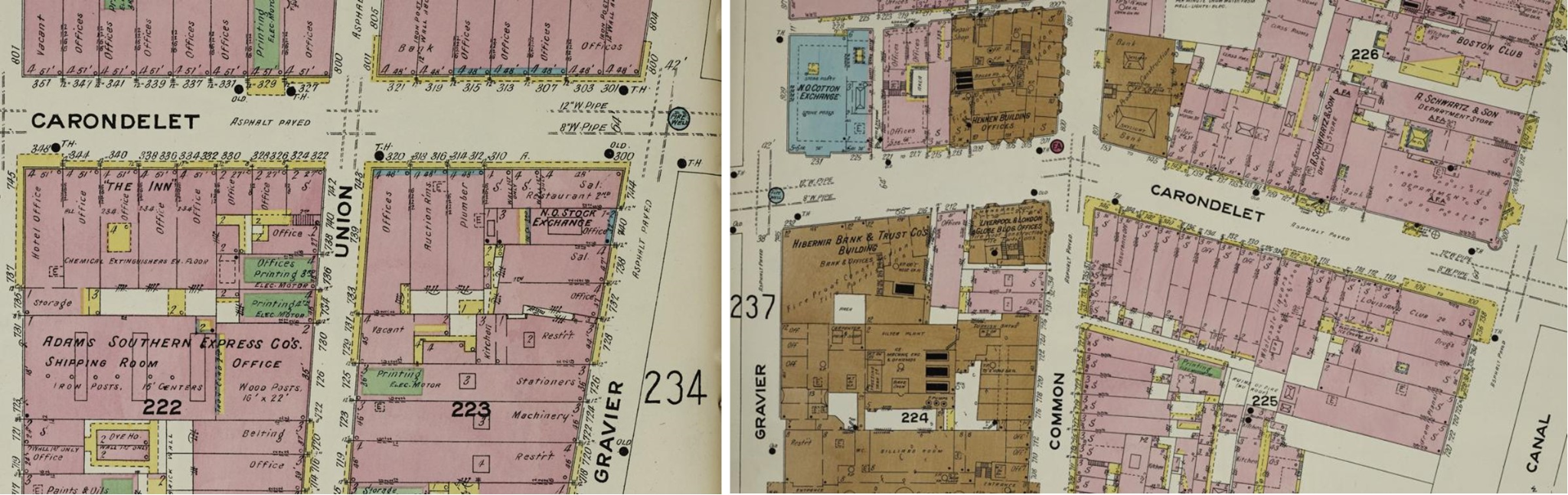
The Sugar Exchange occupied a pivotal position in New Orleans’s commercial geography. As Richard Campanella demonstrated in Bienville’s Dilemma: A Historical Geography of New Orleans (University of Louisiana at Lafayette Press, 2008), the city’s crescent-shaped bend in the Mississippi River created a natural deepwater port that made it the principal entrepot for the commodities of the entire Mississippi Valley. The corner of Bienville and North Front Streets sat at the epicenter of what was known as the Sugar Levee—a stretch of riverfront from roughly Canal Street to Toulouse Street where, as Campanella wrote in Preservation in Print (2018), raw sugar arrived daily by steamboat from plantations throughout the bayou country. Draymen towed hogsheads to waiting vessels or to the warehouses of the New Orleans Sugar Shed Company, a firm whose monopolistic overcharging and mishandling of consignments ultimately provoked the planters to form their own exchange. The Sugar Exchange building was designed by Freret specifically to “stand out amid the warehouses and wharves dominating the area,” as the Preservation Resource Center noted—its Beaux Arts elegance deliberately contrasting with the rough industrial landscape of sheds, refineries, and smokestacks that characterized the sugar district. By the late nineteenth century, the Planters Refinery and the Louisiana Sugar Refinery had both been built nearby, their tall smokestacks dramatically changing the city’s skyline. The Sugar Exchange thus anchored a specialized commercial quarter that paralleled the cotton district clustered around Carondelet and Gravier Streets, where the New Orleans Cotton Exchange (founded 1871) occupied its own palatial building. Together with the Fruit Exchange and the Mechanics, Dealers and Lumbermen’s Exchange, these institutions formed a constellation of commodity marketplaces that made late nineteenth-century New Orleans one of America’s great commercial cities. Today, the former sugar district has been subsumed by Woldenberg Riverfront Park, opened in 1989 on the reclaimed wharf land.
The Louisiana Sugar Exchange grew out of the Louisiana Sugar Planters’ Association, whose members resolved in February 1883 to create a dedicated marketplace for sugar transactions. As the Preservation Resource Center’s historical account details, the impetus was frustration with the New Orleans Sugar Shed Company, a corrupt monopoly that overcharged for storage and mishandled consignments. The planters obtained a state charter on March 6, 1883, purchased four lots at Bienville and North Front Streets in July for $16,262, and commissioned James Freret’s Beaux Arts design. The Exchange opened shortly after noon on June 3, 1884, its charter purpose being, as Campanella quoted, “to govern and direct how commodities [are] sold, purchased, and delivered; to fix penalties for failure to comply with contracts…; to establish standards of articles bought and sold, [and] to establish rules for…inspectors, weighers and gaugers.” Louisiana’s sugar industry had deep roots: as the New Orleans Historical website documents, the plantation of Étienne de Boré produced the first commercially granulated sugar in the colony in 1795, with the chemical innovation credited to Antoine Morin, a free man of color with expertise in chemistry. By the 1840s, Louisiana produced nearly all the sugar consumed in the United States, and as Richard Follett demonstrated in The Sugar Masters: Planters and Slaves in Louisiana’s Cane World, 1820–1860 (Louisiana State University Press, 2005), the average plantation was valued at roughly $200,000 and yielded a ten percent annual return. John Alfred Heitmann’s The Modernization of the Louisiana Sugar Industry, 1830–1910 (Louisiana State University Press, 1987) traced how competition from abroad drove technological innovation in milling and refining. In 1889, the Exchange expanded to become the Louisiana Sugar and Rice Exchange. At its peak, an estimated 1,100 sugar mills operated across Louisiana. But as the Preservation Resource Center’s account records, World War I, tariff changes including the damaging Wilson-Gorman Act of 1894, rising competition from Western sugar beets, and the devastating mosaic disease of the 1910s–1920s sent the industry into steep decline. Louisiana’s share of national sugar production fell from eleven percent in 1900 to just 4.5 percent by 1937. The Exchange sold its building in 1941, and the structure was demolished in 1963—its loss documented by HABS photographer Dan Leyrer before it was too late.
The Louisiana Sugar Exchange was established to rationalize the trading of raw sugar, which had previously been conducted in the open air on the Sugar Levee along the Mississippi riverfront. As the Preservation Resource Center’s detailed history recounts, planters consigned their sugar and molasses to city factors—commission merchants who received a 2.5 percent fee—and shipped their hogsheads (large wooden barrels typically containing about 1,000 pounds of sugar) by steamboat to the sugar landing. Clerks boarded arriving steamboats to identify cargo consignments, while brokers met with prospective buyers to sample the product and agree on a price. The Exchange’s great innovation was enabling sugar to be “sold by sample” within the trading hall, circumventing the need for on-site warehouse storage controlled by the monopolistic Sugar Shed Company. Inside the domed hall, buyers would taste-test sugar samples—evaluating color, grain, and sweetness—before executing purchases. The Exchange established formal standards for grading, inspection, weighing, and gauging, bringing institutional order to what had been informal wharf-side transactions. In addition to raw cane sugar in its various grades, the Exchange handled molasses—a major by-product of sugar refining—and after 1889, rice was added when the institution became the Louisiana Sugar and Rice Exchange. As the Federal Reserve Bank of Atlanta’s Museum of Trade, Finance, and the Fed documents in its exhibition on exchanges and clearinghouses, the Exchange served the broader function of price discovery for the American sugar market, transmitting price information via its telegraph office to buyers and sellers across the country. The commodities traded reflected the full spectrum of Louisiana’s plantation output: raw brown sugar destined for refineries, partially refined grades, and the thick dark molasses used in food production and rum distillation. Trading was conducted during fixed exchange hours, with members paying dues and submitting to the institution’s arbitration rules for contract disputes.