Naples Stock Exchange (Palazzo della Borsa di Napoli)
Naples, Italy · Established 1778 (founded by royal decree; Palazzo della Borsa built 1894-1899)
This site requires authorization to access.
To request access, contact
william.goetzmann@yale.edu
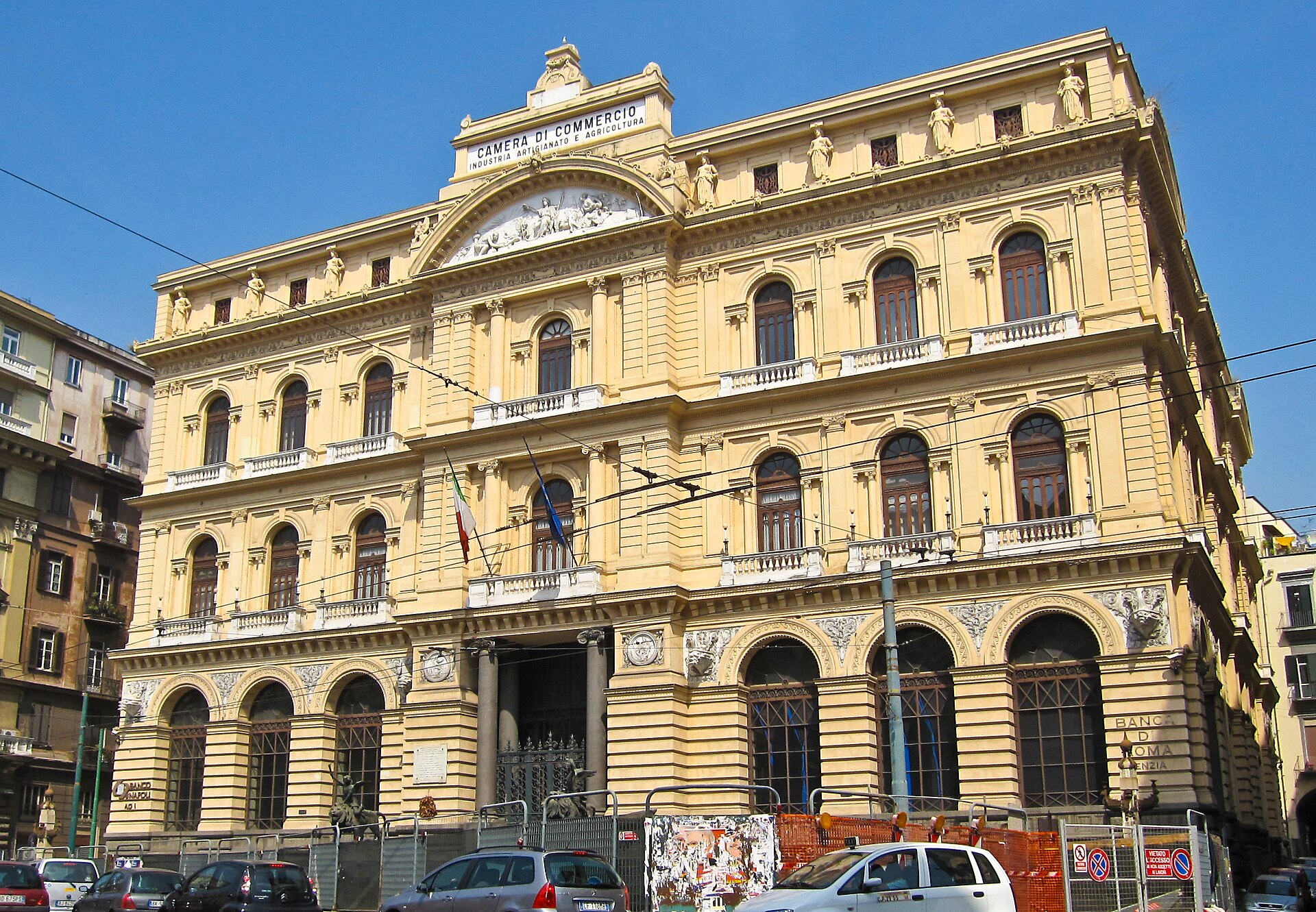
The Palazzo della Borsa that overlooks Piazza Giovanni Bovio was designed in 1895 by the Neapolitan architect-engineer Alfonso Guerra (1845-1920) in collaboration with Luigi Ferrara, and inaugurated in October 1899 as the seat of both the Chamber of Commerce and the stock exchange. Guerra, a pupil of Errico Alvino who trained at Naples's Istituto di Belle Arti and earned an engineering degree in 1867, conceived the building in the eclectic Neo-Renaissance idiom that characterised his mature work (Treccani, Dizionario Biografico degli Italiani, s.v. 'Guerra, Alfonso'). The three-storey palazzo, financed in part from funds donated in 1861 by General Enrico Cialdini, presents a facade articulated by two superimposed orders of pilaster strips and engaged columns that relieve the mass of the wall; two Ionic columns frame the main entrance, which is preceded by a broad staircase, while the uppermost floor is punctuated by caryatids flanking a large frieze depicting Hermes and Dionysus (Wikipedia, 'Palazzo della Borsa, Naples'; it.wikipedia, 'Palazzo della Borsa (Napoli)'). Internally the ground floor employs iron-and-glass construction to illuminate the trading hall, the Sala delle Grida, a characteristic late-nineteenth-century solution that married industrial materials to academic ornament.
The artistic programme of the Borsa is dominated by its sculpture. At the foot of the entrance staircase stand two bronze groups by Luigi De Luca representing winged genii mounted on lions, an allegory glossed as 'il Genio che domina la forza' -- the light of reason taming brute force -- which remain the building's most quoted feature (Wikipedia, 'Palazzo della Borsa, Naples'). Above the entrance a sculpted lunette carries the bas-relief of Hermes and Dionysus, the gods of commerce and abundance appropriate to a bourse. The principal salon was decorated with frescoed lunettes attributed to a group of Neapolitan painters including Gustavo Mancinelli, Gaetano Esposito and Vincenzo Migliaro, with stuccowork by Ciro Sannino and Vincenzo Belligiono and a statue by Giuseppe del Fico on the first floor (Wikipedia, 'Palazzo della Borsa, Naples'). The decorative ensemble is competent and richly Belle Epoque rather than first-rank, its interest lying chiefly in De Luca's bronzes and in the building's incorporation of far older fabric.
The Palazzo stands at Piazza Giovanni Bovio 32, the square long known popularly as Piazza della Borsa, at the seaward end of the Corso Umberto I (the 'Rettifilo') driven through the old city during the Risanamento, the sweeping urban renewal that followed the cholera epidemic of 1884. Guerra was himself deeply involved in those works, and the Borsa was conceived as a monumental terminus and commercial showpiece for the new boulevard (Treccani, Dizionario Biografico, s.v. 'Guerra, Alfonso'). The square is centred on an equestrian monument to Victor Emmanuel II and lies between the historic harbour and the business district. Remarkably, the construction did not sweep away the tiny early-Christian Cappella di Sant'Aspreno al Porto, dedicated to the first bishop of Naples and built over a Roman bath chamber; remodelled in 1895, it was instead enveloped within the flank of the Palazzo, so that one of the city's oldest places of worship survives hidden inside its grandest temple of commerce (Chiesa di Sant'Aspreno al Porto, it.wikipedia).
Merchants had gathered to transact business in Naples since at least the sixteenth century, but a formal exchange was established only by royal decree of 22 June 1778, when it was placed under the self-government of the merchant class -- its first meetings held in the cloister of the church of San Tommaso d'Aquino on Via Toledo (Borsa Italiana, 'Naples Stock Exchange: the locations and the historical events'). Under French rule the institution was reorganised on the Napoleonic model: the Naples Chamber of Commerce was created on 10 March 1808 and the exchange placed under its control, an arrangement preserved through the Bourbon Restoration. On 4 October 1826 trading moved to a new hall in the Palazzo San Giacomo (Palazzo delle Finanze), and after Italian unification the exchange continued as the principal bourse of the Mezzogiorno before relocating in 1899 to the purpose-built Palazzo della Borsa. Overshadowed by Milan and Genoa and by the long economic decline of the South, the Naples exchange dwindled in importance through the twentieth century and ceased operating in the early 1990s, leaving the Palazzo to the Chamber of Commerce that occupies it today (Borsa Italiana).
In its early decades the Naples bourse dealt chiefly in state securities -- the public debt of the Kingdom of Naples and later of unified Italy -- alongside a modest list of equity shares particular to the Neapolitan market. Borsa Italiana records that roughly thirty share listings circulated between 1833 and 1845, though by 1860 only a single one remained actively traded, an index of the market's thinness. Trading was conducted by a small, tightly regulated body of licensed brokers (agenti di cambio), who numbered between six and twenty under French and Restoration rule and stabilised at around fifteen through the period of unification (Borsa Italiana, 'Naples Stock Exchange'). Business was transacted by open outcry in the trading hall -- the Sala delle Grida of the new Palazzo -- where bank, railway and utility shares of the post-unification economy joined government rente. The exchange never rivalled the volumes of Milan or Genoa, and its securities list reflected the comparatively limited industrialisation of the former Bourbon kingdom.
Images will be added as the project develops. Photographs by Larry Ng and from research sources.