Palais de la Bourse of Nantes (Palais Crucy)
Nantes, France · Established first bourse 1641; current Palais Crucy designed 1790, completed 1815
This site requires authorization to access.
To request access, contact
william.goetzmann@yale.edu
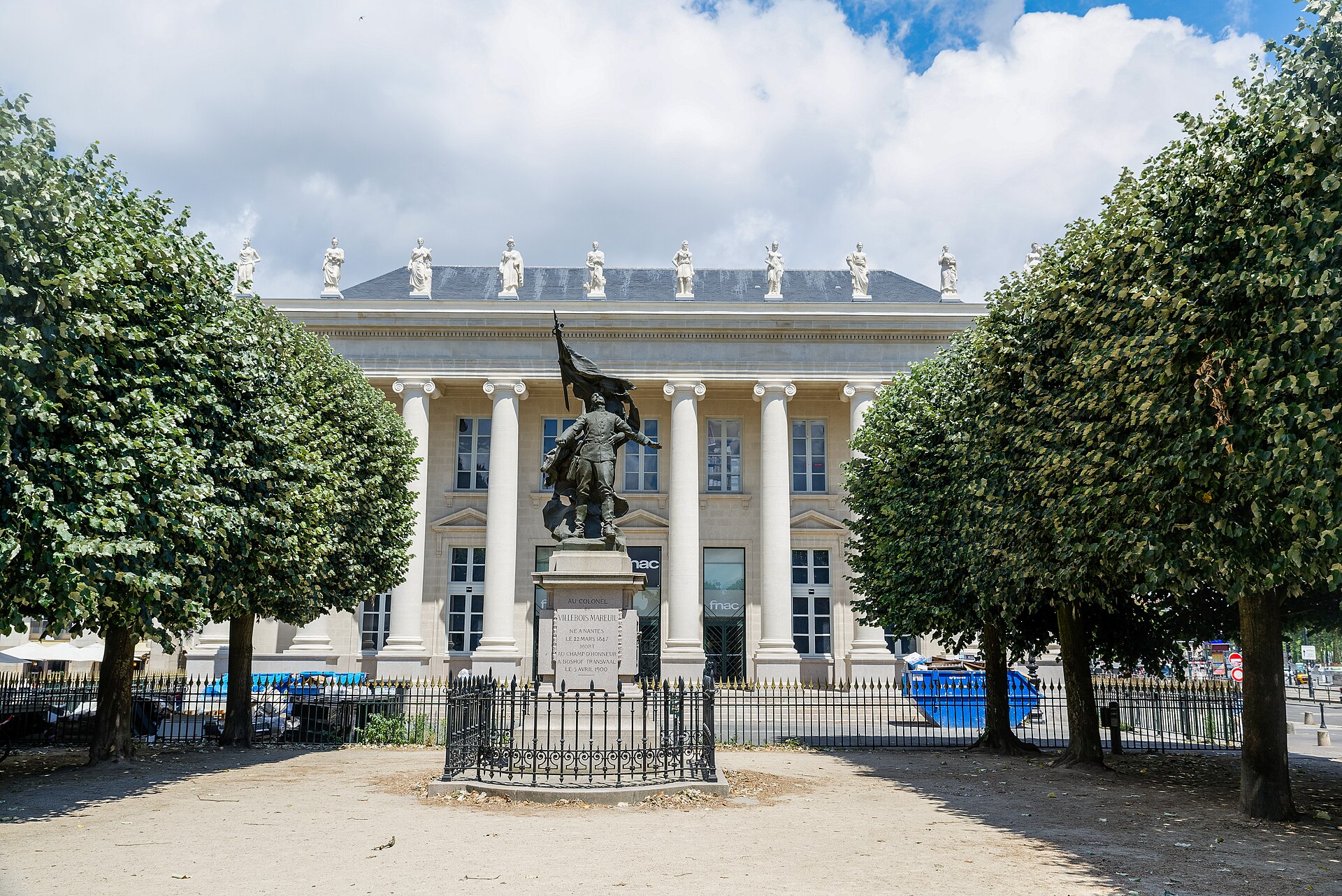
The Palais de la Bourse, often called the Palais Crucy after its architect, was designed by the Nantes-born neoclassicist Mathurin Crucy (1749-1826), the city's chief architect (architecte-voyer) and a Prix de Rome laureate of 1774 who had studied at the Villa Medici and absorbed the lessons of Palladio. The municipality accepted Crucy's plans in 1790, and construction formally began on 1 July 1790; the project belonged to the same monumental neoclassical campaign that gave Nantes the Place Graslin, the Théâtre Graslin and the Place Royale (Mathurin Crucy, Wikipedia; Nantes Patrimonia, 'Palais de la Bourse'). The building is a rectangular monument in the néo-grec idiom, its principal western front facing the river dominated by a portico of ten Ionic columns carrying a deep architrave and cornice. Because the reclaimed riverside ground beside the Loire was unstable, the structure was partly raised on piles. The French Revolution and the city's financial collapse halted work for a quarter-century, leaving the building roofless and unusable; the project was relaunched only after Napoleon I's visit to Nantes in 1808 and was completed in 1815 (Histoires d'universités, '1790, Nantes. Palais de la Bourse', 2021; fr.wikipedia.org, 'Palais de la Bourse (Nantes)'). Allied bombardments on 16 and 23 September 1943 gutted the interior and severely damaged both facades; because the facades had been inscribed as a monument historique in 1947, the Palais was rebuilt to Crucy's original drawings under architect Jean Merlet, reopening on 28 June 1957.
The chief artistic interest of the Palais lies in the ten over-life-size allegorical statues, each about two metres tall, set above the columns of the west portico. They were carved by the sculptors Charles-Guillaume Robinot-Bertrand (1778-1840) and Jean-Baptiste-Joseph Debay the elder (1779-1863) and installed in 1812, personifying the City of Nantes, the Loire, the Fine Arts, Geography, Prudence, Abundance and Astronomy together with the four continents then known to European commerce -- Europe, Asia, Africa and America -- an iconographic programme that frankly advertised the global reach of the port's trade (Nantes Patrimonia, 'Statues du Palais de la Bourse'; fr.wikipedia.org, 'Palais de la Bourse (Nantes)'). The original statues were lost in the 1943-44 destruction; faithful copies were carved and reinstalled, the last of them returned to the entablature in April 2019. Beyond this sculptural ensemble the building's ornament is restrained: the neoclassical vocabulary of column, entablature and pediment supplies the principal aesthetic effect, and the interior, much altered by reconstruction and by its late-twentieth-century conversion to retail use, preserves little decorative fabric.
The Palais stands on the Place du Commerce, the nerve-centre of central Nantes and a square whose very name records its mercantile vocation. Nantes had turned decisively to international trade from the 1630s, and a first Bourse was raised here in 1641; the eighteenth-century rebuilding of the quarter, including Crucy's Palais and the bridges linking the square to the newly urbanised Ile Feydeau, transformed the riverside into a planned commercial showpiece oriented toward the Loire and the port (Nantes Patrimonia, 'Palais de la Bourse'; aroundtheworld4u.com, 'Place du Commerce'). The site itself had ancient commercial associations, having served as the medieval 'Port-au-Vin' merchant harbour. Today the Place du Commerce remains the symbolic heart of the city centre, served by Nantes's three tram lines at the Commerce stop, and the Palais -- since 4 October 1996 occupied by an Fnac media store -- continues to anchor the square even as the river arm that once lapped its foundations has long since been filled in.
Nantes built its first exchange on this site in 1641, institutionalising the gatherings of merchants who had made the city France's leading Atlantic trading port. Crucy's far grander Palais, conceived in 1790, was completed in 1815 and thereafter housed the services of the Chamber of Commerce and the Tribunal de Commerce (commercial court), uniting under one neoclassical roof the negotiating, regulatory and judicial functions of a great merchant community (fr.wikipedia.org, 'Palais de la Bourse (Nantes)'; epotec.univ-nantes.fr, 'Le Palais de la Bourse'). The building's fortunes tracked those of the port: erected at the close of the era of Nantes's commercial supremacy, it served the Chamber and court through the nineteenth and twentieth centuries until the wartime bombing of 1943. Reconstructed by 1957 to Crucy's plans, it was finally given over to commercial retail use in 1996. Its facades were inscribed on the supplementary inventory of historic monuments on 24 January 1947 (Mérimée reference PA00108652).
The Bourse and the Place du Commerce were the financial expression of an economy built on Atlantic and colonial trade. In the eighteenth century Nantes was the foremost slave-trading port of France -- responsible for roughly 43 percent of all French slaving expeditions and the point of departure for ships that carried an estimated 450,000 captive Africans across the Atlantic -- and the direct trade with the French Caribbean colonies brought back cargoes of sugar, cotton, coffee, indigo, tobacco and precious woods that were bought, sold and financed by the merchants who met here (en.wikipedia.org, 'Nantes slave trade'; Mémorial de l'abolition de l'esclavage, Nantes). The wealth that paid for Crucy's monumental square was very largely the wealth of this commerce: the city's population doubled from 40,000 to 80,000 over the century on the strength of it. The merchants who congregated at the Bourse traded in colonial commodities, marine insurance, bills of exchange, and shares in ships and slaving ventures, while the adjoining commercial court adjudicated the disputes that such long-distance, high-risk trade inevitably generated.
Images will be added as the project develops. Photographs by Larry Ng and from research sources.