Chamber of Commerce and Industry of Meurthe-et-Moselle (Chambre de commerce, salle de la Bourse), Nancy
Nancy, France · Established 1754 (exchange function); building 1906-1909
This site requires authorization to access.
To request access, contact
william.goetzmann@yale.edu
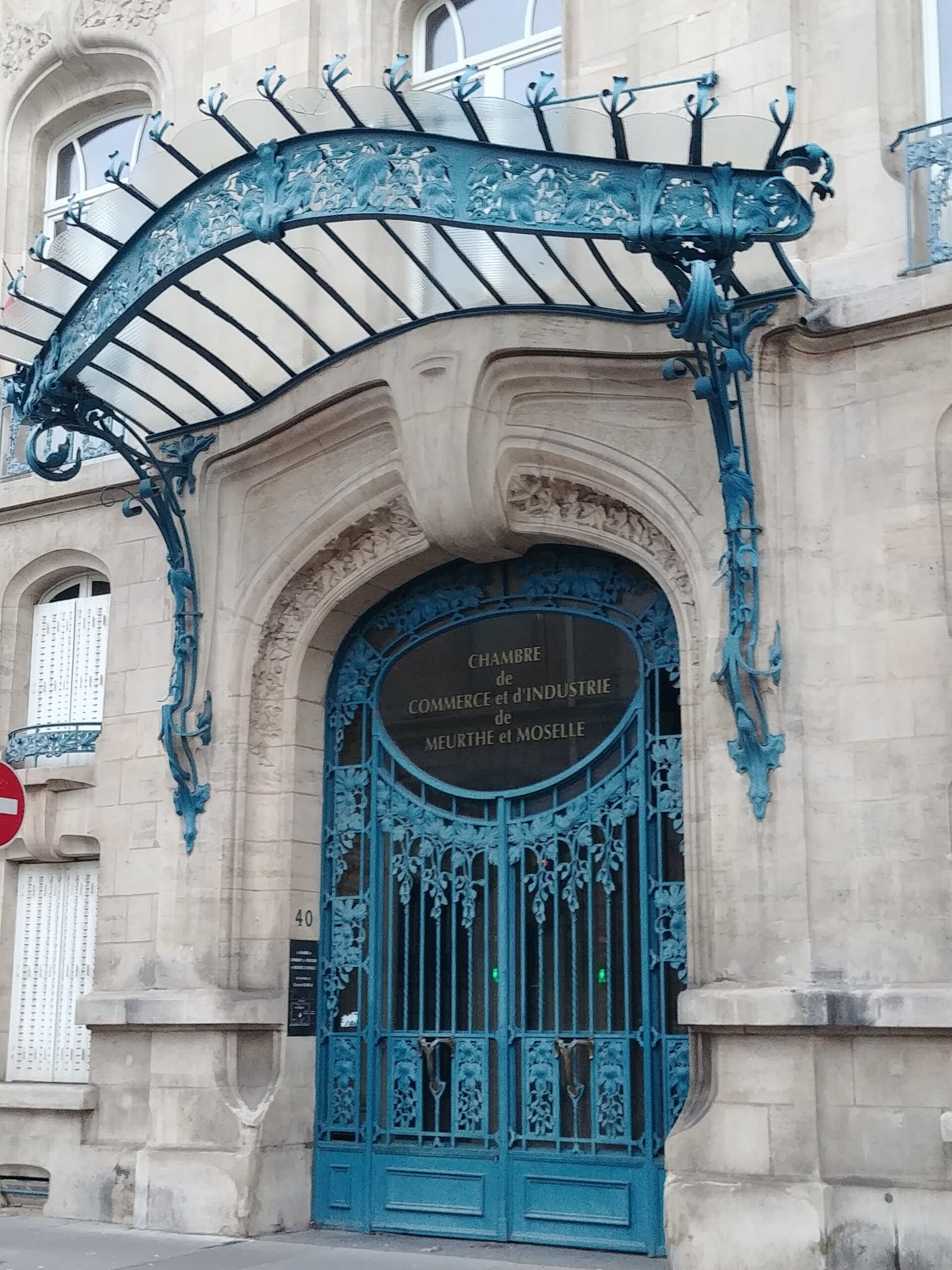
The headquarters of the Chamber of Commerce and Industry of Meurthe-et-Moselle, at 40 rue Henri-Poincaré in Nancy, was designed by the architects Émile Toussaint (1872-1914) and Louis Marchal (1871-1954), who won a competition opened in 1905 for the premises of the Chamber and the Société industrielle de l'Est. Constructed between 1906 and 1908 and inaugurated in June 1909, the building is one of the principal public monuments of the École de Nancy, the regional Art Nouveau movement that flourished around Émile Gallé and Louis Majorelle. Its long stone street facade carries sculptural ornament drawn from the local flora and from the region's industries, organised around a deep glazed marquise (canopy) of wrought iron. The plan disposes the working rooms of the Chamber -- a vestibule and ceremonial staircase, a salle de la bourse (exchange hall), and a salle du conseil (council chamber) -- behind this facade. The Mérimée heritage record (Base Mérimée, ref. PA00106103, Ministère de la Culture) credits Toussaint and Marchal with the design and dates the campaign to 1906-1908, noting the contributions of the principal decorative-arts workshops of Nancy to the interiors. The biographies of the two architects in the French-language reference literature (see the Wikipedia notices 'Émile Toussaint' and 'Louis Marchal (architecte)') record that this building was the major public commission of both men, Toussaint -- a pupil of Victor Laloux at the École des Beaux-Arts -- being killed at the front in 1914.
The interiors are among the richest surviving Art Nouveau ensembles in France, and here the decorative programme is more important than any single work of fine art. The wrought-iron marquise and the metalwork of the doors and railings were executed by the workshops of Louis Majorelle, whose plant-derived ironwork is the building's most photographed feature (the Wikimedia Commons image 'Nancy, Chambre de commerce et d'industrie.jpg' records this ferronnerie). The stained glass was supplied by Jacques Gruber, with the participation of Antonin Daum, and depicts the landscapes and industries of Lorraine -- glassmaking and the chemical trades among them; the windows of the salle de la bourse are by Gruber. The decorative scheme also includes pâte-de-verre panels by Amalric Walter, the École de Nancy specialist in that technique, ornamented with the thistle that is the heraldic emblem of Lorraine. The Mérimée record (PA00106103) classifies the Gruber glazing in its own right (classement of 5 July 1996), confirming its standing as a work of art independent of the building's general protection.
The Chamber stands in the nineteenth-century commercial heart of Nancy, on the rue Henri-Poincaré that runs from the railway station toward the eighteenth-century royal ensemble of the Place Stanislas, the city's monumental core laid out for Stanislas Leszczyński, duke of Lorraine, in the 1750s. The building occupies a corner site also addressing the rue Stanislas, and it belongs to a dense concentration of École de Nancy architecture -- banks, shops and private houses -- erected in the prosperous decades around 1900, when Nancy received an influx of capital and population after the annexation of neighbouring Alsace-Moselle by Germany in 1871 left the city as France's eastern industrial frontier. As the official seat of the Chamber of Commerce it functioned as the institutional centre of that economy, a counterpart in the commercial district to the ducal and civic monuments of the old town a few hundred metres to the east.
Commercial self-organisation in Nancy long predates the present building: a Confrérie des marchands is recorded from the fourteenth century, and a Bourse des marchands (merchants' exchange) was inaugurated in 1754 on the Place de la Carrière, beside the new Stanislas ensemble. Nancy was among the provincial cities given a formal bourse under the Napoleonic legislation of the early nineteenth century that organised the regional exchanges of France alongside Paris, Lyon, Bordeaux, Lille, Marseille and others (see 'Histoire des bourses de valeurs', French Wikipedia). The Chamber of Commerce itself was reconstituted in the mid-nineteenth century, and by the 1900s its growing administrative and exchange functions required a permanent seat, leading to the Toussaint-and-Marchal competition and the 1906-1909 building. The structure has remained the home of the Chamber -- today the Chambre de commerce et d'industrie Grand Nancy Métropole Meurthe-et-Moselle -- ever since. It was protected as a monument historique by inscription on 4 May 1994, with the Gruber glass classified on 5 July 1996 and the protection extended to further facades and interiors on 28 February 2013 (Base Mérimée PA00106103).
The salle de la bourse served the trade of an industrial region rather than a great national securities market. Nancy and its hinterland in Lorraine were a centre of heavy industry -- iron and steel from the Briey and Longwy basins, salt and soda, glass and crystal, and textiles -- and the exchange functioned chiefly as a meeting place where merchants, manufacturers and brokers transacted commercial business and dealt in commodities, bills and the securities of regional enterprises, alongside the official quotation of government and corporate stock that the provincial bourses handled under French law. The decorative iconography of the building, with Gruber's windows celebrating the glass and chemical industries of Lorraine, makes the connection between the room and the regional economy explicit. The general historical literature on the French provincial bourses (e.g. the survey 'Histoire des bourses de valeurs') situates Nancy within this network of regional exchanges that channelled local industrial capital before their activity was progressively centralised on Paris during the twentieth century.
Images will be added as the project develops. Photographs by Larry Ng and from research sources.