Nagoya Stock Exchange (名古屋証券取引所)
Nagoya, Japan · Established 1886
This site requires authorization to access.
To request access, contact
william.goetzmann@yale.edu
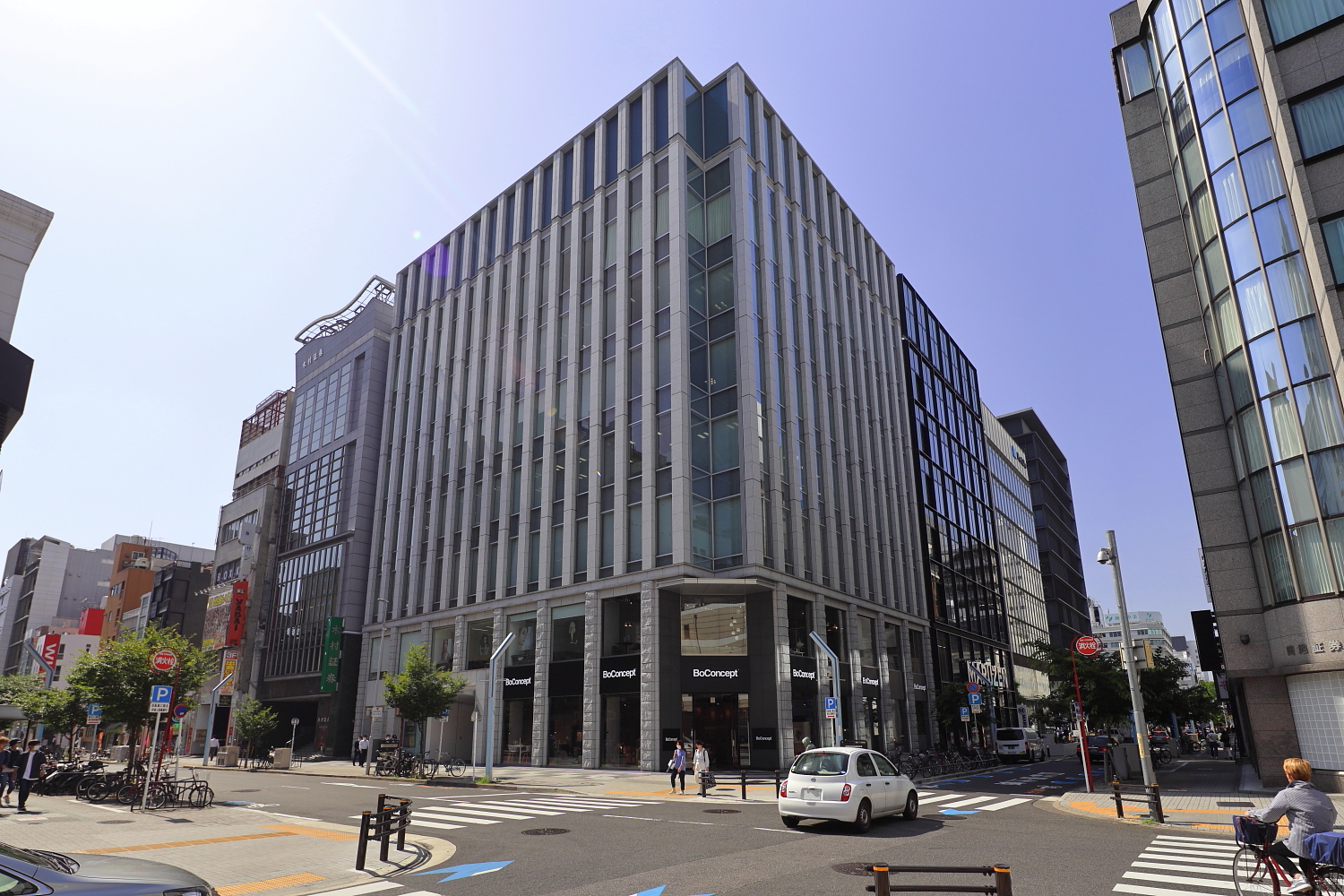
The present home of the Nagoya Stock Exchange is the Nagoya Securities Exchange Building (名古屋証券取引所ビル) at 3-8-20 Sakae in Naka Ward, a seven-storey steel-framed structure with a single penthouse level and a total floor area of roughly 4,829 square metres, designed and built by Shimizu Corporation and completed in August 2007 (Shimizu Corporation, 'Works: Nagoya Stock Exchange Building'). It is a restrained contemporary office block rather than a monumental temple of commerce, its glazed and curtain-walled facade typical of early twenty-first-century Japanese commercial architecture; the building is owned and let by Heiwa Real Estate, the firm that has held Japan's exchange properties since the dissolution of the wartime Japan Securities Exchange in 1947 (Heiwa Real Estate, building portfolio listing). The exchange moved into this structure on 3 September 2007, completing a full relocation from its post-war premises on the same Sakae block. Its modesty marks a deliberate generational change: the present building succeeded a far more idiosyncratic predecessor, the 1950 market hall, and reflects the contemporary reality that trading is conducted electronically rather than on a populated floor.
As a working office building completed in 2007, the Nagoya Stock Exchange possesses little of the decorative or fine-art programme found in the great nineteenth-century bourses; there are no allegorical statues of Mercury, no commissioned murals, and no ornamental order to speak of. What civic and didactic interest the building offers is concentrated in its visitor and exhibition facilities: the exchange maintains a public gallery and viewing area (見学・閲覧のご案内) where the institution's history and the mechanics of the regional market are explained to schools and visitors (Nagoya Stock Exchange, visitor information). The architectural character is otherwise that of functional corporate Modernism, and any honest account must record that the artistic dimension here is thin by comparison with the older European exchanges in this study.
The building sits in Sakae, the commercial and financial heart of central Nagoya in Naka Ward, a few minutes' walk from Sakae Station on the Higashiyama and Meijō subway lines and connected to the Sakae-chika underground concourse. The exchange has been associated with this district for nearly a century — the Nagoya Stock Exchange Company relocated to the Sakae area around 1931 — and the surrounding quarter remains thick with bank headquarters, brokerages and the offices of the manufacturing and trading concerns of the Chūbu region. Locals long referred to the exchange by its street, 'Isemachi', a metonym for the market itself. Nagoya is Japan's fourth-largest city and the gateway to the Aichi industrial belt, and the exchange's placement in Sakae situates it at the civic centre of that regional economy rather than in a detached financial district.
The institution traces its origin to the original Nagoya Stock Exchange (名古屋株式取引所), established on 18 March 1886 and opened for trading that July in government bonds and shares; after a brief dissolution in 1889 it was re-incorporated as a joint-stock company in 1893, resuming trading in 1894 (Nagoya Stock Exchange, company history). Under wartime consolidation, on 1 July 1943 it was merged with the other Japanese bourses into the single state-controlled Japan Securities Exchange (日本証券取引所), becoming its Nagoya branch. The market hall was burned out in the Nagoya air raid of 19 March 1945, and all markets closed that August; following the dissolution of the Japan Securities Exchange in 1947, the modern Nagoya Stock Exchange was re-established under the Securities and Exchange Law in April 1949, resuming trading in May with securities firms as its members. A second section opened in 1961, a bond market followed, and in 1999 the exchange launched 'Centrex', a market for emerging and start-up companies. It demutualized into Nagoya Stock Exchange, Inc. in 2002. From 2007 onward it delegated its trading systems to the Tokyo Stock Exchange, adopting Tokyo's 'arrowhead' platform in 2010, and in April 2022 it restructured its boards into the Premier, Main and Next markets, mirroring the national reform. It remains Japan's second-oldest continuously operating exchange after Tokyo, though its share of national turnover is small.
From its 1886 beginnings the exchange dealt in government bonds (公債) and corporate shares, and through the twentieth century it broadened into convertible bonds (1971), government securities (1973) and, after 1999, the shares of emerging companies on the Centrex board. Today it lists equities across its Premier, Main and Next markets together with public and foreign bonds, securities with subscription rights, and exchange-traded funds (introduced 2010). The exchange's distinctive economic function is regional: of its roughly 300 listed companies, only a few dozen are listed exclusively in Nagoya rather than dual-listed with Tokyo, but those 'Nagoya-only' names anchor the market to the Chūbu and Aichi industrial heartland — the manufacturing base that includes the Toyota group and its dense network of automotive and machinery suppliers. Trading is fully electronic, conducted in two daily sessions (09:00–11:30 and 12:30–15:30) over the Tokyo Stock Exchange's shared 'arrowhead' system, so that the Nagoya market's prices are produced on the same national infrastructure that drives the country's principal exchange.
Images will be added as the project develops. Photographs by Larry Ng and from research sources.