Muziris / Pattanam (Roman-Indian Pepper Exchange)
Pattanam (ancient Muziris), India · Established c. 2nd century BCE
This site requires authorization to access.
To request access, contact
william.goetzmann@yale.edu
The archaeological site at Pattanam, identified as ancient Muziris, sprawls across roughly seventy hectares near the village of Pattanam in Ernakulam District, Kerala. P. J. Cherian and the Kerala Council for Historical Research (KCHR) began systematic excavations in 2007, revealing continuous habitation strata from the second century BCE through the tenth century CE (Cherian, “Excavation of the Wharf at Pattanam,” in Pattanam Excavation Reports, KCHR, 2014). The most dramatic structural find is a massive wharf measuring over six meters in length and 7.3 meters in width, constructed of laterite blocks with a nineteen-course outer brick lining — the first physical evidence of harbor infrastructure at a site long known only from literary sources. A dugout canoe recovered from the waterlogged lower levels, radiocarbon-dated to the first centuries CE, attests to the inland waterway traffic that connected the port to the pepper-growing hinterland. The excavation trenches have yielded dense concentrations of brick structures, terracotta ring wells, iron nails, and tile fragments consistent with a densely built commercial settlement. Mediterranean amphora sherds, found in nearly every trench, confirm the site’s integration into the Roman Indian Ocean trade network described by Roberta Tomber in Indo-Roman Trade: From Pots to Pepper (Duckworth, 2008). The ongoing excavations represent the most important archaeological investigation of ancient Indian Ocean commerce yet undertaken, transforming Muziris from a literary legend into a documented physical reality.
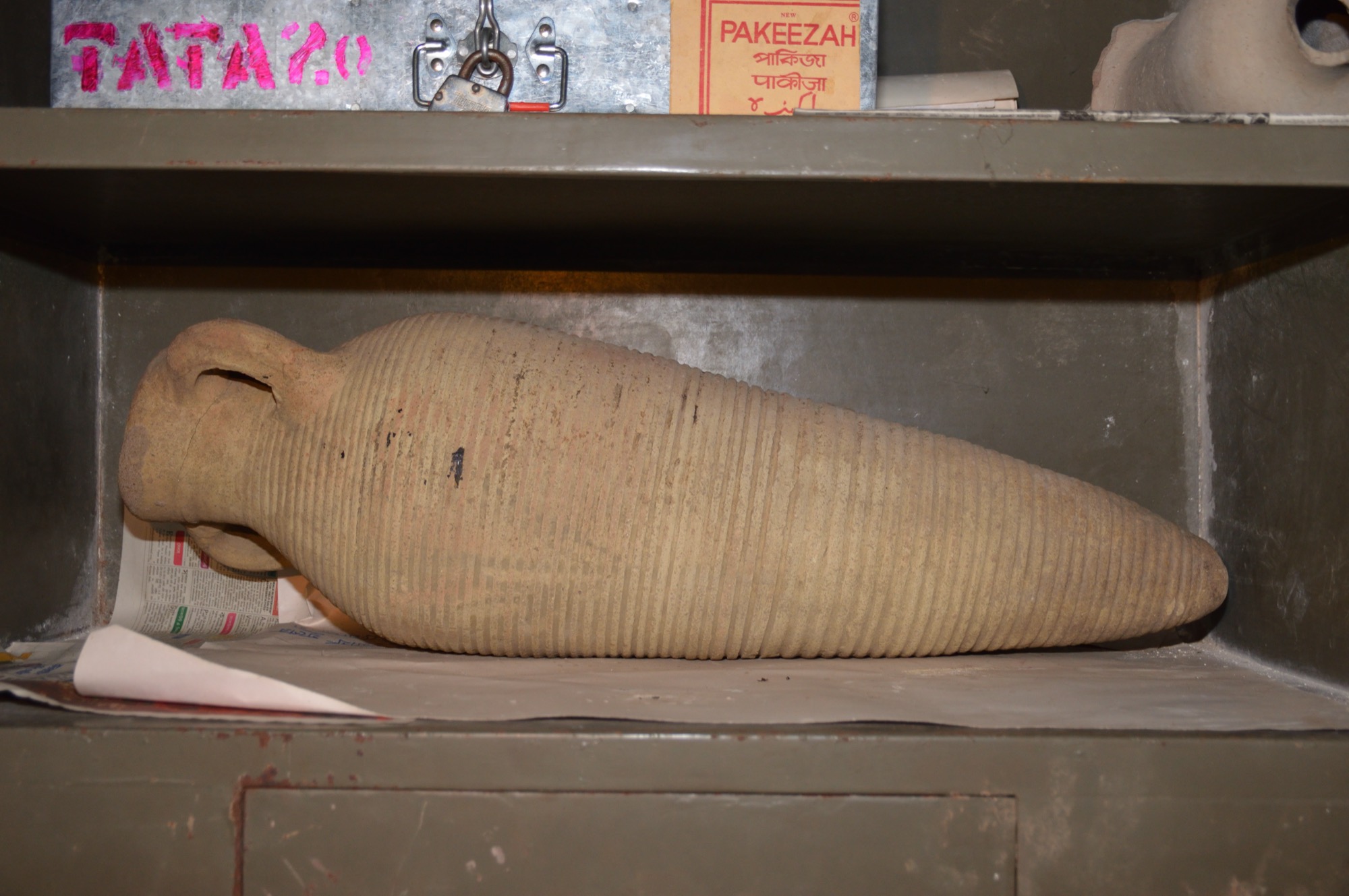
The material culture recovered at Pattanam reflects the convergence of Mediterranean, West Asian, and South Asian craft traditions. Roman amphorae dominate the imported ceramics — primarily Dressel 2–4 wine containers from Italy and flat-bottomed amphora types from the eastern Mediterranean, analyzed in detail by Roberta Tomber (“From the Roman to the Islamic Period: Ceramics from Pattanam,” Journal of Indian Ocean Archaeology, 2009). West Asian torpedo jars and turquoise-glazed pottery point to Persian Gulf intermediaries. Among the most visually striking finds are semi-precious stone beads — carnelian, agate, and rock crystal — worked in styles characteristic of both Indian and Roman lapidary traditions, suggesting local bead workshops serving export markets. The Tabula Peutingeriana, a thirteenth-century parchment copy of a late Roman road map now in the Österreichische Nationalbibliothek in Vienna, depicts a temple labeled “Templum Augusti” at Muziris, accompanied by a building vignette — the only Roman-era cartographic representation of the Malabar coast. Perhaps the single most important document of ancient Indian Ocean commerce is the Muziris Papyrus (Papyrus Vindobonensis G 40822), a second-century CE Greek text preserved in Vienna, which records a commercial loan contract financing a trading voyage from the Red Sea port of Myos Hormos to Muziris. Federico De Romanis, in his critical edition and commentary (The Indo-Roman Pepper Trade and the Muziris Papyrus, Oxford University Press, 2020), demonstrated that the papyrus specifies the cargo’s value at nearly seven million sesterces and details the legal mechanics of a maritime loan — a bottomry contract securing the lender against loss at sea.
Pattanam lies near the modern town of Kodungallur on the northern bank of the Periyar River, approximately thirty kilometers north of present-day Kochi (Cochin) on the Malabar coast of Kerala. The site’s commercial power derived from a conjunction of geography and meteorology. The Periyar River, the longest in Kerala, provided navigable access deep into the interior, connecting the coast to the cardamom- and pepper-producing highlands of the Western Ghats. The discovery attributed to the Greek navigator Hippalus in the first century BCE — that the monsoon winds allowed direct sailing across the Arabian Sea from the Red Sea to India, rather than creeping along the Arabian coast — transformed Muziris from a regional port into a terminal of intercontinental trade. Ships departing Myos Hormos or Berenike in Egypt in July could reach the Malabar coast in approximately forty days (Lionel Casson, The Periplus Maris Erythraei, Princeton University Press, 1989). The port’s position on a tidal backwater offered sheltered anchorage, though the anonymous first-century author of the Periplus warned that the harbor was difficult to approach because of shoals. When Muziris declined — probably after a catastrophic flood of the Periyar in 1341 CE that silted up the harbor — commercial activity shifted southward to Cochin and later to Calicut (Kozhikode), both of which inherited the spice-trading networks that Muziris had sustained for over a millennium. The relationship between these successive Malabar ports — Muziris, Quilon, Calicut, Cochin — illustrates how shifts in river hydrology and harbor silting could redirect centuries of accumulated commercial geography.
Muziris appears in the earliest Western accounts of Indian Ocean commerce. The anonymous Greek merchant who composed the Periplus of the Erythraean Sea around 50 CE described it as a port that “abounds in ships sent there with cargoes from Arabia, and by the Greeks” (Casson, Periplus, §54). Pliny the Elder, writing in the Natural History (VI.101, XII.84), lamented that India drained Rome of at least fifty million sesterces annually through the spice trade, calling it a drain on the empire’s bullion reserves. The Roman-Indian pepper trade was one of the great commercial connections of the ancient world: Roman gold aurei have been found in hoards across southern India, confirming Pliny’s complaint. Tamil Sangam literature, particularly the Akananuru and the Purananuru anthologies (compiled approximately second century BCE to third century CE), independently records the presence of Yavana (Greek/Roman) merchants at Muchiri (Muziris), describing wine arriving in “beautiful vessels” and gold flowing in exchange for pepper. The Muziris Papyrus, analyzed most thoroughly by Federico De Romanis (“Playing Sudoku on the Verso of the ‘Muziris Papyrus,’” Journal of Ancient Indian History, 2012), documents the financial infrastructure behind this trade: a maritime loan contract specifying cargo values, duties payable at Alexandria (twenty-five percent of value), and warehousing arrangements. The Chera dynasty controlled the Muziris region during the Sangam period. The port’s decline is traditionally associated with a catastrophic flood of the Periyar River, possibly in 1341 CE, which destroyed the harbor and redirected the river’s mouth, although the archaeological evidence suggests a more gradual contraction beginning several centuries earlier.
Pepper was the supreme commodity of Muziris — Pliny estimated that it constituted the bulk of Malabar cargo, and the Muziris Papyrus lists pepper and malabathron (a cinnamon-leaf product) as the principal items financed by the maritime loan (De Romanis, “Comparing Silk Road and Indian Ocean Trade,” in Empires, Post-Empires, and the Global System, ed. Ferrara and Ferrara, Routledge, 2019). Cardamom, long pepper, ginger, turmeric, and nard supplemented the spice trade. Non-vegetable exports included pearls from the Gulf of Mannar, precious and semi-precious stones (sapphires, beryls, diamonds), ivory, tortoiseshell, and fine Indian textiles. In return, Mediterranean merchants brought Roman gold coins — aurei and later solidi — creating the massive trade deficit that alarmed Pliny. The Periplus and archaeological evidence confirm that wine (shipped in the amphorae found at Pattanam), olive oil, coral from the Mediterranean, tin, lead, copper, colored glass, and fine pottery traveled eastward. The Muziris Papyrus records a single voyage’s cargo valued at nearly seven million sesterces, giving a sense of the enormous capital at stake. As Tomber emphasizes in Indo-Roman Trade (2008), the pepper trade was not a luxury trickle but a bulk commercial operation requiring substantial shipping capacity, organized finance, and legal infrastructure — a genuine long-distance commodity market linking the Roman Mediterranean to the Indian Ocean world.


