Jagat Seth House (Mint and Banking House)
Murshidabad, India · Established 1704
This site requires authorization to access.
To request access, contact
william.goetzmann@yale.edu
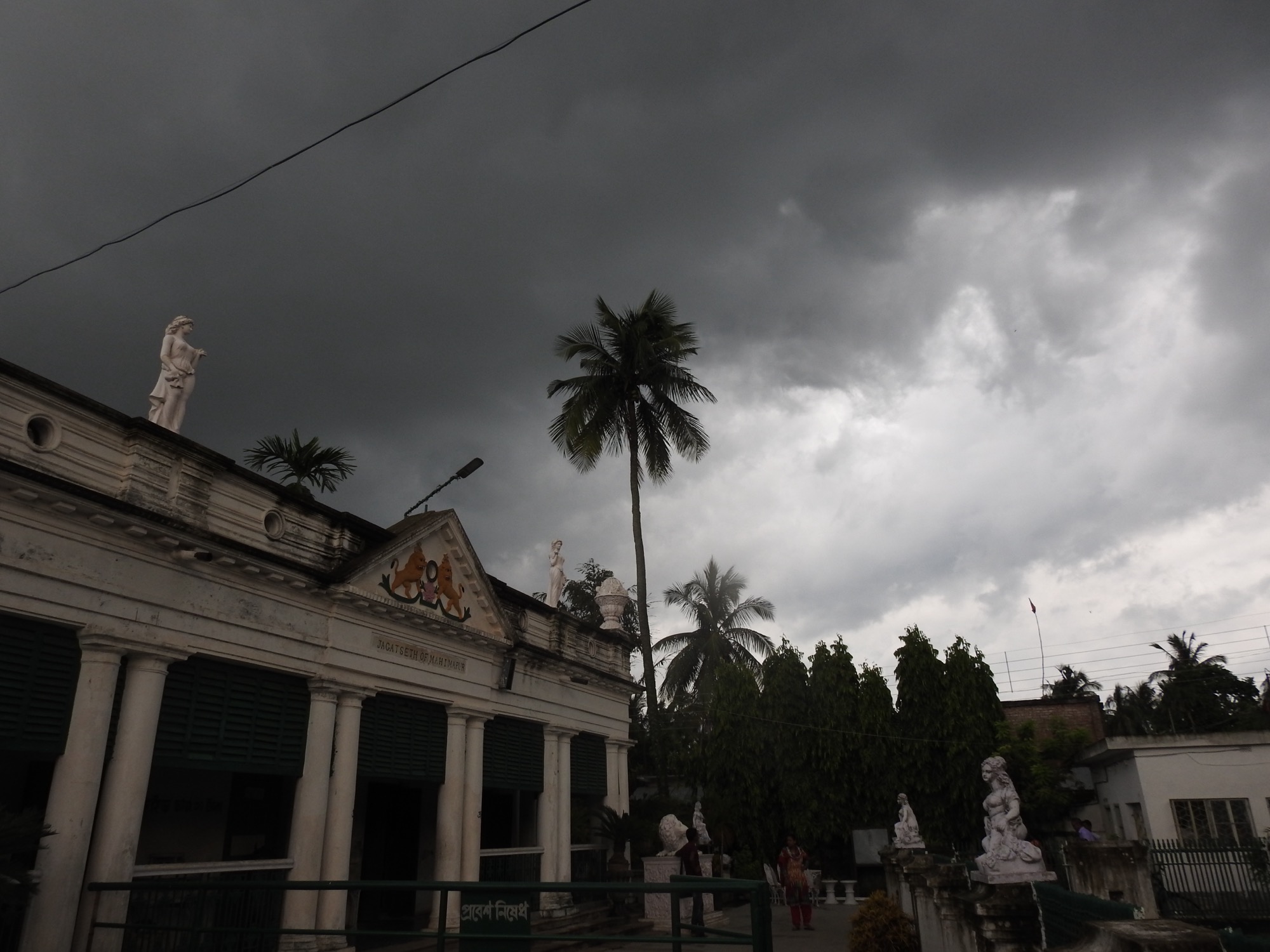
The Jagat Seth House stands in the Mahimapur locality of Murshidabad, a white two-storied building complex arranged around a square water pool that belies the staggering financial power once concentrated within its walls. Commissioned by Seth Manik Chand in the first decade of the eighteenth century, shortly after Murshid Quli Khan transferred Bengal's capital from Dhaka to Murshidabad in 1704, the compound served simultaneously as family residence, banking headquarters, treasury, and imperial mint. J.H. Little, the headmaster of the Nawab Bahadur's Institution in Murshidabad who spent years researching local archives, described the complex in his monograph The House of Jagat Seth (first serialized in Bengal Past and Present, 1920-21; published by the Calcutta Historical Society, 1967) as the nerve center of Bengal's entire financial apparatus. The architectural idiom blends Bengali vernacular traditions with Mughal spatial planning: broad courtyards for receiving clients and officials, thick-walled chambers suited to the storage of bullion and coin, and an infrastructure of subterranean passages that served both security and operational purposes. The most remarkable surviving features are the underground chambers and secret tunnels that run beneath the compound, which served as concealed treasury vaults and confidential meeting spaces. A triangular staircase descends into these subterranean passages, connecting the surface-level reception halls with the underground arms repository and treasury rooms. The compound also includes the Lakshmi Narayan Temple, recently renovated. The Archaeological Survey of India has designated the house, temple, and associated ruins at Mahimapur as a State Protected Monument (Item S-WB-94). Converted into a privately managed museum in 1980, the building preserves the spatial logic of an eighteenth-century banking house where coins were minted, bullion weighed, hundis drafted, and the revenues of three provinces consolidated under a single roof.
The decorative program of the Jagat Seth House reflects the eclectic visual culture of eighteenth-century Murshidabad, where Mughal court aesthetics, Bengali craft traditions, and the devotional art of Jain merchant communities converged. The museum preserves oil paintings and huge mirrors made of Belgian glass, luxury imports that testify to the family's participation in global trade networks. Among the most celebrated artifacts is a cunningly engineered optical device crafted so that an observer can see everyone else reflected in it but cannot see his own image -- whether security device or optical curiosity, it exemplifies the Seths' appetite for ingenious technology. The underground arms museum displays daggers, swords, shields, and single-barrel muskets alongside a massive iron suit of armor once worn by Indian cavalry soldiers. The museum's textile collection includes exquisite Banarasi sarees embroidered with gold and silver thread and lengths of muslin, the legendary diaphanous fabric of Bengal that European traders prized above all Indian exports. The adjacent Lakshmi Narayan Temple, with its recently restored interior, represents the Jain-influenced devotional art that wealthy Oswal merchant families transplanted from Rajasthan to Bengal. Scholars contributing to Sahapedia's study of Jain visual culture in early modern Bengal have documented how migrant Jain banking families like the Seths patronized temple construction and religious art across their adopted territories, creating distinctive hybrids that combined Rajasthani iconographic traditions with Bengali spatial and decorative sensibilities.
Murshidabad's ascent as Bengal's capital began in 1704 when Murshid Quli Khan, the Diwan and later Nawab of Bengal, transferred his seat of government from Dhaka to a site on the eastern bank of the Bhagirathi River, a distributary of the Ganges. Robert Clive, visiting Murshidabad for the first time after the Battle of Plassey in 1757, wrote with undisguised astonishment that the city was as extensive, populous, and rich as the city of London, with this difference: that there were individuals in Murshidabad possessing infinitely greater wealth than the whole of Lombard Street joined together. Contemporary accounts describe a city extending five miles in length and two and a half miles in breadth along both banks of the Bhagirathi, with a population reaching an estimated 700,000 at its mid-century peak. The Jagat Seth compound in Mahimapur occupied a strategic position within this urban fabric, situated in proximity to the Nawab's administrative complex and connected by road and river to the city's commercial arteries. The Bhagirathi River served as Murshidabad's lifeline, linking the capital to the ports of Hooghly and Calcutta downstream and to the agricultural hinterland of Bihar upstream. Silk weaving, muslin production, and saltpetre processing clustered along the riverbanks, while European trading factories maintained establishments in the nearby settlements of Kasimbazar and Berhampur. As Sushil Chaudhury argued in From Prosperity to Decline: Eighteenth Century Bengal (Manohar, 1995), it was the very prosperity of Bengal, not its weakness, that made it a lucrative prize in the eyes of Europeans, and Murshidabad was the spatial embodiment of that prosperity.
The Jagat Seth dynasty began with Hiranand Sahu, a Jain Oswal Bania of the Gailara gotra from Nagaur in the Marwar principality of Rajasthan, who migrated to Patna around 1650 and established himself as a jeweler, moneylender, and trader in saltpetre. His grandson Manik Chand relocated the family operations to Dhaka and then to Murshidabad, aligning the firm with Murshid Quli Khan. Manik Chand stood surety for zamindari revenue payments, advanced loans to the Nawab, and secured the monopoly of minting coins in the province. In recognition, Mughal Emperor Farrukhsiyar conferred upon him the title Jagat Seth, Banker of the World, in 1713. After Manik Chand's death around 1714, his nephew and adopted son Fateh Chand expanded the enterprise to its greatest extent. Robert Orme, the official historiographer of the East India Company, described Fateh Chand in his History of the Military Transactions of the British Nation in Indostan (1763) as the greatest banker and money changer known in the world. N.K. Sinha, in his introduction to Little's monograph, compared the Seths' role in money and politics to that of the Fuggers of Augsburg and the Medicis of Florence. After Fateh Chand's death in 1744, his grandsons Mahtab Chand and Maharaja Swarup Chand became entangled in the most consequential political conspiracy of eighteenth-century India. Alienated by the volatile young Nawab Siraj ud-Daulah, the Seths joined the conspiracy organized through William Watts, the East India Company's agent in Murshidabad, to replace Siraj with the pliable Mir Jafar. The Battle of Plassey on 23 June 1757, in which Clive's force of three thousand defeated Siraj's army of fifty thousand largely through the treachery of his own commanders, permanently altered the balance of power in India. The irony was savage: in 1763, Mir Qasim ordered the execution of Mahtab Chand and Swarup Chand, their bodies thrown from the ramparts of Munger Fort. Karen Leonard, in her influential article The Great Firm Theory of the Decline of the Mughal Empire (Comparative Studies in Society and History, vol. 21, no. 2, 1979), argued that the diversion of credit and resources by great indigenous banking firms like the Jagat Seths from the Mughal state to rival political powers contributed fundamentally to imperial collapse. J.F. Richards challenged this thesis, and Leonard replied in Indigenous Banking Firms in Mughal India: A Reply (Comparative Studies in Society and History, vol. 23, no. 2, 1981). The last holder of the Jagat Seth title died in 1912, the family surviving on a British pension, their colossal fortune dissipated.
The Jagat Seth firm operated as what modern scholars have called the central bank of Bengal, combining functions that would today be distributed among a national mint, a treasury, a commercial bank, and a foreign exchange clearinghouse. The cornerstone of their operations was the monopoly on minting coins at the Murshidabad mint, which alone generated an estimated annual income of 350,000 rupees and gave the Seths effective control over the money supply and exchange rates across Bengal. The mint produced silver sicca rupees, the standard currency of Bengal, struck at 0.98 fine silver, as well as gold mohurs. Beyond minting, the Seths operated an extensive hundi (bill of exchange) network that constituted one of the most sophisticated credit transfer systems in the pre-modern world. A hundi drafted in Murshidabad could be redeemed in Kabul, Isfahan, or even Moscow. The entire land revenue of Bengal, Bihar, and Orissa flowed through the Seths' hundi operations to the imperial treasury in Delhi. Manik Chand's original revenue-farming arrangement required him to stand surety for zamindari tax payments in exchange for a ten percent commission, providing an additional annual income of approximately one million rupees. The firm lent extensively to the Nawabs of Bengal, to Mughal nobles, to zamindars, and eventually to the East India Company itself, charging interest rates between seven and twelve percent. They dealt in bullion, purchasing much of the foreign gold and silver imported into Bengal by European and Asian traders, and they financed the province's major export trades in silk textiles, muslin, saltpetre, and opium. At the height of their power in the 1750s, the family's total wealth was estimated at 140 million rupees. Sushil Chaudhury, in From Prosperity to Decline (1995), documented how the Seths controlled approximately half of Bengal's provincial economy through their combined lending, minting, revenue, and exchange operations.
Images will be added as the project develops. Photographs by Larry Ng and from research sources.