Munich Stock Exchange (Börse München)
Munich, Germany · Established 1830
This site requires authorization to access.
To request access, contact
william.goetzmann@yale.edu
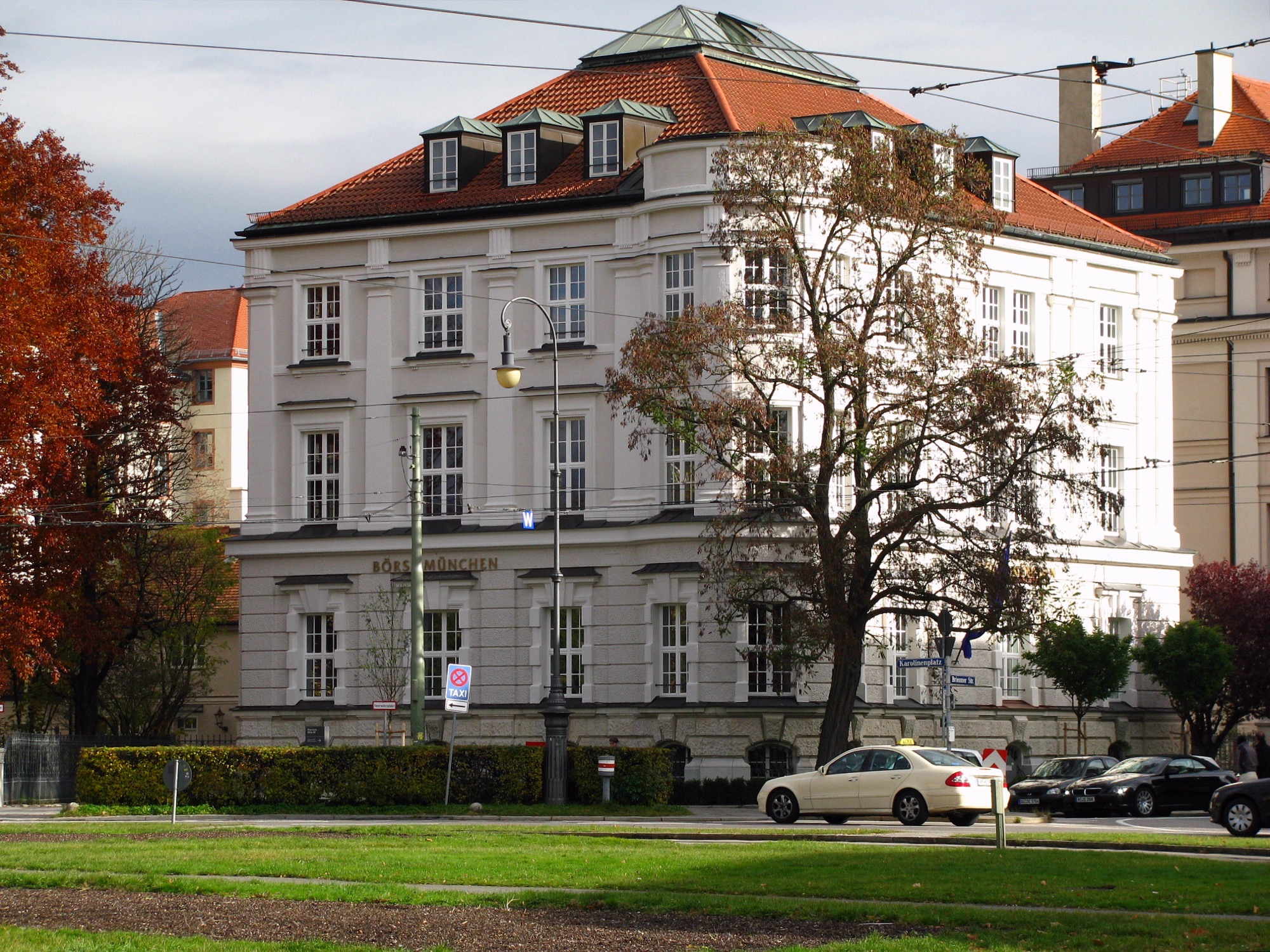
The Munich Stock Exchange has occupied a sequence of architecturally distinguished premises across the city’s historic core. Founded in 1830, it first convened at Weinstraße 14 before relocating through several interim addresses—including the “Blaue Traube” tavern on Dienerstraße and the “Börsenbazar” on Schäfflerstraße—before settling into a purpose-built exchange hall at Maximiliansplatz 8, designed by Friedrich von Thiersch and occupied from 1901, as documented in the Historisches Lexikon Bayerns. In 1963, trading operations moved into the Alte Börse at Lenbachplatz 2, a Wilhelminian Neo-Baroque edifice erected between 1896 and 1898 by architect Albert Schmidt for the Deutsche Bank. Schmidt’s design featured dramatic sandstone facades, fluted Corinthian columns, vermiculated rustication on the ground storey, and originally four corner cupolas that gave the building a palatial silhouette. Severely damaged during Allied bombing raids in World War II, the Alte Börse was restored in 1948–1949 by architect Jac Lehner, though without the distinctive corner domes. The exchange occupied this landmark until 2007, after which the building underwent comprehensive heritage-sensitive renovation by PATRIZIA Immobilien AG. Adjacent to the Alte Börse stands the Künstlerhaus am Lenbachplatz (Artists’ House), designed by Gabriel von Seidl between 1893 and 1900 in the Neo-Renaissance manner, a building intimately connected to Munich’s cultural and financial elite. In 2009, the Bayerische Börse AG relocated to Karolinenplatz 6, occupying a restored 1894 Neo-Renaissance villa originally built for porcelain manufacturer Viktor Hutschenreuther. The architectural firm Landau + Kindelbacher oversaw the conversion, which was completed in eleven months, incorporating glass-fronted offices, traditional parquet floors evoking the old trading hall, and modern digital infrastructure for the gettex electronic platform.
The artistic heritage of Munich’s exchange district is anchored in the extraordinary decorative program of the Künstlerhaus am Lenbachplatz, which Gabriel von Seidl conceived not merely as an architectural shell but as a Gesamtkunstwerk—a total work of art uniting architecture, painting, and sculpture. Inaugurated in 1900 by Prince Regent Luitpold of Bavaria, the Künstlerhaus was the clubhouse of the Münchner Künstlergenossenschaft (Munich Artists’ Cooperative) and served as the social nexus where artists, industrialists, and financiers mingled. As the art historian Robin Lenman describes in Artists and Society in Germany, 1850–1914 (Manchester University Press, 1997), Munich’s turn-of-the-century art scene was inseparable from its commercial patronage networks. The Künstlerhaus interiors reflected this fusion: Franz von Lenbach himself donated paintings and furnishings, while deep-toned wall paintings, a gold coffered ceiling, and a gold-gleaming gallery extending the full length of the building created what contemporary accounts called an impression of “the liveliest beauty of life.” The celebrated Venetian Room (Venezianisches Zimmer) in the north pavilion, with its ornate Italianate decoration, survives as one of the few original interior spaces. The grand staircase, with its canopy-like alcove and festive garland wreaths, also preserves Seidl’s original vision. Tragically, incendiary bombs struck the Künstlerhaus on January 13, 1945, destroying much of the interior decoration—especially the Festsaal. Architect Erwin Schleich led the postwar restoration in 1960–1961, rebuilding the Festsaal in approximation of its original form while preserving the Venetian Room and staircase intact. Outside on Lenbachplatz, the Wittelsbacher Brunnen (1893–1895) by sculptor Adolf von Hildebrand provides a monumental Neo-Classical counterpoint. Commissioned to celebrate Munich’s 1883 water supply system, Hildebrand’s 25-meter-wide semicircular basin features two allegorical marble figures—a youth astride a water horse symbolizing water’s destructive force and an Amazon offering a bowl representing its tamed bounty—as analyzed by art historian Sigrid Esche-Braunfels in Adolf von Hildebrand (Deutscher Kunstverlag, 1993). The fountain was damaged in wartime air raids and restored by Theodor Georgii, Hildebrand’s student, in 1952.
Lenbachplatz sits at a pivotal juncture in Munich’s urban fabric, occupying the site of the city’s former western fortifications between Stachus (Karlsplatz) and Maximiliansplatz, within the Altstadt-Lehel district. The square’s name honors the painter Franz von Lenbach, whose portraits of Munich’s business and cultural elite epitomized the city’s late-nineteenth-century prosperity. As architectural historian Winfried Nerdinger documents in Architekturführer München (Dietrich Reimer Verlag, 2002), the area developed rapidly after the demolition of the medieval walls, with monumental commercial and cultural buildings replacing the old Capuchin monastery that once stood here. Lenbachplatz became a showcase of Wilhelminian-era ambition: the Alte Börse, the Künstlerhaus, and the Bernheimer-Haus (1888–1889, by Friedrich von Thiersch with neo-Baroque facade by Martin Dülfer)—Munich’s first neo-Baroque building—stood side by side, creating an urban ensemble of financial, artistic, and commercial power. The Old Main Synagogue also stood on the square until its forced demolition by the Nazi regime in 1938. Munich’s position as Bavaria’s financial capital reflects a centuries-long rivalry with Frankfurt am Main. While Frankfurt emerged as Germany’s dominant exchange city, Munich cultivated a distinctive niche as the insurance and reinsurance capital of Europe. As the Munich Financial Center Initiative documents, the region hosts some 70 insurance companies, including global leaders Allianz SE (founded 1890) and Munich Re (founded 1880 by Carl von Thieme and Wilhelm von Finck of the Merck Finck & Co. bank). With 160 banks, savings institutions, and credit unions—including HypoVereinsbank (now UniCredit) and BayernLB—Munich maintains Germany’s second-largest banking sector. The city’s 55,810 financial-sector employees represent 8.1 percent of the regional workforce, a concentration that historian Harold James, in The Deutsche Bank and the Nazi Economic War Against the Jews (Cambridge University Press, 2001), traces to the deep intertwining of Bavarian industrial capital with local banking and insurance institutions since the mid-nineteenth century.
The Munich Stock Exchange was founded on December 16, 1830, when the Münchner Kaufmannsstube—a merchants’ association constituted in October 1829 with 78 members—established formal structures for securities trading during Bavaria’s dawning industrial age. As the Historisches Lexikon Bayerns records, the new platform initially disappointed expectations, hampered by stagnant banker numbers and weak institutional support. Growth accelerated after 1868, when the introduction of Gewerbefreiheit (trade freedom) in Bavaria and the founding of the Munich Trade Association in 1869 catalyzed a financial transformation: six joint-stock banks were established in the city between 1869 and 1876, and securities listings surged from 54 in 1869 to 342 by 1906, making Munich the fifth-ranked German exchange. The Bayerische Hypotheken- und Wechsel-Bank, founded in 1835 by decree of King Ludwig I, was among the earliest and most important securities traded, becoming Germany’s leading mortgage bank by 1908, as documented in the Encyclopedia of International Banking (Palgrave Macmillan). During the Weimar Republic, Munich’s exchange—like all German bourses—endured the catastrophic hyperinflation of 1923, which, as economic historian Gerald Feldman details in The Great Disorder: Politics, Economics, and Society in the German Inflation, 1914–1924 (Oxford University Press, 1993), destroyed currency values while producing speculative stock market bubbles. Under the Nazi regime, the Munich and Augsburg exchanges were forcibly merged on January 1, 1935, to form the Bayerische Börse, and trading was progressively restricted through successive wartime regulations from 1939 to 1943. The exchange closed on April 27, 1945, amid the final collapse of the Third Reich. Remarkably, the Munich exchange reopened on August 10, 1945—the first German stock exchange to resume operations after the war, a distinction noted by the Munich Financial Center Initiative. During the Wirtschaftswunder (economic miracle) of the 1950s, the exchange benefited enormously from Berlin’s loss of financial importance due to German division, briefly ranking first among German exchanges in stock value in 1950. The exchange was restructured as Bayerische Börse AG in 2001, rebranded as Börse München in 2003, and today operates the gettex electronic trading platform (offering access to over 240,000 securities) and the MAX-ONE system alongside the m:access market segment for small and medium-sized enterprises, launched in 2005.
From its earliest days, the Munich Stock Exchange served as the primary marketplace for Bavarian industrial and financial securities. The Historisches Lexikon Bayerns documents that listings grew from just 54 securities in 1869 to 342 by 1906, reflecting Bavaria’s rapid industrialization. Among the most historically significant were shares of the Bayerische Hypotheken- und Wechsel-Bank (founded 1835 by King Ludwig I), which became Germany’s preeminent mortgage bank, and the Bayerische Vereinsbank—the two institutions that merged in 1998 to form HypoVereinsbank, later absorbed by Italy’s UniCredit. Munich’s great insurance companies dominated the exchange: Münchener Rückversicherungs-Gesellschaft (Munich Re), founded in 1880 by Carl von Thieme and Wilhelm von Finck, grew into the world’s largest reinsurer, while Allianz Versicherungs-AG, established in 1890, became one of the world’s largest financial services groups. Both remain among the most heavily traded securities on German exchanges. Bavaria’s iconic brewing industry also featured prominently: Spaten-Brauerei, one of Munich’s great Oktoberfest breweries, became a joint-stock company in 1922 when it merged with Franziskaner-Leist-Bräu to form Spaten-Franziskaner-Bräu AG, whose shares traded on the Munich exchange before its eventual acquisition by Anheuser-Busch InBev. The Paulaner brewery, tracing its origins to the Paulaner monks of the Neudeck ob der Au monastery, also operated within Bavaria’s capital markets ecosystem before becoming privately held by the Schörghuber group. Industrial giants headquartered in Bavaria—BMW AG (Bayerische Motoren Werke, founded 1916), Siemens AG (relocated its headquarters to Munich), and MAN SE—have long been flagship listings. Today, the Bayerische Börse AG lists over 22,000 shares, bonds, and funds from more than 60 countries, along with 1,200 ETFs and ETCs. The gettex electronic platform provides access to over 240,000 securities and certificates, including warrants and structured products. The m:access market segment, established in 2005, serves as a dedicated equity financing venue for Bavarian and German Mittelstand firms, with 61 companies currently listed. The exchange controls approximately 3.5 percent of total German stock exchange volume, operating as what the Historisches Lexikon Bayerns characterizes as a “Nischenanbieter” (niche provider) that maintains relevance through specialized platforms and regional economic ties.
Images will be added as the project develops. Photographs by Larry Ng and from research sources.