Old Moscow Stock Exchange Building (Здание Московской биржи на Ильинке)
Moscow, Russia · Established 1839 (exchange); building 1873–1875
This site requires authorization to access.
To request access, contact
william.goetzmann@yale.edu
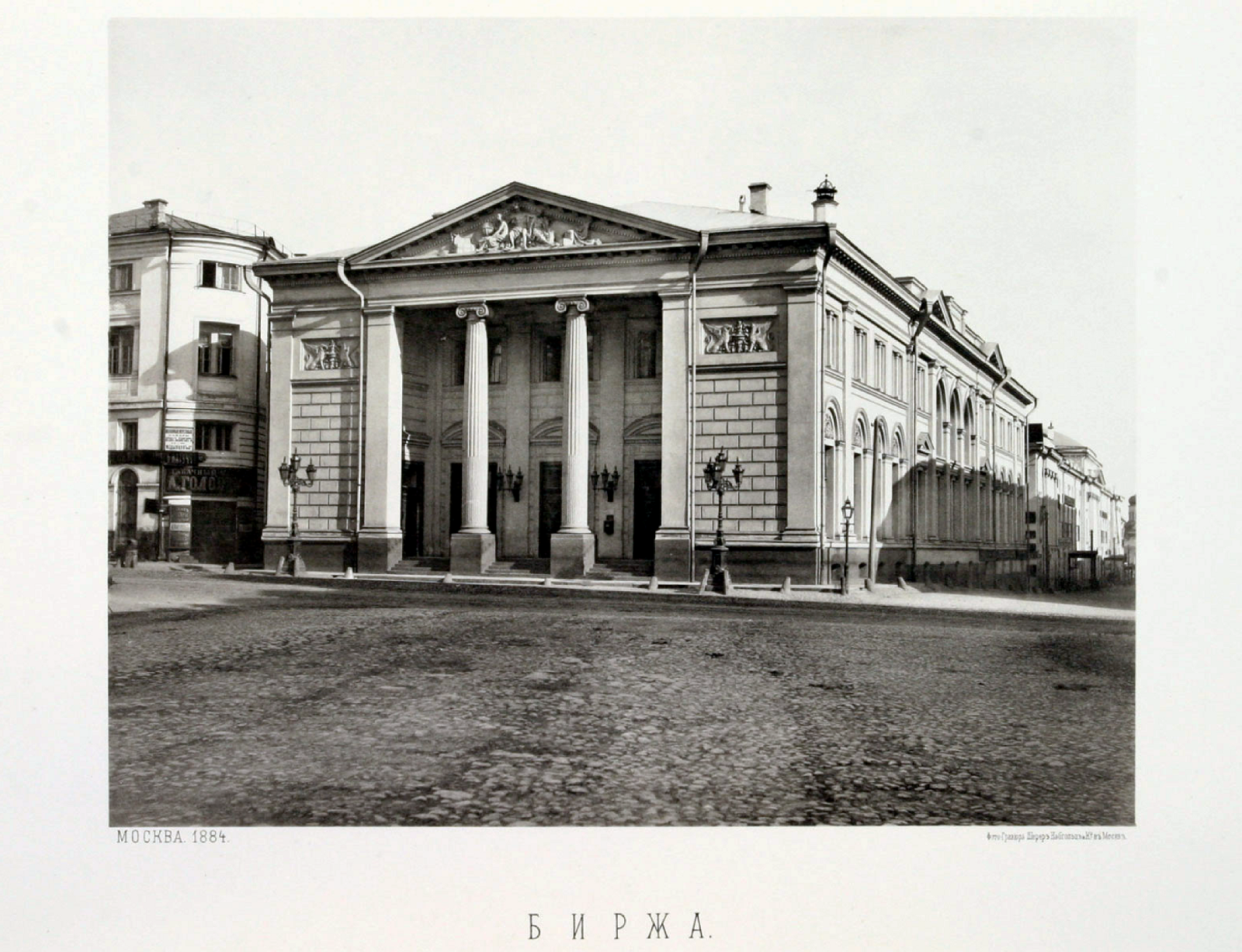
The Moscow Stock Exchange occupies a monumental block at the head of Ilyinka Street in Kitai-gorod, the historic merchant quarter at the foot of the Kremlin. The first purpose-built exchange on the site was raised in 1836–1839 to designs by Mikhail Bykovsky in an early Renaissance-eclectic manner, partly funded by Emperor Nicholas I; Bykovsky placed a terrace with slender metal columns between two arched entrances, where for decades brokers stubbornly conducted business in the open air rather than enter the main hall (ru.wikipedia.org, 'Здание биржи (Москва)'). The structure visible today is the 1873–1875 rebuilding by Alexander S. Kaminsky, executed in the late-eclectic idiom: a classical portico faces Ilyinka, while a two-storey Neo-Renaissance elevation runs along Rybny Pereulok, and the enlarged interior could hold as many as 1,150 traders at once. In 1925 the architect Ivan Kuznetsov added a further storey, adapting the building to Soviet institutional use. It is a federal architectural-heritage monument of the second half of the nineteenth century (vseomoskve.info; mosprogulka.ru).
Kaminsky, who had trained at the Imperial Academy of Arts under Konstantin Thon and worked on the Cathedral of Christ the Saviour, brought an academically schooled vocabulary of classical ornament to the exchange — pilasters, a pedimented and columned portico, and richly modelled cornices characteristic of the prosperous Moscow merchant architecture of the 1870s (Узнай Москву, 'Каминский Александр Степанович'). As the lifelong family architect of the Tretyakov dynasty and senior architect of the Moscow Merchants' Society from 1867, Kaminsky designed the building as a representative civic showpiece for Moscow's commercial elite, and its grand top-lit trading hall was conceived as much for display and assembly as for the conduct of business.
The exchange stands at Ilyinka 6/1, on the corner of Rybny Pereulok, in Kitai-gorod — the walled trading district immediately east of Red Square and the Kremlin that was the commercial heart of the Russian Empire's second capital. So central was the institution to the life of the quarter that the adjoining open space took its name from it, becoming Birzhevaya (Exchange) Square (architectstyle.livejournal.com). Surrounded by the merchant counting-houses, banks, and trading rows of Kitai-gorod, the building anchored a dense financial precinct that functioned as Moscow's answer to the great bourses of St Petersburg and Western Europe. Since the 1990s the building has housed the Chamber of Commerce and Industry of the Russian Federation, preserving its association with Russian commerce.
Moscow's merchants had pressed the authorities for an organised exchange since a petition to the governor-general in 1828, and the Moscow Exchange was formally established on 8 November 1839 once Bykovsky's first building was complete (ru.wikipedia.org). It grew into the principal exchange of Russia's commercial capital, second in the Empire only to the St Petersburg Bourse. Outgrowing its original premises, the exchange commissioned Kaminsky's far larger building of 1873–1875. The exchange society became a powerful corporate body representing Moscow's industrial and trading interests in the late imperial economy (Atlantis Press, 'The role of the Moscow exchange society'). After the 1917 Revolution the exchange was abolished; the building was adapted for Soviet institutional use (with Kuznetsov's added storey in 1925) and ultimately passed to the Russian Chamber of Commerce and Industry, which occupies it today.
In its imperial heyday the Moscow Exchange functioned as a combined commodity and securities bourse, but its character was strongly mercantile, reflecting Moscow's role as the hub of Russia's textile and manufacturing economy. The staple goods quoted there were cotton, cotton yarn, and muslin — the raw materials and products of the great Central-Russian textile industry — with oil, coal, and minerals added as the industrial economy expanded (mosprogulka.ru; all-andorra.com). Alongside this commodity trade, the exchange handled state bonds, railway securities, and the shares of banks and joint-stock manufacturing companies, making it a key venue for mobilising capital in the rapidly industrialising late-imperial economy.
Images will be added as the project develops. Photographs by Larry Ng and from research sources.