Old English Court (Muscovy Company)
Moscow, Russia · Established 1556
This site requires authorization to access.
To request access, contact
william.goetzmann@yale.edu
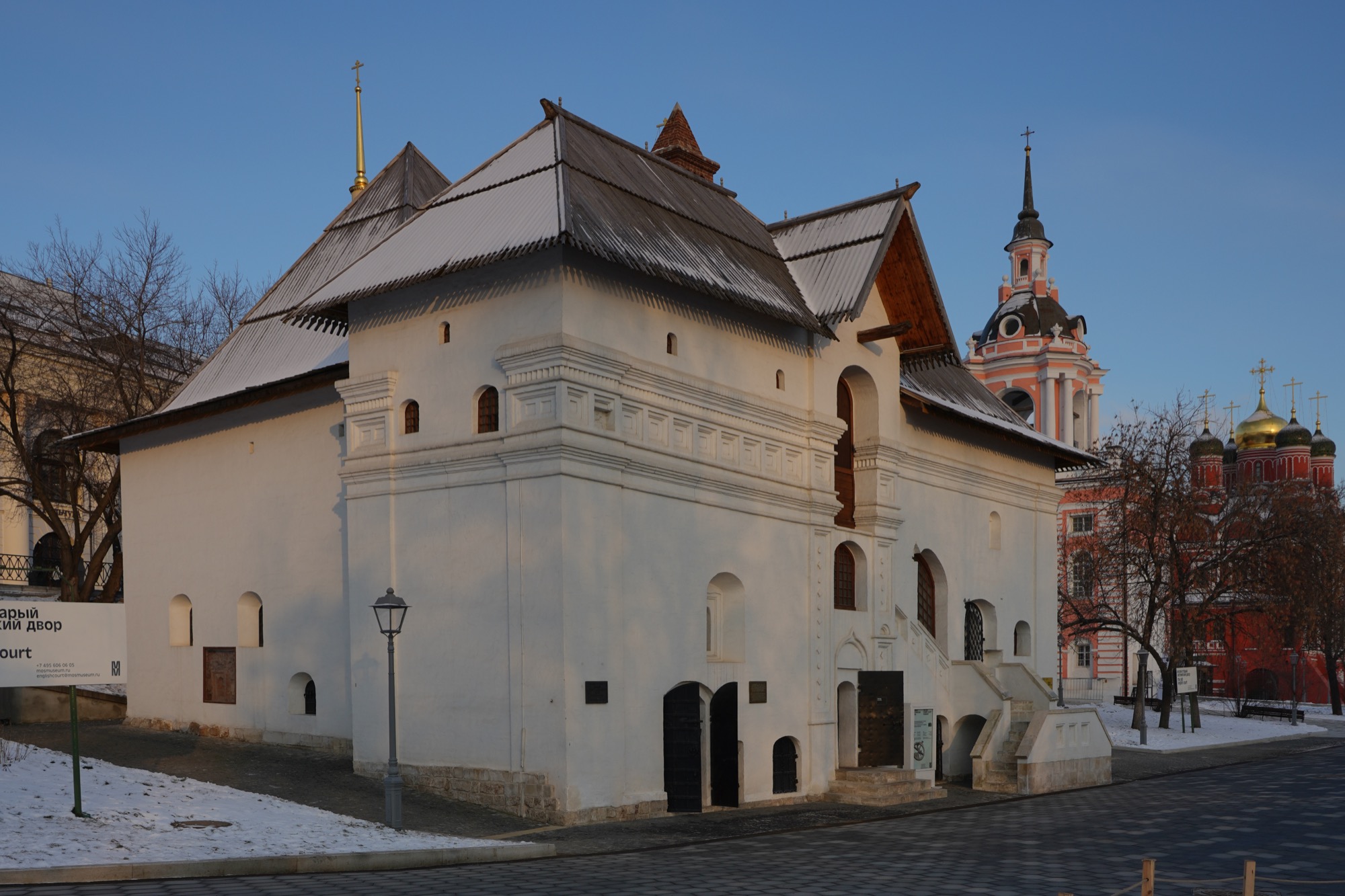
The Old English Court (Stary Angliysky Dvor) at 4A Varvarka Street is one of the oldest surviving civilian buildings in Moscow. The white-stone chambers were erected in the late fifteenth century as the residence of Ivan Bobrischev, a bed-keeper (postelnichy) in the court of Ivan III. The original structure comprised a main hall, a treasury chamber, a kitchen, a vaulted basement for storage, an attic, and ladder-type passages connecting the floors. Constructed of local white limestone in the manner of medieval Russian merchant houses, the building featured thick load-bearing walls, barrel-vaulted ceilings, and deeply recessed window openings suited to Moscow's harsh winters. After Bobrischev's death and the property's reversion to the state, Ivan IV (the Terrible) granted the chambers to English merchants of the newly chartered Muscovy Company in 1556, making it the first permanent foreign trading compound in Moscow. Under English use, the building was adapted for commercial purposes: the vaulted cellars became warehouses for imported and exported goods, while the upper floors served as offices, living quarters for factors, and reception rooms for diplomatic audiences. A notable architectural feature, unusual for medieval Moscow though common in Western European merchant houses, was a hoisting device on the southern facade — a block-and-tackle mechanism with a double-lid hatch for lifting heavy cargo directly to the attic storage level. The building suffered damage during the Crimean Khan Devlet Giray's devastating raid on Moscow in 1571, but was promptly rebuilt and expanded with vestibules added to the northern and southern sides. After the English expulsion in 1649, the chambers passed through various owners, including boyar Miloslavsky and the Metropolitan of Nizhny Novgorod. Peter I established an arithmetic school there in the early eighteenth century. By the mid-twentieth century, successive alterations — including Empire-style facade decorations added after the 1812 fire — had entirely obscured the original medieval structure. The building's survival itself was precarious: during the 1960s demolition of Zaryadye for the massive Rossiya Hotel, the celebrated architect and preservationist Pyotr Baranovsky identified the medieval core beneath later accretions and fought to save it from destruction when a car ramp was planned for its site. His followers, restoration architects Inessa Kazakevich and Yevgenia Zhavoronkova, led the painstaking 1968-1972 restoration that stripped away centuries of modifications and returned the chambers to their approximate late sixteenth-century appearance, using directional charges to remove later masonry while preserving the original white-stone walls and vaults. A second restoration phase in 1994, overseen by architect Ekaterina Kuftyreva, prepared the building for its new life as a museum. On October 18, 1994, Queen Elizabeth II personally attended the opening ceremony of the Old English Court Museum, dedicating it as a monument to Anglo-Russian relations. Further restoration in 2013-2014 updated the exhibition, and in 2016 the museum reopened with expanded displays on the life of the English merchant house in the sixteenth and seventeenth centuries. The building is now part of the Museum of Moscow complex and stands within the landscape of Zaryadye Park, opened in 2017.
The artistic character of the Old English Court is that of a functional trading house rather than a decorated palace, yet the building preserves several remarkable features. The most significant is the bestiary oven — a reconstructed hearth in the official chamber, originally heated by a stove covered with relief ceramic tiles bearing plant, animal, and bird motifs. As archaeological investigations during the 1968-1972 restoration revealed, these sculpted red ceramic tiles constitute the most complete set of such tiles ever found by archaeologists in Moscow. The imagery includes a dragon-like beast, a creature resembling a unicorn, and a small winged figure evoking the legendary Sirin bird, drawing on the visual vocabulary of medieval Russian and Western European bestiaries. The original tiles were discovered by Kazakevich and Zhavoronkova during the Baranovsky-directed restoration; in 1994, exact copies were installed on the reconstructed hearth in its original position, while the originals are preserved in the Museum of Moscow, with selected fragments displayed under glass alongside the copies for comparison. The vaulted cellar rooms, which once stored English woolen cloth, Russian furs, and other trade goods, have been restored to suggest their commercial function, with their thick white-stone arches and low ceilings conveying the atmosphere of a working warehouse. The treasury chamber on the upper floor, where the company's accounts were kept and diplomatic negotiations conducted, has been furnished to approximate its sixteenth-century appearance, including a large table for the signing of trade agreements. The museum's current exhibition displays archaeological artifacts recovered from the site — ceramic fragments, metalwork, and domestic objects from the English occupation period. Trade-related exhibits include reproductions and period examples of the goods that passed through the building: English broadcloth and kersey samples, Russian furs, wax, and navigational instruments reflecting the Muscovy Company's origins in Arctic exploration. The building's exterior, restored to its late sixteenth-century form, is an austere composition of white limestone walls punctuated by narrow window openings, with minimal decorative elaboration — an honest expression of its mercantile rather than aristocratic purpose.
The Old English Court stands in Zaryadye, Moscow's medieval merchant quarter, situated between the Kremlin walls and the Moskva River. The district's name derives from "za ryady" — "behind the rows" — referring to its position beyond the market stalls that lined Red Square, underscoring its identity as an extension of Moscow's primary commercial zone. Zaryadye lies within Kitay-gorod, the walled commercial district that constituted Moscow's second fortified ring after the Kremlin itself. The Kitay-gorod wall, built in 1535-1538 under the direction of the Italian architect Petrok Maly, enclosed the posad (merchant settlement) with brick fortifications, creating a protected space for trade. Varvarka Street, on which the English Court stands, is one of Moscow's oldest thoroughfares, first documented in 1380 and named for the Church of St. Barbara (Varvara). It served as a principal commercial artery connecting Red Square to the river wharves, lined with churches, boyar residences, and merchant houses that testified to the area's wealth. The English Court's immediate neighbors include some of Moscow's most important medieval structures: the Romanov Boyar Chambers (late fifteenth to early sixteenth century), where the first Romanov tsar was born; the Church of St. Maximus the Blessed; the Cathedral of the Znamensky Monastery; and the Church of St. George the Victorious on Pskov Hill. Just north, the Gostiny Dvor (Merchant Court), originally constructed of brick in the 1590s and rebuilt in stone from 1638-1641, served as Moscow's principal wholesale marketplace — a vast enclosed courtyard where Russian and foreign merchants displayed their wares. Catherine the Great commissioned the architect Giacomo Quarenghi to replace it with the monumental Neoclassical structure completed in 1805. The proximity of the English Court to the Gostiny Dvor and the Kremlin placed it at the nerve center of Muscovite commerce and diplomacy. Moscow's position at the confluence of river routes was essential to the Muscovy Company's operations. Goods arriving from England via the White Sea port of Archangel traveled up the Northern Dvina to Vologda, then overland or by smaller rivers to Moscow. From Moscow, the Volga provided access southward to Astrakhan and the Caspian Sea, enabling the company's ambitious attempts to reach Persia and Central Asia. The Moskva River, flowing past Zaryadye, connected the city to this broader network of waterborne commerce. Much of medieval Zaryadye was destroyed in the twentieth century — first by Stalin's 1935 master plan, which designated the district for demolition to build a massive skyscraper, and then by the construction of the Rossiya Hotel in the 1960s-1970s. The Old English Court is one of the few surviving structures from the district's centuries as a living merchant quarter. Since 2017, the surrounding area has been transformed into Zaryadye Park, designed by Diller Scofidio + Renfro, which incorporates the Old English Court into a new landscape that at least gestures toward the historical layering of the site.
The Muscovy Company, chartered by Queen Mary I on February 6, 1555, was the first major English joint-stock trading company — a pioneering corporate form that pooled subscriber capital into a permanent fund rather than dissolving after each voyage, as T.S. Willan documented in The Muscovy Merchants of 1555 (Manchester University Press, 1953). The company originated in the Company of Merchant Adventurers to New Lands, formed in 1551 by Sebastian Cabot, Sir Hugh Willoughby, and Richard Chancellor, with some 240 investors purchasing shares at twenty-five pounds each. Sebastian Cabot, the Venetian-born navigator who had served both English and Spanish crowns, was named the company's first governor. The founding voyage of 1553 sought the Northeast Passage to China. Three ships departed London on May 10, 1553: Willoughby's flagship Bona Esperanza, Chancellor's Edward Bonaventure, and the Bona Confidentia. Willoughby and two crews perished in the Arctic winter near the Kola Peninsula, but Chancellor reached the White Sea, landing near the Nikolo-Korelsky Monastery at what would become Archangel. He traveled overland to Moscow, where he secured trading privileges from Ivan IV at the Kremlin. As Willan detailed in The Early History of the Russia Company, 1553-1603 (Manchester University Press, 1956), the early company records were destroyed in the Great Fire of London in 1666, requiring the history of the sixteenth-century company to be reconstructed from scattered sources. Ivan IV granted the English merchants the chambers on Varvarka Street in 1556, establishing the Old English Court as the company's Moscow headquarters — a combined warehouse, office, residence, and diplomatic station. The tsar extended extraordinary privileges: free passage through Russian lands, freedom from arrest, the right to maintain their own settlement, and exemption from certain tolls. The company's agent Anthony Jenkinson, appointed captain-general, extended the company's reach far beyond Moscow. In 1558, Jenkinson traveled from Moscow down the Volga to Astrakhan, crossed the Caspian Sea, and reached Bukhara in Central Asia — the first Englishman to penetrate so far into the Asian interior. His second journey (1561-1564) took him to the court of Shah Tahmasp of Persia at Qazvin, where he negotiated preferential trading terms, as documented in Richard Hakluyt's Principal Navigations (1589). Jenkinson's travelogues, preserved by Hakluyt, and his celebrated 1562 map of Russia remain foundational sources for the period. However, the company's privileges were not uncontested. In 1571, Ivan IV revoked the right of free navigation down the Volga, angered by English demands for exclusive access, and the relationship between the company and the Russian court fluctuated through the late sixteenth century under Tsars Fyodor and Boris Godunov. Maria Salomon Arel, in English Trade and Adventure to Russia in the Early Modern Era: The Muscovy Company, 1603-1649 (Lexington Books, 2019), demonstrated that the company successfully rebuilt after the Time of Troubles (1598-1613), securing a privileged position under the Romanov dynasty and outpacing Dutch competitors on most indicators including number of ships, agents, warehouses, and legal privileges through the 1640s. The end came abruptly. On January 30, 1649, Charles I of England was publicly executed — an act of regicide that horrified European monarchies. Tsar Alexei Mikhailovich, regarding the execution as an affront to the principle of monarchy, expelled all English merchants from Russia and revoked the Muscovy Company's privileges. The Old English Court on Varvarka Street was confiscated and passed to Russian owners. As Kevin Gledhill discussed in "The Russia Company and Russo-British Trade after 1600" (Kritika, 2021), the company's later history has been reassessed by recent scholarship, which has moved beyond the older narrative of inevitable decline to examine the company's continuing networks and adaptation. The company itself survived, eventually restored to limited trade after Charles II's accession, and persisted as the Russia Company until the Russian Revolution, though it never regained its sixteenth-century prominence. The Muscovy Company's joint-stock structure directly influenced the formation of the East India Company (chartered 1600) and the Virginia Company, making the Old English Court not merely a trading post but a birthplace of the corporate form that would reshape global commerce.
The Old English Court served as the central depot for a bilateral trade that connected England's textile industry with Russia's vast natural resources. As Willan documented in The Early History of the Russia Company, 1553-1603 (1956), the company's principal English exports were woolen textiles — kerseys (a coarse, lightweight wool) and broadcloths (heavier, finer-quality fabrics) — which constituted the staple of English overseas commerce and were in high demand among Russian consumers and for re-export to Asian markets via the Volga route. The English also shipped metals, pewter, tinware, non-ferrous metals, weapons, gunpowder, saltpeter, lead, medicines, and Mediterranean luxury goods obtained through intermediary trade. Russian exports flowing back through the Old English Court included furs (sable, ermine, fox, and other pelts), beeswax, tallow (essential for candles and soap), hemp, flax, rope and cordage (vital to the English navy), tar, timber, and potash. The company also traded in leather, whale oil (blubber), corned meat, and grain. Jarmo Kotilaine, in Russia's Foreign Trade and Economic Expansion in the Seventeenth Century (Brill, 2005), placed this trade within the broader pattern of growing Western European demand for Russian commodities, with English merchants serving among the principal conduits integrating the Muscovite economy into the early modern global trading system. The trade route itself shaped how goods moved through the building. English cloth and metals arrived at the White Sea port of Archangel (founded 1584; before that, the anchorage of St. Nicholas in the Northern Dvina delta), having traveled the Northern Sea Route from English ports. From Archangel, goods were transported upriver on the Northern Dvina to Vologda, the company's principal inland depot, and thence overland or by river to Moscow. At the Old English Court, goods were stored in the vaulted basement cellars — the thick-walled, cool chambers ideal for preserving textiles and furs. The hoisting mechanism on the southern facade lifted heavy bales to the attic storage level. Russian buyers, including agents of the tsar himself, came to the Court to inspect and purchase English cloth. The company's resident factors — salaried agents who lived permanently at the Court — managed the warehouse inventory, negotiated prices with Russian merchants, arranged credit, and maintained accounts in the treasury chamber upstairs. Arel's research (2019) on the seventeenth-century company revealed that the Muscovy Company maintained not only the Moscow depot but a network of subsidiary warehouses and depots in Vologda, Kholmogory, Yaroslavl, and other Russian cities. The company dispatched seven English rope-makers to Russia in 1557 to establish a domestic rope industry, reflecting a direct transfer of manufacturing technology. Trade was conducted partly on credit, with complex arrangements between London shareholders, the company's factors in Moscow, and Russian counterparts — an early instance of the long-distance commercial credit networks that would become characteristic of later chartered trading companies. The company's monopoly charter of 1555, reinforced by Privy Council interventions, ensured that only its members could legally trade with Russia, though interlopers and private traders persistently challenged this restriction, as Willan showed in The Muscovy Merchants of 1555 (1953).
Images will be added as the project develops. Photographs by Larry Ng and from research sources.