Moscow Commodity Exchange
Moscow, Russia · Established Early 1990s
This site requires authorization to access.
To request access, contact
william.goetzmann@yale.edu
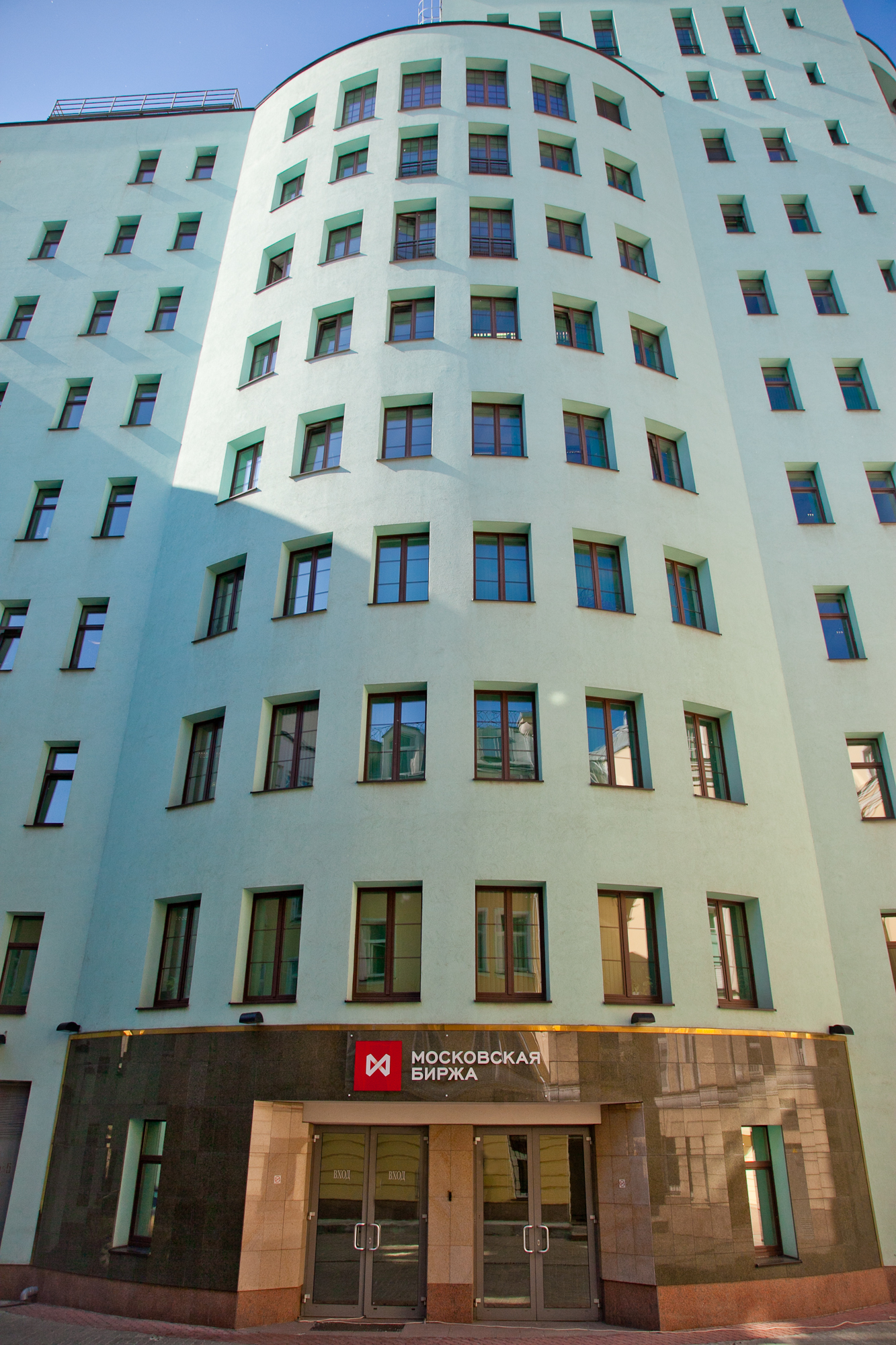
The institutional lineage of commodity exchange architecture in Moscow stretches from the original Bourse building on Ilyinka Street — erected in 1839 and rebuilt in 1873–1875 by Alexander Stepanovich Kaminsky (1829–1897), the senior architect of the Moscow Merchant Society — to the modern offices of the Moscow Exchange (MOEX) at 13 Bolshoy Kislovsky Pereulok. Kaminsky’s Exchange building, situated at the corner of Ilyinka Street and Rybny Lane (Ilyinka 6/1), was executed in a restrained neoclassical idiom characteristic of the eclectic historicism then prevailing in Moscow commercial architecture. The three-story stone structure featured a rusticated ground floor, pilastered upper stories with arched windows framed by molded surrounds, and a pedimented central bay facing Ilyinka. Kaminsky, who had trained under Konstantin Thon at the Imperial Academy of Arts in St. Petersburg and participated in the construction of the Cathedral of Christ the Saviour, brought a monumental sensibility to commercial commissions. His Exchange building served the Moscow birzhevoi komitet (exchange committee) throughout the late imperial period until the Bolsheviks abolished commodity exchanges in 1929. In the Soviet era the building housed the Chamber of Commerce and Industry of the USSR, and today it serves the Russian Union of Industrialists and Entrepreneurs. The modern MOEX headquarters, by contrast, occupies a contemporary office building befitting a twenty-first-century electronic marketplace — a shift from monumental stone to functional modernity that mirrors the transformation of exchange architecture worldwide.
The decorative program of Kaminsky’s 1875 Exchange building on Ilyinka Street reflected the visual language of mercantile authority common to nineteenth-century European bourses. The neoclassical facade incorporated pilasters with Corinthian-inspired capitals, molded cornices articulating each story, and cartouches set within the pediment — ornamental devices that signaled institutional gravitas in a district crowded with competing bank and insurance headquarters. Inside, the principal trading hall featured coffered ceilings, polished stone floors, and galleries overlooking the main floor where merchants gathered for price-setting sessions. As William Craft Brumfield documented in A History of Russian Architecture (Cambridge University Press, 1993), Kaminsky’s commercial buildings synthesized Western European academic classicism with the pragmatic requirements of Moscow’s mercantile elite, who demanded imposing interiors suitable for both trade and civic assembly. The building’s ornamental vocabulary — acanthus scrollwork, keystoned arches, and balustraded parapets — participated in the broader aesthetic competition along Ilyinka Street, where each financial institution sought to project solidity and permanence through architectural ornament. During the Soviet period, the interior was substantially altered to serve the Chamber of Commerce and Industry, losing many of its original exchange-specific fittings. The modern MOEX headquarters at Bolshoy Kislovsky dispenses with historicist ornamentation entirely, its functional interiors dominated by electronic trading screens and server infrastructure rather than carved stone and gilded moldings — a material testament to the dematerialization of market exchange itself.
The Moscow Commodity Exchange occupied a position at the commercial heart of Kitai-gorod, the fortified trading quarter adjacent to the Kremlin that had served as Moscow’s mercantile center since the fourteenth century. Ilyinka Street — named after the medieval Monastery of St. Elijah (Il’inskii) — was by the late nineteenth century the richest thoroughfare in Moscow, lined with banks, trading houses, and insurance companies. The Exchange building stood on Birzhevaya Ploshchad (Bourse Square), directly adjacent to the monumental Gostiny Dvor (Merchants’ Court) rebuilt by Giacomo Quarenghi in the 1790s, creating a concentrated node of commercial architecture unmatched elsewhere in the Russian Empire. As Colton observed in Moscow: Governing the Socialist Metropolis (Harvard University Press, 1995), Kitai-gorod’s three principal streets — Varvarka, Ilyinka, and Nikolskaya — each developed distinct functional identities, with Ilyinka emerging as the financial axis. The proximity of the exchange to the Kremlin reinforced the symbiosis between state power and commercial activity that has characterized Moscow’s political economy across regimes. After the Bolshevik closure of exchanges in 1929, this spatial relationship was inverted: the former exchange building became a state institution, and organized commodity trading disappeared from Moscow’s urban fabric for six decades. The post-1990 revival scattered exchange activities across multiple locations, and the modern MOEX headquarters at Bolshoy Kislovsky Pereulok sits in a quieter district northwest of the Kremlin, reflecting the shift from physical trading floors to electronic platforms that no longer require proximity to merchant warehouses.
The Moscow Commodity Exchange traces its institutional origins to 1798, when Tsar Paul I authorized the establishment of a formal bourse in Moscow, following the precedent set by Peter the Great’s founding of the St. Petersburg Exchange in 1703. As Alexander Belozertsev and Jerry W. Markham documented in “Commodity Exchanges and the Privatization of the Agricultural Sector in the Commonwealth of Independent States” (Law and Contemporary Problems, Vol. 55, No. 4, Fall 1992), pre-revolutionary Russia developed a network of commodity exchanges that facilitated trade in grain, cotton, sugar, and metals until the Bolsheviks abolished all exchanges in 1929, transferring commodity distribution to centralized state planning organs. The exchange lay dormant for six decades. In the spring of 1990, an effort to revive the Moscow Commodity Exchange began with support from the Chicago Board of Trade and the Chicago Mercantile Exchange, whose cooperation marked a historic moment in the Cold War’s financial thaw. In January 1991, the revived exchange commenced trading in physical commodities including metals, crude oil, and agricultural products. By 1992, dozens of commodity and stock exchanges had proliferated across Russia as the Yeltsin-Gaidar “shock therapy” reforms dismantled price controls. In summer 1992, thirty brokerage firms formed a new clearinghouse called the Moscow Exchange, which launched currency futures trading in October 1992. However, the August 1995 banking crisis devastated derivatives markets, and the original Moscow Exchange shut down in 1996. The institutional legacy was ultimately consolidated through the Moscow Interbank Currency Exchange (MICEX, founded January 1992) and the Russian Trading System (RTS, founded 1995), which merged on December 19, 2011 to form the modern Moscow Exchange (MOEX), now one of the world’s largest multi-asset exchange groups.
The revived Moscow Commodity Exchange of 1991 initially traded physical commodities — metals, crude oil, and agricultural products — in spot markets that reflected the chaotic conditions of Russia’s post-Soviet economic transition. As Lerman and Brooks documented in “Building Market Institutions: Agricultural Commodity Exchanges in Post-Communist Russia” (Journal of Communist Studies and Transition Politics, 1994), early Russian commodity exchanges faced severe logistical and cultural obstacles: unreliable delivery infrastructure, absence of standardized grading, and merchants’ unfamiliarity with exchange-based price discovery after decades of administered pricing. The successor Moscow Exchange launched currency futures in October 1992, with the U.S. dollar–Russian ruble contract becoming its signature instrument amid the hyperinflationary conditions of Gaidar’s reforms. The modern MOEX operates one of the world’s most diversified multi-asset platforms. Its Derivatives Market — ranked among the global top ten by volume in 2014 — offers seventy-eight futures contracts and thirty-nine options on futures, with underlying assets spanning equity indices (RTS Index, MOEX Index), individual equities (Russian and foreign), currency pairs, interest rates (MosPrime), and commodity contracts on Brent crude oil, natural gas, precious metals, and agricultural products. The Commodity Section, organized through the National Commodity Exchange (a MOEX subsidiary), facilitates spot trading in gold, silver, grain (wheat, corn, barley), sugar, and sunflower seeds, with grain trading volumes reaching two hundred thousand tons annually by 2019. The Foreign Exchange Market hosts the world’s most liquid dollar–ruble futures contract, while the Money Market provides interbank lending, repo, and deposit facilities. MOEX also operates Russia’s central securities depository (NSD) and the National Clearing Centre.
Images will be added as the project develops. Photographs by Larry Ng and from research sources.