Montreal Stock Exchange
Montreal, Canada · Established 1874
This site requires authorization to access.
To request access, contact
william.goetzmann@yale.edu
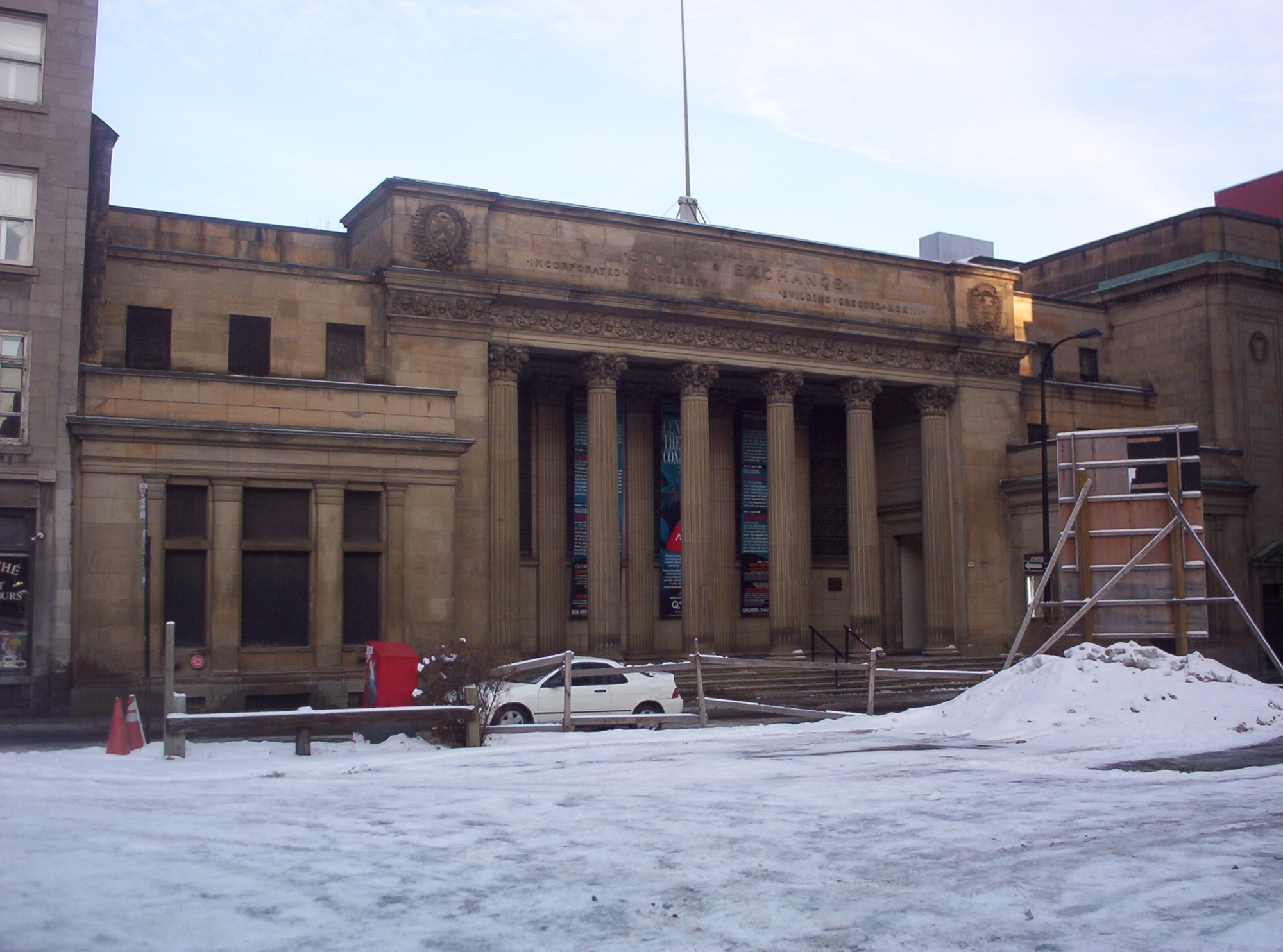
The Montreal Stock Exchange occupied three successive homes that chart the arc of Canadian financial architecture. Informal trading began in 1832 at Asa Goodenough’s Exchange Coffee House on rue Saint-Paul, where brewer John Molson and Bank of Montreal president Peter McGill gathered merchants to finance the Champlain and St. Lawrence Railroad — Canada’s first railway. The Board of Brokers subsequently met in rented rooms on rue Saint-François-Xavier until, in 1903, the Exchange commissioned the celebrated New York architect George B. Post to design a purpose-built exchange at 453 rue Saint-François-Xavier. Post, who had just completed the New York Stock Exchange on Broad Street, produced a compact Beaux-Arts temple front in grey Montreal limestone, its facade dominated by six monumental Corinthian columns with lion-head capitals aligned across the entablature. Edward and William Maxwell, Montreal’s preeminent architectural firm, served as supervising architects and executed the detail drawings from their local office, as documented in the Maxwell Archive at McGill University. The interior followed a symmetrical U-shaped plan: the central board room and trading hall were flanked by lateral wings containing a members’ coat room, committee rooms, and a public gallery with fluted columns finished in marble and cast-iron stair railings — an ensemble the contemporary press called ‘admirable decoration.’ The building opened on June 20, 1904 and served the Exchange for over sixty years. Architect Kenneth Guscotte Rea carried out modifications in 1928–29 to accommodate expanded membership. On October 21, 1965, Mayor Jean Drapeau sounded the closing gong, and the Exchange relocated to the Tour de la Bourse at Place Victoria — a 47-storey reinforced-concrete tower designed by Italian architect Luigi Moretti with structural engineering by Pier Luigi Nervi. At 190 metres, the tower briefly held the record as the world’s tallest concrete skyscraper, surpassing Chicago’s 1000 Lake Shore Plaza. Moretti envisioned the building’s form as three stacked blocks articulated by mechanical floors whose octagonally recessed corners break the mass of the curtain wall. The Exchange’s trading floor occupied the third and fourth storeys, fitted with the most modern electronic quote systems of the era. In 2018 the Montréal Exchange relocated once more, to the Deloitte Tower between Windsor Station and the Bell Centre. The old 1904 building on Saint-François-Xavier, purchased by the Centaur Theatre in 1974 and renovated by architect Victor Prus, survives as a designated heritage structure in Old Montreal.
The decorative program of the 1904 exchange building, designed by George B. Post with Edward and William Maxwell supervising, drew on the same Beaux-Arts classical vocabulary Post had deployed at the New York Stock Exchange. The Saint-François-Xavier facade presents six full-height Corinthian columns executed in dressed grey limestone, their acanthus-leaf capitals supporting a continuous entablature crowned by a classical pediment — a monumental frontispiece unprecedented in Montreal at the time. Arrayed along the cornice line are carved lion heads, a motif of vigilance and authority common to exchange architecture since antiquity, rendered here with fine detail ‘not commonly seen in Montreal,’ as architectural historian François Rémillard noted in Old Montreal: A Walking Tour (1992). The facade’s neoclassical severity marked a deliberate departure from the Victorian eclecticism that dominated the city’s commercial buildings at the turn of the century, projecting instead an image of financial gravitas modeled on the great temple-front exchanges of New York and London. Inside, the trading hall employed a rich material palette: wood pilasters framed the board room, fluted columns were finished in polished marble, and cast-iron balustrades ornamented the public gallery overlooking the trading floor — an arrangement that allowed spectators to witness the ritual of open-outcry trading from above. When the Exchange moved in 1965 to the Tour de la Bourse, Moretti and Nervi’s International Style tower offered a radically different aesthetic. The facade is a bronze-tinted anodized aluminium curtain wall contrasting with pre-cast concrete corner columns that taper with a subtly convex profile. Inside, a monumental helical staircase connects the public levels; during a recent renovation the staircase was fitted with a bespoke suspension chandelier by Barovier & Toso, the Murano glassmakers active since 1295, composed of approximately three thousand hand-blown Venetian crystal tubes with a bark-like surface texture that ‘extend like a cascade of luminous boughs,’ linking the Italian architectural heritage of the tower with the centuries-old Venetian glass tradition.
Montreal’s emergence as Canada’s financial capital was inseparable from its geography. Situated at the head of navigation on the St. Lawrence River, the city controlled the transshipment point where ocean-going vessels met the inland waterway system. The opening of the Lachine Canal in 1825 — a 13.4-kilometre engineering feat that bypassed the impassable Lachine Rapids — transformed Montreal into the gateway linking Atlantic commerce to the Great Lakes interior, and the Montreal Harbour Commission, established in 1830, formalized the port as a major hub for grain, timber, and manufactured goods. It was in this commercial milieu that the Bank of Montreal erected its headquarters on rue Saint-Jacques (Saint James Street) in 1818, inaugurating what would become known as the ‘Wall Street of Canada.’ By the late nineteenth century, Saint James Street concentrated an extraordinary density of financial power: the Royal Bank of Canada, Sun Life, Canada Life, the Great Scottish Life Insurance Company, and scores of brokerage houses lined the corridor, and by 1910 approximately seventy percent of all Canadian wealth was managed from this single street. The Exchange itself sat one block south on rue Saint-François-Xavier, embedded in the dense grid of Old Montreal alongside the Board of Trade, the Customs House, and the warehouses of the merchant class. The proximity to the port was functional: canal and railway securities — the dominant instruments of the mid-nineteenth century — financed the very infrastructure visible from the Exchange’s windows. Between 1900 and 1915, thirty-four skyscrapers rose in the expanding downtown, many housing firms listed on the Exchange, as the financial district pushed northward from the old waterfront quarter. The 1965 move to the Tour de la Bourse at Place Victoria marked both a physical and symbolic shift: the Exchange now anchored Victoria Square at the intersection of rue Saint-Jacques and the emerging International Quarter, directly above the new Métro station, integrating the financial marketplace into the modernist urban fabric of Expo 67-era Montreal.
Canada’s oldest stock exchange traces its origins to May 1, 1832, when several of Montreal’s leading merchants — including brewer John Molson and Peter McGill, president of the Bank of Montreal — gathered at Asa Goodenough’s Exchange Coffee House to raise capital for the Champlain and St. Lawrence Railroad, the country’s first railway. This informal securities market evolved through a sequence of institutional forms: the Board of Stock and Produce Brokers (established 1842), the Board of Brokers (1848), and, after a split with the Corn Exchange in 1862, the Montreal Stock Exchange, which received its formal charter from the Quebec Legislature on January 28, 1874. As David McKeagan documented in ‘Development of a Mature Securities Market in Montreal from 1817 to 1874’ (Business History, vol. 51, no. 1, 2009), the market’s growth was notably steady and free of speculative booms — practically unique in the global history of finance — because the major infrastructure projects were financed in London rather than locally. Lorn MacDougall, elected the first Chairman of the Governing Committee, presided over an exchange of just 40 members trading 63 listed shares, with daily volume often fewer than 800 shares. By 1900 average daily trading had risen to approximately 7,000 shares among 45 members, and by 1910 the Exchange’s volume of roughly $2.1 million far surpassed the Toronto Stock Exchange’s $900,000, establishing Montreal as the dominant securities market in the Dominion. The 1926 creation of the Montreal Curb Market provided a venue for junior and speculative mining stocks; between 1926 and 1933 twenty-five issuers graduated from the Curb to the main board. The interwar period saw Montreal lose its primacy: trading on the Toronto Stock Exchange surpassed Montreal’s in the early 1930s, a shift reinforced by Toronto’s proximity to the Ontario mining camps and by the gradual migration of corporate head offices westward. The Exchange reinvented itself as a derivatives pioneer: in 1975 it became the first Canadian exchange to offer stock options and founded the Montreal Options Clearing Corporation, Canada’s first derivatives clearinghouse. In 1982 the institution was renamed the Montréal Exchange to reflect its growing options and futures franchise. In 1999, under a restructuring agreement among Canada’s four regional exchanges, the Montréal Exchange became the sole Canadian derivatives exchange, transferring its equity listings to the Toronto Stock Exchange. That same year it demutualized — the first traditional North American exchange to do so while specializing in derivatives. On December 10, 2007 TSX Group announced its acquisition of Montréal Exchange Inc. for C$1.31 billion; the transaction closed on May 1, 2008, creating TMX Group Inc., with derivatives trading remaining in Montreal. Louis-Joseph Forget, who served as the first francophone president in 1895, inaugurated a tradition continued since 1972, when all nine subsequent presidents have been francophone — a reflection of the Quiet Revolution’s transformation of Quebec’s financial sector.
The earliest securities traded in Montreal were bank shares and railway bonds. At the 1832 gathering at the Exchange Coffee House, the immediate purpose was to raise capital for the Champlain and St. Lawrence Railroad, and bank stocks — led by the Bank of Montreal, founded in 1817 — dominated the list from the beginning. By the time the Exchange received its charter in 1874, the board quoted eighteen banks, two mining companies, four transport firms, the Merchants’ Exchange, Montreal Telegraph, Canada Glass, and various government debentures. Canal securities, particularly those financing the Lachine Canal and the Welland Canal improvements, were prominent instruments in the mid-nineteenth century, as the waterway system was essential to Montreal’s role as a transshipment hub. Railway shares expanded rapidly after Confederation in 1867: the Grand Trunk Railway, the Canadian Pacific Railway (whose transcontinental completion in 1885 was a defining national project), and numerous regional lines gave the Montreal board a strong transportation weighting. As Andrew Smith documented in ‘The Canadian Securities Market, 1850–1914’ (Business History Review, vol. 65, 1991), the Canadian market of this period was characterized by a heavy concentration in bank, railway, and utility stocks, with government bonds providing a safe anchor. The creation of the Montreal Curb Market in 1926 opened a channel for speculative mining and resource stocks — gold producers such as Hollinger and base-metal giants like Noranda became actively traded as the northern Ontario and Quebec mining camps boomed. In the postwar era the Exchange diversified into industrial equities, with listings spanning pulp and paper, steel, asbestos, and emerging technology firms. The pivotal transformation came in 1975 when the Exchange introduced stock options, making it the first Canadian market for listed derivatives. Subsequent product launches broadened the derivatives franchise: three-month Canadian bankers’ acceptance futures (1988), ten-year Government of Canada bond futures (1989), five-year bond futures (1995), S&P/TSX 60 Index futures (1999), two-year bond futures (2004), and thirty-year bond futures (2007). After the 1999 restructuring that transferred equity listings to the Toronto Stock Exchange, the Montréal Exchange became exclusively a derivatives marketplace. Today, operating as MX within TMX Group, it is Canada’s sole exchange for financial derivatives, trading interest-rate futures and options, equity index derivatives, and, since 2020, CORRA (Canadian Overnight Repo Rate Average) futures — instruments that underpin the pricing of the entire Canadian fixed-income market.
Images will be added as the project develops. Photographs by Larry Ng and from research sources.