Montevideo Stock Exchange (Bolsa de Valores de Montevideo)
Montevideo, Uruguay · Established 1867
This site requires authorization to access.
To request access, contact
william.goetzmann@yale.edu
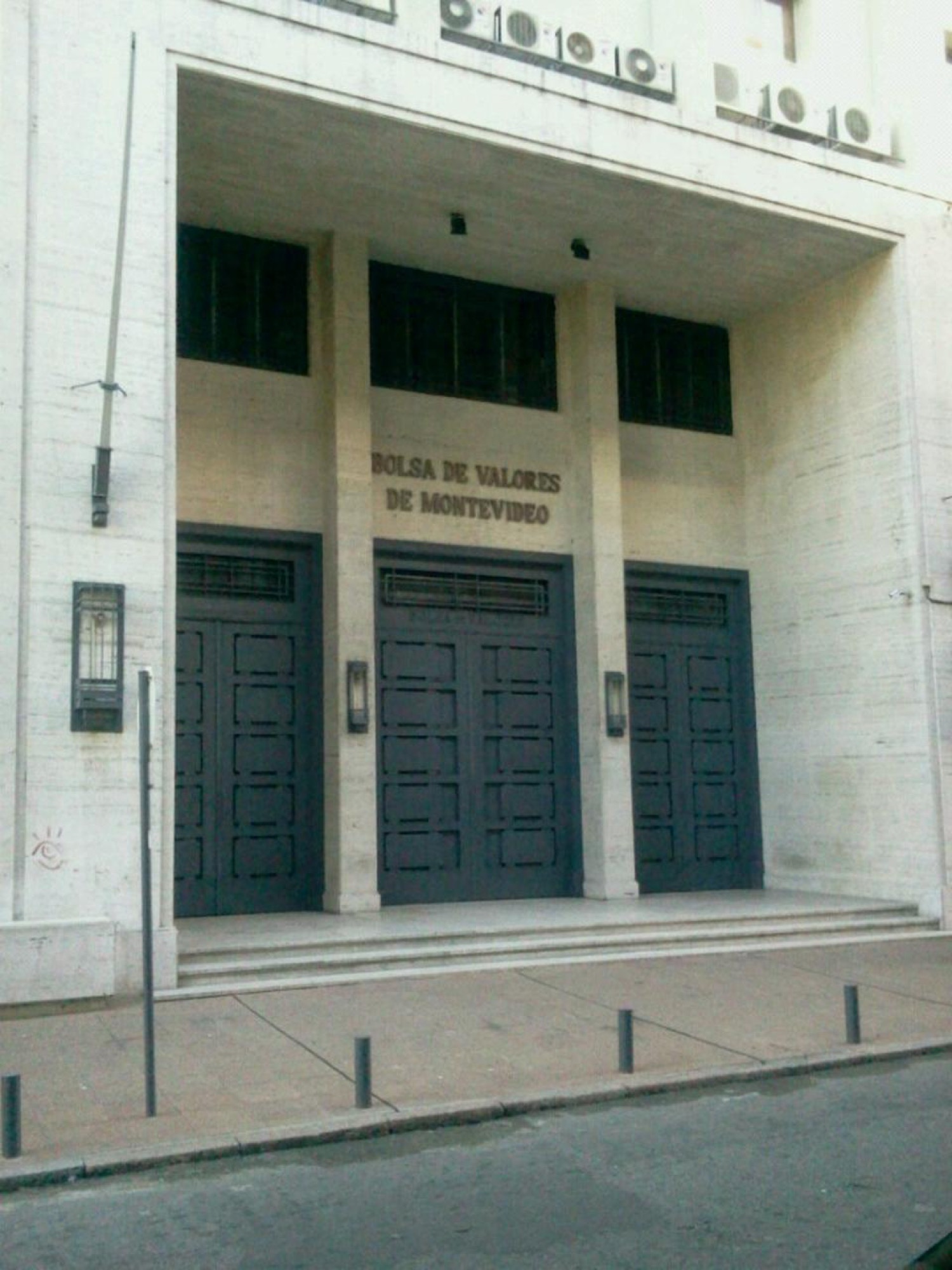
The Bolsa de Valores de Montevideo occupies a purpose-built modernist structure at the corner of Rincón 454 and Misiones 1400 in Montevideo’s Ciudad Vieja, inaugurated on July 18, 1940, under the presidency of Alfredo Baldomir. Architects Beltrán Arbeleche and Miguel Ángel Canale won first prize in a 1936 design competition, and construction was carried out by Pascual L. Orrico. The building rises seven stories over a 1,491-square-meter footprint, organized around a central covered courtyard—a reinterpretation of the traditional patio plan adapted for modern institutional use. As documented in the Universidad ORT Uruguay’s “Patrimonio Moderno” survey, Arbeleche and Canale resolved the challenging corner site through “inteligente manejo volumétrico” (intelligent volumetric handling), producing a tripartite composition of base, central block, and crowning element distinguished by contrasting materials and proportions. The two façades receive markedly different treatments: the Rincón street elevation presents a predominantly solid, introverted plane, while the Misiones façade is more open and public. The Montevideo municipal heritage inventory (Padrón 4153) classifies the structure as reinforced concrete frame construction in good condition and assigns it departmental heritage protection. The exchange’s original home was far more ornamental: when the institution was founded as the Centro Comercial in 1867, it occupied the premises of Catalan merchant Juan Peipoch at the intersection of Piedras and Zabala streets—a site now housing the headquarters of the Banco Central del Uruguay. That earlier building bore six allegorical statues by the Catalan sculptor Mora, representing livestock, industry, confidence, commerce, agriculture, and navigation. By around 1930 the original building had deteriorated beyond repair, prompting the competition that yielded Arbeleche and Canale’s rationalist replacement.
The current Bolsa de Comercio building exemplifies a deliberately austere modernist aesthetic in which spatial composition and material honesty substitute for applied ornament. As the Universidad ORT Uruguay’s architectural heritage study notes, “no ornamentation is used except for the inclusion and design of light fixtures and flagpoles that frame the accesses and adorn its interior.” The principal artistic achievement of the building lies in its double-height trading floor, known as the “Rueda,” ringed by a continuous peristyle that functions as both ambulatory and structural expression. Architectural historians at ORT have compared this introverted central volume to H. P. Berlage’s Amsterdam Beurs (1903) in its “univocal conception of space” and to Otto Wagner’s Vienna Postal Savings Bank (1905) in its use of overhead zenithal lighting. The Sala de los Pasos Perdidos—the “Hall of Lost Steps” serving as entrance vestibule on the Misiones side—provides a ceremonial transition from the street into the trading space. The façades are finished in rough plaster with geometric window perforations rhythmically distributed, lending the exterior a restrained monumentality. The earlier nineteenth-century building was far more figurative: Catalan sculptor Mora’s six allegorical façade statues—representing livestock, industry, confidence, commerce, agriculture, and navigation—embodied the visual vocabulary typical of Latin American commercial buildings of the period, in which sculptural programs advertised the range of economic activities conducted within. These themes echo the broader artistic culture of Montevideo’s Ciudad Vieja, where Beaux-Arts and Art Deco bank buildings along Calle Sarandí and Rincón deployed allegorical sculpture, wrought-iron grillwork, and ornamental cartouches to project financial solidity and cosmopolitan aspiration.
The Bolsa de Valores de Montevideo sits at the heart of Ciudad Vieja, the peninsula neighborhood that constitutes Montevideo’s historic core and principal financial district. Founded in 1724 as a walled Spanish colonial settlement at the mouth of the Bay of Montevideo, Ciudad Vieja developed into the commercial and administrative center of the Banda Oriental. Its northern shore houses the Port of Montevideo, one of the few natural deep-water harbors in the Southern Cone and historically the gateway for Uruguay’s pastoral exports—wool, hides, salted beef (tasajo), and later frozen meat. As Luis Bértola observes in his EH.net encyclopedia survey “An Overview of the Economic History of Uruguay since the 1870s” (2008), residents of Montevideo gauged the country’s prosperity by counting the stacks of cowhides and bales of wool awaiting shipment at the port. The exchange’s address at Rincón and Misiones places it within a dense cluster of financial institutions: the Banco de la República Oriental del Uruguay, established in 1896, stands nearby, as do branches of international banks that helped earn Uruguay its sobriquet “the Switzerland of America.” Plaza Independencia, the monumental square marking the boundary between Ciudad Vieja and the modern Centro district, lies just blocks to the east along the Avenida 18 de Julio. Across the Río de la Plata, Buenos Aires served simultaneously as commercial rival and partner. Montevideo’s superior natural harbor gave it strategic advantages in transatlantic shipping, while Buenos Aires dominated as the political and economic capital of the Viceroyalty of the Río de la Plata from 1776. As the Britannica entry on the Río de la Plata notes, control of river navigation has remained a source of competition into the twenty-first century. The Bolsa thus operated within a distinctive urban geography: a compact peninsular financial district oriented toward the port and the Atlantic trade routes, perpetually in dialogue with the far larger market across the estuary.
The Bolsa de Valores de Montevideo traces its origins to January 17, 1867, when a group of merchants—including Juan Miguel Martínez, Narciso Farriols, Juan Mac Coll, Daniel Zorrilla, Fructuoso G. Busto, Alcides Montero, and Ramón Arocena—inaugurated the “Sociedad Bolsa Montevideana,” also known as the Centro Comercial, to provide a fixed meeting place for the conduct of trade. Two parallel bodies were established: the Cámara Sindical, representing commercial interests, and the Comisión Interna de Corredores, regulating brokerage activities. The institution’s founding coincided with Uruguay’s post-civil-war reconstruction and the rapid growth of its pastoral export economy. Gastón Díaz Steinberg, in “The Formation of the Financial Market in Uruguay (1851–1900): Currency, Credit and Capital,” documents how waves of company creation, banking expansion, and monetary disputes shaped the mutually constitutive relationship between the Uruguayan state and its nascent financial markets during this period. In 1907 the institution was renamed the Bolsa de Comercio S.A. The early twentieth century brought expansion under the reformist presidency of José Batlle y Ordóñez, whose “Batllismo” program of state-led development—including nationalization of key industries, labor protections, and progressive taxation—transformed Uruguay into what M. H. J. Finch, in A Political Economy of Uruguay since 1870 (Macmillan, 1981), characterized as an advanced welfare state resting upon a pastoral export base. The Bolsa enjoyed strong growth into the late 1920s, suffered contraction during the 1929–1933 global depression, then recovered between 1934 and 1947 as private securities issuance increased. From the 1950s through the 1960s, the limits of import-substitution industrialization in a country of barely two million inhabitants produced stagnation, fiscal deficits, and social conflict, as Bértola’s EH.net survey documents. In 1952 the Comisión de Corredores adopted the name “Bolsa de Valores.” The civic-military dictatorship (1973–1985) pursued financial liberalization, deregulating capital transactions and attracting foreign lending through high interest rates—policies analyzed in Juan Pérez-Campanero and Alfredo Leone’s IMF Working Paper “Liberalization and Financial Crisis in Uruguay (1974–1987)” (1991). A severe banking crisis erupted in 1982, leading to widespread institutional failures. After the return to democracy in 1985, successive governments continued market-oriented reforms. The Securities and Negotiable Obligations Law (Ley 16.749) of 1996 modernized the regulatory framework, and the creation of private pension fund administrators (AFAPs) in that year introduced institutional investors into the market. In 1997 the Bolsa de Valores formally separated from the Bolsa de Comercio and developed its own clearing, settlement, and custody system. Eduardo Siandra’s working paper “Uruguay Capital Market: Law-in-the-Books or Law-in-Action?” (dECON, Universidad de la República, 2005) assessed the gap between legislative ambitions and actual market development. The institution adopted its current name, Bolsa de Valores de Montevideo, in 2004, and in 2008 launched electronic trading through the Spanish SIBE platform. A revised Securities Act (Ley 18.627) followed in 2009, seeking to align Uruguayan regulation with IOSCO standards.
The Bolsa de Valores de Montevideo has historically served as the marketplace for Uruguayan government bonds, corporate debt, equities, and, through its institutional predecessor, a wide range of commercial transactions related to the country’s pastoral export economy. In its earliest decades as the Centro Comercial, the exchange facilitated dealings in wool, hides, leather, and salted beef (tasajo)—commodities that Bértola’s EH.net survey identifies as the foundations of Uruguay’s export-led growth, with wool exports matching the value of leather by 1884. Government debt instruments became central to the exchange’s activity from the late nineteenth century onward, as the Uruguayan state financed infrastructure, state enterprises, and social programs through bond issuance. Bank stocks—including shares in the Banco Comercial, founded in 1857, and later the Banco de la República Oriental del Uruguay, established in 1896—constituted a significant share of listed equities. Utility and state-enterprise securities reflected the Batllista program of nationalization. During the import-substitution era (1930s–1950s), shares of light industrial firms appeared, though as Gabriel Oddone and Joaquín Marandino document in “The Monetary and Fiscal History of Uruguay, 1960–2017” (University of Chicago, Becker Friedman Institute), the domestic equity market remained thin relative to banking-sector intermediation. The exchange’s scale has always been modest compared to that of the Bolsa de Comercio de Buenos Aires across the Río de la Plata. By the early 2000s, as Siandra’s dECON working paper observed, pension fund assets under management far exceeded the total capitalization of listed securities on the BVM. Annual trading volume has been reported at approximately three billion U.S. dollars, dominated by government and central-bank instruments, with a small complement of corporate bonds and equities. Special partners of the BVM include banks, pension fund administrators (AFAPs), social-security institutions, and insurance companies. The creation of the electronic exchange BEVSA in 1993—which began operations in 1994 with twenty-six financial institutions—shifted much of the fixed-income and money-market trading to an electronic platform, while the BVM retained its role in equities and certain bond segments. Settlement operates on a T+1 basis for domestic securities and T+3 for foreign instruments.
Images will be added as the project develops. Photographs by Larry Ng and from research sources.