Mobile Cotton Exchange
Mobile, USA · Established 1871
This site requires authorization to access.
To request access, contact
william.goetzmann@yale.edu
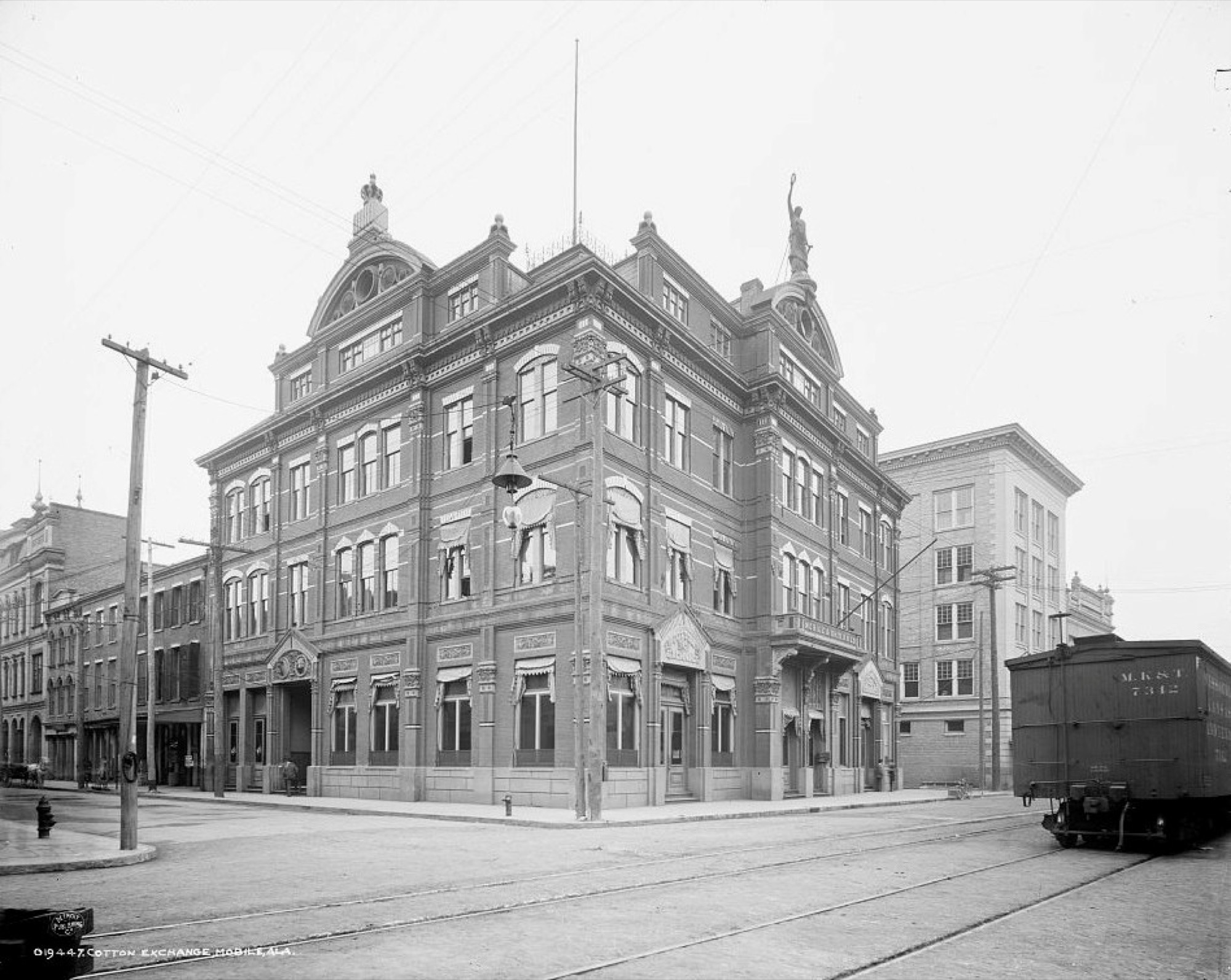
The Mobile Cotton Exchange occupied three successive buildings during its seven decades of operation. Founded in December 1871, the exchange first established its trading rooms on St. Michael Street in the heart of Mobile’s commercial district. As business expanded, the institution commissioned Rudolph Benz—a German-born architect who had emigrated to America in 1869 and achieved his greatest triumphs designing public buildings in Mobile between 1880 and 1900—to design a purpose-built exchange at the corner of St. Francis and North Commerce streets, completed in 1886. Benz’s design was among the most ornate commercial structures in the Gulf South, featuring precise brickwork set in red mortar, retractable canvas awnings, a mansard slate roof, and a triumphant Goddess of Industry crowning one of the parapeted dormers, as described in the local architectural record compiled by John Sledge in his survey of Mobile’s bygone structures (Mobile Bay Magazine, 2019). The building’s Second Empire and Romanesque elements reflected the confidence of Mobile’s cotton merchants, who by the 1880s were handling hundreds of thousands of bales annually. The Benz-designed exchange was destroyed by fire in 1917, forcing the institution to relocate to another St. Francis Street address facing Bienville Square, the tree-shaded park that had served as the civic heart of downtown Mobile since the 1830s. The American Planning Association recognized Bienville Square in 2012 as one of America’s Great Public Spaces. The exchange operated from this third location until its closure in August 1942, when wartime conditions suspended cotton trading. Neither the Benz building nor the later exchange quarters survive today; much of the historic waterfront commercial district was demolished during twentieth-century urban renewal.
The decorative program of Rudolph Benz’s 1886 Cotton Exchange building embodied the visual aspirations of Mobile’s cotton elite. The structure’s most distinctive ornamental feature was the sculptural figure of the Goddess of Industry, mounted atop one of the building’s parapeted dormers, symbolizing the commercial vitality that cotton brought to the Gulf port. The exterior brickwork, laid in red mortar with meticulous precision, reflected the craftsmanship of Mobile’s German and Irish artisan communities. The mansard slate roof, a hallmark of the Second Empire style popular among American commercial buildings of the 1870s and 1880s, lent the exchange a cosmopolitan grandeur befitting its role as a center of international trade. While the 1917 fire destroyed the building and its interior appointments, the broader visual culture of Mobile’s cotton trade is richly documented. Edgar Degas’s celebrated 1873 painting A Cotton Office in New Orleans—depicting the interior of Michel Musson’s cotton factoring firm, with brokers examining raw fiber amid cluttered desks—provides the most vivid artistic record of the Gulf Coast cotton exchange milieu in which Mobile merchants also operated. As art historian Marilyn Brown has argued, Degas’s composition transforms the labor of cotton commerce into a study of bourgeois anxiety and commodity aesthetics. In Mobile itself, the “Golden Age” of the cotton trade brought a vogue for Neoclassical and Italianate facades along the commercial streets, with elegant cast-iron galleries and decorative pilasters ornamenting the factor offices and warehouses on Commerce and Water streets.
Mobile occupies a commanding position at the head of Mobile Bay, where the Alabama and Tombigbee rivers converge before emptying into the Gulf of Mexico, creating a natural funnel for the agricultural wealth of the interior. As Harriet E. Amos demonstrated in Cotton City: Urban Development in Antebellum Mobile (University of Alabama Press, 1985), this geographic advantage transformed a quiet frontier settlement of roughly 1,500 inhabitants in 1820 into a thriving commercial metropolis of 30,000 by 1860. The city’s waterfront commercial district developed along Commerce, Front, and Water streets, where cotton factor offices, warehouses, steamboat ticket agencies, and hardware merchants clustered in dense proximity to the wharves. John Sledge noted that these blocks were at one time dubbed “the English Channel” for the numerous British cotton merchants at work there. Bienville Square, named for the city’s French founder Jean-Baptiste Le Moyne and dating from the 1830s, anchored the civic center, with banks lining St. Francis Street and retail shops along Dauphin Street. Mobile’s rivalry with New Orleans defined the Gulf cotton trade: while New Orleans commanded the Mississippi River hinterland, Mobile drew from Alabama’s Black Belt and portions of eastern Mississippi via the Tombigbee watershed. By 1860, Mobile ranked third nationally in total export value behind only New York and New Orleans, as the Encyclopedia of Alabama documents. The city’s cosmopolitan character—encompassing free Black, Creole, and foreign-born communities—resembled New Orleans more than any other Alabama settlement.
The Mobile Cotton Exchange was founded in December 1871 with Thomas K. Irwin as chairman, making it the third cotton exchange established in the United States after New York (1870) and New Orleans (1871), and preceding those in Savannah and Memphis. The institution arose from the need of local cotton factors and merchants to regulate sales, warehousing, and shipping in the chaotic Reconstruction-era economy. Mobile’s rise as a cotton port had been dramatic: in 1817 the city shipped just seven thousand bales, but by 1858–1859 over half a million bales passed through its harbor. Cotton constituted ninety-nine percent of the total value of antebellum exports, as Amos documented in Cotton City (1985). The Civil War devastated this commerce; Admiral David Farragut’s victory at the Battle of Mobile Bay in August 1864 sealed the Union blockade that had already strangled cotton exports. Post-war cotton shipments plummeted from a prewar average of 800,000 bales to fewer than 300,000, as recorded in the Encyclopedia of Alabama’s Port of Mobile entry. Michael W. Fitzgerald’s Urban Emancipation: Popular Politics in Reconstruction Mobile, 1860–1890 (Louisiana State University Press, 2002) traces how the recovering cotton economy reshaped the city’s political landscape. The boll weevil’s arrival in Mobile County in 1910 dealt a further blow, reducing Alabama’s cotton crop from 1.7 million bales to just 515,000 by 1917. The exchange suspended operations in August 1942 and never reopened. Harold D. Woodman’s King Cotton and His Retainers (University of Kentucky Press, 1968) situates Mobile’s exchange within the broader institutional transformation of Southern cotton marketing.
The Mobile Cotton Exchange primarily traded Alabama upland cotton (Gossypium hirsutum), the short-staple variety that dominated Black Belt plantations and required 180 to 200 days from seed to maturity, as described in the Encyclopedia of Alabama’s cotton entry. Cotton was classified by grade using the standardized system that evolved through the nineteenth century, with designations ranging from Strict Good Middling at the top to Good Ordinary at the bottom, assessed by fiber length, color, and leaf content. Mobile “Middling” cotton became a recognized benchmark in the international trade. The exchange also oversaw transactions in naval stores—turpentine and resin derived from Alabama’s longleaf pine forests—and lumber, which by the 1850s constituted a burgeoning secondary export. Cotton reached Mobile via an elaborate river transportation network: steamboats stopped at nearly 300 landings along the Tombigbee River and 200 more along the Alabama River, as documented in the Encyclopedia of Alabama’s steamboat entry. Harold D. Woodman’s King Cotton and His Retainers (1968) details the commission merchant and factor system that governed these transactions: factors in Mobile sold cotton on consignment for interior planters, extended credit for supplies, and arranged shipment to domestic and foreign buyers. Sven Beckert’s Empire of Cotton: A Global History (Knopf, 2014) notes that sixty percent of all U.S. exports in 1860 were raw cotton, with Mobile’s bales destined primarily for Liverpool, the nexus of the British textile industry, where Manchester mill owners purchased American fiber. The exchange standardized these practices, establishing uniform rules for sampling, weighing, and arbitrating disputes that facilitated Mobile’s integration into global commodity markets.
Images will be added as the project develops. Photographs by Larry Ng and from research sources.