Minneapolis Grain Exchange
Minneapolis, USA · Established 1881
This site requires authorization to access.
To request access, contact
william.goetzmann@yale.edu
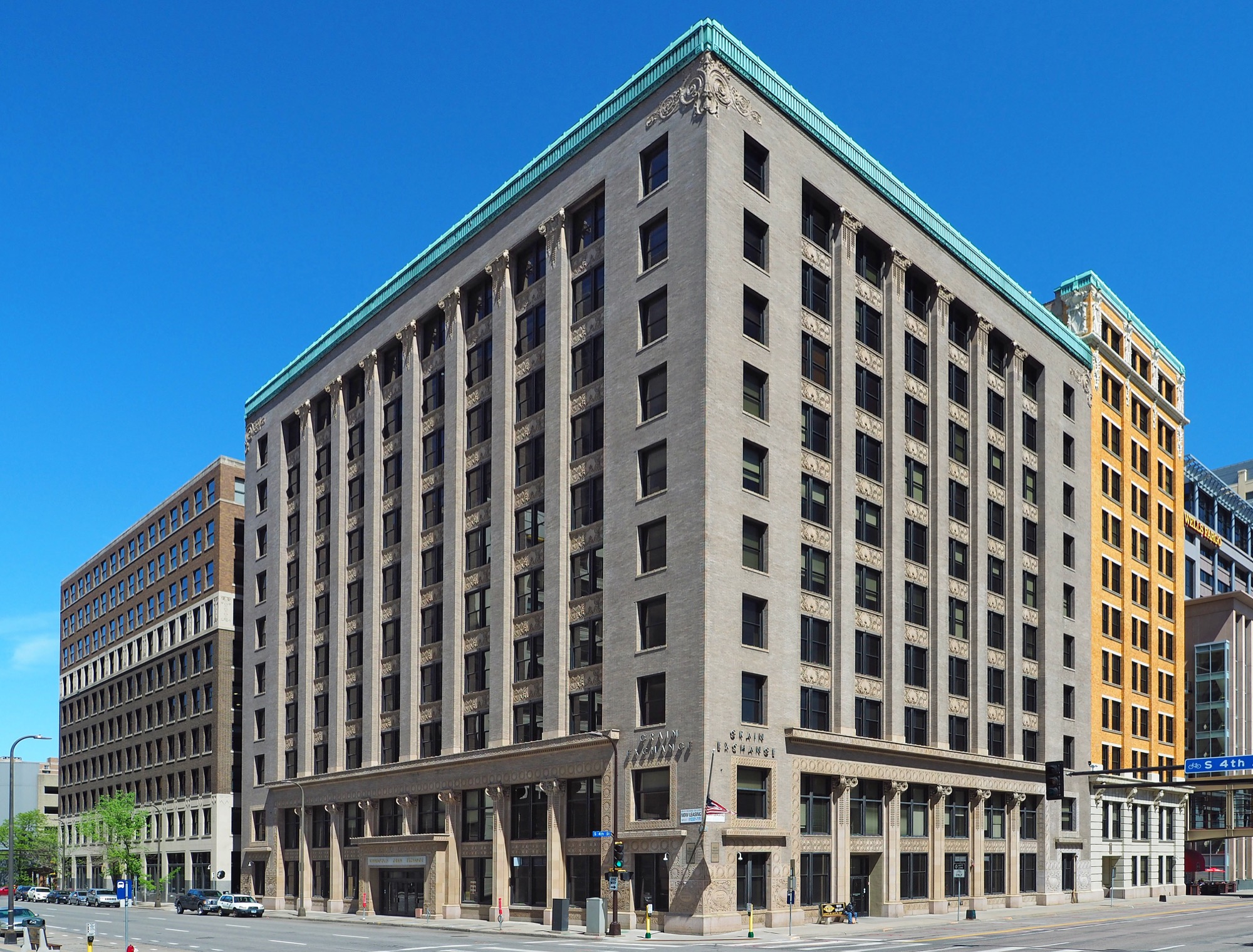
The Minneapolis Grain Exchange complex stands at 400–12 South Fourth Street as a three-phase ensemble reflecting the growth of the region’s grain trade over four decades. The Main Building, completed between 1900 and 1902, was designed by Frederick Kees and Serenus Colburn, whose partnership (1899–1921) is documented in the Kees and Colburn architectural collection at the University of Minnesota’s Northwest Architectural Archives. The ten-story L-shaped structure was one of the first steel-frame buildings in Minneapolis, its light internal steel skeleton supporting a masonry shell of cream Roman brick with extensive terra cotta and granite accents—an approach heavily influenced by Louis Sullivan’s Wainwright Building in St. Louis, earning it the Sullivanesque or Chicago Commercial style designation, as described in Larry Millett’s AIA Guide to the Twin Cities (Minnesota Historical Society Press, 2007). Terra cotta ornament includes decorative octagonal pilasters with heavily ornamented capitals, vertically emphasized window bays separated by ornate spandrel panels, and motifs of wheat sheaves and ears of corn that signal the building’s commercial purpose. The main lobby features Italian marble floors, fine wainscoting, hand-pressed tin ceilings, and a marble staircase. An East Building designed by Long, Lamoreaux and Long was added in 1909, rising twelve stories in orange brick with white terra cotta rusticated stone courses at the base and elaborate cornice work on the upper stories. The North Building, designed by Bertrand, Chamberlin, and Edmund J. Prondzinski, was erected in 1928 on the site of the original 1884 Chamber of Commerce building at Fourth Avenue and Third Street—reportedly constructed in just six months, a record for the Northwest. Three additional floors were added to the North Building in 1955. The Main and East Buildings were listed on the National Register of Historic Places on November 23, 1977 (NRHP No. 77000741), and the full complex was nominated under reference No. 95000821 in 1995, recognizing contributions to commerce and architecture. The city of Minneapolis designated the complex a local landmark in 1977. Since the cessation of open-outcry trading in 2008, the grand trading floor has been adaptively reused as event and coworking space, preserving the original architectural character detailed in the commemorative volume The Minneapolis Chamber of Commerce, 1881–1903 (1903), held by the Library of Congress.
The principal artistic achievement of the Grain Exchange is the soaring trading hall itself, an interior space of approximately 16,000 square feet with ceilings reaching forty to forty-two feet, illuminated by tall Palladian-style windows that flood the room with natural light—a deliberate design choice, since grain traders required unfiltered daylight to assess the color and quality of wheat samples displayed on the cash tables, as documented in Farm Security Administration photographs by John Vachon held at the Library of Congress (September 1939). The terra cotta program on the exterior constitutes the most extensive Sullivanesque decorative scheme in Minneapolis, with intricate botanical ornament inspired by Louis Sullivan’s organic vocabulary of interlaced vegetal motifs, including stylized wheat sheaves and corn ears that celebrate the building’s commercial purpose. Interior ornamentation includes artfully crafted ceilings with pressed-tin panels, ornamental elevator surrounds, and paintings depicting Minneapolis’s milling past that line the trading hall walls. The expansive wood cash tables where grain samples were inspected, the original phone booths used by traders, and the preserved forty-foot-high trading board—which still displays the final recorded trades in millet, flaxseed, and other commodities—together constitute a kind of industrial-age installation art, a material record of market practice. Vachon’s 1939 FSA photographs, including Open Grain Market, Minneapolis Grain Exchange and Bidding on Futures, Minneapolis Grain Exchange (Library of Congress Prints and Photographs Division), remain the most important visual documentation of the trading floor in its working state and have been widely reproduced in Dave Kenney’s The Grain Merchants: An Illustrated History of the Minneapolis Grain Exchange (Afton Historical Society Press, 2006).
The Grain Exchange occupies a pivotal position in downtown Minneapolis at South Fourth Street, just blocks from the Mississippi River and the Falls of St. Anthony—the natural cataract whose fifty-foot drop provided the hydraulic power that made Minneapolis the flour-milling capital of the world, as Lucile Kane documented in The Falls of St. Anthony: The Waterfall That Built Minneapolis (Minnesota Historical Society Press, 1987). By 1880, approximately twenty-seven mills lining both banks of the river produced over two million barrels of flour annually, and Minneapolis surpassed St. Louis as the nation’s leading flour producer, a dominance it held for fifty years. The city’s explosive population growth—from 13,000 in 1870 to nearly 165,000 by 1890—was driven largely by the wheat and milling economy. Railroads were essential to this network: James J. Hill’s St. Paul, Minneapolis and Manitoba Railway (later the Great Northern) carried over twenty million bushels of wheat annually from the Red River Valley bonanza farms of Dakota Territory, as the National Park Service’s Teaching with Historic Places study Wheat Farms, Flour Mills, and Railroads: A Web of Interdependence details. Hill’s stone arch bridge connected mill complexes to rail terminals along the river. Grain elevators proliferated along railroad sidings throughout Minneapolis; the Peavey Company pioneered reinforced-concrete cylindrical grain storage, and Cargill built a 250,000-bushel terminal in the city by 1886. The Grain Exchange building itself anchored a cluster of commodity-trade institutions in the downtown commercial core, adjacent to the separately built Flour Exchange (1892), creating an institutional district that mediated between the agricultural hinterland and global flour markets—a spatial relationship analyzed in William Cronon’s Nature’s Metropolis: Chicago and the Great West (W. W. Norton, 1991), which traces how grain elevators, railroad networks, and commodity exchanges transformed the ecology and economy of the Upper Midwest.
The Minneapolis Grain Exchange was founded as the Minneapolis Chamber of Commerce in the fall of 1881, when twenty-one prominent businessmen met in the basement of a fledgling bank to create a regulated marketplace for grain, as recounted in The Minneapolis Chamber of Commerce, 1881–1903 (H. B. Hudson, ed., 1903), a commemorative volume issued upon completion of the new building and now held by the Library of Congress. The Chamber was established just one year after Minneapolis surpassed St. Louis as the nation’s leading flour producer, a milestone driven by the adoption of the middlings purifier and chilled-iron roller technology that made hard spring wheat superior to soft winter varieties, as Charles B. Kuhlmann analyzed in The Development of the Flour-Milling Industry in the United States (Houghton Mifflin, 1929). Washburn-Crosby (later General Mills), Pillsbury, and Northwestern Consolidated Milling dominated the industry; by the early 1900s three Minneapolis-based firms controlled ninety-seven percent of national flour production, and milling peaked during World War I when twenty-five mills produced 18.5 million barrels annually—more than twenty percent of the national output. The Chamber introduced its first futures contract in 1883, for hard red spring wheat, establishing a price-discovery mechanism that persists to this day. In 1947, the institution was renamed the Minneapolis Grain Exchange to distinguish itself from civic chambers of commerce. The Exchange operated the nation’s largest open cash grain market for much of the twentieth century, as documented in Dave Kenney’s The Grain Merchants: An Illustrated History of the Minneapolis Grain Exchange (Afton Historical Society Press, 2006). Open-outcry pit trading ended on December 19, 2008, and the Exchange transitioned to electronic trading on the CME Globex platform. In December 2020, Miami International Holdings completed its acquisition of MGEX through a demutualization merger, and in October 2024 the exchange was formally renamed MIAX Futures Exchange, though its hard red spring wheat contract continues to trade as the benchmark for the world’s premium bread wheat.
The Minneapolis Grain Exchange was formed in 1881 as a regional cash marketplace for wheat, oats, and corn, but its identity was defined from the outset by hard red spring wheat—the high-protein bread wheat grown across the Northern Plains and prized by bakers worldwide. In 1883 the Chamber of Commerce introduced its first futures contract for hard red spring wheat, making it the world’s exclusive futures market for that variety, a distinction it maintained for over a century. Trading on the cash market relied on physical inspection: railcars arriving from Dakota Territory and the Red River Valley were sampled, and small pans of grain were placed on long wooden cash tables on the trading floor, where buyers under natural light assessed color, kernel size, and protein quality. The grading system—eventually standardized into federal categories such as No. 1 Hard Red Spring—allowed the transformation of physical grain into a fungible commodity, a process William Cronon analyzed in his chapter Pricing the Future in Nature’s Metropolis (W. W. Norton, 1991). Kuhlmann’s earlier article The Influence of the Minneapolis Flour Mills upon the Economic Development of Minnesota and the Northwest (Minnesota History, vol. 6, no. 2, 1925) traced how the Exchange’s cash and futures markets created the price signals that connected Great Plains wheat farmers with the Minneapolis milling giants. Futures trading occurred in the pit on the opposite side of the trading floor from the cash tables, with twelve to twenty traders conducting open outcry during active sessions. Board markers—historically all women—recorded prices on a forty-foot-high chalkboard visible across the hall. Besides spring wheat, the Exchange traded futures and options in white wheat, corn, soybeans, and various index products. After 2008, all trading moved to electronic platforms, and the Exchange’s hard red spring wheat contract now trades on CME Globex as the global benchmark for premium milling wheat, with quality specifications including minimum test weight of 58 pounds per bushel, falling numbers of 300 or better, and protein content appropriate for artisan bread flour.
Images will be added as the project develops. Photographs by Larry Ng and from research sources.