Milwaukee Stock Exchange
Milwaukee, USA · Established 1858
This site requires authorization to access.
To request access, contact
william.goetzmann@yale.edu
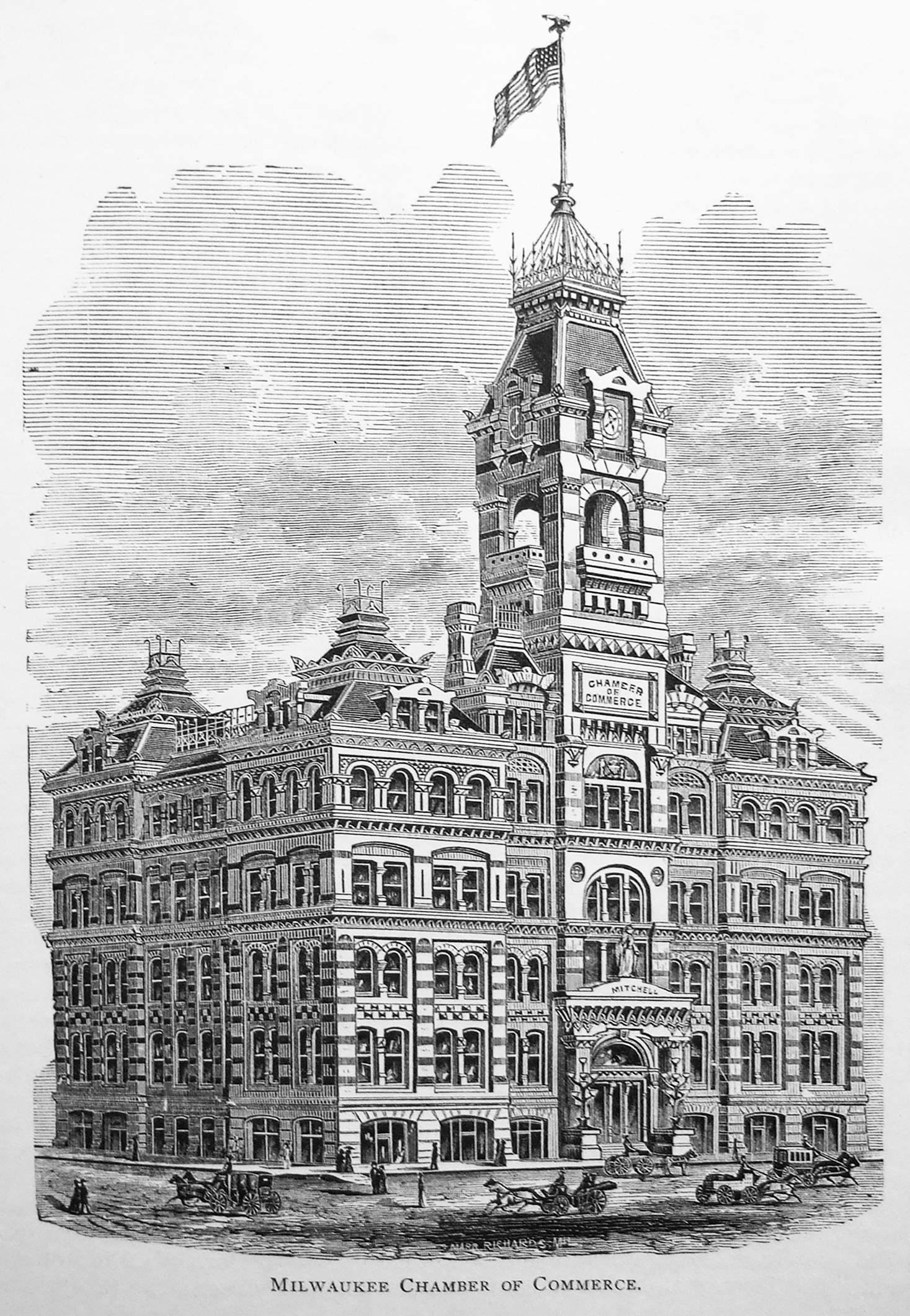
The Milwaukee Stock Exchange operated within the Mackie Building, a five-and-a-half-story Victorian edifice at 225 East Michigan Street designed by Edward Townsend Mix and completed in 1880. Mix, a Connecticut-born architect who trained under Richard Upjohn before establishing his Milwaukee practice in 1856, conceived the structure in the Second Empire style with pronounced Italianate inflections, as documented in the Society of Architectural Historians’ Archipedia entry on the building. Financed by Scottish-born railroad magnate and banker Alexander Mitchell—whose biography by David Blake Leonard (University of Wisconsin, 1957) details his dominance over Wisconsin’s financial landscape—the building consolidated the city’s grain and securities commerce under one mansard roof. The exterior presents symmetrical facades of gray sandstone, granite, and limestone, divided vertically into bays and horizontally by cornices of varying patterns, crowned by a slate mansard roof with dormers characteristic of the French Second Empire mode. A 175-foot bell tower rises above the entrance, flanked by polished granite columns. The interior’s centerpiece is the three-story Grain Exchange Room, an approximately 10,000-square-foot trading hall featuring the world’s first octagonal trading pit, designed by William J. Langston, the Chamber’s secretary. As the National Register of Historic Places nomination (added April 3, 1973) observes, this sunken, tiered pit was “widely copied by other grain exchanges” across America. The building was listed on the National Register in recognition of its architectural and commercial significance. Joshua Jeffers acquired the property in 2016 and, with Continuum Architects, converted the upper floors to twenty-six apartments while preserving the Grain Exchange Room as an event venue, earning a 2018 Mayor’s Design Award.
The decorative program of the Mackie Building’s Grain Exchange Room constitutes one of the most lavishly ornamented commercial interiors in the Upper Midwest. Chicago artist P. M. Almini designed the room’s elaborate frescoes in what contemporaries described as a “free expression of the late Renaissance style,” featuring wheat-sheaf medallions encircled by Wisconsin wildflowers painted across the soaring ceiling, as documented in the Conrad Schmitt Studios restoration project records. Colossal faux-marble pillars rise through the three-story space, their gilded capitals bearing ornamental plaster casts of locomotives and steamships—symbols of the transportation networks that funneled grain to Milwaukee’s lakefront wharves. Three-dimensional gilded floral wreaths adorn the zones below each capital. At the ceiling’s center, a stained-glass skylight bathes the trading floor in natural light, surrounded by the agricultural frescoes. Local artist John S. Conway contributed the room’s principal canvas mural, mounted above the entrance; Conway was also known for his portrait of Alexander Mitchell. The building’s exterior carries equally significant sculptural ornament: carved representations of a bull and bear—the universal symbols of market optimism and pessimism—flank the entrance alongside a carved rendering of the Wisconsin state seal and a figure of Mercury, Roman god of commerce and trade. After decades of neglect during which a dropped ceiling concealed the original decorative scheme, the Ashley family initiated a comprehensive restoration in 1981. Conrad Schmitt Studios of New Berlin, Wisconsin, undertook a three-year project beginning in 1997, photographing and coding over 140 colors, replicating missing murals, cleaning surviving frescoes, repairing gilded plasterwork, and retrieving stained-glass panels that had been removed to a local pub. The restored room was recognized as the most significant restoration project in the Midwest that year.
The Mackie Building stands at the corner of Broadway and East Michigan Street in downtown Milwaukee, occupying a pivotal position within what became the city’s Victorian-era financial district. As the East Side Commercial Historic District survey prepared for the Milwaukee Historic Preservation Commission documents, the erection of the Chamber of Commerce Building in 1879–80 and the Northwestern Mutual Life Insurance Company headquarters at 611 North Broadway in 1886 solidified Michigan Street as Milwaukee’s center of finance. Alexander Mitchell’s adjacent Mitchell Building (1876), also designed by E. Townsend Mix in Second Empire style, housed his Marine Bank and railroad offices, creating a dense cluster of financial institutions along the North Water Street and Broadway corridor. Milwaukee’s strategic position on the western shore of Lake Michigan made it a natural transshipment point for the agricultural wealth of the Upper Midwest. As the Encyclopedia of Milwaukee’s economy entry details, the city’s grain exports surged from 95,510 bushels in 1845 to over 7.5 million bushels of wheat by 1860, establishing Milwaukee briefly as the world’s largest primary wheat market. German immigrants brought specialized skills in brewing and leather manufacturing, and by 1900 the city’s population had grown from 2,000 in 1840 to 285,315. The nearby Third Ward, historically home to wholesale grocery and commission merchants along “Commission Row” on the 300 block of Broadway, reinforced the commercial density surrounding the exchange. The distinctive Cream City brick that characterized Milwaukee’s built environment—produced from local clay rich in lime and sulfur—gave the Victorian commercial district its warm, pale-yellow palette.
The Milwaukee Stock Exchange traces its origins to the Milwaukee Board of Trade, established in 1849 as one of the earliest grain-trading organizations west of the Alleghenies. In 1858, this body merged with its rival, the Milwaukee Corn Exchange (founded 1855), to form the Milwaukee Chamber of Commerce, as the Wisconsin Historical Society’s archival finding aid for the Milwaukee Grain Exchange Records (1848–1974) documents. Unlike modern promotional chambers, this institution’s sole function was commodity trading. A state charter granted in 1868 conferred special powers for commodity inspection and dispute arbitration. Milwaukee’s grain trade peaked in the early 1860s, when the city was the nation’s largest wheat shipper, but as the wheat belt migrated westward after 1873, Milwaukee adapted. Grain futures trading began in 1864, and the exchange pioneered fair grading and inspection standards during the 1860s. The exchange became a major barley trading center in the early twentieth century, reflecting the demands of Milwaukee’s renowned brewing industry—home to Pabst, Schlitz, Blatz, and Miller. In 1931, the institution was renamed the Milwaukee Grain and Stock Exchange, formally recognizing its expanded role in securities trading. Following the Securities Exchange Act of 1934, the exchange registered with the newly created SEC, but as Bjorn Jorgensen, Kenneth Kavajecz, and Scott Swisher demonstrate in “The Historical Dynamics of US Financial Exchanges” (Financial History Review, Cambridge University Press), the Act accelerated the closure of smaller regional exchanges. Milwaukee was among ten exchanges that closed after SEC registration; securities trading ceased in 1938. The institution reverted to the name Milwaukee Grain Exchange in 1946 and continued diminished commodity operations through the late 1940s.
The Milwaukee exchange traded a diverse array of commodities and, after 1931, securities. Wheat dominated the early decades: the Milwaukee Chamber of Commerce established grading standards for spring wheat during the 1860s, classifying grain by color, weight, and moisture content in a system that preceded and influenced the federal standards codified in the United States Grain Standards Act of 1916. Grain futures trading commenced in 1864, making Milwaukee one of the earliest Midwestern exchanges to offer forward contracts alongside spot transactions. The Hathi Trust’s catalog of the Annual Report of the Milwaukee Grain & Stock Exchange records the institution’s evolution from purely agricultural commodities to a mixed trading platform. Corn, oats, and rye joined wheat as actively traded grains. After 1873, as the wheat frontier shifted westward and Wisconsin farmers transitioned to dairy and barley cultivation, barley futures emerged as a signature Milwaukee contract—driven by the voracious demand of the city’s brewing giants. The malt industry, as the Encyclopedia of Milwaukee documents, grew directly from the brewing sector’s need for processed barley. When the exchange expanded into securities in 1931 as the Milwaukee Grain and Stock Exchange, it listed stocks and bonds of regional industrial, banking, and utility companies. These local issues—shares in Wisconsin manufacturers, insurance firms like Northwestern Mutual, and railroad concerns built by Alexander Mitchell—served investors who preferred dealing through a nearby exchange rather than routing orders to New York or Chicago. The SEC’s Second Annual Report (1936) recorded the Milwaukee Grain and Stock Exchange among the registered national securities exchanges, though its small volume made it vulnerable to the consolidation pressures that Jorgensen, Kavajecz, and Swisher identify as characteristic of post-1934 regional exchange dynamics.
Images will be added as the project develops. Photographs by Larry Ng and from research sources.