Borsa Italiana
Milan, Italy · Established 1808

This site requires authorization to access.
To request access, contact
william.goetzmann@yale.edu
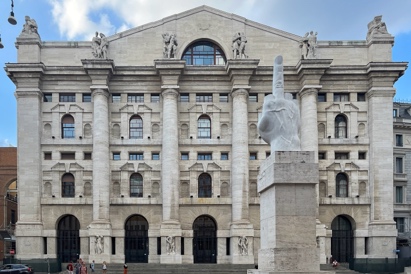
Milan's stock exchange traces its origins to 1808, when Eugene de Beauharnais, viceroy of Napoleon's Kingdom of Italy, established the Borsa di Commercio di Milano by decree. Trading initially took place in three cramped rooms inside the Monte di Pieta, the city's public pawnbroking house, before moving in September 1809 to the hearing room on the first floor of the Palazzo dei Giureconsulti, the sixteenth-century merchants' guild hall overlooking Piazza Mercanti. As trading volume grew through the nineteenth century, the exchange relocated around 1901 to a purpose-built structure in Piazza Cordusio. In 1925 the city launched a competition for a grand new exchange building. Architect Paolo Mezzanotte, a prominent figure in the Milanese Novecento movement, won the commission. He began his design in 1927 and construction started in 1929, but excavations uncovered the ruins of a first-century Roman theater beneath the site, delaying the work. Completed and inaugurated in April 1932, the Palazzo Mezzanotte rises with a monumental thirty-six-meter facade of travertine and marble in a style blending stripped neoclassicism with Rationalist modernism. At its opening it was hailed as the most technologically advanced building in Italy: it featured centralized elevator controls, air conditioning, and Italy's largest electric quotation board, which displayed the prices of the seventy-eight listed securities in real time. The Sala delle Grida — the open-outcry trading hall — spans approximately 960 square meters, conceived as a vast covered piazza.
The Palazzo Mezzanotte's facade is crowned by prominent allegorical sculptural groups on the pediment, the work of sculptors Leone Lodi and Geminiano Cibau. These monumental figures depict the four natural elements — earth, water, air, and fire — portrayed through images of industrious men and women exerting mastery over nature through human labor, embodying themes of commerce, industry, and economic prosperity. Inside, the Sala delle Grida's ceiling features a remarkable velario — a translucent glass canopy engraved with depictions of the celestial vault and its constellations — designed by Gio Ponti and executed by the celebrated master glassmaker Pietro Chiesa, a collaboration that represents a landmark of Italian decorative arts in the interwar period. The walls of the trading hall incorporated colored glass rustications in red, green, and blue to visually distinguish different trading categories: currencies, bonds, and equities. In the building's underground dining hall, the Taverna del Ferraio, Gio Ponti created wall decorations in Richard Ginori majolica — the refined ceramics manufacturer for which Ponti served as artistic director — employing allegorical imagery of grain, cereals, fish, and birds celebrating themes of abundance. Since September 2010, the Piazza degli Affari has been dominated by Maurizio Cattelan's L.O.V.E. — a 4.6-meter figure carved from white Carrara marble atop a Roman travertine pedestal, reaching eleven meters in total height. The sculpture depicts a hand with all fingers severed except the middle one, directed squarely at the exchange's facade. The title is an acronym for Liberta, Odio, Vendetta, Eternita (Freedom, Hatred, Revenge, Eternity). Cattelan described the work as an anti-fascist statement: if the fingers were restored, the hand would form the Roman salute associated with Mussolini's regime, and the mutilation transforms this gesture into a defiant riposte to the totalitarianism that shaped the building's era.
Piazza degli Affari occupies a site in the heart of Milan's historic center, roughly equidistant between the Duomo and the Castello Sforzesco. The piazza was not an ancient open space but a Fascist-era creation: the construction of Palazzo Mezzanotte in the late 1920s and the flanking residential and commercial buildings by architect Emilio Lancia in 1939 carved out a formal quadrilateral square from the dense medieval urban fabric. The urban historian Lucy Maulsby has shown how the piazza's design was the product of fierce negotiations between the Fascist regime, the municipality, and Milan's financial establishment. The Roman theater discovered beneath the site during construction — an Augustan-era structure with a capacity of some 8,000 spectators — underscores the extraordinary archaeological layering of the location. Milan's ascendancy as Italy's undisputed financial capital dates to the aftermath of the 1907 banking crisis, which devastated the Genoa exchange and shifted the center of gravity northward.
The Milan Merchandise Exchange was established by two decrees issued by Viceroy Eugene de Beauharnais on 16 January and 6 February 1808. Official trading began on Monday, 15 February 1808, under the direction of Carlo Ciani, overseen by a commission of fifteen members including bankers, traders, and brokers under the Ministry of the Interior. Through the nineteenth century Milan was one of several competing Italian exchanges. After Italian unification in 1861, the Genoa exchange — rooted in the old maritime republic's banking traditions — was by far the most important in the new kingdom, specializing in government bonds and railroad securities. Milan introduced greater transparency and stricter market-access rules, while Genoa remained opaque and loosely regulated. Between 1909 and 1911, Milan definitively surpassed Genoa to become Italy's principal bourse. Milan's exchange both drove and reflected Italy's industrialization: Edison, founded in 1884 by Giuseppe Colombo after meeting Thomas Edison, operated Europe's first power plant at Santa Radegonda and became a major listed company. Pirelli, founded in Milan in 1872, went public in 1874. Fiat, established in Turin in 1899, listed in the early 1920s. In the postwar era, Mediobanca — founded in 1946 by Raffaele Mattioli and the legendary Enrico Cuccia — orchestrated the mergers, acquisitions, privatizations, and cross-shareholding arrangements that defined Italian corporate capitalism for half a century. The consolidation of all ten Italian regional exchanges into a single entity in 1997, followed by privatization as Borsa Italiana S.p.A. in 1998, formalized Milan's long-standing dominance.
The Milan exchange was founded primarily as a market for government debt and bill discounting: the Napoleonic administration sought a broad, organized platform for underwriting public bonds to finance imperial expenditures. Through the early nineteenth century, commodities and bills of exchange dominated trading alongside state securities. After Italian unification in 1861, industrial securities joined government bonds on the bourse. By the late nineteenth century, Milan's listings reflected the explosive growth of northern Italian industry: Edison (electricity, founded 1884), Pirelli (rubber and cables, listed 1874), and eventually Fiat (automobiles, listed in the early 1920s) became bellwether stocks. Government bonds — later formalized as Buoni del Tesoro Poliennali (BTPs) and Buoni Ordinari del Tesoro (BOTs) — remained central to the market throughout the twentieth century. The Sala delle Grida's colored glass walls visually encoded the principal trading categories: red for currencies, green for bonds, and blue for equities. Milan's triumph over Genoa following the 1907 crisis cemented its role as the market for Italy's leading industrial and banking shares.