Memphis Cotton Exchange
Memphis, United States · Established 1873 (institution); building 1924-25
This site requires authorization to access.
To request access, contact
william.goetzmann@yale.edu
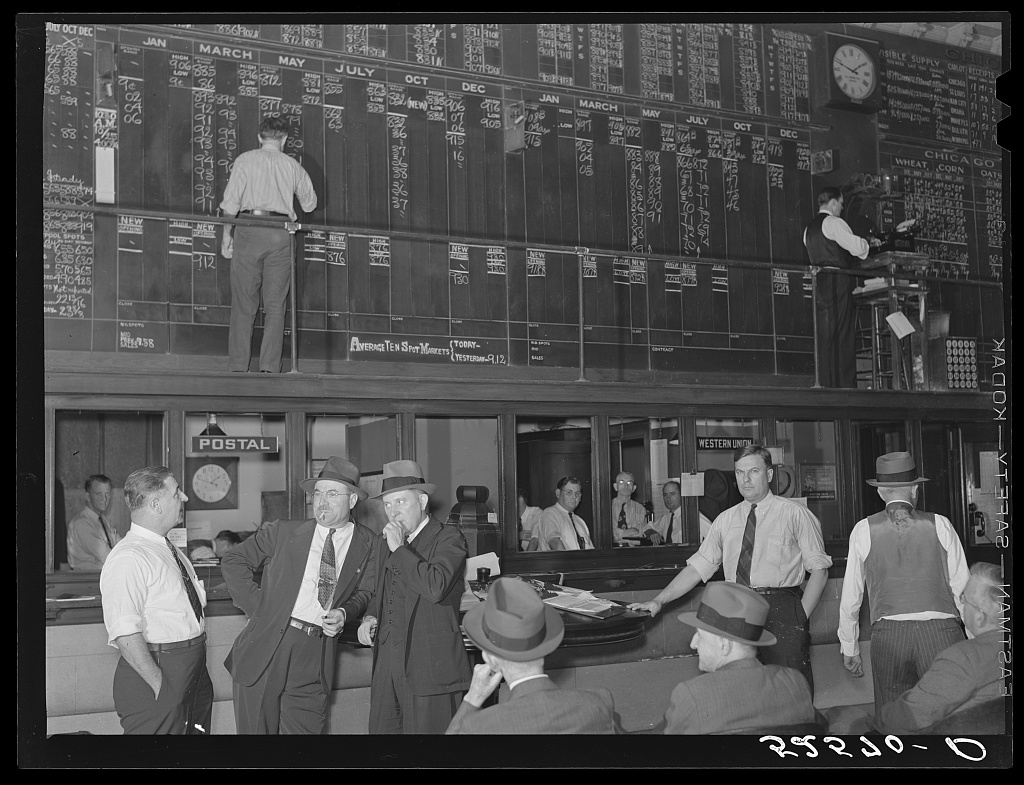
The building that now houses the Cotton Museum stands at the corner of Front Street and Union Avenue (65 Union Avenue) and was constructed in 1924-25 as the third home of the Memphis Cotton Exchange, succeeding an 1883-85 exchange at Second and Court and the twenty-story 1910 Exchange Building at Second and Madison designed by Memphis architect Neander Montgomery Woods Jr. (the latter often confused with the present structure). Built in the restrained neoclassical commercial idiom characteristic of Memphis's riverfront cotton district, the building is utilitarian rather than ornate, in keeping with the surrounding warehouses and brokerage houses of Cotton Row; the Memphis Heritage survey notes that the Row's structures were deliberately plain and functional, fitted with broad ground-floor openings for moving bales. The architect of the 1924-25 building is not securely recorded in published architectural literature, and most accounts (the Tennessee History for Kids virtual tour and the Historic-Memphis 'Cotton Row' survey among them) describe it simply as 'built in 1924-25' in a neoclassical mode with stately columns. The defining interior feature is the double-height trading room, ringed by an upper gallery carrying a chalkboard 'trade board' running the full length of the room roughly ten feet above the floor, with the Western Union and Postal Telegraph wire offices set directly beneath it.
The Memphis Cotton Exchange is not a building of fine-art ambition; its interest is documentary and industrial rather than decorative. The single most evocative 'image' associated with the interior is photographic rather than architectural: Marion Post Wolcott's November 1939 Farm Security Administration photograph of the trading room 'just before closing,' which captures the chalkboard markers on their ladders, the brokers below in shirtsleeves and hats, and the Western Union counter, and which survives in the Library of Congress FSA-OWI collection (the same image is mounted on Wikimedia Commons). Within the present Cotton Museum the chief surviving 'artifact-as-art' is the preserved trade board itself, displayed with actual price quotations chalked from a day in May 1939 and read today as a kind of found graphic record of a vanished trading culture. Beyond that the interior is sparing: period furnishings, classing-room and gin displays, and signage rather than murals, statuary, or allegorical ornament of the sort found in grander European bourses.
The exchange sits at the head of Cotton Row, the riverfront commercial spine along Front Street between roughly Monroe and Gayoso just above the Mississippi bluff, which for more than a century concentrated the cotton factors, brokers, classers and compress companies of the Mid-South. The whole district was listed on the National Register of Historic Places on 1 August 1979 as the Cotton Row Historic District (reference number 79002467), its boundaries explicitly running along Front Street and a short stretch of Union Avenue that takes in the exchange building. Standing a block from the cobblestone steamboat landing on the river, the exchange occupied the natural meeting point between the cotton arriving by river and rail and the brokerage offices that lined Front Street, so that the building functioned as the institutional and informational heart of a working warehouse-and-wharf quarter rather than as an isolated civic monument.
The Memphis Cotton Exchange was organized by the city's cotton men and formally opened at the end of 1873, following the model of the New York Cotton Exchange (1870) and the New Orleans Cotton Exchange (1871); many popular sources, including a 2025 Action News 5 'This Day in History' notice, date it to 1874, reflecting the gap between organization and incorporation. As the Tennessee Encyclopedia entry by Lynette Boney Wrenn (2017) explains, earlier attempts had foundered on the fear of cotton factors that futures speculation would depress prices, and the exchange accordingly opened as a 'spot' market with no provision for futures, a character it kept apart from two short-lived experiments. The exchange wrote uniform rules of trade, built a reliable grading system, gathered and distributed crop and price information to its members, and arbitrated disputes; it also promoted 'Memphis cotton' abroad by sending graded samples to Liverpool, New York and New Orleans and requesting separate quotations. Memphis was, by most accounts, the largest spot cotton market in the world between roughly 1880 and 1930. The exchange's prominence waned through the twentieth century as the trade consolidated, the federal government took over crop statistics, and trading moved onto screens; floor trading ended in 1978, and the historic trading room reopened in 2006 as the Cotton Museum.
What changed hands here was physical cotton, classed and priced by grade, not paper contracts. The trading room operated as a members-only spot market - membership reportedly numbering around 175 - where brokers acting for planters and merchants sold the Mid-South crop in standardized bales (the roughly 500-pound bale) to buyers supplying textile mills across the United States, Britain and the Continent, with professional 'classers' grading samples drawn from the bales and deals frequently sealed by handshake under the exchange's formal rules. Above the floor the chalkboard markers continuously updated quotations relayed by Western Union from New York, New Orleans, Chicago and Liverpool, so that the live numbers on the gallery board - including futures quotations from those markets - set the reference prices against which Memphis spot cotton actually traded. The exchange thus combined three functions in one room: a physical sampling-and-classing market, an information hub wired to the world's cotton centers, and a self-regulating membership body enforcing grades, rules and arbitration.
Images will be added as the project develops. Photographs by Larry Ng and from research sources.