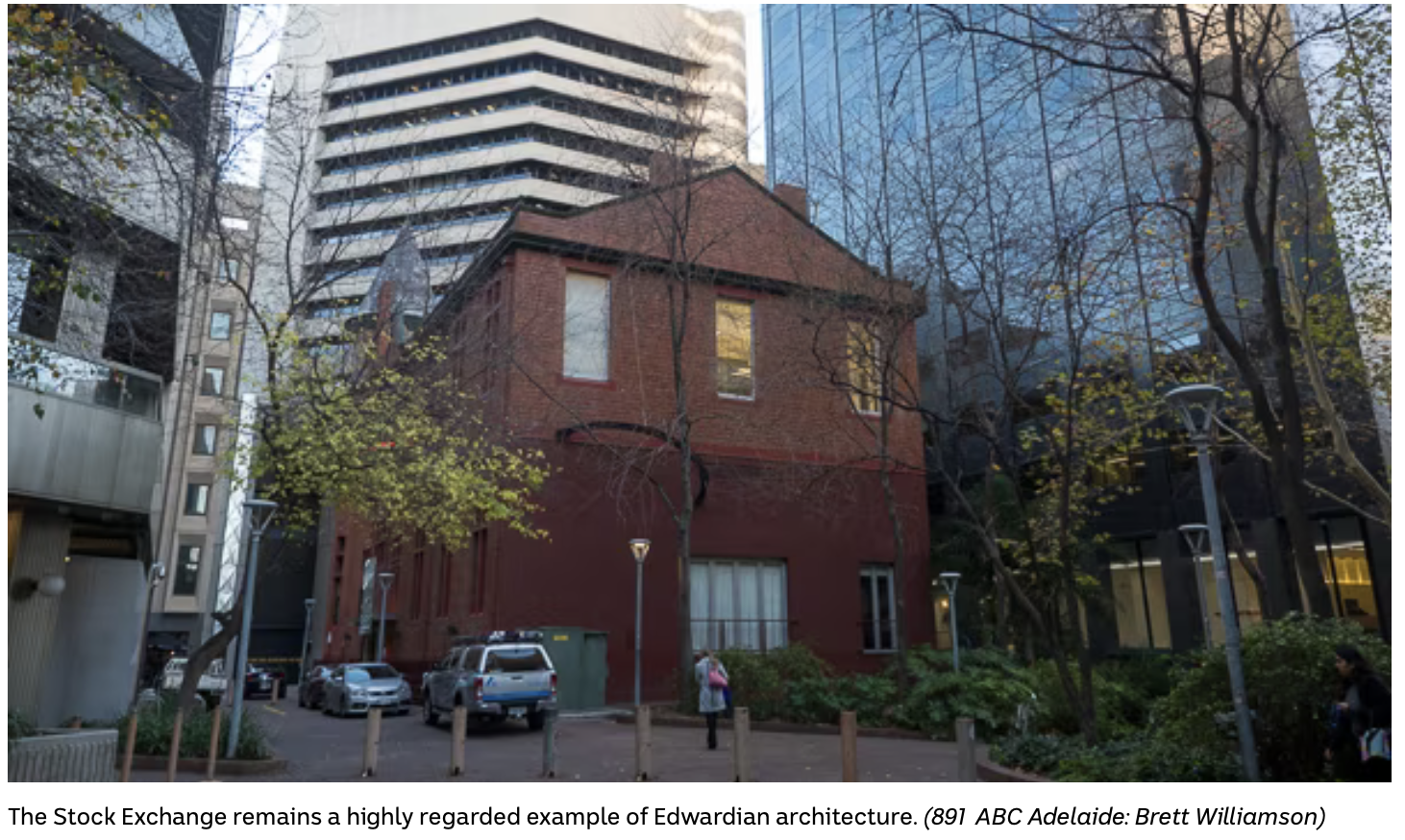
Melbourne Stock Exchange
Melbourne, Australia · Established 1861
This site requires authorization to access.
To request access, contact
william.goetzmann@yale.edu
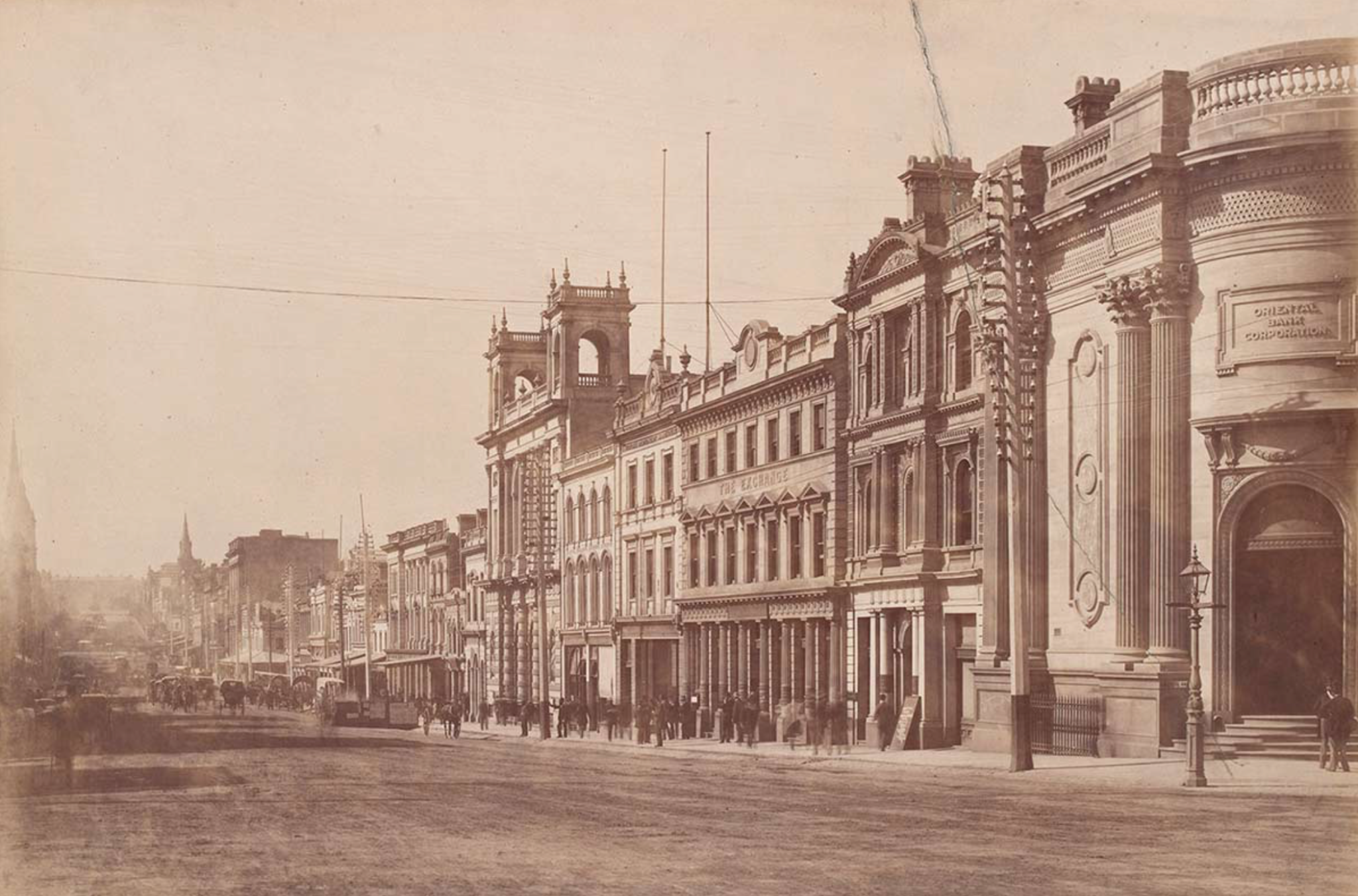
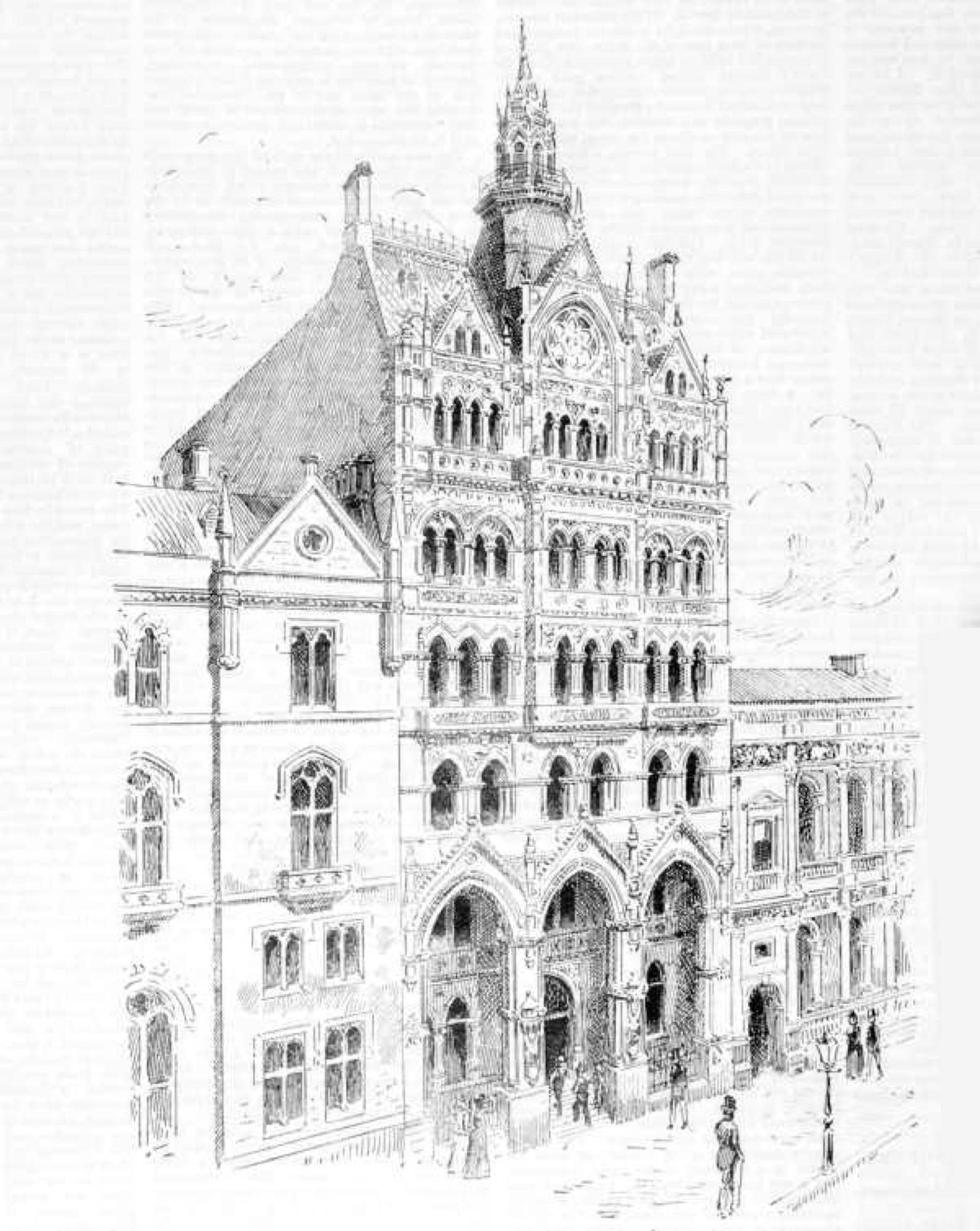
The Melbourne Stock Exchange building at 376–380 Collins Street stands as one of the finest Gothic Revival commercial structures in Australia, designed by the prolific architect William Pitt (1855–1918) and constructed between 1888 and 1891. Pitt, whom the Australian Dictionary of Biography describes as “a sensitive draftsman and a competent gothicist,” won the design commission through an architectural competition in 1888, at the height of the speculative land boom that had earned the city the sobriquet “Marvellous Melbourne.” The five-storey façade features a three-bay portico with arched and colonnaded openings in elaborately carved sandstone, ornamented with gargoyles, heraldic beasts, pointed tracery, and groupings of narrow Gothic-shaped windows characteristic of Pitt’s signature style, as documented in the Victorian Heritage Database Report (Heritage Council Victoria, VHR H0034). A magnificent rose window crowns the composition, and a slender spire once punctuated the skyline. The ground floor houses the celebrated “Cathedral Room,” a vaulted trading hall approximately twenty metres by fifteen metres, entered through deep pointed-arch doorways adorned with bas-relief sculpture. Six monumental Harcourt granite columns, each weighing between sixteen and twenty tonnes and transported from Bendigo by teams of thirty horses, support capitals of white Tasmanian marble beneath the ribbed vault. In 1890 Pitt added the companion Safe Deposit Building around the corner on Queen Street, the first such facility in Australia, its vault containing three thousand safes behind metre-thick walls and a strong room of nearly two hundred tonnes of “un-drillable steel.” The Stock Exchange sold the Collins Street building in 1921 to the English, Scottish and Australian Bank, subsequently relocating to 422 Little Collins Street (1924), then 351 Collins Street (1968), and finally 530 Collins Street (1992). In 1923 the adjacent banking chamber designed by William Wardell was expanded into the former exchange space, integrating the complex. ANZ Bank committed over twenty million pounds in 1989 to a comprehensive restoration of the Gothic Bank precinct, including the former Stock Exchange and Safe Deposit buildings, and the Cathedral Room now serves as a heritage event space and part of the ANZ Banking Museum. The building is listed on the Victorian Heritage Register and classified by the National Trust of Australia (Victoria) at the state level of significance.
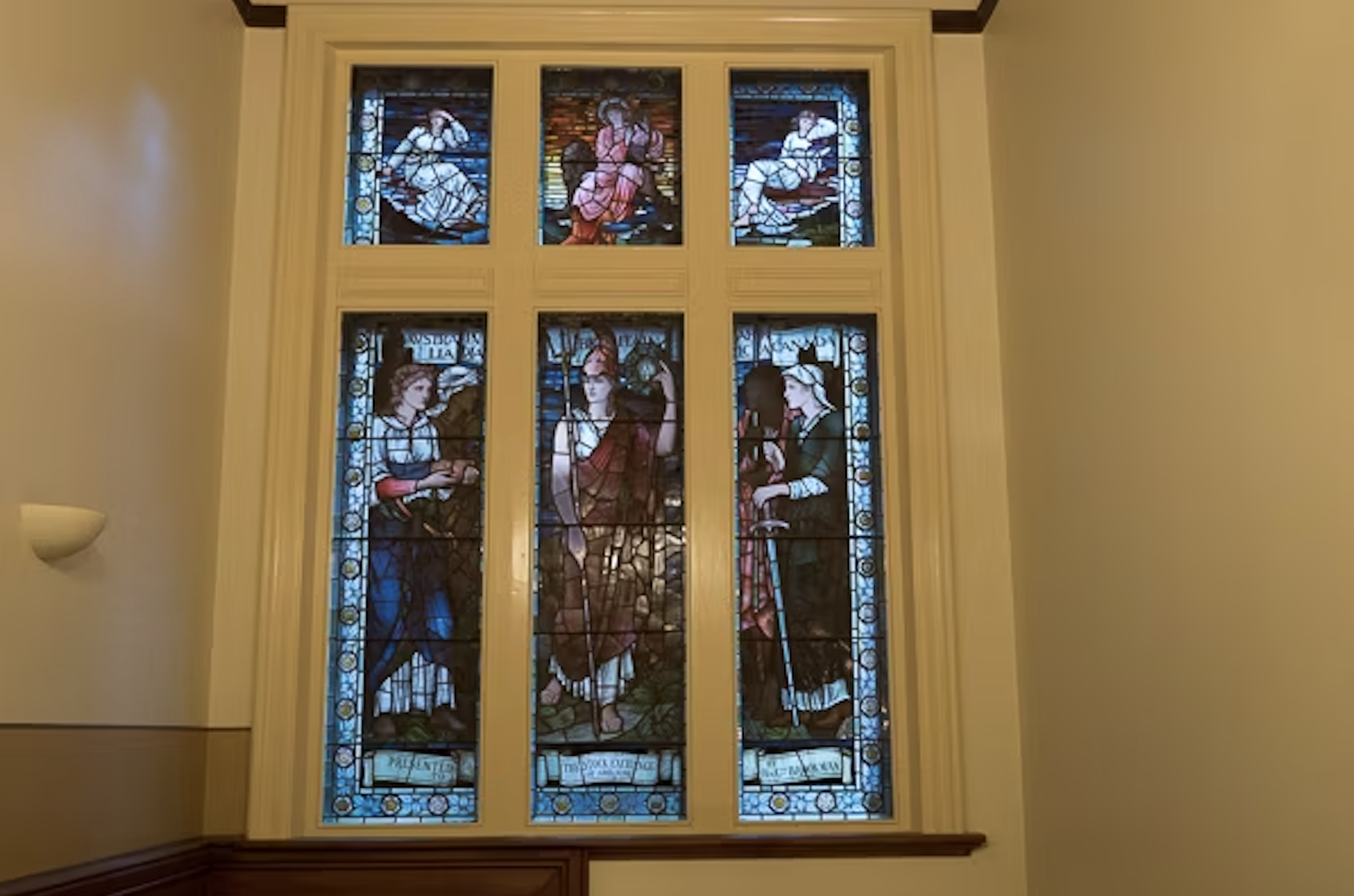
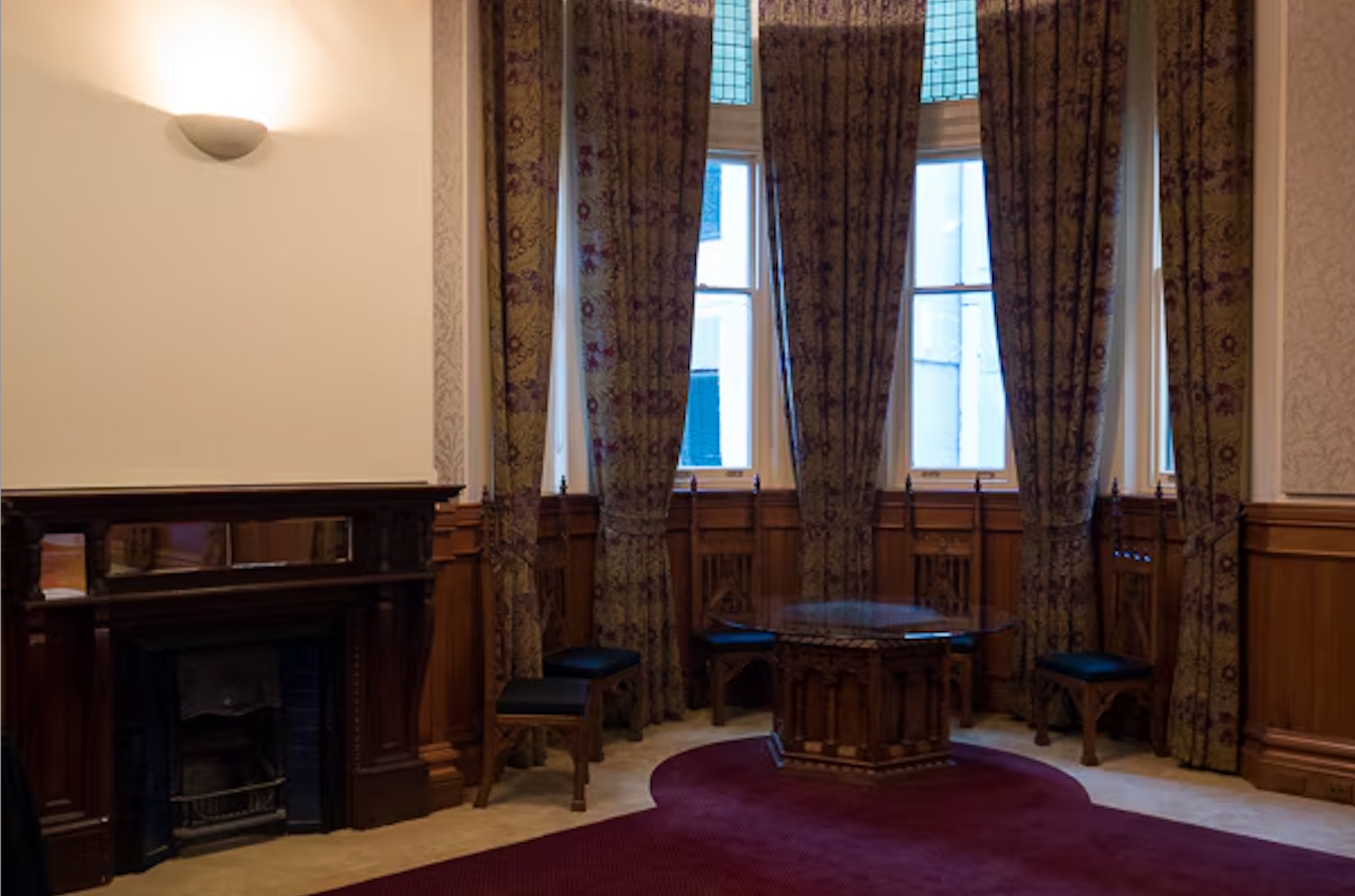
The decorative programme of the Melbourne Stock Exchange building constitutes one of the most elaborate ensembles of applied art in any Australian commercial interior. The façade’s carved sandstone displays a rich vocabulary of Gothic ornament—gargoyles projecting from the upper storeys, heraldic beasts flanking the entrance bays, foliate capitals, crocketed pinnacles, and intricate tracery surrounding each tier of pointed windows. The Victorian Heritage Database notes the “decorative detail and heraldic beasts and other carvings” that give the exterior its distinctive character (Heritage Council Victoria, Place No. 71947). Inside, the Cathedral Room’s vaulted ceiling rises above walls lined with decorative stonework, and the polished Harcourt granite columns with their white Tasmanian marble capitals create a dramatic interplay of dark and light stone. The floor, though not original, was reconstructed during the 1989 ANZ restoration based on the building’s original tile patterns and colour schemes. The centrepiece of the interior decorative programme is a magnificent stained-glass window executed by Ferguson and Urie, Melbourne’s pre-eminent nineteenth-century glass studio, whom the Encyclopedia of Melbourne identifies as “the most successful 19th-century Australian stained-glass window-makers” (eMelbourne, “Stained Glass” entry). Installed in 1893—on the eve of the devastating banking crisis—this was the firm’s last major commission before the deaths of partners James Urie (1890) and James Ferguson (1894) led to the studio’s decline. The window’s allegorical programme depicts at its apex a miner “panning off,” representing the origins of Victorian wealth in the goldfields; the central figure is a woman personifying Labour; and the surrounding panels display the coats of arms of Britain and Australia alongside symbols of the four quarters of the globe, a visual assertion of Melbourne’s place in imperial and global commerce. Additional decorative stained glass fills the pointed Gothic windows throughout the building, filtering light through the deep sandstone reveals. The entrance features spectacular wrought-iron gates, and bas-relief sculptural panels frame the pointed-arch doorways of the Cathedral Room, as documented in the University of Western Australia’s Medievalism in Australian Cultural Memory project (Shane McLeod, digital photograph, 2013). Together, these elements express the aspirations of a colonial exchange that sought to rival the grandeur of European financial institutions through the appropriation of medieval ecclesiastical aesthetics for commercial purposes.
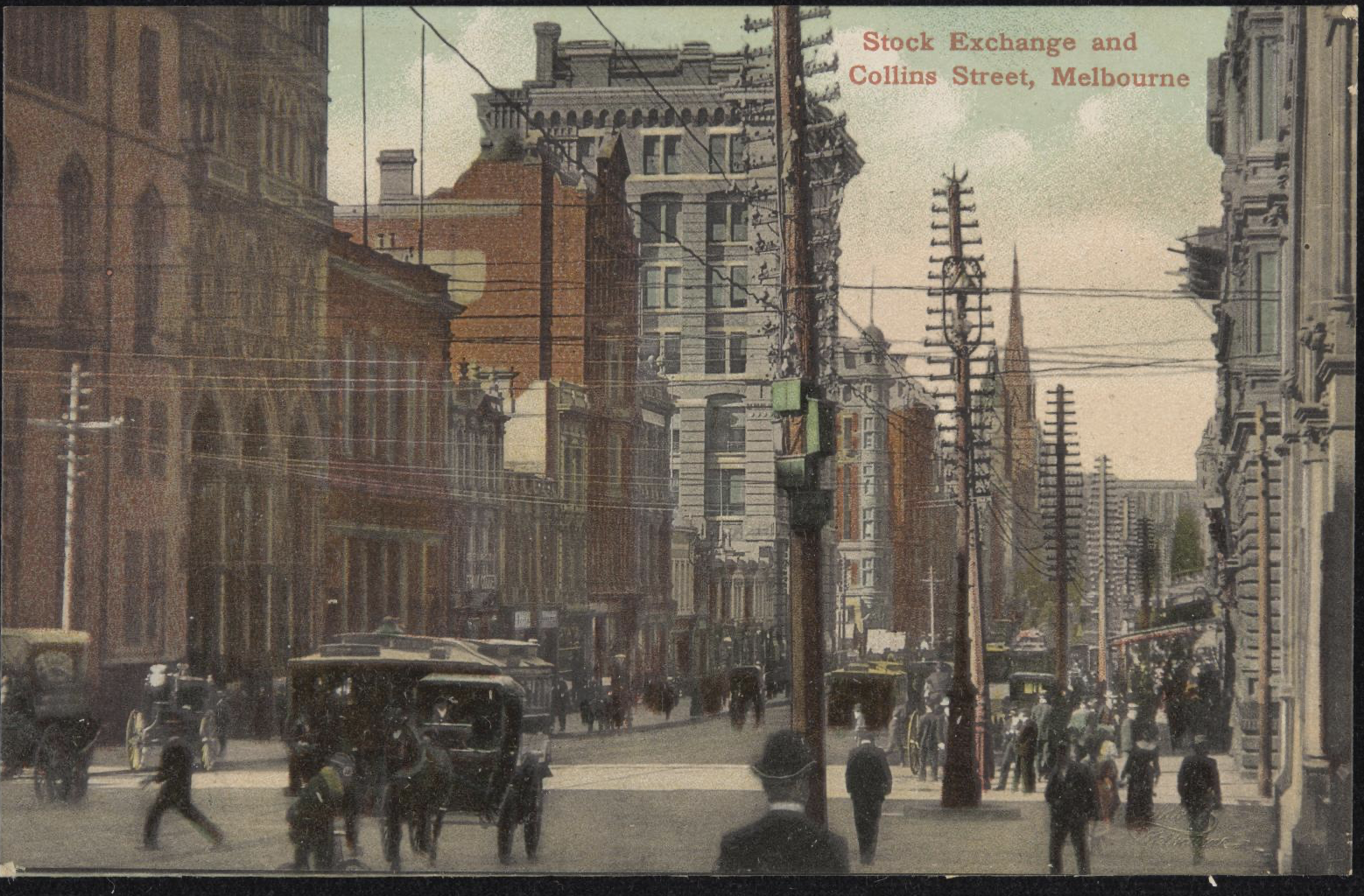
The Melbourne Stock Exchange occupied a pivotal position in the western end of Collins Street, the district that by the 1880s had become, in Graeme Davison’s phrase, the epicentre of “Marvellous Melbourne”—a city whose offices and warehouses were “leaping skyward” and whose commerce reached across the continent (Davison, The Rise and Fall of Marvellous Melbourne, Melbourne University Press, 1978). The blocks between Elizabeth and Queen streets had been “firmly established as the city’s financial centre” since at least 1855, when the Hall of Commerce was erected as a precursor to the exchange (eMelbourne, “Collins Street” entry). Banks, insurance companies, auction rooms, and merchant houses clustered along this stretch, creating what contemporaries called the “money end” of Collins Street—in contrast to the fashionable “Paris End” further east. The Stock Exchange building at 376–380 Collins Street stood alongside William Wardell’s English, Scottish and Australian Bank (the “Gothic Bank,” 1883)—described by Heritage Victoria as “the finest sectarian gothic revival building in Victoria”—on the northeast corner of Queen Street, forming a concentrated precinct of High Victorian Gothic commercial architecture. Nearby stood the headquarters of the National Bank of Australasia, the Colonial Bank of Australasia, and numerous insurance offices, while the Old Treasury Building (1862) anchored the eastern end of the government precinct. The 1880s and 1890s saw Collins Street at what the Encyclopedia of Melbourne describes as its “height of splendour, full of fantastic buildings, beautiful shops, ladies wearing the latest fashions, artists and musicians creating a cultural life unseen elsewhere, and, of course, plenty of money being made in the banks and at the stock exchange.” The devastating crash of 1893—when fifteen of twenty-eight Australian banks suspended operations within weeks—emptied many of these grand buildings and cast a pall over the precinct for years. Yet the physical fabric survived, and the western Collins Street financial quarter evolved continuously through the twentieth century. Today, most global financial institutions with a Melbourne presence, including Goldman Sachs and Lazard, maintain offices on Collins Street, perpetuating the district’s identity as Australia’s premier financial address, while the former exchange building endures as a heritage landmark within the ANZ Gothic Bank complex.
The institutional history of the Melbourne Stock Exchange is inseparable from the economic transformation wrought by Victoria’s gold rush. As A. R. Hall documents in The Stock Exchange of Melbourne and the Victorian Economy, 1852–1900 (Australian National University Press, 1968), gold discoveries at Ballarat and Bendigo in 1851 triggered explosive growth: Victoria’s population surged from 80,000 to 540,000 within a decade, and Melbourne briefly surpassed Chicago in size. Edward Khull, describing himself as a “Stock and Share Broker,” published Melbourne’s first stock and share list in the Argus on 18 October 1852, comprising fourteen companies—five banks, three railway companies, and assorted enterprises. The Melbourne Brokers’ Association formed in 1859 and traded from rented premises in the Hall of Commerce on Collins Street, constituting what the National Museum of Australia identifies as the nation’s first stock exchange. Increasing activity in gold-mining shares led to the association’s reorganisation in 1865, and by 1870 some 118 mining companies were listed. The introduction of “no liability” shares under Victoria’s Mining Companies Act 1871—a radical innovation in Anglophone company law, as detailed by Simon Ville and David Merrett in Business History (2023)—freed investors from obligation to meet further calls on unprofitable mines, dramatically boosting speculative trading. The formal Stock Exchange of Melbourne was constituted in 1884, inheriting the accumulated practices of its precursors, and in 1891 moved into William Pitt’s purpose-built Gothic Revival headquarters at 380 Collins Street. The 1880s land boom, fuelled by British capital, had inflated property values across Melbourne; annual returns on land reached 40 per cent, and average prices per acre rose from £39 in 1882 to £303 by 1888. The collapse came swiftly: the land boom burst in 1891, the Commercial Bank of Australia closed its doors on 5 April 1893, and within weeks fifteen of twenty-eight banks had suspended operations in what the Reserve Bank of Australia describes as “the most severe” financial crisis in Australian history. The exchange weathered the depression partly by shifting toward government securities and the shares of the Broken Hill mines. Through the twentieth century the exchange modernised steadily—adopting the “post” trading system with “chalkies” recording prices on blackboards, installing computers in 1968—before federal regulation ended self-governance in 1981. On 1 April 1987 the Melbourne Stock Exchange merged with exchanges in Sydney, Brisbane, Adelaide, Hobart, and Perth to form the Australian Stock Exchange (ASX), ending 126 years of independent operation. The ASX demutualised in 1996 and merged with the Sydney Futures Exchange in 2006, becoming the Australian Securities Exchange.
Throughout the greater part of the period 1852–1900, as A. R. Hall observes, “the predominant business of the share market was in mining securities” (The Stock Exchange of Melbourne and the Victorian Economy, ANU Press, 1968). Gold-mining shares dominated the earliest lists: in 1865 there were 133 mining companies on the exchange, and by 1870 the number remained above 118 even as alluvial yields declined. The introduction of no-liability shares under the Mining Companies Act 1871 transformed the market’s character, encouraging speculative participation by investors who could abandon unprofitable positions without meeting further calls—a form of company unique to Australasia, as the Corporations Act 2001 still recognises. Silver and lead mining at Broken Hill provided the exchange’s next great stimulus: the Broken Hill Proprietary Company Limited (BHP) was incorporated on 13 August 1885 and floated on the Melbourne exchange with its headquarters in the city. BHP’s first consignment of 48 tonnes of ore yielded 35,605 ounces of silver worth nearly £7,500, and the company’s shares rose sharply, inaugurating what would become one of the world’s largest mining conglomerates. Copper in Tasmania and gold in Western Australia further diversified the mining portfolio through the 1890s. Beyond extractive industries, the exchange listed banks, insurance companies, gas utilities, railway companies, and pastoral enterprises—reflecting Australia’s pastoral-agricultural base alongside its mineral wealth. Government bonds and debentures also traded, particularly after the 1893 crisis redirected capital toward safer instruments. The land-boom era of the 1880s brought a flood of speculative property and building company scrip: buyers and sellers of shares in upstart land banks and mortgage companies jostled for space on the exchange floor, as documented by Graeme Davison in The Rise and Fall of Marvellous Melbourne (1978). After Federation in 1901, industrial listings expanded to include manufacturing, brewing, and retail companies. The formation of the Australian Associated Stock Exchanges in 1937 facilitated cross-listing among the six state exchanges. By the time the Melbourne Stock Exchange merged into the ASX in 1987, trading had evolved from open-outcry gold-share auctions into an electronically assisted market of diversified equities, government and corporate bonds, and derivative instruments—culminating in the ASX’s introduction of the Stock Exchange Automated Trading System (SEATS) in October 1987.