Fairs of Medina del Campo (Ferias generales del reino de Castilla)
Medina del Campo, Spain · Established Early 15th century; declared "General Fairs of the Kingdom" c. 1491
This site requires authorization to access.
To request access, contact
william.goetzmann@yale.edu
The Fairs of Medina del Campo had no single exchange building; instead they animated the town's vast arcaded Plaza Mayor — today the Plaza Mayor de la Hispanidad — a rectangular porticoed square that served as a model for the later Plaza Mayor of Valladolid and which, under the Ordenanzas de Feriantes, allotted a fixed space to each guild and nation of traders (spain.info; en.wikipedia.org/wiki/Medina_del_Campo). The most significant purpose-built structure to survive from the fair's apogee is the Reales Carnicerías, the royal meat market authorised by the Catholic Monarchs in 1500 and finally completed in 1562 under Philip II to a design attributed to the great Spanish architect Rodrigo Gil de Hontañón. Built of brick and limestone on a rectangular plan, it is divided into three naves by arcades carried on Tuscan stone columns, with three monumental round-arched doorways framed by pilasters and crowned by triangular pediments bearing the royal arms of Philip II; it is reputedly the only historic building of its type still in use for its original purpose (es.wikipedia.org; spain.info). The financial heart of the fairs lay along the Calle de Padilla, the bankers' and jewellers' street where money-changers (cambistas) kept their tables.
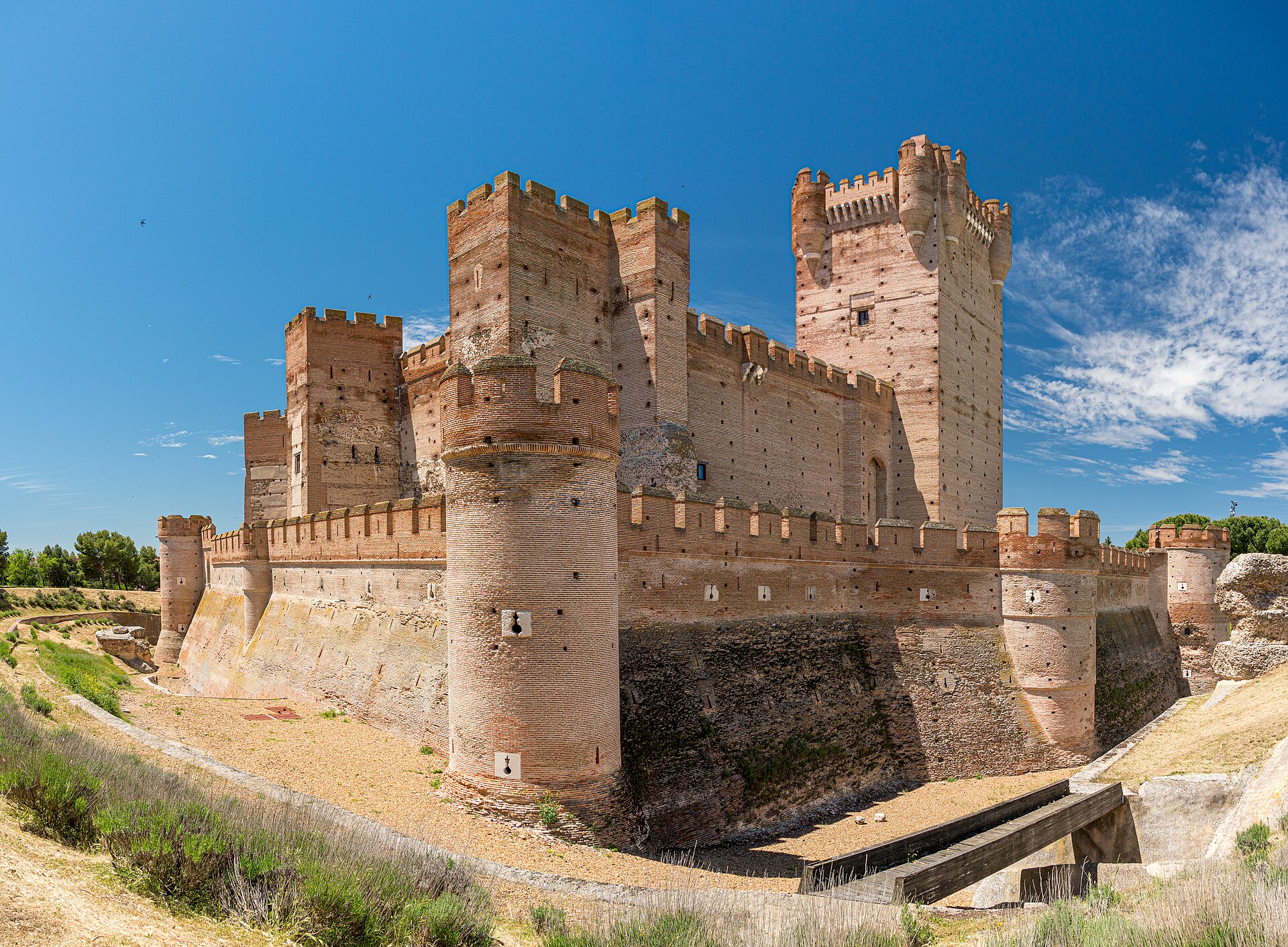
As a fair rather than a single monument, Medina del Campo's artistic legacy is dispersed across the surviving fabric of the historic core. The Reales Carnicerías displays the heraldic sculpture of Philip II's royal arms over its pedimented portals and the restrained Renaissance ornament — with Mudéjar inflections in its brickwork and cornices — characteristic of Rodrigo Gil de Hontañón's circle (es.wikipedia.org). The memory and material culture of the fairs are now gathered in the Museo de las Ferias, which conserves and exhibits the Simón Ruiz Archive: some 23,000 original bills of exchange drawn between 1553 and 1606 across forty-five European financial centres, together with merchants' ledgers and correspondence — a documentary corpus inscribed on UNESCO's Memory of the World register (unesco.org; paperinmotion.org). The square itself remains overlooked by the redbrick Castillo de la Mota, whose nearly forty-metre keep is one of Castile's most recognisable late-medieval fortresses.
Medina del Campo lies in the province of Valladolid on the Castilian meseta, at roughly 41.31°N, 4.91°W, astride the routes that linked the wool-producing interior, the Cantabrian ports of Burgos's consulado, and the fairs of Lyon, Antwerp and Besançon. The town was laid out around its great Plaza Mayor, from which the fairs radiated: international dealers — Castilian, Portuguese, Italian and Flemish, with French, English and German merchants besides — lodged and traded according to the lodging ordinances, while the money-changers clustered on the Calle de Padilla and mass for the assembled traders was celebrated at the Chapel of the Virgen del Pópolo (en.wikipedia.org/wiki/Medina_del_Campo). The whole ensemble was dominated by the Castillo de la Mota, a royal fortress of the Catholic Monarchs that served both as a defensive stronghold and, at times, as a state prison and treasury, a visible reminder that the fairs were instruments of Crown finance as much as of private commerce.
Medina del Campo's fairs grew through the fifteenth century into the premier commercial gathering of Castile, and around 1491 they were granted the status of 'General Fairs of the Kingdom' (ferias generales del reino), two annual fairs of fifty days each (the feria de mayo and the feria de octubre) that increasingly functioned as payment fairs — ferias de pagos — where bills of exchange were cleared and the Crown's asiento loans settled (en.wikipedia.org/wiki/Medina_del_Campo; Marcos Martín, academia.edu). At their sixteenth-century height the fairs were a key node of the European credit network, linking Genoese, Flemish and Castilian bankers; the archetypal figure is Simón Ruiz (c. 1525–1597), who settled at Medina around 1550 as a cloth merchant trading with Nantes and Brittany before moving into high finance and lending to Philip II, endowing in his last years the General Hospital of the Immaculate Conception (paperinmotion.org). The Crown's repeated bankruptcies — above all the suspensions of payments and the financial crisis of 1575–1577 — fatally disrupted the payment fairs, and over the seventeenth and eighteenth centuries Medina del Campo declined into a market town, its fairs eclipsed by the rise of permanent bourses elsewhere in Europe (academia.edu; en.wikipedia.org/wiki/Medina_del_Campo).
The fairs handled an enormous variety of goods — Castilian and imported wool, textiles, hardware, spices, leather and the printed books for which Medina was a notable market — but their defining business was financial. As payment fairs they specialised in credits and loans, currency exchange, and above all the acceptance, compensation and settlement of bills of exchange (letras de cambio) drawn on and payable at the principal financial centres of Europe, allowing international payments to be cleared by offsetting paper rather than by the physical transport of coin (en.wikipedia.org/wiki/Medina_del_Campo; paperinmotion.org). Money-changers of Medina, Valladolid, Burgos and Segovia acted as the intermediaries who advanced credit and discounted paper, while the Crown used the fairs to raise and service its asiento loans from Genoese and other bankers — making Medina del Campo, in its sixteenth-century prime, one of the great clearing-houses of early-modern European finance (unesco.org).
Images will be added as the project develops. Photographs by Larry Ng and from research sources.