Palais de la Bourse
Marseille, France · Established 1860
This site requires authorization to access.
To request access, contact
william.goetzmann@yale.edu
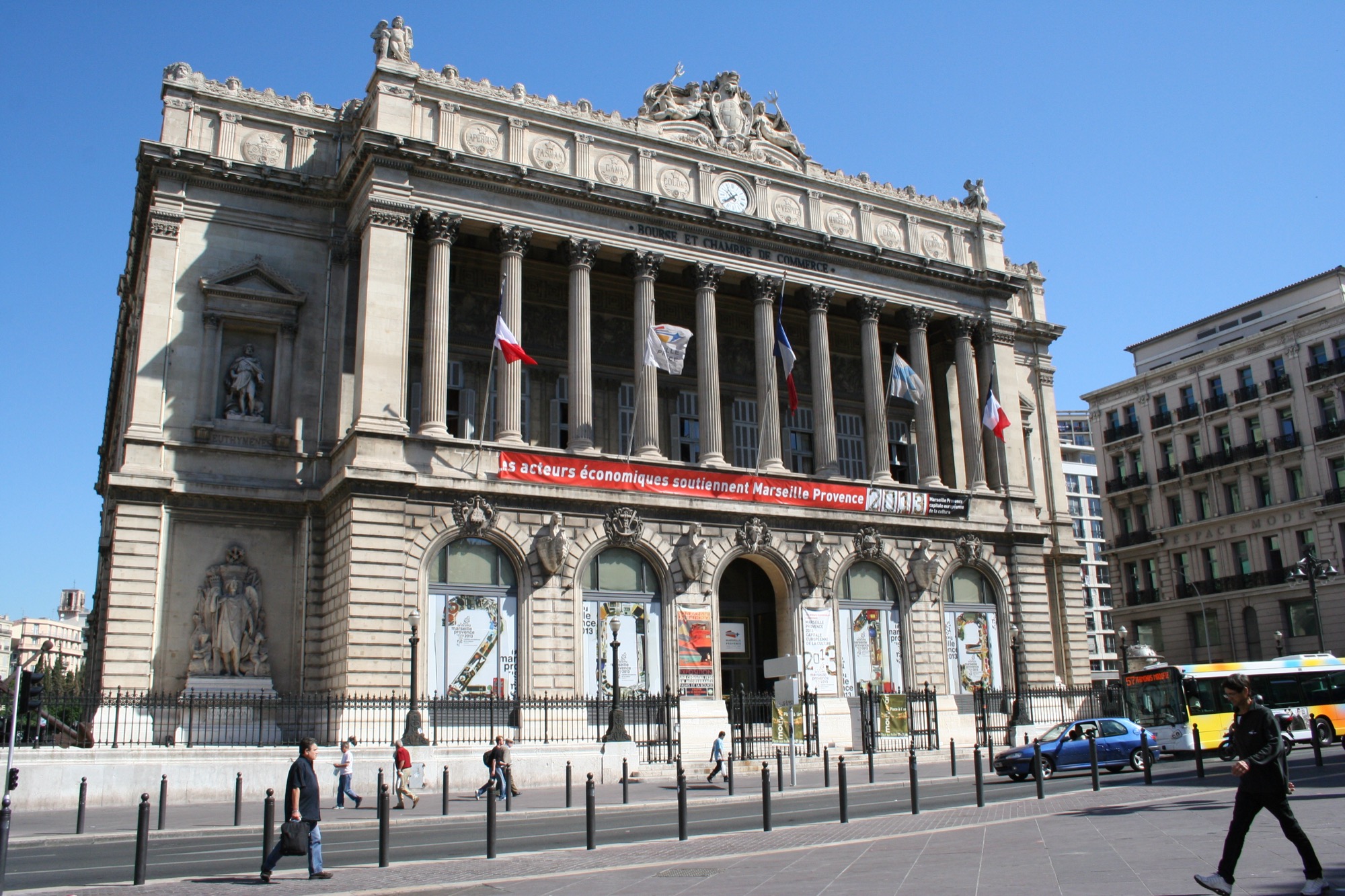
The Palais de la Bourse de Marseille stands as one of the most accomplished expressions of Second Empire civic architecture in France. Designed by Pascal-Xavier Coste (1787–1879), who had served as chief architect to the Ottoman Viceroy Muhammad Ali in Egypt before gaining the post of chief architect of Marseille in 1844, the building was conceived as the permanent seat of the Chambre de Commerce de Marseille. As Isabelle Music demonstrates in her study “De la critique du projet architectural à sa réalisation” (Livraisons d’histoire de l’architecture, 2014), the project underwent extensive review by the Conseil des Bâtiments Civils. The foundation stone was laid on September 26, 1852, and construction proceeded until the building’s inauguration by Napoleon III and Empress Eugénie on September 10, 1860, at a total cost of 8,300,000 francs. Coste, working alongside collaborator Joseph Ferrié, employed a basilica-plan layout measuring 47 meters wide, 68 meters deep, and over 25 meters in height. The main facade presents a rusticated ground level pierced by five arcades, surmounted by a Corinthian colonnade forming an open gallery at the noble story. The grand trading hall—the corbeille—measured approximately 1,120 square meters, surpassing even the Paris exchange in floor area. Coste introduced iron-truss construction and zinc roofing, making the Palais the first building in Marseille to employ iron frameworks. Exterior stone was carefully selected: Cassis limestone for the structural base, fine-grained Calissanne stone for the facades, and hard Arles “rateau” stone for ornamental details, with interior marbles sourced from Carrara, Spain, and Algeria.
The decorative program of the Palais de la Bourse represents one of the richest ensembles of Second Empire architectural sculpture in provincial France. Coste and Ferrié selected three Grand Prix de Rome laureates for the principal sculptural commissions. Auguste Ottin (1811–1890) carved marble statues of France and Marseille sheltered within niches inside the main portico, along with monumental statues of the ancient Phocaean navigators Pytheas and Euthymenes on the rear facades. Eugène Guillaume (1822–1905) executed two exceptional stone bas-reliefs on the lateral sections representing the allegorical geniuses of Navigation and Commerce, while the five arcade keystones bear ornamental attributes of Industry, the Marine, Astronomy, Agriculture, and Commerce. Armand Toussaint contributed a twenty-seven-meter-long Renaissance-style frieze above nine pilaster-framed windows behind the colonnade. Inside, the trading hall arcade opens through eighteen archways, each 3.5 meters wide, with floors of black and white marble and thirty-six circular cartouches representing global commercial zones. The ceiling decoration of the grand hall was entrusted in 1866 to Dominique-Antoine Magaud (1817–1899), later director of the École des Beaux-Arts de Marseille, who painted “L’Apothéose des grands hommes de la Provence,” considered among his finest monumental works. The grand staircase, executed by the Marseille marble artisan Jules Cantini at a cost of 26,824 francs, features gray marble balustrades and red-and-yellow veined marble landings. Tragically, German artillery bombardment in August 1944 destroyed Magaud’s ceiling frescoes; the original lanterneau was replaced by a glass cupola, and the ceiling was repainted solid rose.
The Palais de la Bourse commands the head of La Canebière, Marseille’s grand commercial boulevard, where it terminates at the Quai des Belges and the ancient Vieux-Port. As the historian Alessi Dell’Umbria argues in “The Sinking of Marseille” (New Left Review, 2012), the Second Empire transformed the city’s urban fabric through Haussmann-inspired interventions: popular quarters were razed, and new boulevards—financed, as in Paris, by the Péreire Brothers—sliced through the medieval street grid. The Canebière’s present appearance dates essentially to this mid-nineteenth-century campaign, when the center of financial and commercial activity shifted southward from the Vieux-Port. The Palais de la Bourse anchored this transformation. Simultaneously, the saturated Vieux-Port was supplemented by the construction of the new Joliette basin, authorized by a national law of August 5, 1844, at a cost of thirteen million francs. Between 1858 and 1864, engineer Gustave Desplaces built the immense Docks de Marseille—monumental stone-faced warehouses stretching 365 meters—to handle the flood of colonial imports. The Rue Impériale (now Rue de la République), a twenty-five-meter-wide boulevard more than a kilometer long, was driven through the Carmes and Moulin hills, demolishing nearly a thousand houses and displacing 16,000 residents to connect the old port to La Joliette. The Palais de la Bourse thus stood at the pivot between old Marseille—the Greek-founded Lacydon harbor—and the modern industrial port that made the city France’s premier Mediterranean gateway to North Africa, the Levant, and the colonial empire beyond.
Marseille’s commercial heritage extends to the founding of Massalia around 600 BC by Phocaean Greek colonists from the Aegean coast of Asia Minor. The modern institutional foundation was laid on August 5, 1599, when the General Council of the City of Marseille elected four deputies charged with defending maritime commerce against Mediterranean piracy—a body confirmed by letters patent of Henry IV on April 15, 1600. As the comprehensive Histoire du commerce de Marseille published by the Chambre de Commerce documents, this was the first chamber of commerce in the world, and indeed the Marseillais institution invented the very term “chambre de commerce.” Junko Takeda, in Between Crown and Commerce: Marseille and the Early Modern Mediterranean (Johns Hopkins University Press, 2011), demonstrates how the commercial elite forged a civic spirit reconciling republican sensibility with royal mercantilism, particularly during the Colbert era when the crown in 1669 created tariffs channeling all Levantine trade through Marseille. The Chamber operated from successive premises before Coste’s Palais provided a permanent monumental home. The building survived both world wars, though German artillery fire in August 1944 caused significant damage to the upper floors and destroyed Magaud’s ceiling paintings. The Chamber of Commerce continued to occupy the Palais, which also housed the Musée de la Marine et de l’Économie from 1929 until 2018, when collections were transferred to the Mucem and city reserves. A major restoration in 2010 employed micro-gommage cleaning techniques to return the facades to their original golden luster.
The commodities flowing through the Marseille exchange reflected the city’s position as France’s principal gateway to the Mediterranean, the Levant, and the colonial empire. As Silvia Marzagalli documents in her studies of eighteenth-century maritime trade networks, colonial products came to dominate Marseille’s re-export trade: sugar and coffee from the Antilles accounted for 28 percent of Levantine commerce in 1750–1754, rising to fully 50 percent by 1785–1789. Annual coffee imports from Martinique alone reached fourteen million pounds by 1785. Xavier Daumalin, in Marseille et l’Ouest africain: L’outre-mer des industriels, 1841–1956 (Chambre de Commerce et d’Industrie Marseille-Provence, 1992), traces how nineteenth-century merchants broke the Hamburg monopoly in West African trade, connecting Marseille to routes spanning Saint-Louis, Zanzibar, and the Philippines. Textiles dominated the export ledger, constituting 68 percent of outbound cargoes by the late eighteenth century, while imports included raw cotton, silk, olive oil, tobacco, hides, and angora and cashmere wools essential to French manufacturing. The Savon de Marseille industry, regulated since Colbert’s edict of 1688 requiring 72 percent olive oil content, consumed vast quantities of oil and by the nineteenth century incorporated palm and peanut oils from Africa, with nearly ninety soap factories operating in the city and production peaking at 180,000 tonnes in 1913. Greek merchant families such as the Zafiropulo brokered Russian wheat shipments from the Black Sea and Danube to Marseille. Maritime insurance, shipping contracts, and bills of exchange were negotiated in the trading hall, where the thirty-six cartouches on the walls marked the global commercial zones with which Marseille’s merchants conducted business.
Images will be added as the project develops. Photographs by Larry Ng and from research sources.