Marseille Palais de la Bourse
Marseille, France · Established 1860s
This site requires authorization to access.
To request access, contact
william.goetzmann@yale.edu
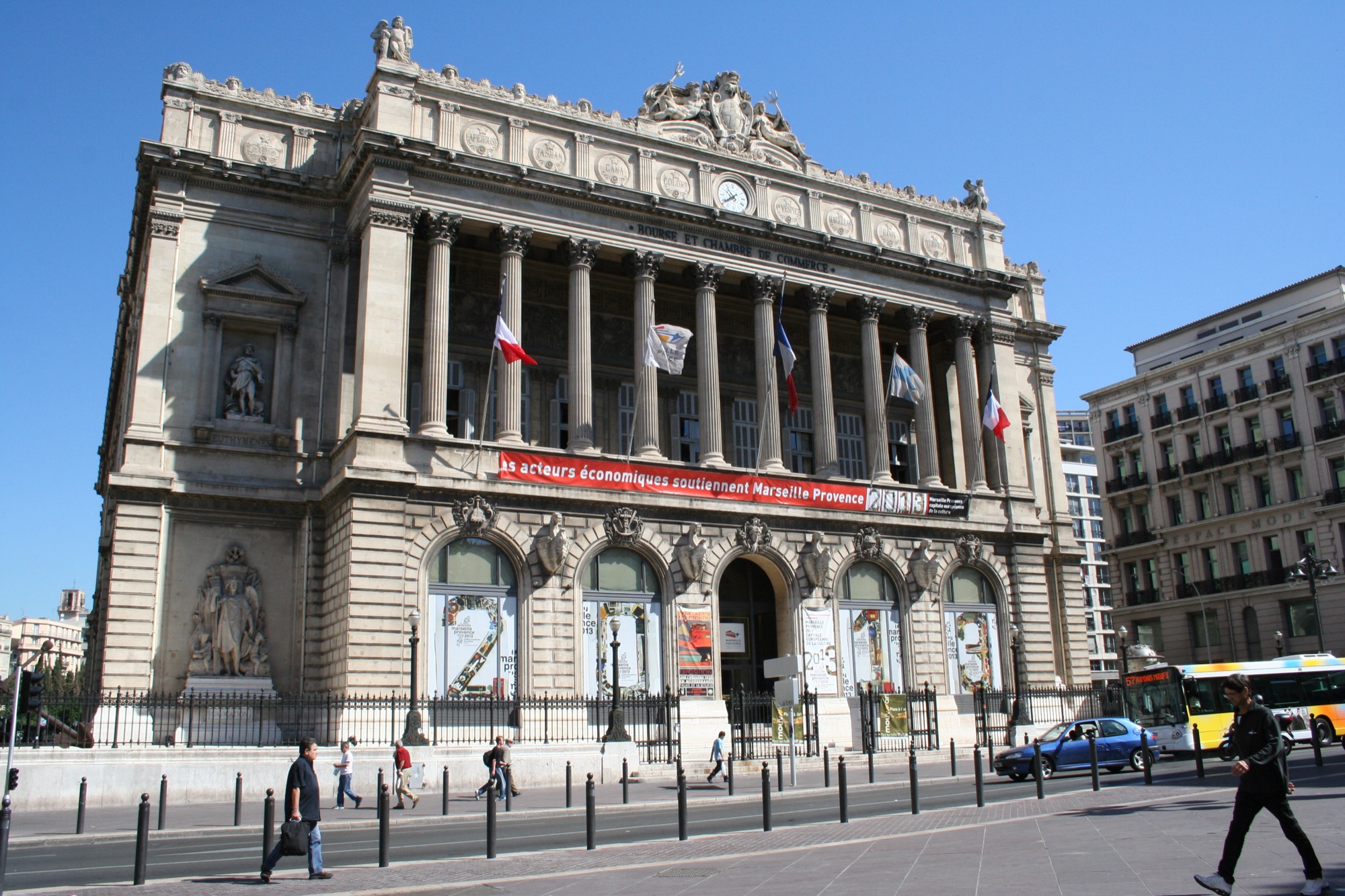
The Palais de la Bourse in Marseille, designed by Pascal-Xavier Coste (1787–1879) and completed in 1860, stands as the first monumental building erected under France’s Second Empire. Coste, who had served as personal architect to Muhammad Ali Pasha of Egypt and later published the celebrated Architecture arabe (Firmin-Didot, 1837), brought an unusual cosmopolitan sensibility to the commission. Appointed Marseille’s chief architect in 1844 after his journeys through Iran documented in Voyage en Perse (Gide & Baudry, 1843–51), he was tasked by Chamber of Commerce president M. Luce in 1846 with designing a bourse equal to the city’s commercial ambitions. As Isabelle Music’s study in Livraisons de l’histoire de l’architecture demonstrates, the project underwent rigorous review by the Conseil des Bâtiments Civils between 1842 and 1851, with inspectors Caristie and Leclère demanding monumental distinction from mere private architecture. Construction began in September 1852 on difficult clay soils and required three successive loans totaling four million francs. The rectangular plan—forty-seven meters wide, sixty-eight meters deep, and thirty meters tall—features a rusticated ground floor with five arched bays bearing naval ornaments and a noble story articulated by a Corinthian colonnade. Coste adopted what he called “the Renaissance style… most sympathetic to our customs and national character,” drawing on Bramante’s civic vocabulary. The centerpiece is the great covered trading hall, or corbeille, spanning 1,120 square meters under an iron framework manufactured by the Roussel workshops at Batignolles and clad in zinc—larger than the comparable hall of the Paris Bourse at 1,020 square meters. Napoleon III inaugurated the completed building on September 10, 1860, accompanied by Empress Eugénie, marking it a monument to Second Empire architectural ambition.
The decorative program of the Palais de la Bourse constitutes one of the most ambitious sculptural ensembles on any French commercial building, executed by three winners of the Grand Prix de Rome: Eugène Guillaume (1822–1905), Auguste Ottin (1811–1890), and Armand Toussaint (1806–1862). Guillaume carved the allegorical groups of Commerce and Navigation flanking the principal entrance, embodying Marseille’s twin mercantile and maritime vocations. Above them, in lateral niches framed by pilasters and triangular pediments, Ottin’s full-length statues of the Phocaean navigators Euthymenes and Pytheas invoke the city’s ancient Greek founding as Massalia. Crowning the attic, Toussaint’s monumental group depicts the Atlantic and Mediterranean united around Marseille’s coat of arms, while his twenty-seven-meter-long frieze across the façade portrays Marseille in majesty receiving peoples and products from the Strait of Gibraltar and the Isthmus of Suez. Inside the corbeille, ten relief panels sculpted by François-Ambroise-Germain Gilbert (1816–1891), a student of Jean-Pierre Cortot who debuted at the Paris Salon in 1845, encircle the cupola with episodes from Marseille’s commercial history: the foundation of Massalia, the departure of the Crusades, Provence’s union with France, the establishment of consulates and scientific expeditions, the conquest of Algeria, and France receiving trophies from the Crimean and Italian campaigns. The floor of the great hall is paved in polychrome marble, and eighteen arcades frame the interior space. The overall iconographic scheme, as the Structurae architectural database records, transforms the trading floor into a narrative theater linking antiquity to empire, trade to civilization—a visual argument that Mediterranean commerce was the engine of French grandeur.
The Palais de la Bourse commands a pivotal site at the head of the Canebière, Marseille’s principal commercial artery whose very name—from the Provençal canebiera, meaning hemp field—records the medieval rope-making industry that once served the port. As Marcel Roncayolo’s classic study Marseille (Editions Parentheses) establishes, the Canebière was extended to the Vieux-Port in 1785 following demolition of the royal arsenal, and in 1861 the narrow rue Noailles was widened from eight to thirty meters to create the unbroken boulevard leading to the Bourse. The building faces the Place de la République, the former royal square, and its inauguration by Napoleon III in 1860 coincided with the emperor’s authorization of the great Haussmannian thoroughfare—the rue de la République—connecting the Old Port to the newly constructed basins at La Joliette. This infrastructure transformed the surrounding district into a nexus of maritime offices, banking houses, shipping agencies, and cafés where merchants gathered. As the Britannica article on Marseille notes, the Second Empire was responsible for new thoroughfares, elegant buildings, and an entirely new port complex. By the 1860s, up to 18,000 merchant vessels docked annually at the Vieux-Port, and the Bourse’s porticoes—designed so that brokers could conduct business in the open air as was customary—served as an intermediate zone between the enclosed trading hall and the bustling quayside. The more prosperous middle-class quartiers expanded southward along the rue Paradis and the avenue du Prado, but the Canebière axis anchored by the Bourse remained the symbolic center of Marseille’s identity as a global port city well into the twentieth century.
Marseille’s institutional commercial life predates the Palais de la Bourse by more than two centuries. The Chambre de Commerce de Marseille, founded in 1599 with four deputies charged with defending the interests of trade and the port, is the oldest chamber of commerce in France—and among the oldest in the world. As Junko Takeda documents in Between Crown and Commerce: Marseille and the Early Modern Mediterranean (Johns Hopkins University Press, 2011), the chamber was established to address declining French Mediterranean trade in the face of competition from Dutch and English merchants who had negotiated their own Ottoman commercial treaties. Throughout the seventeenth and eighteenth centuries, the chamber managed Levant trade consulates, quality controls on goods, and the port’s quarantine system. By the 1830s, the conquest of Algeria opened vast new commercial horizons: Xavier Daumalin’s studies in Presses Universitaires de Provence show that African trade through Marseille reached nearly 180,000 tonnes by 1860. The existing premises proved inadequate, and in 1834 the chamber resolved to build a new bourse commensurate with the city’s growing stature. After protracted architectural deliberation, Pascal Coste’s design was accepted and construction began in 1852, producing the first major public monument of the Second Empire. The completed Palais housed not only the trading floor but also the chamber’s administrative offices and, from 1934, the Musée de la Marine et de l’Économie, which preserved ship models, navigation instruments, and commercial archives documenting Marseille’s maritime heritage until its closure in 2018. The Palais de la Bourse was classified as a Monument Historique, ensuring the preservation of a building that physically embodies the institutional continuity of Mediterranean commerce from the age of sail to the modern era.
The Marseille Bourse served as the commercial heart of a port that handled an extraordinarily diverse range of Mediterranean, colonial, and global commodities. Grain was foundational: as scholarship on early modern Mediterranean markets shows, Marseille’s hinterland could supply barely a third of the city’s annual wheat demand, making the bourse a critical marketplace for cereals imported from Egypt, Thessaly, Thrace, and the Black Sea ports. The study by Bertilorenzi, Fumian, and Gozzini, A History of the Global Wheat Trade (Routledge, 2023), documents how Greek merchant networks—families like the Zafiropulo and Zarifi—channeled Russian and Danubian wheat through Odessa to Marseille from the 1830s onward. The conquest of Algeria after 1830 added North African grain, wine, and raw materials to the flow. Beyond cereals, the bourse handled the commodities of Marseille’s famous soap-manufacturing industry: olive oil from Provence and North Africa, soda ash, and tallow. Levantine raw cotton, silk, tobacco, hides, and wool passed through the trading hall, as did colonial sugar from the Antilles and indigo from Saint-Domingue, which, as Olivier Ferrara documents in the Western Society for French History Proceedings, became increasingly vital to Ottoman textile production via French mediation. Coffee was another major article: by the late seventeenth century, 600,000 kilograms of Egyptian coffee worth more than one million livres comprised two-thirds of French annual imports from Egypt. The opening of the Suez Canal in 1869 further amplified Marseille’s position as a gateway for Asian goods—spices, tea, rice, and silk—while the La Joliette port complex facilitated industrial-scale trade in chemicals, metals, and petroleum. The bourse’s brokers thus operated at the intersection of ancient Mediterranean grain routes and modern colonial supply chains.
Images will be added as the project develops. Photographs by Larry Ng and from research sources.