Mangalore Pepper Trade (Abraham Ben Yiju’s Factory)
Mangalore, India · Established c. 12th century CE
This site requires authorization to access.
To request access, contact
william.goetzmann@yale.edu
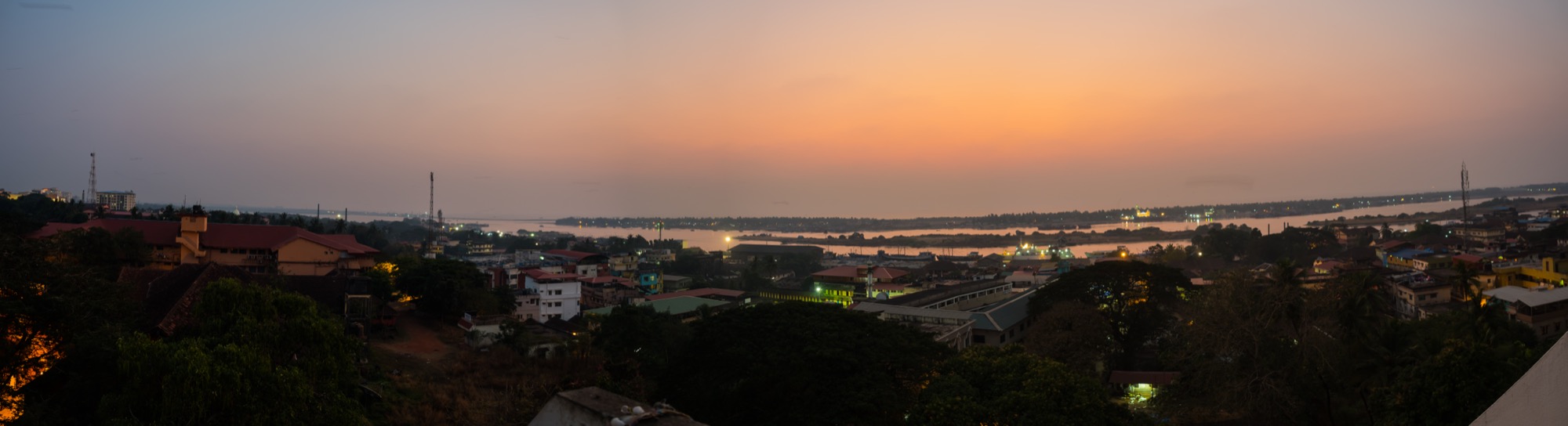
The medieval port of Mangalore — known in Arabic sources as Manjarūr and in Sanskrit texts as Maṅgalūru — served as one of the principal harbors on India’s Malabar coast during the twelfth century. The physical infrastructure of the port, as reconstructed from the Cairo Geniza documents edited by S. D. Goitein and Mordechai Friedman in India Traders of the Middle Ages: Documents from the Cairo Geniza (Brill, 2008), comprised an open roadstead harbor where oceangoing dhows anchored offshore and smaller craft ferried goods to warehouses along the riverbank. The town stood at the confluence of the Netravathi and Gurupura (Phalguni) rivers, whose estuarine channels provided sheltered mooring during the southwest monsoon. Abraham Ben Yiju, a Tunisian Jewish merchant who settled in Mangalore around 1132 CE, operated a brass factory (maṣnac) employing local Nair metalworkers — a detail preserved in his business correspondence now housed in the Taylor-Schechter Collection at Cambridge University Library. As Goitein first demonstrated in Letters of Medieval Jewish Traders (Princeton University Press, 1973), Ben Yiju’s factory produced finished brassware for export to Aden and Egypt, situating industrial production directly within the port quarter. The political setting was shaped by the Alupa dynasty, which governed the coastal strip of Tulunad from their seat at Mangalore until the late twelfth century, when Hoysala overlordship extended to the coast under Vishnuvardhana and his successors, as documented in P. Gururaja Bhat’s Studies in Tuluva History and Culture (Manipal, 1975). Archaeological remains of the medieval commercial quarter are extremely limited; successive centuries of Portuguese bombardment beginning in 1568, Hyder Ali’s fortification campaigns in the 1760s, and modern urban development have obliterated most traces of the twelfth-century harbor infrastructure.
The artistic heritage surrounding Mangalore’s medieval trading milieu is preserved in temple architecture, manuscript culture, and the material output of its metalworking industry. The Kadri Manjunath Temple, situated on a hill overlooking the port, houses a celebrated set of bronze Lokeshvara (Avalokiteshvara) images dating to the tenth and eleventh centuries that reflect the syncretic Buddhist-Hindu devotional culture of coastal Karnataka, as analyzed by K. V. Ramesh in A History of South Kanara (Karnatak University, 1970). Nearby Jain basadis, including those at Karkala and Moodabidri, preserve superb examples of late Hoysala and Vijayanagara-period stone carving and bronze casting, attesting to the metallurgical skills available in the region — the same craft traditions that Ben Yiju harnessed for his brass factory. The factory’s products themselves — brass bowls, buckets (saṭl), and locks (qufl) — are enumerated in Geniza letters translated by Goitein and Friedman in India Traders of the Middle Ages (Brill, 2008), and constitute evidence of an export art industry linking Malabar metalwork to markets across the Indian Ocean. The Geniza documents are themselves remarkable artifacts of cross-cultural exchange: written in Judeo-Arabic (Arabic in Hebrew script), they record transactions between Jewish, Hindu, and Muslim merchants in a commercial lingua franca that Amitav Ghosh evocatively described in In an Antique Land (Granta, 1992) as evidence of a “world of accommodations” that preceded the rigid boundaries of later colonial categories. The temple architecture of the wider region — particularly the thousand-pillar basadi at Moodabidri, constructed under Jain mercantile patronage — demonstrates how commercial wealth was channeled into monumental religious art throughout the medieval Malabar-Tulunad corridor.
Mangalore’s significance as a trading port derived from its precise geographical position at the juncture of maritime and terrestrial commercial networks. The town sits where the Western Ghats descend steeply to a narrow coastal plain along the Arabian Sea, creating a natural funnel through which the spice-producing hinterland — the cardamom hills and pepper forests of the Ghats — connected to oceanic trade routes. As K. N. Chaudhuri demonstrated in Trade and Civilisation in the Indian Ocean: An Economic History from the Rise of Islam to 1750 (Cambridge University Press, 1985), the entire rhythm of Malabar coast commerce was governed by the monsoon system: the southwest monsoon (June–September) brought ships from Arabia and East Africa, while the northeast monsoon (October–January) enabled return voyages. The Netravathi and Gurupura rivers provided the riverine arteries linking the interior pepper-growing tracts to the coast. Mangalore occupied a middle position among the chain of Malabar ports — north of Cannanore (Kannur) and south of the great emporia at Calicut, Cochin, and Quilon (Kollam) — each commanding its own slice of the pepper trade. Roxani Eleni Margariti, in Aden and the Indian Ocean Trade: 150 Years in the Life of a Medieval Arabian Port (University of North Carolina Press, 2007), reconstructed how Mangalore and its neighboring ports fed into the Aden hub, which served as the principal transshipment point for Indian Ocean goods destined for Egypt and the Mediterranean. The multi-religious character of the port town — Hindu Bunts and Nairs, Jain merchants, Arab Muslim traders, and the small Jewish community of which Ben Yiju was a member — reflected the cosmopolitan social structure typical of Indian Ocean port cities, what André Wink characterized in Al-Hind: The Making of the Indo-Islamic World (Brill, 1990) as the “frontier zone” of Islamicate commercial expansion into South Asia.
The history of Mangalore’s pepper trade is known primarily through the extraordinary survival of business correspondence in the Cairo Geniza — the repository of discarded documents in the Ben Ezra Synagogue in Fustat (Old Cairo) — which preserved letters exchanged between Abraham Ben Yiju in Mangalore and his commercial partners in Aden and Egypt. Ben Yiju, born in Ifriqiya (modern Tunisia), traveled via Egypt and Aden to settle on the Malabar coast around 1132 CE, where he remained for approximately seventeen years, marrying a local woman (probably a Nair) and operating both a brass manufactory and a pepper export business. His principal agent and formerly enslaved assistant, known in the Geniza documents as Bomma (or Būmā) and identified by Goitein as the Sanskrit name Brahma, managed day-to-day commercial operations and served as intermediary with local suppliers. The corpus of Ben Yiju’s papers was first systematically studied by S. D. Goitein in his monumental A Mediterranean Society: The Jewish Communities of the Arab World as Portrayed in the Documents of the Cairo Geniza (University of California Press, 1967–1993, six volumes), and received its fullest scholarly treatment in the posthumous collaboration between Goitein and Mordechai Friedman, India Traders of the Middle Ages: Documents from the Cairo Geniza (Brill, 2008), which provides critical editions, translations, and extensive commentary on the India trade letters. These documents reveal a sophisticated commercial network linking Mangalore to Aden through agency relationships (Arabic: wakāla), in which trusted partners handled consignments of pepper, iron, betel nut, and manufactured brassware on commission. Amitav Ghosh brought this world to public attention in In an Antique Land (Granta, 1992), a genre-defying work blending ethnography, history, and travel narrative that traced the lives of Ben Yiju and Bomma across the medieval Indian Ocean. The multi-religious character of this trading community — in which Jewish, Muslim, Hindu, and Jain merchants operated under the protection of local rulers without the confessional barriers that would later harden under European colonial rule — has been emphasized by scholars including Engseng Ho in The Graves of Tarim: Genealogy and Mobility across the Indian Ocean (University of California Press, 2006) and Sebastian Prange in Monsoon Islam: Trade and Faith on the Medieval Malabar Coast (Cambridge University Press, 2018). Ben Yiju eventually returned to Egypt around 1149, but his Mangalore years left behind a documentary record unparalleled for any medieval Indian Ocean port.
Pepper was the supreme commodity of the Mangalore trade — the “black gold” of the medieval Indian Ocean, as Sebastian Prange described it in Monsoon Islam: Trade and Faith on the Medieval Malabar Coast (Cambridge University Press, 2018). Malabar long pepper (Piper longum) and black pepper (Piper nigrum), grown on vines in the forested Western Ghats and brought down to the coast by inland traders, constituted the single most valuable export from India to the Middle East and Europe throughout the medieval period. The Geniza letters edited by Goitein and Friedman in India Traders of the Middle Ages (Brill, 2008) document Ben Yiju shipping pepper in large consignments to his partners in Aden — particularly to Madmun ibn Bundar, the representative of merchants (wakil al-tujjār) in the Yemeni port, and to Khalaf ibn Ishaq, another regular correspondent. Alongside pepper, the letters enumerate cardamom, areca (betel) nuts, ginger, cinnamon, and coconut products among the outbound cargoes. Ben Yiju’s brass factory added a crucial manufactured dimension to this trade: his workshop produced brass and copper vessels — bowls, buckets (saṭl), and locks — for export, transforming raw materials imported from the interior into finished goods with substantial value added, a pattern Goitein analyzed in Letters of Medieval Jewish Traders (Princeton University Press, 1973). Iron and steel, particularly the famed wootz steel of South India, also moved through Malabar ports to Arabian markets. The entire commercial calendar was structured by the monsoon: goods accumulated in coastal warehouses during the dry months, and shipping concentrated in the narrow windows when prevailing winds favored the westward crossing to Aden. Chaudhuri, in Trade and Civilisation in the Indian Ocean (Cambridge University Press, 1985), estimated that a single monsoon crossing from the Malabar coast to Aden took roughly three to four weeks under favorable conditions. The agency system — in which Ben Yiju entrusted consignments to ship captains (nakhudas) and commission agents at both ends of the route — distributed risk across a network of personal relationships cemented by trust, reputation, and the threat of communal sanction, a mechanism that Avner Greif influentially modeled in Institutions and the Path to the Modern Economy: Lessons from Medieval Trade (Cambridge University Press, 2006) as a “coalition” of Maghribi traders enforcing cooperation through collective punishment of cheaters.


