Lonja of Palma de Mallorca
Mallorca, Spain · Established 1426
This site requires authorization to access.
To request access, contact
william.goetzmann@yale.edu
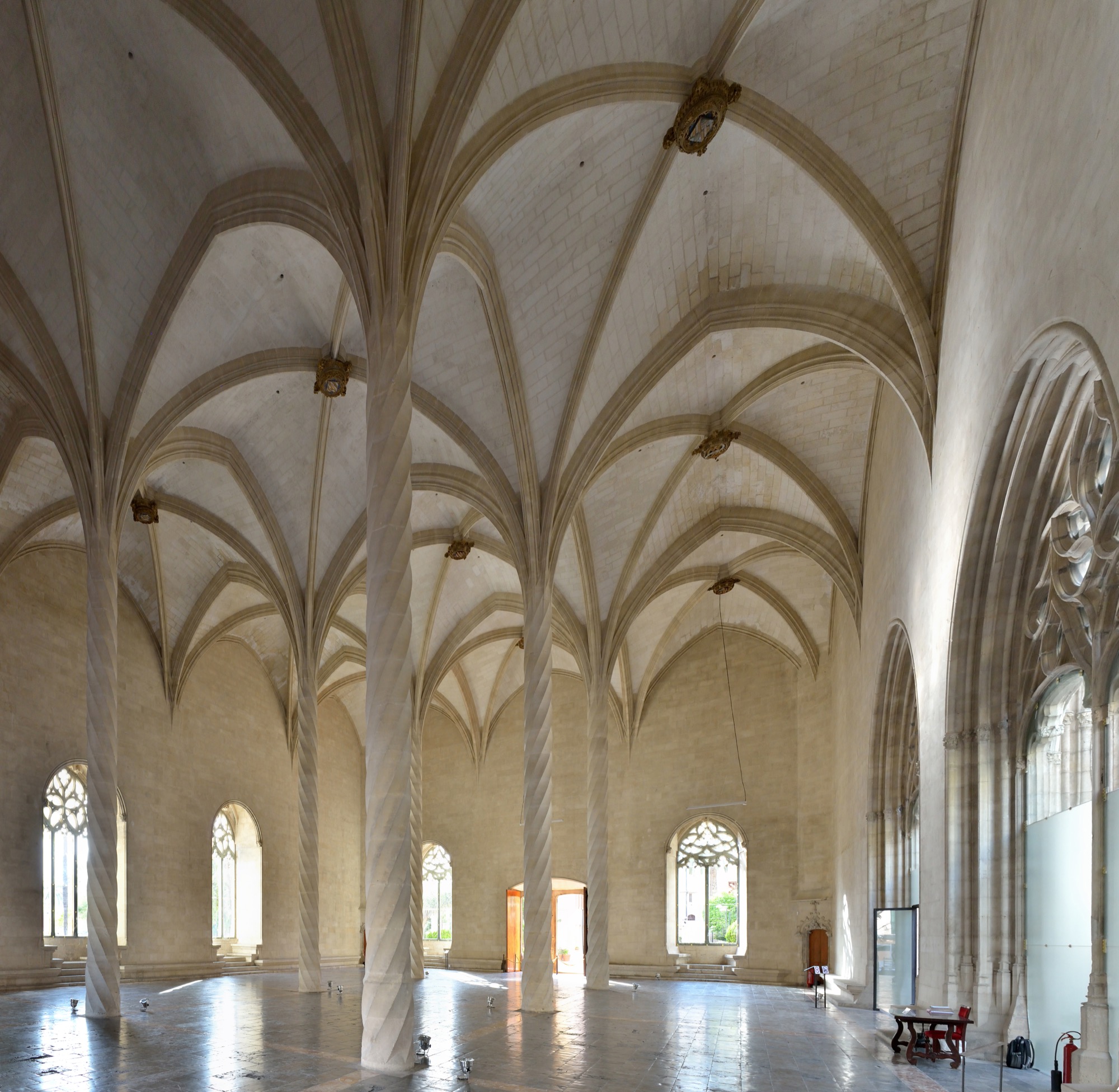
The Llotja dels Mercaders of Palma de Mallorca, known in Castilian as the Lonja and popularly as Sa Llotja, stands as one of the supreme achievements of late Gothic civil architecture in the Mediterranean. In 1409 the merchants of Palma petitioned King Martí I for permission to erect an exchange hall that would, in the words of the surviving documentation, “ennoble their profession and the City of Mallorca.” Construction did not commence until 1426, when the Col·legi de la Mercaderia contracted the Mallorcan master builder and sculptor Guillem Sagrera (born c. 1380 in Felanitx, Mallorca) to design and execute the project. As Francisco Cifuentes Utrero demonstrated in his doctoral thesis at the Universitat Politècnica de Catalunya, “La Lonja de Guillem Sagrera: el Salón de los Mercaderes” (2015), the building contract imposed strict dimensional and programmatic constraints that Sagrera resolved through an innovative system of standardized, modulated construction using the fine-grained Santanyí limestone quarried in southeastern Mallorca. The resulting hall is a rectangular volume divided into three naves of equal height and twelve vaulted bays by six celebrated helicoid columns that rise without bases or capitals, their spiraling shafts merging seamlessly into the ribs of the star-pattern vaults above. The effect, likened by numerous observers to a stone palm grove, creates a vast, luminous interior unified by the structural logic of the helicoidal supports — a daring solution that eliminated the visual interruption of capitals and allowed the eye to travel unbroken from floor to vault. The exterior presents four sober facades framed by four large octagonal corner towers and ten smaller turrets functioning as buttresses, crowned by battlements that give the ensemble the character of a fortified palace. Windows with flamboyant tracery and an open gallery beneath the parapet admit light while maintaining the building’s austere dignity. Sagrera worked on the hall until 1447, when the main interior space was substantially complete; final sculptural and finishing works continued until approximately 1452, when Sagrera departed for Naples to serve Alfonso V of Aragon at the Castel Nuovo, where he designed the great Sala dei Baroni with an equally audacious Gothic vault. The Palma Lonja’s helicoid columns exerted lasting influence: as scholars have noted, the motif was subsequently adopted at the Lonja de la Seda in Valencia (begun 1483 by Pere Compte), though a rigorous geometric study of the two buildings published in the Universitat Politècnica de València’s repository concluded that the helical parameters of the Valencia columns differ significantly from Sagrera’s originals, suggesting conceptual inspiration rather than direct copying. The building was declared an Asset of Cultural Interest (Bien de Interés Cultural) on 3 June 1931. After centuries of varied use — including service as a warehouse, artillery depot, and exhibition hall — it was restored and today functions as a cultural exhibition space under the Ajuntament de Palma.
The sculptural program of Sa Llotja is inseparable from the architecture, for Guillem Sagrera was both the building’s designer and its principal sculptor, executing the figurative carving with his own workshop. As Joan Domenge Mesquida of the Universitat de Barcelona demonstrated in his chapter “Iconographic Observations on the Sculptural Decoration of the Llotja of Palma: The Primacy of the Angels,” published in Les llotges comercials a la Corona d’Aragó (s. XIV–XVI) (edited by Magda Bernaus and Joan Domenge, 2021), the 1426 contract stipulated only the exterior figurative decoration, yet the resulting program is unexpectedly rich in religious imagery for a commercial building. The most prominent element is the monumental sandstone figure of the Àngel Custodi dels Mercaders (Guardian Angel of the Merchants) installed above the main northeast portal, a sculpture of approximately three meters attributed to Sagrera himself. The angel holds a phylactery inscribed “Defensor Mercatorum” (Defender of Merchandise), explicitly linking celestial protection to commercial enterprise. As Doron Bauer argued in “Merchant Identity and Cartographic Impulse in the Architectural Sculpture of the Lonja of Palma de Mallorca,” published in Hortus Artium Medievalium 22 (2016) and revised for the Routledge volume Architecture of Trade (2017), the angel was adopted as the official emblem of the merchants’ guild in 1409 and appears repeatedly throughout the building — on ceiling bosses, on a commemorative plaque dated 1444, and at additional portal positions on both the northeastern and southwestern facades. Four corner statues representing saints, including Saint Nicholas, patron of merchants and sailors, occupy niches on the octagonal towers; Bauer demonstrated that these figures “function as topographical markers linking the merchants to significant urban landmarks” and expressed “both reverence and defiance towards the political powers of the time.” The interior presents the six helicoid columns themselves as sculptural objects: their spiraling grooves, rising without interruption into the ribbed vaults, have been compared to Solomonic columns, an allusion that may carry intentional symbolic weight evoking the Temple of Solomon and the sanctity of just commerce. The vault keystones preserve their original polychromy and gilding, bearing the royal arms of the Crown of Aragon in the central nave and the arms of the City of Mallorca in the lateral bays. Ten gargoyles of high artistic quality project from the exterior walls, their fantastical forms — grotesque creatures and hybrid beasts — carved with the same virtuosity as the angel figure. Small conopial-arched doors at the four corners bear carved imagery of the Evangelists. Mariano Carbonell’s analysis in his study of the Llotja’s facades (2021) observed that the deliberate fusion of ecclesiastical and civil architectural vocabulary was so convincing that when Emperor Carlos V visited Mallorca in 1541, he famously mistook the exchange for a church — a testament to the ambiguity Sagrera cultivated between sacred and mercantile space.
Sa Llotja occupies a commanding position in the Raval de Mar, Palma’s medieval maritime quarter, steps from the waterfront and the old port where Mediterranean trading vessels docked. Cifuentes Utrero’s doctoral research (2015) emphasized that Sagrera’s commission was dual-purpose: the Col·legi de la Mercaderia sought not only a grand trading hall but a monumental anchor for a neighborhood that was periodically devastated by flooding from the sea — a catastrophic flood in 1403 had prompted the original 1409 petition. The Lonja thus served an urbanistic function, ordering and dignifying a quarter whose low-lying position near the harbor made it simultaneously valuable for commerce and vulnerable to inundation. The building stands in close proximity to Palma’s most important monumental ensemble: the great Cathedral of Santa Maria de Palma (La Seu), begun after Jaume I’s conquest of the island in 1229 and consecrated in 1346, rises on the bluff immediately to the east, while the Royal Palace of the Almudaina — originally a tenth-century Muslim alcazar converted into the residence of the Aragonese kings — adjoins the cathedral precinct. The Consolat de Mar, seat of Mallorca’s maritime tribunal established in 1326, was located nearby in the same waterfront zone, creating a concentrated civic-commercial complex that linked royal authority, ecclesiastical prestige, judicial power, and mercantile activity along the harbor. The surrounding streets of the old city preserve the layered urban fabric of Roman Palma, the Islamic medina of Madina Mayurqa, and the post-conquest Christian reorganization, with narrow medieval lanes giving way to small plazas. The Plaça de la Llotja, the open square before the exchange, provided space for outdoor transactions and the loading and unloading of goods from the adjacent quays. Palma’s position as a natural deep-water harbor on the Bay of Palma, centrally situated in the western Mediterranean between Iberia, southern France, Italy, and North Africa, made it a crucial waypoint on maritime routes connecting Barcelona, Montpellier, Genoa, Pisa, and the ports of the Maghreb. David Abulafia’s A Mediterranean Emporium: The Catalan Kingdom of Majorca (Cambridge University Press, 1994) described how this geographic centrality allowed the island to function as “a commercial crossroads between Europe and Africa,” with the harbor quarter serving as the physical locus where these routes converged.
The institutional history of the Palma exchange is bound to the fortunes of the Col·legi de la Mercaderia, the merchant corporation founded in 1409 that commissioned and governed the Lonja. Mallorca’s role as a trading center dates to the Christian conquest of the island by Jaume I of Aragon in 1229, which transformed the former Islamic territory of Madina Mayurqa into a node in the expanding Catalan-Aragonese commercial network. As David Abulafia documented in A Mediterranean Emporium (1994), the Kingdom of Majorca — comprising the Balearic Islands along with the mainland trading centers of Montpellier and Perpignan — was ruled from 1276 to 1343 by a cadet dynasty of the Crown of Aragon, during which period the island developed into a vigorous commercial hub despite the political fragility of the kingdom itself. Mallorcan merchants and navigators established trading presences across the Mediterranean: Maria Teresa Ferrer i Mallol’s comprehensive study “Catalan Commerce in the Late Middle Ages” (Catalan Historical Review, 2012) traced how Catalan maritime trade encompassing Catalonia, Mallorca, and Valencia extended from Occitania and France through Italy and the Maghreb to the Levant and the Atlantic seaboard. The establishment of the Consolat de Mar in Mallorca in 1326, under a privilege granted by Jaume III, provided an institutional framework for resolving maritime and commercial disputes according to the customary law codified in the Llibre del Consolat de Mar — a compendium of Mediterranean maritime law that would be translated into numerous languages and remain influential for centuries. The Col·legi de la Mercaderia, formally constituted in 1409, consolidated the political and economic agency of Palma’s merchant class; it was this body that petitioned for the exchange building and contracted Sagrera in 1426. The merchants adopted the angel as their official emblem, asserting a quasi-sacred legitimacy for commercial enterprise. From 1452, when the Lonja was completed, until the 1830s, the building served continuously as the seat of the maritime trade exchange. Mallorca’s cartographic tradition further distinguished its commercial culture: the Jewish workshop of Cresques Abraham and his son Jehuda produced the celebrated Catalan Atlas of 1375, the most sophisticated portolan chart of its era, reflecting the navigational knowledge accumulated by the island’s maritime community. The economic decline of the island beginning in the late fifteenth century, driven by the disruption of Mediterranean trade routes, the expulsion of the Jewish community after the 1391 pogroms, and the shift of commercial gravity to the Atlantic, gradually reduced the Lonja’s function. By the seventeenth century the building had been repurposed as a mere warehouse. Successive centuries saw it serve as a prison, hospital, and gunpowder magazine before its declaration as an Asset of Cultural Interest in 1931 and its eventual restoration as a cultural exhibition space.
The Lonja of Palma served as the physical marketplace for the full spectrum of Mediterranean commercial activity that flowed through the island’s port. Maria Teresa Ferrer i Mallol’s survey of Catalan commerce (Catalan Historical Review, 2012) identified the principal local products entering the Mallorcan trade network: olive oil, salt, saffron, dried fruits including raisins and figs, coral harvested from Mediterranean waters, raw wool, tallow, glue, and manufactured goods such as woolen cloth, ceramics, crafted leather, and glassware. The island’s position as an entrepot meant that Mallorcan merchants also handled goods in transit between distant markets — spices, pepper, ginger, incense, gum arabic, and shellac arriving from the Levant and the Maghreb destined for northern European consumers, as well as wheat and other grains moving between surplus and deficit regions. Daniel Duran i Duelt’s study of “Mallorcan Merchants in the Medieval Maghrib” (Mediterranean Historical Review, vol. 28, no. 2, 2013) documented the operations of Mallorcan traders in North African ports such as Hunayn (Honein) in the sultanate of Tlemcen, where they organized large-scale wool purchasing operations through mercantile leagues. The slave trade formed a significant if morally troubling component of this commerce: Muslim captives taken in naval warfare and piracy were sold in the Mallorcan market, while Christian captives were ransomed through the same commercial networks. The Consolat de Mar, whose seat adjoined the Lonja district, adjudicated disputes involving maritime contracts, freight agreements, salvage claims, and cargo damage. Institutional mechanisms for managing commercial risk developed alongside the commodity trade: maritime insurance contracts, which Enrico Bensa and later scholars traced to Italian origins in the fourteenth century, were adopted throughout the Crown of Aragon’s commercial centers including Mallorca, and bills of exchange (lletres de canvi) circulated among the Catalan trading communities connecting Mallorca to Barcelona, Valencia, Montpellier, Perpignan, Naples, and the North African ports. The Lonja itself served not merely as a venue for spot transactions but as the institutional center where commercial information was aggregated, shipping schedules coordinated, insurance terms negotiated, and the customary law of the Consolat enforced — a physical infrastructure for the management of risk and trust in long-distance Mediterranean trade.


