Makati Stock Exchange
Makati, Philippines · Established 1963
This site requires authorization to access.
To request access, contact
william.goetzmann@yale.edu
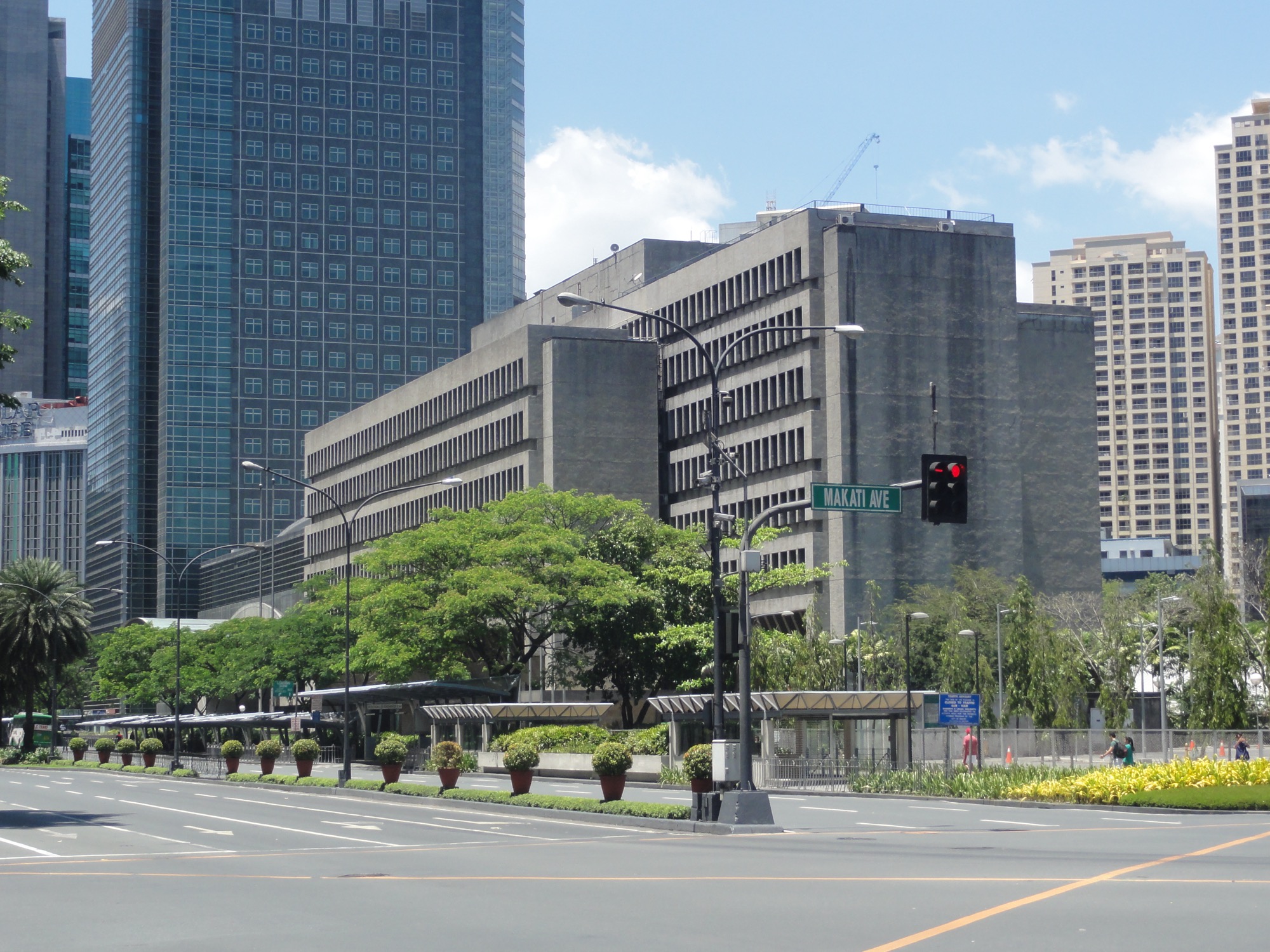
The Makati Stock Exchange Building, completed in 1971 on Ayala Avenue in the heart of the Makati Central Business District, stands as one of the most significant early works of Leandro V. Locsin, who was proclaimed National Artist for Architecture in 1990. As documented in Nicholas Polites’s pioneering monograph The Architecture of Leandro V. Locsin (Weatherhill, 1977)—the first international publication devoted to a Filipino architect—the eight-story structure exemplifies Locsin’s signature approach to monumental modernism in a tropical setting. The building is composed of what Wallpaper* magazine’s survey of Philippine Brutalism (2020) describes as “a sandwich of wafer-thin volumes lined with concrete sun baffles,” with repeating geometric forms in the concrete sunscreens that modulate the harsh equatorial light while creating a rhythm of shadow and transparency across the facade. Jean-Claude Girard’s comprehensive Birkhäuser monograph Leandro Valencia Locsin: Filipino Architect (2021) situates the building within Locsin’s broader exploration of floating masses and structural abstraction, noting his debt to Paul Rudolph’s concrete work encountered during visits to the United States. The interior features column-free office floors, an innovation that accommodated the open trading hall, along with an executive lounge, function rooms, a sports center, and two-level basement parking. Before the exchange acquired its own building, it operated from 1965 to 1971 in the Insular Life Building nearby, another mid-century landmark on Ayala Avenue. Ayala Land has preserved the building’s original facade while continually updating its interiors and building services, and it remains a premier Class A office address, now marketed as the Makati Stock Exchange Center.
Documentary evidence of specific decorative programs within the Makati Stock Exchange Building is limited, reflecting the building’s austere Brutalist aesthetic and its architect’s preference for letting structural form serve as ornament. Leandro Locsin’s design philosophy, as Polites describes in The Architecture of Leandro V. Locsin (1977), emphasized the poetry of space through proportion, symmetry, and the expressive use of raw concrete rather than applied decoration. The principal artistic statement of the building lies in its concrete brise-soleil—the repeating geometric sunscreens whose interplay of light and shadow transforms the facade into a kinetic composition that shifts throughout the day. The inner courtyard, visible from the trading areas, demonstrates what architectural critics have called Locsin’s mastery of repeating geometric forms, creating an almost sculptural experience of enclosed space. The trading floor itself, with its open-plan design facilitating the open outcry system, was a functional theater of commerce where brokers gathered to shout orders at a central blackboard—a performative spectacle of capitalism that was itself a kind of living art. The PSE later introduced commemorative bells as institutional symbols: one bearing the 1927 Manila Stock Exchange seal and one from the Makati exchange, which, as Philstar reported in “Why Are There Two Bells?” (2018), were eventually joined by a “Unification Bell” when the exchanges fully consolidated in 2018. These bells remain preserved as artifacts of Philippine financial history.
The Makati Stock Exchange Building occupies a pivotal site on Ayala Avenue, one of the principal arteries of the Makati Central Business District, itself built upon the runways of the former Nielson Field—Manila’s first commercial airport, opened in 1937 on land leased from the Zobel de Ayala family. As The Urban Roamer’s historical series The Story of Ayala Triangle (2019) documents, when the airport was decommissioned in the late 1940s, the Ayala Corporation’s visionary master plan, drafted under Colonel Joseph McMicking in 1948, transformed the idle marshland and runways into an integrated financial, commercial, and residential hub. The former primary runway became Ayala Avenue, the secondary runway became Paseo de Roxas, and together with Makati Avenue they defined the Ayala Triangle—now home to the Ayala Triangle Gardens park that opened in 2009. The stock exchange building was among the first major structures erected in this planned district, and its presence helped anchor Makati’s identity as the Philippines’ financial capital, displacing the congested Binondo district in Manila where the older Manila Stock Exchange had operated since 1927. Adjacent landmarks include Ayala Tower One (completed 1996, designed by Skidmore, Owings & Merrill), which later housed the unified Philippine Stock Exchange trading floor, and the preserved Nielson Tower—the original airport control tower repurposed as a heritage restaurant. The Development Asia case study by the Asian Development Bank on Makati’s walkability initiatives (2018) notes how the district evolved from an automobile-oriented grid into a pedestrian-friendly network of elevated walkways and covered sidewalks, knitting together the financial institutions, hotels, and retail centers that surround the exchange.
The Makati Stock Exchange was organized on May 27, 1963, by five businessmen—Hermenegildo B. Reyes, Bernard Gaberman, Eduardo Ortigas, Aristeo Lat, and Miguel Campos—who sought to establish a rival to the Manila Stock Exchange (founded August 8, 1927). As the Philippine Stock Exchange’s official corporate history records, the new exchange faced fierce opposition from the incumbent Manila bourse, which petitioned the Securities and Exchange Commission to block its operations. In the landmark 1965 Supreme Court case Makati Stock Exchange, Inc. v. Securities and Exchange Commission (G.R. No. L-23004, June 30, 1965), the Court ruled that the SEC lacked authority to impose a prohibition on dual listing, holding that such a restriction would amount to creating a monopoly in violation of the organizers’ constitutional right to equality before the law. Operations finally commenced on November 16, 1965, with eighteen listed companies. For nearly three decades, the two exchanges traded identical securities from separate trading floors, creating price discrepancies and market inefficiencies that confused investors. The unification came on December 23, 1992, when, as the PSE’s memorial tribute to President Fidel V. Ramos (2022) recounts, Ramos brokered a “shotgun marriage” between the two rivals, with the merger accelerated by SEC Chairman Rosario N. Lopez. The Philippine Stock Exchange received its formal license on March 4, 1994. In June 1993, the Makati exchange launched its automated MakTrade system, which became the basis for the Unified Trading System implemented on November 13, 1995. The Securities Regulation Code of 2000 (Republic Act No. 8799) mandated demutualization, completed on August 8, 2001, converting the PSE from a member-organization into a publicly listed stock corporation. The PSE permanently closed its physical trading floor on June 24, 2022, transitioning to fully electronic, floorless operations.
From its opening in 1965, the Makati Stock Exchange listed equities that mirrored those of the older Manila Stock Exchange, with both bourses trading shares of the same Philippine corporations. As Gochoco-Bautista and Remolona note in studies of Philippine capital market development, the market in the 1960s and 1970s was dominated by mining and oil exploration companies—many of them speculative small-board issues—alongside a limited roster of blue-chip industrial stocks such as San Miguel Corporation, Atlas Consolidated Mining, and Philippine Long Distance Telephone Company (PLDT). The PIDS Philippine Journal of Development’s survey of stock market development documents that in 1974, securities dealers accounted for only 1.2 percent of total financial system assets, while commercial banks held 56.7 percent, underscoring the equity market’s marginal role in Philippine finance during this period. Trading on both exchanges was conducted through the open outcry system, with brokers physically gathered on the trading floor to call out buy and sell orders at a central board. The Manila exchange had introduced the Industrial Share Average index in 1958 to track manufacturing and commercial issues, supplemented by a Mining and Oil Index, and the Makati exchange adopted similar benchmarks. After unification, the PSE Composite Index (originally PHISIX, renamed PSEi on April 3, 2006) was established with a base of 1,022.045 points pegged to February 28, 1990. The Makati exchange’s MakTrade automated trading system, launched in June 1993, replaced open outcry with electronic order matching, and in 2010 the PSE adopted PSEtrade, a platform acquired from the New York Stock Exchange. The modern PSE lists equities across six sector indices—financials, industrial, holding firms, property, services, and mining and oil—and also offers Exchange Traded Funds and Real Estate Investment Trusts (REITs), instruments that would have been unimaginable in the open-outcry era of the Makati trading floor.
Images will be added as the project develops. Photographs by Larry Ng and from research sources.