Meenakshi Temple Market Complex
Madurai, India · Established 7th century AD (current structure 16th-17th century)
This site requires authorization to access.
To request access, contact
william.goetzmann@yale.edu
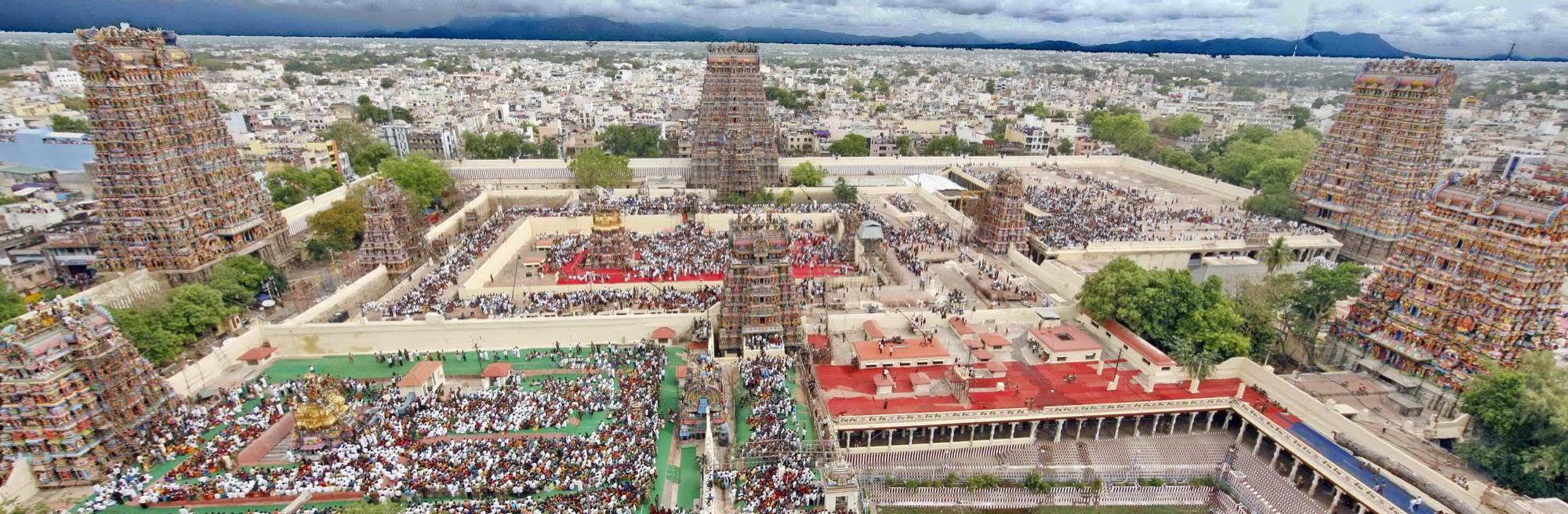
The Meenakshi-Sundareshwarar Temple complex at Madurai represents the most fully realized example of the South Indian temple-market typology, a vast precinct covering approximately 5.7 hectares in which sacred and commercial architecture are entirely integrated. The present complex is largely the creation of the Madurai Nayak dynasty (sixteenth to seventeenth centuries), though the site's sanctity reaches back to the Pandya period. After the devastation wrought by Malik Kafur's raid in 1311, the temple lay in ruins for nearly two and a half centuries. Reconstruction began under Vishwanatha Nayak (r. 1529-1564), the first Nayak ruler of Madurai, whose prime minister and general Ariyanatha Mudaliar supervised the initial rebuilding according to principles set out in the Shilpa Shastras, the ancient Hindu texts on sacred architecture. The complex is organized as a series of concentric rectangular enclosures (prakaras), each fortified with high masonry walls, with shrines to Meenakshi (Parvati) and Sundareshwarar (Shiva) at the center. Four monumental gopurams (gateway towers) mark the cardinal entrances to the outer enclosure, the tallest being the southern tower at approximately 52 meters, while ten smaller gopurams punctuate the inner walls. These soaring towers, constructed of brick and stucco over granite cores, follow the classic Dravidian form analyzed in George Michell's Encyclopaedia of Indian Temple Architecture: South India, Dravidadesa, Later Phase, c. A.D. 1289-1798 (2001). The Thousand Pillar Hall (Aayiram Kaal Mandapam), built in 1569 under Ariyanatha Mudaliar's direction, contains 985 carved granite columns arranged so that they appear in perfectly aligned rows from every angle; an equestrian statue of Ariyanatha himself flanks the entrance. The most commercially significant structure is the Pudu Mandapam (New Hall), constructed circa 1629-1635 under the patronage of Tirumala Nayak (r. 1623-1659). As Crispin Branfoot documented in his detailed study of the building (Journal of the Royal Asiatic Society, 2001), this long pillared hall was built as a festival mandapam just outside the eastern gopuram. Its 124 bays, each defined by massive composite piers bearing monumental sculptures, have functioned continuously as commercial space: cloth merchants, tailors, and jewelers have occupied the stalls between the sculpted pillars for centuries, making it perhaps the most vivid surviving example of integrated temple-market architecture anywhere in South Asia. The Ashta Shakthi Mandapam (Hall of Eight Goddesses) stands at the entrance near the eastern tower, its pillars carved with images of the eight forms of Shakti. At the heart of the complex lies the Porthamarai Kulam (Golden Lotus Tank), a sacred bathing reservoir measuring approximately 165 by 120 feet, added by Saluvanarasana Nayaka in 1516 and surrounded by a pillared corridor. The musical pillars near the western end of the Thousand Pillar Hall, carved from single blocks of granite during the Nayak period, produce distinct tonal notes when struck, demonstrating the extraordinary mastery of stone acoustics achieved by the temple's builders.
The artistic program of the Meenakshi-Sundareshwarar complex is inseparable from its commercial function, for the most spectacular sculpture adorns the very halls where merchants traded. The Pudu Mandapam's 124 composite pier sculptures constitute one of the finest ensembles of Nayak-period monumental sculpture in South India. Branfoot's analysis in "'Expanding Form': The Architectural Sculpture of the South Indian Temple, ca. 1500-1700" (Artibus Asiae, 2002) describes how figures of Hindu deities, Nayak kings and queens, warriors on rearing horses, and mythical yali (composite lion-horse creatures) emerge from the stone columns in a distinctive sculptural concept he terms "expanding form." The yali figures, placed at the base of many piers, served simultaneously as architectural supports, apotropaic guardians, and display pedestals for the cloth and goods sold in the stalls between them. Life-size royal portraits of fourteen Nayak rulers, including Tirumala Nayak himself, are carved into the pillars, making the commercial hall also a dynastic gallery. Three separate sets of scale drawings of this single building were made by European draftsmen between the 1780s and 1831, and bronze scale models of eighteen of the columns were cast in the 1780s; these are now held in the Victoria and Albert Museum, the British Library, and the Royal Asiatic Society in London, as Branfoot documents (Journal of the Royal Asiatic Society, 2001). The Thousand Pillar Hall's 985 granite columns bear carvings of deities, mythical beasts, female musicians, celestial nymphs, and attendant figures, with prominent rows of yali sculptures along the central processional axis. The musical pillars, each cluster carved from a single granite monolith, produce notes resembling the tones of the veena, flute, and mridangam when tapped. The gopuram towers carry an estimated total of nearly 4,000 stucco figures across their multiple tiers, depicting scenes from Hindu mythology alongside representations of daily life; these polychrome compositions are repainted every twelve years in the ritual known as Kumbabishekam. The temple also preserves processional bronze images in the Chola tradition, used during the elaborate festival processions that historically moved through the commercial corridors. The Ashta Shakthi Mandapam's pillars feature the eight forms of Shakti carved in high relief, along with scenes of the Meenakshi Thirukalyanam (divine wedding) and images of Kali, Nataraja, Surya, and Chandra. Paintings on the ceilings of several mandapams depict the Thiruvilayadal Puranam (the sacred sports of Shiva at Madurai), binding the commercial spaces to the temple's mythological narrative.
Madurai offers one of the clearest examples in the world of a city planned concentrically around a temple-market nucleus. The old city follows what treatises such as the Mansara Shilpashastra describe as the Rajdhani (royal capital) plan: a fivefold concentric rectangular formation with the Meenakshi-Sundareshwarar Temple at its precise center. Ancient Tamil classics, as scholars have noted, describe the temple as the center from which the surrounding streets radiate like the petals of a lotus flower. The four gopurams of the outer enclosure open onto axial streets aligned with the cardinal directions, and successive concentric rectangular streets surround the temple at increasing distances, historically organized by social hierarchy and trade specialization. Streets were traditionally named for the occupations conducted there, so that the urban fabric itself encoded a map of commercial activity. The wealthy merchant and priestly classes occupied the streets closest to the temple, while artisan and laboring communities resided in the outer rings. The Vaigai River, which flows through Madurai approximately one kilometer north of the temple, served as a crucial commercial artery. As research on the Vaigai river valley's trade routes has demonstrated, the river connected the Pandyan capital to the port of Alagankulam on the Bay of Bengal coast and, via overland routes, to the Chera port of Muziris (modern Kodungallur) on the Malabar coast. This position astride routes linking the Coromandel and Malabar coasts made Madurai a natural inland entrepot. The Nayak rulers reinforced this centrality: Tirumala Nayak's palace (begun 1636), located approximately one kilometer southeast of the temple, established a secondary node connected to the temple precinct by processional avenues that doubled as commercial thoroughfares. Sanjay Subrahmanyam, in The Political Economy of Commerce: Southern India 1500-1650 (1990), situates Madurai within the broader network of Nayak-period commercial centers that linked interior temple-towns with maritime trade. The concentric plan of Madurai, with its integration of sacred, administrative, and commercial functions around the temple nucleus, represents a distinctive South Asian model of urban organization that persists in the city's modern street pattern.
The Meenakshi Temple's history as a combined religious and commercial institution spans at least two millennia. The Pandya dynasty, which made Madurai its capital, first appears in the historical record in the accounts of Megasthenes (c. 300 BCE), the Seleucid ambassador to the Mauryan court, who described a wealthy southern kingdom ruled by a queen and famed for its pearls. The author of the Periplus of the Erythraean Sea (first century CE) noted the riches of the Pandyan kingdom, while Pliny the Elder referred to the Pandyan ruler of Madurai in his Natural History. Tamil Sangam literature, composed between roughly the third century BCE and the third century CE, portrays Madurai as a thriving commercial center, and the legendary Sangam academies were traditionally held there under Pandyan patronage. The temple's fortunes declined catastrophically in 1311, when Malik Kafur's Delhi Sultanate armies sacked the city and destroyed much of the complex. Reconstruction did not begin for more than two centuries, until the establishment of the Madurai Nayak dynasty as governors under the Vijayanagara Empire. Burton Stein's seminal article "The Economic Function of a Medieval South Indian Temple" (Journal of Asian Studies, 1960), based on analysis of approximately 1,000 stone inscriptions from the Tirupati shrine, demonstrated that South Indian temples served as central economic institutions: receiving endowments in land and cash, lending money at interest, managing agricultural estates, and redistributing resources through ritual expenditure. The Madurai temple followed this pattern precisely. Arjun Appadurai and Carol Breckenridge, who conducted fieldwork at the Meenakshi-Sundareshwarar Temple between 1973 and 1974, analyzed this economic redistributive function in their influential article "The South Indian Temple: Authority, Honour and Redistribution" (Contributions to Indian Sociology, 1976), showing how material endowments were transformed through the temple into symbols of prestige and social honor. Noboru Karashima's epigraphic studies of Chola and Pandyan inscriptions ("South Indian Temple Inscriptions: A New Approach to Their Study," South Asia, 1996) revealed how temples recorded not only religious donations but also land transactions, government orders, and commercial compacts. Under the Nayaks, temple inscriptions document sophisticated financial operations: loans to merchant guilds at specified interest rates, endowments generating perpetual income streams, and the administrative management of donated villages. Velcheru Narayana Rao, David Shulman, and Sanjay Subrahmanyam's Symbols of Substance: Court and State in Nayaka Period Tamil Nadu (Oxford University Press, 1992) places these temple-centered economic activities within the broader political culture of the Nayak successor states, showing how Tirumala Nayak and his predecessors used temple patronage to legitimate their authority and stimulate commercial activity.
The Meenakshi Temple complex functioned simultaneously as marketplace, financial institution, and administrative center, a combination that Burton Stein characterized as central to the economic life of medieval South India. Textiles dominated the commerce conducted within the temple precincts. Madurai was historically renowned for cotton production, and the introduction of expanded cotton cultivation during the Nayak period in the sixteenth century increased the region's agricultural revenue and textile output. The Pudu Mandapam served as the primary cloth market, with merchants occupying the bays between its sculpted pillars; this function persists today, as tailors and fabric dealers continue to trade in the hall. The Saurashtrian weaving community, silk merchants who migrated from Gujarat beginning around the eighth century and settled in Madurai under Nayak patronage, established guilds specializing in silk textiles. By the seventeenth century, under the patronage of Tirumala Nayak, they developed the distinctive Madurai Sungudi (tie-dye) sari tradition. Beyond textiles, the bazaar corridors radiating from the temple traded in gems, spices (pepper, cardamom, cloves), ivory, and pearls. The Pandyan kingdom's ancient pearl fisheries at Korkai, documented in the Periplus of the Erythraean Sea and by Megasthenes, had for centuries channeled pearls through Madurai to markets across the Indian Ocean and the Roman Mediterranean. The merchant guild known as the Ainnurruvar (Five Hundred Lords of Ayyavole), whose inscriptions spanning the ninth through fourteenth centuries document trade in an extraordinary range of goods including horses, elephants, precious stones, aromatics, and textiles, maintained connections to the Madurai region; the Nayak rulers bore the title "lord of Ayyavalipura." The temple itself operated as a financial institution of considerable sophistication. Inscriptions record that the temple accepted cash deposits and endowments, lent money at interest (one inscription records a loan of 360 kasu at 12.5 percent to four merchant guilds), managed agricultural estates donated as devadana (temple land), and exercised judicial and administrative authority over endowed villages. Appadurai and Breckenridge (1976) showed how this economic redistribution operated through the temple's ritual calendar: endowments funded festivals, processions, and daily worship, which in turn drew pilgrims and merchants, generating further commercial activity in the surrounding bazaars. The temple thus functioned as a self-reinforcing economic engine in which sacred ritual and commercial exchange were mutually constitutive.
Images will be added as the project develops. Photographs by Larry Ng and from research sources.