Madrid Stock Exchange (Bolsa de Madrid)
Madrid, Spain · Established 1831
This site requires authorization to access.
To request access, contact
william.goetzmann@yale.edu
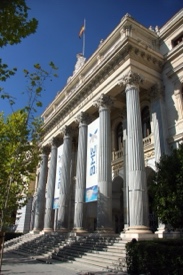
The Palacio de la Bolsa de Madrid at Plaza de la Lealtad 1 ranks among the finest purpose-built exchange halls of late nineteenth-century Europe. Architect Enrique María Repullés y Vargas (1845–1922), a member and secretary of the Real Academia de Bellas Artes de San Fernando who had consolidated eclecticism across its historicist variants, won the 1884 national design competition with a scheme modeled on Theophil von Hansen’s Vienna Stock Exchange, as documented by the Real Academia de la Historia in its Diccionario Biográfico Español. Construction commenced in 1886 under a budget of 1.25 million pesetas, eventually exceeding 2.78 million pesetas, and was inaugurated on 7 May 1893 by Queen Regent María Cristina de Habsburgo-Lorena. The principal facade extends sixty-six meters along the curved plaza, adapting to its irregular footprint, and is dominated by a monumental hexastyle portico of fluted Corinthian columns that Repullés conceived as a temple to commerce. An attic story with roundels and a clock mechanism imported from Strasbourg crowns the composition, flanked by lateral pavilions. The interior centers on the Salón de Contrataciones, or Parquet, a double-height hall of approximately 1,000 square meters bounded by a Neo-Renaissance double arcade: the lower register features fluted pilasters with capitals carved as commercial emblems, while the upper gallery rests on marble columns with bronze bases. The hall is covered by an iron-and-glass barrel vault with a semicircular apse. Declared a Bien de Interés Cultural in 1992, the palace continues to house the exchange and host institutional ceremonies.
The decorative program of the Palacio de la Bolsa integrates painting, sculpture, and applied arts into a unified allegory of Spanish commerce. Sculptor Francisco Molinelli executed four stone reliefs in the entrance atrium representing Commerce, Industry, Agriculture, and Navigation, the four pillars of the national economy. Molinelli also created the building’s signature emblem, the Caduceo, an elaborate caduceus whose intertwined serpents symbolize supply and demand, whose central tick represents the arbitrator, and whose wings evoke the speed of market decision-making. The painter Luis Taberner y Montalvo (Madrid, 1844–1900), trained at the Escuela de Bellas Artes de San Fernando, executed the principal ceiling paintings. In the Salón de Contrataciones, Taberner’s grand allegorical fresco cycle depicts figures and attributes representing the diverse provinces of Spain under the motto “La Paz protege a España y al Comercio” (Peace Protects Spain and Commerce). Working alongside Luis Imbrol and receiving 22,000 pesetas for the trading-hall compositions, Taberner also painted the Sala de Juntas ceiling with an allegory of global commerce showing different regions of the world. The upper arcade of the trading hall displays painted shields of the Spanish provinces alongside those of nations with which Spain maintained significant commercial relations in 1893. Additional decorative elements include ornamental ironwork in the vault structure and balustrades, polychrome marble in the column capitals and bases, and the portraits of successive exchange presidents that line the walls. The Salón de Pasos Perdidos preserves the Caduceo motif alongside representations of the peseta, instituted in 1868.
The Bolsa de Madrid occupies a commanding position on the Plaza de la Lealtad, along the Paseo del Prado axis that UNESCO inscribed as a World Heritage Site in 2021 under the designation “Paseo del Prado and Buen Retiro, a Landscape of Arts and Sciences.” This cultural landscape, evolving since Philip II laid out the tree-lined promenade in the sixteenth century, was transformed under Charles III’s Enlightenment urbanism in the 1770s–1780s, with gardens by José de Hermosilla and fountains by Ventura Rodríguez, creating what UNESCO describes as “a new idea of urban space and development from the enlightened absolutist period.” The exchange building, erected on the site of the former El Dorado theatre, stands adjacent to the Museo del Prado and within steps of the Hotel Ritz (1910). The Plaza de la Lealtad itself centers on the Monument to the Fallen for Spain, commemorating those who died resisting Napoleon’s troops on 2 May 1808. Madrid’s emergence as Spain’s financial capital was paradoxical: an inland city lacking a port or major river, it owed its centrality entirely to its status as the political capital since Philip II’s 1561 decision. As Gabriel Tortella observes in The Development of Modern Spain (Harvard University Press, 2000), state finance and government debt issuance dictated that the machinery of capital markets cluster around the seat of royal and parliamentary power. The Barrio de las Letras to the west and the Retiro Park to the east complete an urban fabric in which political authority, cultural patrimony, and financial infrastructure have been interwoven since the Bourbon reforms.
The Bolsa de Comercio de Madrid was established by the Real Decreto of 10 September 1831 during the reign of Fernando VII, drafted by the jurist and economist Pedro Sainz de Andino, who later described himself as the “material author” of the founding norm. As documented in the Anuario de Historia del Derecho Español (vol. LXVII, 1997), Sainz de Andino conceived comprehensive stock-exchange regulations integrated with his 1829 Código de Comercio, replacing earlier ad hoc rules. The inaugural trading session convened on 20 October 1831 at the Consulado in the Plazuela del Angel, focusing overwhelmingly on government debt (deuda pública) generated by post-Napoleonic reconstruction. The Mendizábal desamortización of 1835–1837, which expropriated ecclesiastical properties and converted proceeds into government bonds, further entrenched public debt as the exchange’s core instrument. From mid-century, the 1855 Ley de Ferrocarriles and the Ley de Bancos y Sociedades stimulated railway and banking listings, though the crises of 1854 and 1866 exposed speculative fragility. Concha Betrán, Pablo Martín-Aceña, and María Ángeles Pons, in “Financial Crises in Spain: Lessons from the Last 150 Years” (Revista de Historia Económica, Cambridge University Press, 2012), demonstrate that Spanish financial crises have been more frequent and complex than the international average. The Ley del Mercado de Valores of 1988 enacted the most transformative reform since 1831, dissolving the centuries-old Colegios de Agentes de Cambio y Bolsa and replacing individual brokers with securities companies. The Comisión Nacional del Mercado de Valores (CNMV) was created in 1989 as an independent supervisory body. In 2002, the four Spanish exchanges merged under Bolsas y Mercados Españoles (BME), later acquired by the SIX Group in 2020.
From its founding in 1831, the Bolsa de Madrid served primarily as a marketplace for government debt securities, reflecting the Spanish state’s chronic fiscal needs. As Pablo Martín-Aceña documents in Money in Spain: New Historical Statistics, 1830–1998 (Banco de España Working Paper, 2018), public bonds dominated trading volumes throughout the nineteenth century. The Mendizábal disentailment bonds of the 1830s–1840s and successive consolidations of the deuda pública made sovereign paper the exchange’s lifeblood. Railway securities emerged as the principal equity class after the 1855 Railroad Law channeled foreign capital, particularly French and British, into Iberian rail construction; Tortella notes in The Development of Modern Spain (Harvard, 2000) that approximately sixty percent of railway investment came from abroad. Mining shares from the Rio Tinto, Tharsis, and Almadén operations and banking stocks completed the listed universe. Trading was conducted through the corro system, a form of open outcry in which agentes de cambio y bolsa gathered around five columns on the Parquet floor, conducting ten-minute sessions per sector, negotiating a viva voz. Markus Denzel’s Handbook of World Exchange Rates, 1590–1914 (Routledge, 2010) records official quotations from the Cotización de la Bolsa de Madrid from 1837 onward. Stefano Battilossi, in “Spanish Stock Returns, Growth, and Inflation, 1900–2020” (Economic History Review, 2025), constructed the historical IBEX (H-IBEX) index demonstrating that Spanish equities underperformed most European markets over the long run. The electronic CATS system, imported from the Toronto Stock Exchange, replaced floor trading in April 1989, succeeded by the domestically developed SIBE platform in 1995, on which the IBEX 35 index has been quoted since its launch in 1992.