Lyon Stock Exchange (Bourse de Lyon)
Lyon, France · Established 1540

This site requires authorization to access.
To request access, contact
william.goetzmann@yale.edu
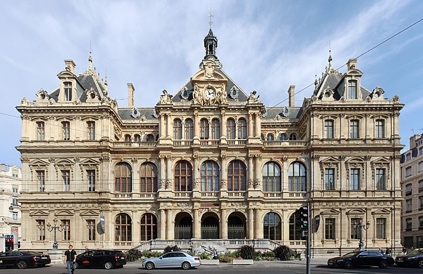
The Palais du Commerce et de la Bourse in Lyon, designed by the Lyonnais architect René Dardel (1796–1871), stands as the monumental embodiment of the city’s commercial renaissance under the Second Empire. Prefect Claude-Marius Vaïsse — whom scholars have called “the Haussmann of Lyon” — commissioned the building in 1853 as a multipurpose palace to house the Chamber of Commerce, the Commercial Court (Tribunal de Commerce), the Conseil des Prud’hommes, the stock exchange, and a museum of art and industry. On 4 August 1854, Dardel was formally appointed architect, and the cornerstone was laid on 15 March 1856. Construction proceeded for five years before Napoleon III and Empress Eugénie inaugurated the completed edifice on 25 August 1860. As the architectural historian Dominique Bertin has shown in Lyon: Silhouettes d’une ville recomposée (2008), the Palais du Commerce initiated a Neo-Renaissance taste that became the defining civic style of Lyon in the second half of the nineteenth century. Dardel’s own Monographie du palais du commerce (1868) documents his design process in detail. The building occupies a quadrilateral measuring 57.60 meters wide by 64.50 meters long, encompassing some 11,500 square meters. It is organized around four corner pavilions and a great central hall — the Salle de la Corbeille — which rises the full height of the structure to approximately 25 meters and covers 490 square meters. This glass-roofed trading hall, ringed by superimposed arcaded galleries, served as the primary space for securities trading. Dardel drew on a learned archaeological synthesis of French Renaissance sources: the Lescot Wing of the Louvre, Philibert Delorme’s Château d’Anet, and the Château de Madrid, as analyzed in the article “Une Renaissance de pierre entre Rhône et Saône” (Livraisons de l’histoire de l’architecture, 2009). The principal north façade on the Place des Cordeliers features paired Corinthian columns, alternating curved and triangular pediments, and richly carved entablatures. The south façade presents three projecting pavilions with recessed upper stories that create dramatic shadow relief. Stone was quarried from Pommiers and Tournus. The building contains 172 windows across three levels, with two narrow interior courtyards providing natural light to ground-floor commercial spaces. Before Dardel’s palace, Lyon’s financial activities had no permanent purpose-built home. The earlier Loge du Change, constructed between 1631 and 1653 after plans by Simon Gourdet and rebuilt by Jacques-Germain Soufflot in 1748–1750 with an uncompromising neoclassical façade, had served money changers in the Vieux Lyon quarter but was converted to a Protestant temple in 1803. A comprehensive restoration of the Palais du Commerce was carried out from 2000 to 2004, restoring missing coats of arms and reopening lateral courtyards with new skylights.
The decorative program of the Palais du Commerce reflects the building’s civic ambitions through an elaborate ensemble of sculpture, painting, and ornamental carving coordinated by Dardel himself. Three principal sculptors from the Lyon school contributed monumental works to the interior. In the Salle de la Corbeille, the first two gallery levels are adorned with allegorical statues of the four elements: on the ground floor’s east side, Earth and Air were executed in Pommiers stone by Jean-Marie Bonnassieux (1810–1892), a native of Panissières in the Loire who had studied at the École nationale supérieure des Beaux-Arts in Paris; on the west side, Water and Fire were carved in Tournus stone by François-Félix Roubaud. On the first floor, stone figures symbolizing the four continents were sculpted by Joseph-Hugues Fabisch, also in Pommiers stone, some tinted with a rose wash. Bonnassieux further contributed the “Groupe des Heures,” a marble sculptural group surmounting the ornamental clock on the north façade, executed between 1858 and 1863, representing the passage of time through allegorical female figures — an apt motif for a building governed by the rhythms of trading sessions. On the exterior, monumental statues representing Justice, Temperance, Agriculture, Commerce, and Industry adorn the façades, reinforcing the building’s identity as a temple of productive enterprise. A later addition to the sculptural ensemble came in 1907, when André César Vermare (1869–1949), a Lyon-born sculptor who won the Grand Prix de Rome in 1899, installed a monumental white marble bas-relief at the foot of the exterior staircase on the Place des Cordeliers depicting “Le Rhône et la Saône” — the personified rivers joining their arms to point toward the future, a powerful allegory of Lyon’s identity as the city at the confluence. The interior ceiling paintings are primarily the work of Lyonnais artists. The vaulted ceiling of the Salle de la Corbeille, designed with double arches and crossed ribs meeting in a central rosette reminiscent of a Gothic nave, was painted by Alexandre-Dominique Denuelle (1818–1879), the Parisian decorative painter who also executed the Red Rooms of the Louvre in 1863. Denuelle’s program for the Corbeille features an apotheosis of Lyon surrounded by seven allegorical virtues, flanked by representations of the Rhône and Saône rivers, with symbolic figures of Labor and Commerce. Additional ceiling paintings in the reception halls were executed by the Lyon painters Antoine Claude Ponthus-Cinier (1812–1885), a Grand Prix de Rome winner in 1841 who specialized in Italianate landscapes, and Jean-Baptiste Beuchot, who contributed neoclassical decorative compositions. The third-level galleries of the Salle de la Corbeille are supported by twenty-four wooden caryatids and atlantes, while the walls display the coats of arms of principal commercial cities of the world in sculpted relief — a cosmopolitan iconographic program befitting an international exchange. Ornate marble fireplaces bearing imperial emblems complete the interior appointments.
The Palais du Commerce occupies a commanding position on the Place des Cordeliers in Lyon’s Presqu’île, the narrow peninsula formed between the Rhône and Saône rivers that has served as the city’s commercial heart since antiquity. Lyon’s geography — at the confluence of two major rivers, positioned on the overland route between the Mediterranean and northern Europe — made it a natural crossroads for trade from the Roman period onward. The Presqu’île was inscribed as a UNESCO World Heritage Site in 1998, encompassing 427 hectares that include Vieux Lyon, Fourvière hill, the slopes of the Croix-Rousse, and much of the peninsula itself. The building anchors one end of the Rue Impériale (today Rue de la République), the grand boulevard that Prefect Vaïsse drove through the medieval street fabric between 1854 and 1865, demolishing 289 buildings and relocating 12,000 residents in a transformation that, as the historian Bruno Benoit has documented in the HAL-SHS paper “La transformation de Lyon et de Paris au Second Empire” (2016), preceded and prefigured Haussmann’s renovation of Paris. To the northwest lies the Place des Terreaux, seat of the Hôtel de Ville, while to the south the peninsula narrows toward the confluence. The earlier financial geography of Lyon was centered on the Vieux Lyon quarter on the west bank of the Saône. The Place du Change, in the heart of the Saint-Paul and Saint-Jean quarters, had been the domain of money changers and bankers since the thirteenth century, as described in Richard Gascon’s Grand commerce et vie urbaine au XVIe siècle (1971). It was here that Lombard and Tuscan bankers exchanged France’s first letters of change in the early sixteenth century. Rising above the Presqu’île to the north, the Croix-Rousse hill became the quartier des canuts, Lyon’s silk-weaving district, where high-ceilinged workshops were built to accommodate the Jacquard looms that by the eighteenth century powered the Grande Fabrique with over 14,000 looms. As Lesley Ellis Miller has documented in studies of Lyon’s silk industry, the proximity of the Croix-Rousse ateliers to the merchant-manufacturers of the Presqu’île and the financial infrastructure of the exchanges created an integrated urban economy in which raw silk arrived from Italy, was woven on the hill, and was traded in the halls below. The Palais du Commerce thus brought together, in a single monumental structure, the institutional apparatus — stock exchange, commercial court, chamber of commerce — that had previously been dispersed across the medieval city, consolidating Lyon’s commercial identity in an era of rapid industrialization.
Lyon’s history as a financial center stretches back to the great fairs that made it one of the most important commercial crossroads in early modern Europe. In 1420, King Charles VII granted Lyon the privilege of holding two annual tax-free fairs, seeking to develop an alternative to the fairs of Geneva, which enriched the Duke of Savoy. As Marc Brésard documented in Les foires de Lyon aux XVe et XVIe siècles (1914), these privileges were progressively expanded: a third fair was added, and by 1463 Louis XI had established four annual fairs explicitly to divert the Italian merchant traffic from Geneva. The fair dates were aligned with the liturgical calendar — after Epiphany, the first Sunday after Easter (Quasimodo), 4 August, and All Saints’ Day — each lasting approximately fifteen days, with merchandise trading in the first week and financial settlements in the second. This bipartite structure, as Richard Gascon analyzed in his magisterial Grand commerce et vie urbaine au XVIe siècle: Lyon et ses marchands (1971), was critical: the second week, known as the “Payments,” evolved into a sophisticated multilateral clearing system in which debts were offset against credits without the physical transfer of coin. Italian merchant-banking houses dominated Lyon’s financial life. As the Musée Gadagne’s research documents, 143 of the 169 major trading companies operating in Lyon were Italian, drawn from the great dynasties of Florence, Genoa, and Lucca — the Medici, Gondi, Gadagne (Guadagni), Capponi, Salviati, and Bonvisi among them. Nathalie Matringe’s studies using the Salviati bank archives, published in the Economic History Review (“Early inventory management practices in the foreign exchange market: Insights from sixteenth-century Lyon,” 2022) and the Financial History Review (“The meandering trajectories of financial innovations,” 2023), have revealed how these banks employed the bill of exchange not merely as a remittance instrument but as a sophisticated netting tool, with limit orders enabling dealers to offset order flows across multiple clients and markets. The fair clearing mechanism thus anticipated modern central-counterparty systems by four centuries. Lyon’s financial centrality made it the natural venue for sovereign borrowing. Richard Ehrenberg’s Capital and Finance in the Age of the Renaissance (1928) devoted extensive attention to how the French Crown drew on Lyon’s capital markets. The most spectacular episode was the Grand Parti de Lyon of 1555, in which Henri II launched a consolidated loan of approximately two million écus. As Georges Gallais-Hamonno argued in “The Stupendous Modernity of the 1555 Grand Parti de Lyon Loan” (2009), this instrument was remarkably modern: reserved for institutional investors (the merchant-bankers), carrying a nominal 16 percent annual interest (4 percent quarterly), with amortization through 41 constant quarterly annuities over eleven years. It effectively consolidated 75 percent existing debt with 25 percent new funds. The Grand Parti’s collapse was dramatic: by 1557, escalating military expenditure — four armies in Italy, the disaster at Saint-Quentin, the expedition to retake Calais — rendered the debt unsustainable. New subscriptions were diverted to service earlier payments, and in December 1557 a royal decree eliminated the lenders’ privilege on assigned fiscal revenues. Only nine percent of the total issue was repaid on schedule. This default reverberated across European financial markets, as Genoa, Spain, and France all experienced sovereign debt crises in 1557–1560 in what amounted to the first international financial crisis of the modern era. The Wars of Religion after 1562 further devastated Lyon’s fairs, and the financial clearing function gradually migrated to the Genoese Bisenzone fairs. Formal stock exchange trading continued in Lyon in subsequent centuries but on a diminished scale. The construction of Dardel’s Palais du Commerce in 1856–1860 marked a nineteenth-century revival, housing the Bourse de Lyon until the consolidation of French regional exchanges into Euronext Paris in the late twentieth century.
The Lyon fairs were among the most comprehensive commercial gatherings in early modern Europe, dealing in an extraordinary range of physical merchandise and financial instruments. As the research published by the Musée Gadagne and analyzed by Richard Gascon in Grand commerce et vie urbaine au XVIe siècle (1971) documents, the merchandise traded during the first week of each fair included Italian silks — velvets, satins, damasks, and taffetas from Florence, Genoa, and Lucca — along with German metals (copper, silver, tin), English and Flemish drapery and woolen cloth, Spanish leather, and fine Dutch linens. Spice inventories from the period record imports from the Levant and Asia: pepper, cloves, nutmeg, ginger, cinnamon, mastic, and numerous medicinal aromatics, as documented in the research blog “At Markets and Fairs in Lyon” (Religion and Urbanity, 2020). After Louis XI established the silk industry in Lyon in 1466 by settling Italian workers from Calabria, and especially after François I formalized silk weaving in 1536, locally manufactured silk became a major article of trade alongside imported fabrics. Books, paper, and the products of Lyon’s flourishing printing industry — the city was one of the great centers of Renaissance publishing — also featured prominently at the fairs. But it was the second week of each fair, the “Payments,” that gave Lyon its decisive importance in European finance. The bill of exchange (lettre de change) was the dominant instrument, used both for international remittance and as a credit and clearing device. As Nathalie Matringe has demonstrated through the Salviati bank archives (Economic History Review, 2022), Lyon’s exchange dealers employed bills of exchange as netting instruments in a multilateral clearing system: debts owed between merchants across Europe were offset against one another, and only net balances required settlement in coin. The ricorsa — a bill of exchange drawn and redrawn between the same parties across successive fair dates — functioned as a rolling credit instrument, effectively creating short-term loans disguised as exchange transactions to circumvent usury prohibitions. Sovereign debt was also traded: the French Crown borrowed extensively at the Lyon fairs, culminating in the Grand Parti de Lyon of 1555, a consolidated annuity loan of two million écus structured with quarterly constant payments — an instrument that, as Gallais-Hamonno (2009) has argued, anticipated modern amortizing government bonds by two centuries. Deposit contracts (dépôts en foire), analyzed by Matringe in the Annales: Histoire, Sciences Sociales (2017), allowed merchants to place funds at interest during fair periods, creating a rudimentary deposit market. Marine insurance and commodity futures were also transacted. In the nineteenth century, following the construction of the Palais du Commerce, the Bourse de Lyon traded listed securities including shares in railroad companies, industrial firms, and Lyon’s own silk manufacturing enterprises, with the Salle de la Corbeille serving as the physical trading floor until the consolidation of French regional exchanges.