Los Angeles Stock Exchange
Los Angeles, USA · Established 1929
This site requires authorization to access.
To request access, contact
william.goetzmann@yale.edu
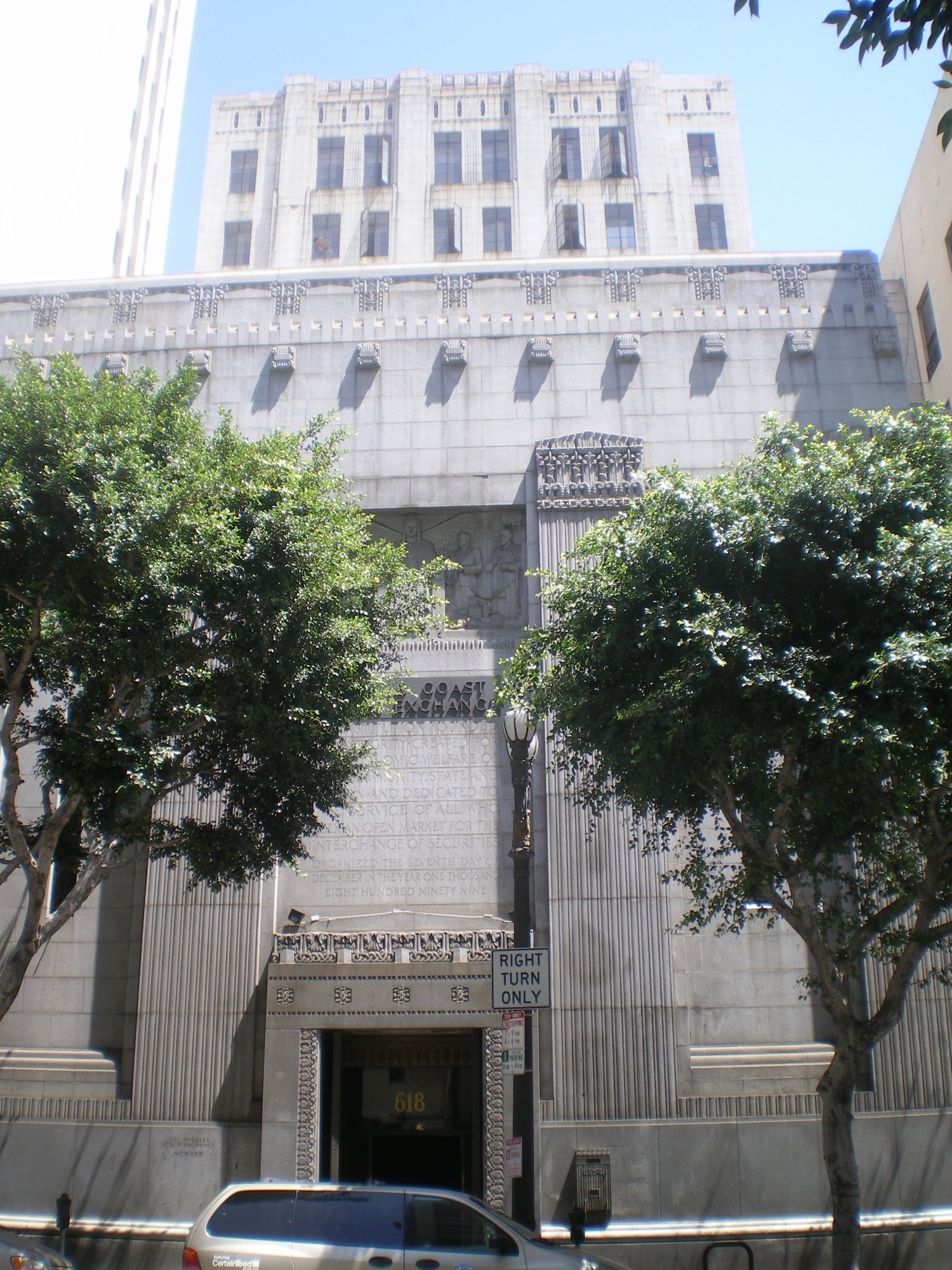
The Los Angeles Stock Exchange Building at 618 South Spring Street stands as one of the finest expressions of Classical Moderne civic architecture in Southern California. Designed by Samuel E. Lunden—a young architect trained at the Massachusetts Institute of Technology—with the celebrated firm of John and Donald Parkinson serving as consulting architects, the building was constructed between 1929 and 1930 and opened for trading in 1931, in the depths of the Great Depression. As Stephen Gee documents in Iconic Vision: John Parkinson, Architect of Los Angeles (Angel City Press, 2013), the Parkinsons were simultaneously at work on Los Angeles City Hall, Bullocks Wilshire, and Union Station, making them the principal shapers of the city’s monumental architectural identity. The building’s street façade rises fifty-three feet in solid granite—a striking rarity in a city where terra cotta was the standard cladding—designed in the Classical Moderne style to project permanence and financial stability. Massive fluted pilasters articulate the façade, framing three monumental bas-relief panels by sculptor Salvatore Cartaino Scarpitta, while the central entrance features twelve-foot bronze doors claimed to be the largest ever fabricated in the western United States. Behind this fortress-like front, a slender twelve-story office tower clad in terra cotta is set back from the street line. The interior centerpiece was the grand trading hall—a double-height space measuring approximately ninety by seventy-four feet, ringed by a mezzanine balcony and rising forty feet to a decorated ceiling—containing sixty-four trading booths. The building is a designated Los Angeles Historic-Cultural Monument within the Spring Street Financial Historic District, listed on the National Register of Historic Places in 1979. After the Pacific Stock Exchange vacated in 1986, extensive renovation transformed the trading floor into Exchange LA, a nightclub and event venue—an adaptive reuse that preserved the monumental exterior while repurposing the trading space.
The decorative program of the Los Angeles Stock Exchange Building constitutes one of the most ambitious artistic ensembles created for a financial institution on the American West Coast during the interwar period. The exterior’s three monumental limestone bas-relief panels, designed by the Sicilian-born sculptor Salvatore Cartaino Scarpitta (1887–1948), are titled Research and Discovery, Production, and Finance. Scarpitta—trained at the Accademia di Belli Arti di Palermo before settling in Los Angeles in 1923—rendered allegorical figures embodying the social contributions of capital markets, with the Finance panel incorporating the familiar iconography of the bull and the bear. The American Institute of Architects awarded Scarpitta a prize specifically for these entrance panels, recognizing their integration of figural sculpture with the building’s Moderne vocabulary. The twelve-foot bronze entrance doors constituted works of decorative art, their surfaces articulated with intricate geometric patterns in low relief exemplifying the Moderne aesthetic’s fusion of machine-age precision with handcraft tradition. Inside the trading hall, the interior design was orchestrated by Julian Ellsworth Garnsey, who drew upon an eclectic vocabulary blending ancient Near Eastern and Native American motifs—a characteristically Southern Californian synthesis reflecting the region’s fascination with pre-Columbian and Mesopotamian design sources. The Wilson Studio created four sculptured allegorical figures for the entrance lobby ceiling representing Speed (Mercury), Accuracy (an archer), Permanence (a figure contemplating the universe), and Equality (a figure bearing scales). This iconographic program—transforming abstract financial principles into tangible bodily allegories positioned directly above the heads of traders entering the hall—enacted a spatial rhetoric in which the physical environment legitimated and dignified the commercial activities conducted within.
The Los Angeles Stock Exchange Building occupies a pivotal position within the Spring Street Financial Historic District, the three-block corridor between Fourth and Seventh Streets that served as the financial capital of the American West during the first half of the twentieth century. As Robert M. Fogelson documents in The Fragmented Metropolis: Los Angeles, 1850–1930 (Harvard University Press, 1967; repr. University of California Press, 1993), Los Angeles’s explosive population growth—from roughly 100,000 in 1900 to over two million by 1930—demanded financial infrastructure commensurate with the city’s ambitions, and South Spring Street became the site where that ambition took monumental form. By the 1920s, Spring Street housed the headquarters of the city’s most powerful institutions—Security Trust & Savings, Pacific Southwest Bank, Title Insurance and Trust, Bank of America, and Crocker National Bank—earning it the sobriquet “the Wall Street of the West.” Kevin Starr, in Material Dreams: Southern California Through the 1920s (Oxford University Press, 1990), situates this financial concentration within the broader narrative of Los Angeles’s self-creation as a major American metropolis, noting how the oil discoveries at Signal Hill (1921) generated fortunes demanding institutional management. Yet the district’s preeminence proved ephemeral. Beginning in the 1960s, the Community Redevelopment Agency’s transformation of Bunker Hill drew financial institutions westward along Figueroa Street and Wilshire Boulevard; in 1973, United California Bank abandoned its Spring Street headquarters for a sixty-two-story tower, symbolizing the definitive shift. The Pacific Stock Exchange departed 618 South Spring in 1986. The twenty-three financial structures of the Spring Street Historic District survive today as an architectural time capsule of early twentieth-century Western finance.
The institutional history of the Los Angeles Stock Exchange traces a trajectory from frontier oil speculation to Pacific Rim finance. The exchange originated in 1899, when a group of oil company owners led by Wallace Hardison—co-founder of the Union Oil Company—organized the Los Angeles Oil Exchange, holding its first session on February 1, 1900. In December 1900 the name changed to the Los Angeles Stock Exchange, absorbing the California Oil Exchange in 1900 and the Los Angeles Nevada Mining Exchange in 1909. As Jules Tygiel recounts in The Great Los Angeles Swindle: Oil, Stocks, and Scandal During the Roaring Twenties (Oxford University Press, 1994), the oil discoveries of the early 1920s—particularly at Signal Hill near Long Beach in 1921—unleashed a torrent of speculative energy, and the exchange opened a separate facility dedicated exclusively to oil stocks. The Julian Petroleum scandal of 1927, in which promoter C. C. Julian and a pool of prominent businessmen including Louis B. Mayer perpetrated a massive stock fraud, devastated tens of thousands of small investors. Kevin Starr’s Endangered Dreams (Oxford, 1996) frames this episode within the broader collapse of 1920s boosterism. The decision to construct a monumental headquarters on Spring Street—opened in 1931—represented a deliberate assertion of institutional permanence after scandal and amid the Depression. In 1957, the Los Angeles Stock Exchange merged with the San Francisco Stock and Bond Exchange to form the Pacific Coast Stock Exchange, maintaining trading floors in both cities. Renamed the Pacific Stock Exchange in 1973 and demutualized in 1999 as the first American exchange to do so, the Los Angeles trading floor closed in 2001. NYSE Arca acquired the Pacific Exchange in 2005, ending over a century of independent West Coast securities trading.
The securities traded on the Los Angeles Stock Exchange reflected the distinctive industrial economy of Southern California—built on resource extraction, real estate, and entertainment rather than the manufacturing that dominated eastern exchanges. From its founding as the Los Angeles Oil Exchange in 1899, petroleum securities constituted the exchange’s lifeblood. As Kenny A. Franks and Paul F. Lambert document in Early California Oil: A Photographic History, 1865–1940 (Texas A&M University Press, 1985), the oil discoveries transforming the Los Angeles Basin—from Edward Doheny’s 1892 strike through the massive fields at Huntington Beach (1920), Signal Hill (1921), and Santa Fe Springs (1923)—generated hundreds of small drilling companies whose shares constituted the bulk of early listings. Jules Tygiel’s The Great Los Angeles Swindle documents how oil stock volume became so enormous that the exchange established a separate facility exclusively for petroleum issues. Mining shares—particularly Nevada silver and gold operations—comprised a second major category, formalized by absorbing the Los Angeles Nevada Mining Exchange in 1909. Real estate securities, including mortgage bonds financing the 1920s construction boom that Edward Glaeser and Joseph Gyourko analyze in their NBER Working Paper 18852 (2013), circulated actively as Los Angeles’s population tripled. The rise of the motion picture industry added distinctive local coloring: shares of film production and distribution companies were listed alongside oil and mining stocks, making this exchange unique in reflecting the capitalization of the entertainment industry. After the 1957 merger with San Francisco, the combined Pacific Exchange broadened listings to national equities and became a major options trading venue in the 1970s and 1980s.
Images will be added as the project develops. Photographs by Larry Ng and from research sources.