Steelyard of the Hanseatic League (Stalhof)
London, England · Established c. 1320
This site requires authorization to access.
To request access, contact
william.goetzmann@yale.edu
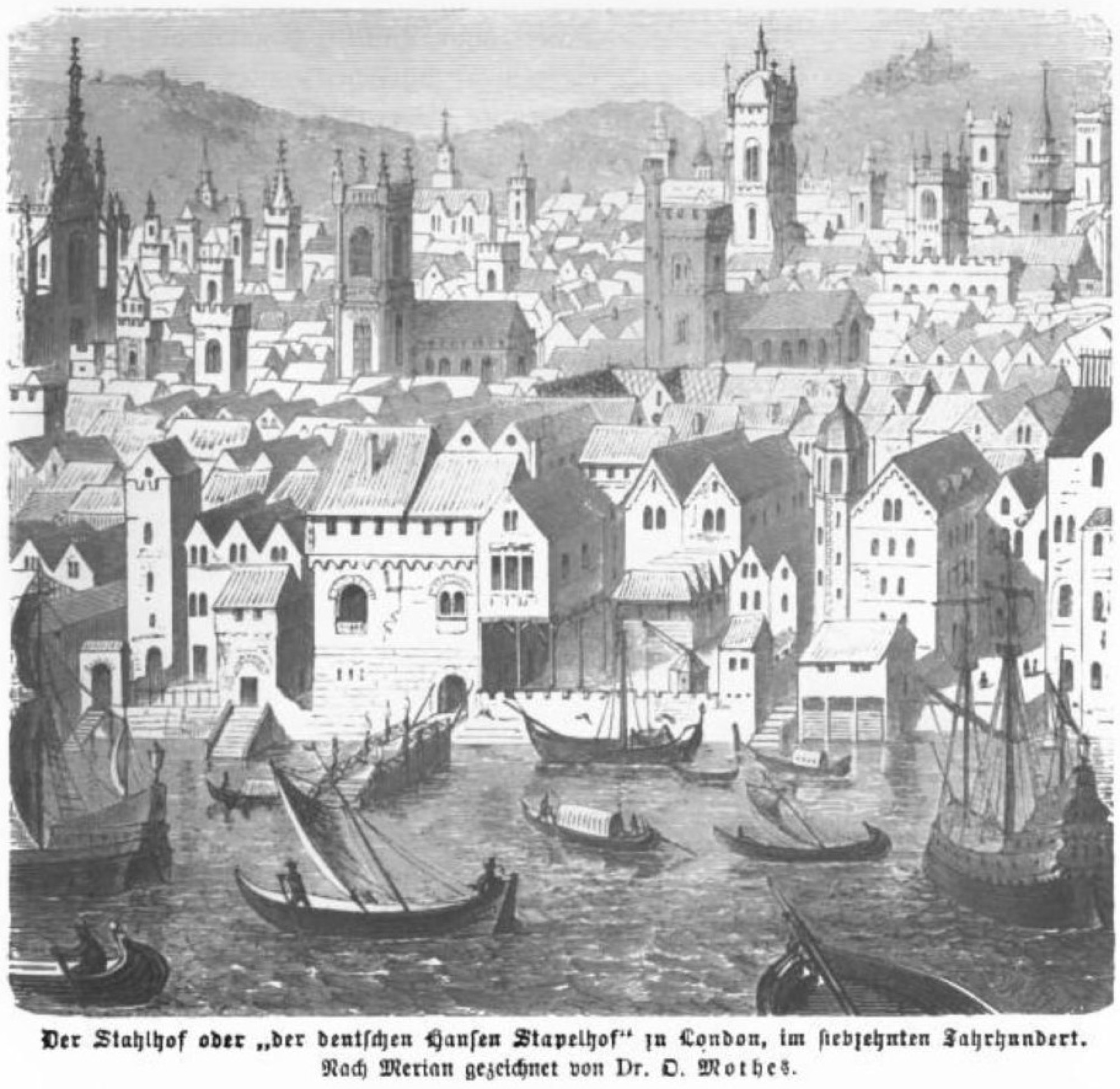
The Steelyard -- known in German as the Stalhof -- occupied a walled compound of approximately 5,250 square meters (1.3 acres) on the north bank of the Thames, bounded by Cousin Lane to the west, Allhallows Lane to the east, Upper Thames Street to the north, and the river itself to the south, in the Dowgate ward of the City of London. The compound exemplified the fondaco or factory typology of medieval long-distance trade: a fortified, self-contained merchant colony in a foreign city, comparable to the Venetian Fondaco dei Tedeschi or the Hanseatic Kontore in Bergen, Bruges, and Novgorod. John Stow, writing in his Survey of London (1598), described its imposing street frontage: a large stone hall with "three arched gates towards the street, the middlemost whereof is farre bigger then the other, and is seldome opened; the other two bemured up; the same is now called the old hall." Behind this stern facade lay a complex ensemble of buildings accumulated over centuries: a great guildhall for assemblies and feasting, a weighing house (from which the English name "Steelyard" likely derives, referencing the steelyard balance used for weighing imported goods), cloth halls, counting houses, warehouses with direct river access, wine cellars for storing Rhenish vintages, a chapel, kitchens, residential quarters, and gardens descending to the waterfront with vines and fruit trees. Over forty meters of land had been reclaimed from the river by the fourteenth century to create usable wharf space, and a crane operated on the waterfront for loading and unloading cargoes from the Hanseatic cogs that arrived from Lubeck, Danzig, and the Baltic ports. The compound was governed by a council of twelve, including a Master and two assessors, and operated under strict internal discipline: women were forbidden entry, marriage was prohibited for resident merchants, a curfew was enforced, and gatekeepers controlled access. As T.H. Lloyd documented in England and the German Hanse, 1157-1611 (Cambridge, 1991), at its peak the compound housed as many as four hundred residents, functioning as a miniature city within the City of London. After Elizabeth I revoked Hanseatic privileges in 1598, the compound gradually emptied -- by 1632 no Hanseatic merchants remained in residence. The medieval buildings were destroyed in the Great Fire of London in 1666, though the properties remained in the hands of Lubeck, Hamburg, and Bremen until 1853, when they were sold for 70,000 pounds to the South Eastern Railway Company for the construction of Cannon Street Station. Museum of London Archaeology excavations in 1988-89 uncovered remains of the former kontor beneath the station, including late twelfth-century ragstone precinct walls up to 1.4 meters high, distinctive coin-like jettons used by Hanse merchants for accounting, and lead seal hallmarks for authenticating wool bales. The site is today commemorated in the names of Steelyard Passage and Hanseatic Walk.
The Steelyard's most significant artistic legacy is the body of work produced by Hans Holbein the Younger during his association with the Hanseatic merchants in the 1530s. Holbein, who had returned to England from Basel in 1532, found wealthy patrons among the German merchants of the Steelyard and painted a remarkable series of at least eight individual portraits of members of the community between 1532 and 1536. The most celebrated of these is the Portrait of the Merchant Georg Gisze (1532), an oil on oak panel measuring 86.2 by 97.5 centimeters, now in the Gemaldegalerie, Berlin. As Thomas S. Holman analyzed in "Holbein's Portraits of the Steelyard Merchants: An Investigation" (Metropolitan Museum Journal, vol. 14, 1979), the Gisze portrait is unique among the series in depicting its subject within his working environment -- a wood-panelled counting room filled with the paraphernalia of trade: sealed letters from correspondents across northern Europe, a balance for weighing coins, inkpots, scissors, sealing wax, a signet ring, account books, and a Turkish carpet draped over the table, with a glass vase of carnations possibly symbolizing his betrothal (Gisze married Christine Kruger in Danzig in 1535). The other Steelyard portraits -- including Hermann von Wedigh III of Cologne (1532, Metropolitan Museum of Art, New York), Derich Born (1533, Royal Collection), Dirk Tybis of Duisburg (1533, Kunsthistorisches Museum, Vienna), Hans of Antwerp (1532, Royal Collection), and Derick Berck of Cologne (1536, Metropolitan Museum of Art) -- are more conventional bust-length compositions that emphasize the sitters' social status and humanist cultivation rather than their commercial surroundings. In addition to these individual portraits, Holbein executed two monumental allegorical paintings for the Steelyard's great hall or dining room: The Triumph of Riches and The Triumph of Poverty, commissioned around 1532-33. These were very large compositions (between 2.22 and 2.44 meters high), painted on canvas in grisaille on a blue background, heightened with gold and lightly tinted in watercolor. Their subjects corresponded to the Hanseatic merchants' Latin motto inscribed over the main entrance to the compound: "Aurum est laeticiae pater et curae filius; qui caret eo tristatur, qui possidet timet" (Gold is the father of joy and the son of care; he who lacks it is sad, he who has it is uneasy). Following the dissolution of the Steelyard, the paintings passed to Henry, Prince of Wales, thence to Charles I, and through exchange to the Earl of Arundel -- Joachim von Sandrart saw them hanging at Arundel House in 1627. They were eventually shipped to Antwerp and destroyed by fire at the Bishop's Palace in Kremsier (now Kromeriz, Czech Republic) in 1752. Holbein's original pen-and-ink preparatory drawing for The Triumph of Riches, washed with Indian ink and heightened with white, survives in the Louvre; copies of both compositions by Lucas Vorsterman the Elder (made between 1624 and 1630) are in the Ashmolean Museum, Oxford, and further copies and drawings after the originals are held by the British Museum. The Steelyard also possessed a corporate seal, and the community's material culture -- including accounting jettons and lead wool-seals unearthed in the 1988-89 excavations -- provides further evidence of its visual and commercial identity.
The Steelyard's position on the Thames waterfront in Dowgate ward placed it at the heart of medieval London's commercial geography. Situated on the north bank where the Walbrook -- one of London's ancient tributaries -- emptied into the Thames, the compound lay just downstream from London Bridge, which until 1750 was the only fixed crossing of the river and thus the focal point of the city's overland and waterborne trade. The Thames itself served as London's principal commercial artery: goods arrived by ship from the Continent, the Baltic, and the English coastal trade, and were landed at the series of wharves, quays, and hithes (landing places) that lined the riverbank from the Tower downstream to Queenhithe upstream. The Steelyard's waterfront location gave Hanse merchants direct access to this river traffic -- their own crane and wharves allowed cargoes to be loaded and unloaded without passing through the public port facilities. Nearby Billingsgate, just east of London Bridge, had been a landing place since at least the tenth century and was evolving into the great fish market that would dominate it by the sixteenth century. The Steelyard was not the only foreign merchant enclave in medieval London. As Philippe Dollinger described in The German Hansa (1970), the city's commercial landscape was punctuated by a series of national trading communities: Italian merchants -- Florentines, Genoese, Lucchese, and Venetians -- concentrated in and around Lombard Street, where they had settled from the mid-thirteenth century, introducing bills of exchange and sophisticated banking techniques. The Venetians operated through their own agents rather than a fixed fondaco, while the Florentine houses of Bardi and Frescobaldi had served as bankers to the English Crown. The proximity of these different merchant communities -- the Germans at the Steelyard, the Italians in Lombard Street, the English Merchant Adventurers headquartered nearby -- created a densely layered commercial topography in which the medieval City of London functioned as an international entrepot. The Steelyard's position within Dowgate ward was also significant because the ward contained several important hithes and water-gates giving access to the Thames, and its merchants -- though nominally subject to the ward's jurisdiction -- maintained the extraordinary privilege of electing their own alderman, a mark of the compound's quasi-extraterritorial status within the city.
The presence of German merchants in London can be traced to the mid-twelfth century. As T.H. Lloyd documented in England and the German Hanse, 1157-1611 (Cambridge University Press, 1991), the first record of German traders acquiring a base in London dates to 1157, when merchants from Cologne purchased a house on the Thames waterfront near Dowgate; in the same year, Henry II granted them trading privileges in England. Over the following century, separate groups of merchants from Hamburg, Lubeck, and the Westphalian towns established their own footholds in the city, each with slightly different sets of rights and privileges. A critical turning point came in 1266, when Henry III, having received financial support from the Hanse merchants during his conflict with Simon de Montfort, granted a formal charter to the merchants of Hamburg and Lubeck, permitting them to form their own trade association (hanse) and to regulate their own affairs -- it is in these charters of 1266 and 1282 that the term "Hanse" first appears in English records. Edward I's Carta Mercatoria of 1303 further consolidated their privileges, granting customs concessions that allowed Hanseatic merchants to pay lower duties than their English competitors, a source of lasting resentment. The various German merchant groups gradually consolidated at the Dowgate site, which was formally established as the London Kontor around 1320 and recognized as the chief executive authority of the Hanse in England by 1300. In 1475, following the Treaty of Utrecht that ended a period of Anglo-Hanseatic conflict, the League purchased the London compound outright, and it became universally known as the Steelyard. Philippe Dollinger, in The German Hansa (1970), characterized the London Kontor as one of the four great Kontore of the Hanseatic system, alongside Bergen, Bruges, and Novgorod. Throughout the fourteenth and fifteenth centuries, the Steelyard merchants' privileges provoked escalating tensions with English traders, particularly the Company of Merchant Adventurers, which sought to break the Hanse monopoly on the export of English cloth to northern European markets. Stuart Jenks, in "The London Steelyard's Certifications of Membership 1463-1474 and the European Distribution Revolution" (in Wubs-Mrozewicz and Jenks, eds., The Hanse in Medieval and Early Modern Europe, Brill, 2013), showed how the Steelyard's alderman was compelled to issue formal membership lists certifying who was entitled to Hanseatic privileges, as the English government grew concerned that non-Hansards were trading under the League's preferential customs rates. In 1519 Cardinal Wolsey accused the merchants of selling unfinished cloth in violation of English regulations and demanded sureties totaling 18,800 pounds. The decisive blow came under Elizabeth I: the Merchant Adventurers, now politically powerful and backed by the Crown, secured the formalization of their cloth-trade monopoly in 1564, and in 1598 Elizabeth revoked all Hanseatic privileges and ordered the Steelyard closed -- a retaliatory measure after the Hanse Diet expelled the Merchant Adventurers from the Holy Roman Empire. James I briefly returned the seized properties in 1606, but by 1623 only five merchants remained, and by 1632 the compound was entirely deserted.
The Steelyard functioned as the central node in a trading network that linked England to the Baltic, Scandinavia, the Rhineland, and the Low Countries. As John Stow recorded in his Survey of London (1598), the goods imported by the Hanse merchants included "Wheate, Rie, and other graine, as Cables, Ropes, Masts, Pitch, Tar, Flaxe, Hempe, linnin cloth, Wainscots, Waxe, [and] Steele." T.H. Lloyd's detailed analysis of English customs accounts in England and the German Hanse (1991) reveals the full scope of this commerce: from the Baltic came furs (particularly squirrel pelts from Novgorod), beeswax for candles and sealing, timber products including ship masts and bow staves, metals such as iron, copper, and steel from Sweden, and dried fish (stockfish). From the Rhineland came wine -- the Hansards were the principal importers of Rhenish wine into London, storing it in the Steelyard's own cellars and permitted to sell it only within the compound. In the other direction, the chief English export was cloth: first raw wool, and from the fourteenth century increasingly finished or semi-finished woollen broadcloth, which the Hanse merchants shipped to the great fairs and markets of northern Europe. By the sixteenth century, according to Lloyd, Hanseatic merchants controlled a substantial share of London's cloth exports. The weighing house at the heart of the compound was essential to these operations -- the King's crane-balance for weighing tonnage had originally been located at the Steelyard before moving to Cornhill, and the Germanic merchants are credited with introducing standardized weighing methods to London, with official weights of the mid-thirteenth century known as "steelyard weights." The Hanse merchants' commercial practices included the use of bills of exchange for transferring funds across Europe without physical coin transport, and they developed increasingly sophisticated credit instruments -- as the Hanseatic League's commercial law evolved, bills of exchange drawn on merchants in different cities and denominated in different currencies facilitated multilateral settlement of trade balances. The Steelyard merchants also traded in linen cloth, canvas, flax, hemp, potash, and ashes. Their privileged customs rates -- lower than those paid by English merchants under the terms of the Carta Mercatoria of 1303 -- gave them a decisive competitive advantage that was the source of centuries of conflict with English traders, and it was ultimately the Merchant Adventurers' determination to capture the cloth-export trade for themselves that led to the political campaign resulting in the Steelyard's closure in 1598.
Images will be added as the project develops. Photographs by Larry Ng and from research sources.