Royal Exchange
London, England · Established 1565
This site requires authorization to access.
To request access, contact
william.goetzmann@yale.edu
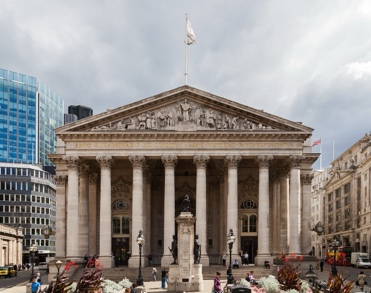
The Royal Exchange has occupied the same site between Cornhill and Threadneedle Street through three successive buildings. Sir Thomas Gresham's original structure, begun on 7 June 1566 under a Flemish master builder known as Henrik, was modeled on the Antwerp Bourse and constructed largely with materials imported from the Low Countries -- slates from Dort, wainscoting and glass from Amsterdam -- forming a four-storey arcaded building around a central open courtyard where merchants gathered beneath covered piazzas, with 109 small shops crammed into the upper floors and a bell tower crowned by an eleven-foot gilded brass grasshopper, the Gresham family crest. After the Great Fire destroyed this first building in 1666, City surveyor Edward Jerman designed a grander Baroque replacement that opened in 1669, featuring a stone facade with Corinthian three-quarter columns, arched entrances to the inner court, statues of English monarchs in niches, and a soaring 178-foot clock tower that dominated the City skyline for nearly two centuries until the building itself was consumed by fire on 10 January 1838 -- a conflagration visible from Windsor, twenty-four miles distant. The present and third Royal Exchange, designed by Sir William Tite after he won an architectural competition in 1839-40, was built in Portland stone between 1841 and 1844 in a Roman Corinthian style, its western facade dominated by a magnificent portico of eight fluted Corinthian columns, and its interior arranged around an ambulatory courtyard measuring 170 feet by 113 feet, modeled after the open courts of Italian Renaissance palaces. Queen Victoria opened the building on 28 October 1844, and its tower -- standing 177 feet above street level -- contains a clock by Edward John Dent and a chime of fifteen bells cast by Charles and George Mears of Whitechapel; in 2001 the courtyard was roofed with a glazed barrel vault during a comprehensive restoration by Aukett Fitzroy Robinson that transformed the Grade I-listed building into a luxury shopping and dining destination.
The crowning artistic achievement of the third Royal Exchange is Richard Westmacott the Younger's monumental pediment sculpture, a tympanum of seventeen figures allegorizing global commerce: at the center stands the crowned figure of Commerce holding a charter of exchange in one hand and a ship's rudder in the other, flanked by a ship's prow, a beehive, and an overflowing cornucopia, while radiating outward appear a Turkish merchant doing his accounts, an Armenian banker, a Greek man bearing an amphora, two Indians (one Muslim, one Hindu), a Chinese trader, a Levantine sailor, an African, a British sailor, and a supercargo, with the inscription below -- chosen by Prince Albert from Psalm 24 -- reading 'The Earth is the Lord's, and the fulness thereof.' Beginning in 1892, twenty-four large murals depicting pivotal scenes from London's commercial history were painted on the first-floor walls by some of the leading artists of the Victorian age, including Lord Frederic Leighton's 'Phoenicians Trading with Early Britons on the Coast of Cornwall' (completed 1895 in spirit fresco on canvas, measuring 5.5 by 3.6 meters), Sir Frank Brangwyn's 'Modern Commerce' (1899), and Stanhope Forbes's scene commemorating the destruction of the second Royal Exchange by fire in 1838. The ornamental cast ironwork throughout the interior was executed by Henry Grissell's Regent's Canal Ironworks, and the building's internal finishes include colored mosaics and marble that complement the grand ambulatory arcades.
The Royal Exchange commands the eastern side of Bank junction, the great convergence point in the heart of the City of London where nine streets meet and three of the most powerful institutions of British finance face one another across a triangular open space: the Bank of England stands directly to the north across Threadneedle Street, the Mansion House (official residence of the Lord Mayor) sits to the southwest on Walbrook, and the Royal Exchange presides between them. When William Tite designed the third building, he made the decisive choice to reorient its principal entrance from Cornhill to face westward onto the junction, and the triangular cluster of old buildings that had previously filled the space was demolished, creating the dramatic open forecourt that allows the full Corinthian portico to be seen in dialogue with the Mansion House's own classical facade across the way. This junction has been a center of gravity in the City since Roman times -- extensive Roman remains have been found deep below the present surface -- and its significance as the ceremonial and commercial heart of the Square Mile is reinforced by the equestrian statue of the Duke of Wellington positioned between the three buildings.
Sir Thomas Gresham, merchant, royal agent in Antwerp, and future founder of Gresham College, conceived the Royal Exchange in the early 1560s as England's answer to the great bourses of the Continent, providing London's merchants with a purpose-built gathering place to replace the open-air dealings on Lombard Street; Queen Elizabeth I visited the completed building on 23 January 1571, dined with Gresham, and commanded that a herald proclaim it the 'Royal Exchange,' a title it has borne ever since. The first building perished in the Great Fire of London in September 1666, but was rebuilt within three years under Edward Jerman and reopened on 28 September 1669; this second exchange served for nearly 170 years before it too was destroyed by fire on 10 January 1838, caused by an overheated stove. William Tite's third building, opened in 1844, continued as a center for mercantile activity through the nineteenth century; Lloyd's of London occupied rooms in the Exchange from 1774 until 1928, and the London International Financial Futures Exchange (LIFFE) used the courtyard as an open-outcry trading floor from 1982 until 1991, making it one of the last great buildings in the City to echo with the shouts of pit traders. Trading operations eventually departed, and after standing largely unused through the 1990s, the building was comprehensively restored and reopened in 2001 as a luxury retail and dining venue, preserving its architectural grandeur while finding a new commercial life in the twenty-first century.
The Royal Exchange was conceived as a commodities bourse where merchants from across the known world could gather to negotiate the purchase and sale of physical goods, and its open courtyard was informally divided into specialized 'walks' associated with particular trades or regions -- designated areas where merchants dealing in specific commodities or trading with specific parts of the globe would congregate, much as the specialized trading posts of the Antwerp Bourse on which it was modeled. In 1698 stockjobbers were expelled from the Royal Exchange for their rowdy behavior and migrated to the nearby coffee houses of Exchange Alley -- notably Jonathan's Coffee-House and Garraway's -- where they continued to deal in shares and government securities, an expulsion that inadvertently planted the seed from which the London Stock Exchange would eventually grow. From 1774, Lloyd's underwriters took rooms in the Royal Exchange itself, conducting marine insurance business within its walls until relocating in 1928, and the building thus served simultaneously as a market for physical commodities, a hub for insurance underwriting, and a nexus for the financial services that clustered around it in the surrounding streets and coffee houses.