The Old Jewry (Medieval Jewish Quarter of London)
London, England · Established c. 1070 (Jewish settlement under William I); expelled 1290
The medieval London Jewry had no single monumental building. What survived from it was a cluster of houses, synagogues, ritual baths and schools, worked into the ordinary stone and timber fabric of the City north of Cheapside. Joe Hillaby's topographical reconstruction from deeds, the Hundred Rolls and post-1290 escheat records ("London: the 13th-century Jewry revisited," Jewish Historical Studies 32, 1990-92) is still the basis for mapping it. Hillaby and others identify at least five synagogue sites in the documents, though for most of them the plan and appearance are unknown. The best documented is the "Great Synagogue" at the north corner of Old Jewry, where the street meets the modern Gresham Street. A City plaque at the street marks its site. In 1271-72 the Friars of the Sack, a small penitential order that had arrived in London in 1257 and settled next to it, complained that Jewish worship ("howling," in the chronicle phrasing) disturbed their devotions. Henry III then granted them the synagogue and allowed the Jews to build another (Victoria County History, London, vol. 1, 1909, "Friars of the Sack"). John Stow (Survey of London, 1598/1603, Coleman Street Ward) follows the building's later history: Robert Fitzwalter acquired the friars' chapel, "of olde time called the Synagogue of the Iewes," in 1305; the mayors Robert Large (1439) and Hugh Clopton (1492) later kept their mayoralties in the house; and in Stow's day it was a tavern with the sign of a windmill. An earlier "new synagogue" had been confiscated c. 1230-32 and given to the brethren of St Anthony of Vienne. Sources place it in Old Jewry or in Threadneedle Street, and both its date and its site differ between accounts.
The most tangible remains are two mikva'ot (ritual immersion baths). In 1986 Ken Steadman excavated a small, roughly built subterranean chamber of greensand blocks at Guildhall House, 81-87 Gresham Street (site code GDH85). It was first read as a strong-room, and Richard Sermon reinterpreted it as a mikveh in 1990. In 2001 Ian Blair's Museum of London Archaeology Service team found a much finer example at 1-6 Milk Street. It was an apsidal-ended chamber faced with greensand ashlar, entered from the north by at least seven steps, measuring about 3.00 by 1.20 metres internally with a maximum depth of 1.45 metres. Blair links the property to the Crespin family of financiers: Moses Crespin held it in 1290, having inherited it from his father Jacob. The joint report (Blair, Hillaby, Howell, Sermon and Watson, "The discovery of two medieval mikva'ot in London and a reinterpretation of the Bristol 'mikveh'," Jewish Historical Studies 37, 2001-02) dates the Milk Street bath to the thirteenth century. The Milk Street bath was dismantled with funding from the Bevis Marks congregation, stored at the London Archaeological Archive, and rebuilt at the Jewish Museum London in Camden in 2010.
Two other royal buildings were part of the Jewry's institutional landscape. In 1232 Henry III founded the Domus Conversorum, a house and chapel for converts from Judaism, on New Street (Chancery Lane), outside the City. After 1290 its wardenship passed to the Keeper (later Master) of the Rolls, and the chapel became the Rolls Chapel. The site is now King's College London's Maughan Library, which keeps a medieval arch from the chapel (Lauren Fogle, The King's Converts, 2019). The Exchequer of the Jews, by contrast, sat with the Exchequer at Westminster. The building that housed London's archa, the chest of registered bonds, has not been securely identified.
Almost nothing survives of the London Jewry's own decorative culture. No synagogue fittings, painted interiors or carved stonework have been securely identified, and the dressed ashlar of the Milk Street mikveh, with its visible chisel marks, is the nearest thing to an architectural ornament from the community. Most of the visual record was made by Christian clerks about Jews, inside the bureaucracy that administered Jewish credit.
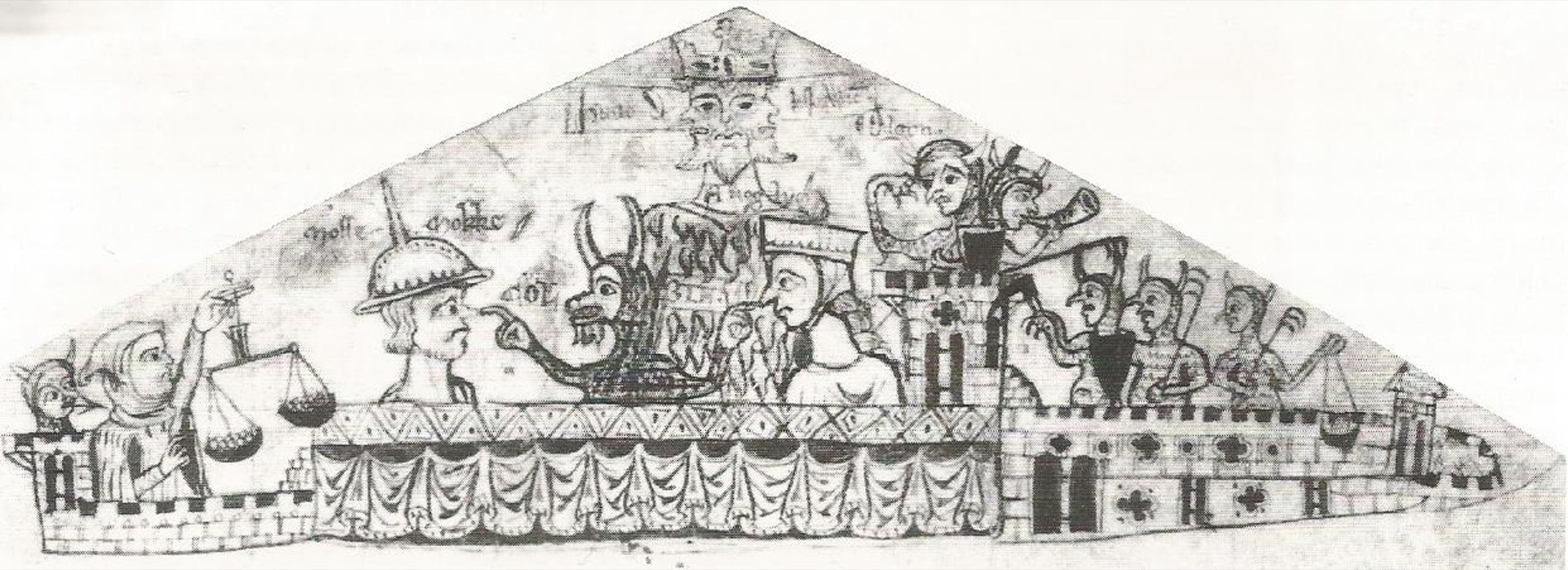
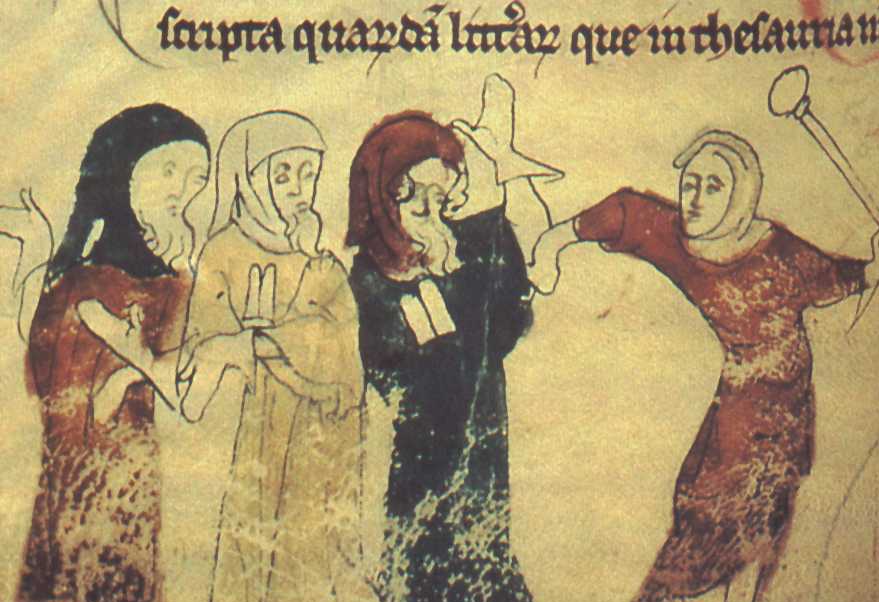
The best-known image is not a London subject. In the upper margin of an Exchequer receipt roll for Hilary and Easter terms 1233 (The National Archives, E 401/1565), a clerk drew a crowned, three-faced "Isaac of Norwich" above the Norwich Jews Mosse Mokke and Avegaye, surrounded by demons. It is often called the earliest dated anti-Jewish caricature. Sara Lipton ("Isaac and Antichrist in the Archives," Past & Present 232, 2016; Dark Mirror, 2014) argues that it should be read as a court satire produced inside the Exchequer, not as a straightforward expression of popular hatred. She also notes that the people drawn do not appear as payers on that roll. The image belongs to Norwich and to the Westminster Exchequer, not to the Old Jewry, and is relevant here as evidence of how the royal financial machine saw its Jewish creditors. The Rochester chronicle (British Library, Cotton MS Nero D II, fol. 183v), a fourteenth-century manuscript, has a small marginal miniature of Jews being beaten. It is traditionally associated with the expulsion of 1290.
The documents of the Jewish credit system were themselves made objects. A chirograph was written in duplicate or triplicate on one sheet and cut through a word or pattern, so that the pieces could be matched later. Michael Clanchy (From Memory to Written Record: England 1066-1307, 1979; 3rd ed. 2013) treats this technique as central to the spread of written proof in England. A starr (from the Hebrew shetar, deed) was a Hebrew acquittance or quitclaim, often with a Latin summary. Hundreds survive, and a large group is in the Westminster Abbey Muniments. Many were edited in J. M. Rigg's Select Pleas, Starrs, and Other Records from the Rolls of the Exchequer of the Jews (Selden Society, 1902) and in Israel Abrahams, H. P. Stokes and Herbert Loewe, Starrs and Jewish Charters Preserved in the British Museum (1930-32). The notched wooden Exchequer tally, the Crown's receipt for money paid in, makes a natural visual companion. It was a related but distinct record.
Later depictions of the area are topographical, not medieval. Examples are Thomas Hosmer Shepherd's steel engraving of Wren's St Olave Old Jewry (c. 1850) and Samuel Ireland's drawing of the Rolls Chapel on Chancery Lane (c. 1800, Yale Center for British Art). The modern commemorative sculpture of Licoricia of Winchester by Ian Rank-Broadley (unveiled in Winchester in 2022) honours the most prominent Jewish businesswoman of the period. Winchester, not London, was her base.
The Jewry occupied the commercial core of the medieval City. It stood immediately north of Cheapside, London's main market street, and south and east of the Guildhall, the seat of civic government. The street now called Old Jewry, a short lane from Poultry to Gresham Street, was simply "the Jewry" while Jews lived there. A "street of the Jews" is recorded by 1128, and the "Old" was added only after 1290. Hillaby's mapping (Jewish Historical Studies 32, 1990-92) and the JTrails survey of the City show Jewish households spread along Old Jewry, Ironmonger Lane, Milk Street, Wood Street, Basinghall Street and Coleman Street. They also lived along the line of modern Gresham Street, then Catte Street and Lad Lane, and north towards Lothbury. Christian householders and parish churches stood among them: St Lawrence Jewry beside the Guildhall, St Olave Old Jewry, and St Martin Pomary. Robin Mundill (The King's Jews, 2010) and Hillaby both stress that this was a quarter of preference, not an enclosed ghetto in the later Venetian sense. Jews and Christians leased houses to one another and lived as neighbours.
The location matched the business. Cheapside held the goldsmiths and mercers and the City's retail and wholesale trade, and the royal exchange for coin and bullion was nearby at the Old Change by St Paul's. A lender's customers included City merchants, knights coming to Westminster, and religious houses with London agents, and all of them could reach the Jewry easily. Two other places mattered for safety and death. The Tower of London served the community as a refuge in 1189, 1220 and 1264, and later as a prison. Until 1177 the only licensed Jewish cemetery in England lay outside the wall at Cripplegate, remembered in the name Jewin Street, so the dead of provincial communities were carried to London for burial.
The quarter also stood at the head of a national credit network. London was among the original archa centres of 1194, the London community paid the largest share of the Northampton donum of 1194, and the Exchequer of the Jews at Westminster administered Jewish credit for the whole country. The Jewry was a short walk from Lombard Street, where Lucchese, Florentine and other Italian merchant-bankers settled from the middle of the thirteenth century. The two quarters sat side by side, and the second took over the first's role as royal lender after 1290. The same few hundred metres later held the Royal Exchange (1566-71), the Bank of England (whose Threadneedle Street site is near the former St Anthony's) and the Stock Exchange.
William of Malmesbury's statement that William I brought Jews from Rouen to London is the conventional starting point, and a London Jewry is documented by c. 1070. For about sixty years London was the only Jewish settlement in England. Communities appeared in provincial towns only under Stephen and Henry II (Hillaby and Hillaby, Palgrave Dictionary of Medieval Anglo-Jewish History, 2013). Jews were legally the king's property. Henry I's charter (known from later confirmations) guaranteed protection and free movement in exchange for the Crown's right to take Jewish wealth when it chose. The charter of John (1201) and the appointment of Jacob of London as presbyter Judaeorum (archpresbyter) in 1199 set the relationship in formal terms. As Richardson argued (The English Jewry under Angevin Kings, 1960), the archpresbyter was a royal official, not a chief rabbi.
Violence shaped the institutions. Jews who came to Westminster with gifts at Richard I's coronation on 3 September 1189 were driven out, and a riot followed in which the London Jewry was burned and at least thirty people were killed (Joseph Jacobs, The Jews of Angevin England, 1893). In March 1190 there were massacres at King's Lynn, Norwich, Stamford, Bury St Edmunds and York, where about 150 died at Clifford's Tower. Rioters at York burned the bonds held in the minster (R. B. Dobson, The Jews of Medieval York and the Massacre of March 1190, 1974). The Crown's answer, the ordinance of 1194 (the Capitula de Judaeis recorded by Roger of Howden), required every Jewish loan to be written as a chirograph before two Christian and two Jewish chirographers and two clerks. One part was to go into a locked archa in designated towns, London among them. The Exchequer of the Jews (Scaccarium Judaeorum), with its Justices of the Jews, developed from this between 1194 and about 1200. Earlier, the death of Aaron of Lincoln in 1186 had shown what was at stake. The king took Aaron's estate, including roughly £15,000 of debts owed by several hundred debtors, and set up a special "Exchequer of Aaron" to collect them.
The thirteenth century was a story of fiscal extraction. John's Bristol tallage of 1210 demanded 66,000 marks. Under Henry III, Robert Stacey ("Royal Taxation and the Social Structure of Medieval Anglo-Jewry: the Tallages of 1239-1242," Hebrew Union College Annual 56, 1985) shows a sharp increase in the 1240s: 20,000 marks assessed at the Worcester assembly of 1241, followed by repeated levies that drained the leading families. Licoricia of Winchester, widowed in 1244, owed 5,000 marks to the king from her husband David of Oxford's estate, and part of the money was put towards Henry's new shrine of Edward the Confessor at Westminster (Suzanne Bartlet, Licoricia of Winchester, 2009). In 1255 Henry mortgaged the whole Jewry to his brother Richard of Cornwall for 5,000 marks. During the Barons' War, London's Jewry was attacked in 1262-63, and the worst attack came in April 1264, when Montfortian forces sacked it. The alderman Arnold fitz Thedmar reported more than 500 dead. The figures and exact dates of the 1262-64 attacks vary between chronicles and modern studies. Mundill (England's Jewish Solution, 1998) treats 1262 as the start of a final, experimental phase in Crown policy.
Edward I's Statute of the Jewry (1275) banned lending at interest, required a badge from age seven, and allowed Jews to trade, work as craftsmen, and farm land on leases of up to ten years. In practice there were few such openings. In November 1278 the Jews of England were arrested in a single operation for coin-clipping, and about 600 were held in the Tower. Zefira Entin Rokéah's analysis of the trials ("Money and the hangman in late-thirteenth-century England," Jewish Historical Studies 31, 1988-90) points to some 269-293 Jews executed in London in 1278-79, along with a much smaller number of Christians. Totals differ by source. On 18 July 1290 (9 Av in the Hebrew calendar) Edward ordered all Jews to leave by 1 November. Parliament had just granted a fifteenth worth about £116,000, and Robert Stacey ("Parliamentary negotiation and the expulsion of the Jews from England," Thirteenth Century England VI, 1997) argues the two were linked. Estimates of the number who left run from about 2,000 to 3,000. The Crown took the archae and houses, but collected little of the outstanding debt.
The Jewry dealt in credit. Jewish lenders made loans to knights, magnates, townsmen and religious houses, secured on land, rents or pledges of plate and goods, at interest. A rate of twopence in the pound per week (about 43 per cent a year) is frequently attested, and higher penalty rates applied after default. Loans were recorded as chirographs, sealed by the debtor and divided among the parties and the archa. They were discharged by starrs (Hebrew acquittances) that the Exchequer could check against the deposited part. H. G. Richardson (The English Jewry under Angevin Kings, 1960) and Paul Brand (ed., Plea Rolls of the Exchequer of the Jews, vol. VI, 2005) show how fully this system worked as a public registry. The Justices of the Jews heard disputes, enrolled transfers, and "scrutinised" the archae for assessment. The Crown could see every Jewish asset, and so could tax it.
Bonds were transferable, and the secondary market in Jewish debts is the Jewry's most important lesson for financial history. A creditor, or the king after confiscating an estate or tallaging a community, could sell a bond to a third party at a discount. The buyer, often a magnate, courtier or abbey, then pursued the debtor or took the land pledged as security. Robert Stacey's studies of the 1240s-1260s and Hillaby's Palgrave Dictionary entries describe a transfer of encumbered knightly estates to well-connected buyers through these purchases. Eleanor of Castile was the most notorious: she acquired Leeds Castle and other properties, and Archbishop Pecham rebuked her for it. Earlier, Aaron of Lincoln's book of debts showed religious houses, including several Cistercian abbeys, deep in debt to a single lender, and the Crown took it over as one portfolio after 1186. The Jews were therefore a channel for royal finance as much as independent lenders. Tallages turned their capital into Crown revenue, and the debt market turned the bonds into land for the king's circle.
After the 1275 ban on interest, Robin Mundill (England's Jewish Solution, 1998) documented a shift to "commodity bonds": contracts for future delivery of wool or grain, often with prices fixed in advance. Historians still debate whether these were real forward trade or disguised loans. Jews also dealt in coin and bullion, which left them open to the coinage charges of 1278-79.
The Crown's demand for credit did not end in 1290. Lucchese and Florentine merchant-bankers on Lombard Street were already taking over that role. From 1272 the Riccardi of Lucca were Edward I's bankers, and from 1275 they were repaid out of the new wool custom of about £10,000 a year. When war with France caused a credit crisis in 1294, Edward seized their assets and ended the relationship (Richard W. Kaeuper, Bankers to the Crown: The Riccardi of Lucca and Edward I, 1973; Adrian Bell, Chris Brooks and Tony Moore on the 1294 "credit crunch"). The Frescobaldi followed, and then the Bardi and Peruzzi under Edward III. The failure of the Bardi and Peruzzi in the 1340s has traditionally been blamed on Edward's default, though Edwin Hunt (Journal of Economic History, 1990) argued that the default was not the main cause. The pattern runs from Aaron of Lincoln to the Riccardi: the Crown depended on licensed outsiders for credit, and it kept the power to expropriate them.