The New Temple (Temple Church), Knights Templar Headquarters
London, England · Established c. 1161 (New Temple site); church consecrated 1185
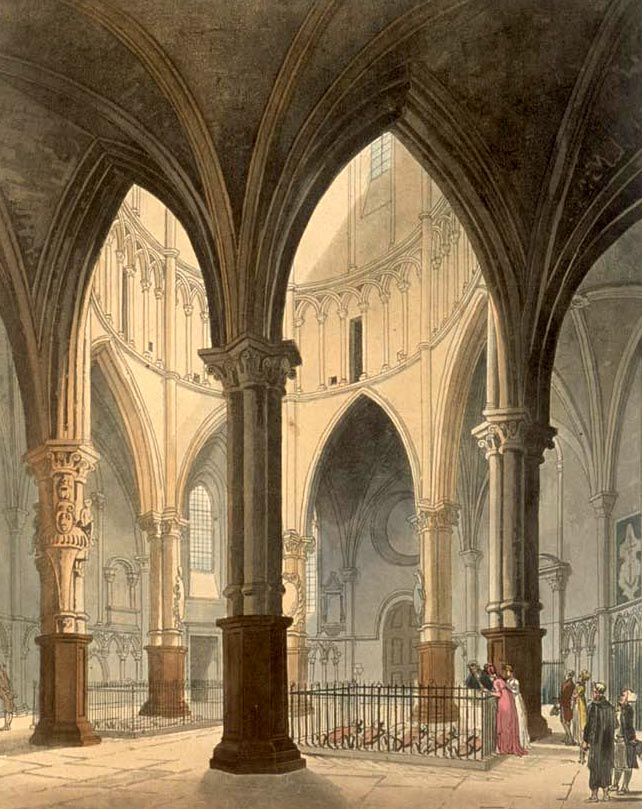
The surviving fabric of the New Temple is its church, which joins two quite different medieval buildings: a round nave and a rectangular chancel. The Round was built as the chapel of the Templars' new London headquarters, which Zachary Stewart dates to around 1160 ('Brotherly Rivals: Templars, Hospitallers and the Architectural Expansion of the Temple Church in London,' Antiquaries Journal 101, 2021), and it was consecrated on 10 February 1185 by Heraclius, Latin Patriarch of Jerusalem, who was then in England seeking help for the Latin East. The plan copies the Anastasis Rotunda of the Church of the Holy Sepulchre in Jerusalem, the order's spiritual centre, a form the Templars also used elsewhere (Sophia Dumoulin, Immediations 20, 2023, summarising Krautheimer, Nicholson and Stewart). Inside, a ring of six piers of polished Purbeck marble carries a triforium arcade and a rib-vaulted aisle around a high central drum. These are often called the earliest known free-standing Purbeck marble columns. Christopher Wilson's chapter in Robin Griffith-Jones and David Park (eds), The Temple Church in London: History, Architecture, Art (Boydell, 2010), 'Gothic Architecture Transplanted: The Nave of the London Temple Church,' argues that the nave was begun in the late 1150s by masons from far northern France. On this view it is among the earliest Gothic buildings in England, combining Romanesque sculpture with pointed arches and rib vaults (as summarised in Nigel Saul's review, English Historical Review 127, 2012). Sources disagree on the Round's diameter, giving figures of 55 to 59 feet (about 17 to 18 metres). The chancel is an aisled hall in which the aisles rise to the same height as the central vessel, about 36 feet (11 metres). Matthew Paris records that it was dedicated in the king's presence on Ascension Day 1240 (Victoria County History, London, vol. 1, 1909). Virginia Jansen's chapter in the same volume dates it to the 1230s and reads its restraint as an expression of Templar monastic values. The church escaped the Great Fire of 1666. Christopher Wren refitted it in 1682-83 in a classicising manner, adding a carved reredos and an organ screen. Robert Smirke and Decimus Burton then re-Gothicised it in 1840-43, lowering the floor fifteen inches to its medieval level and removing Wren's fittings (Dumoulin 2023). On the night of 10 May 1941 incendiary bombs set the roof of the Round alight. The fire destroyed the woodwork and the organ and split the Purbeck piers. Walter Godfrey's post-war restoration, begun in 1947-48, replaced all the Purbeck shafting in identical form on the original foundations, working partly from drawings made by Frederick Nash in 1818. The chancel was reconsecrated in 1954 and the whole church rededicated in November 1958. Stewart's verdict that 'virtually none of the visible stonework... is actually medieval' is a necessary caution for anyone reading the present building as a twelfth-century document.
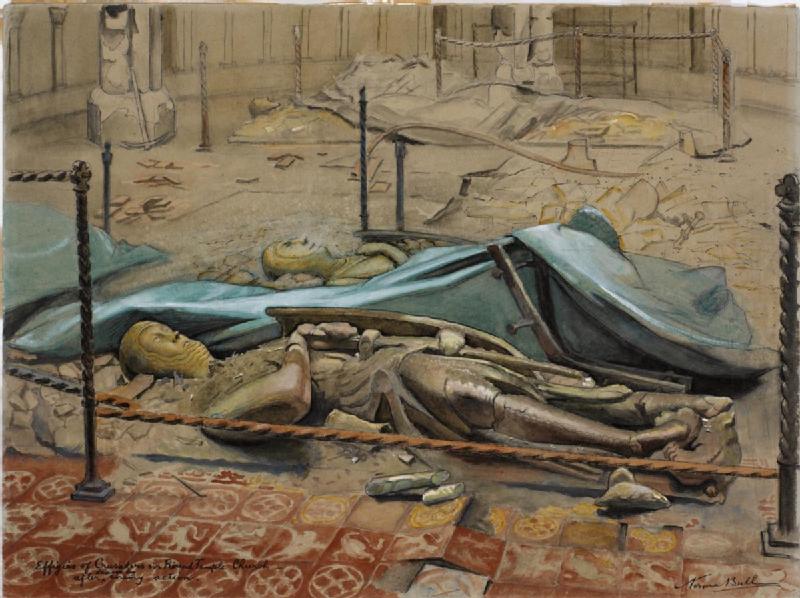
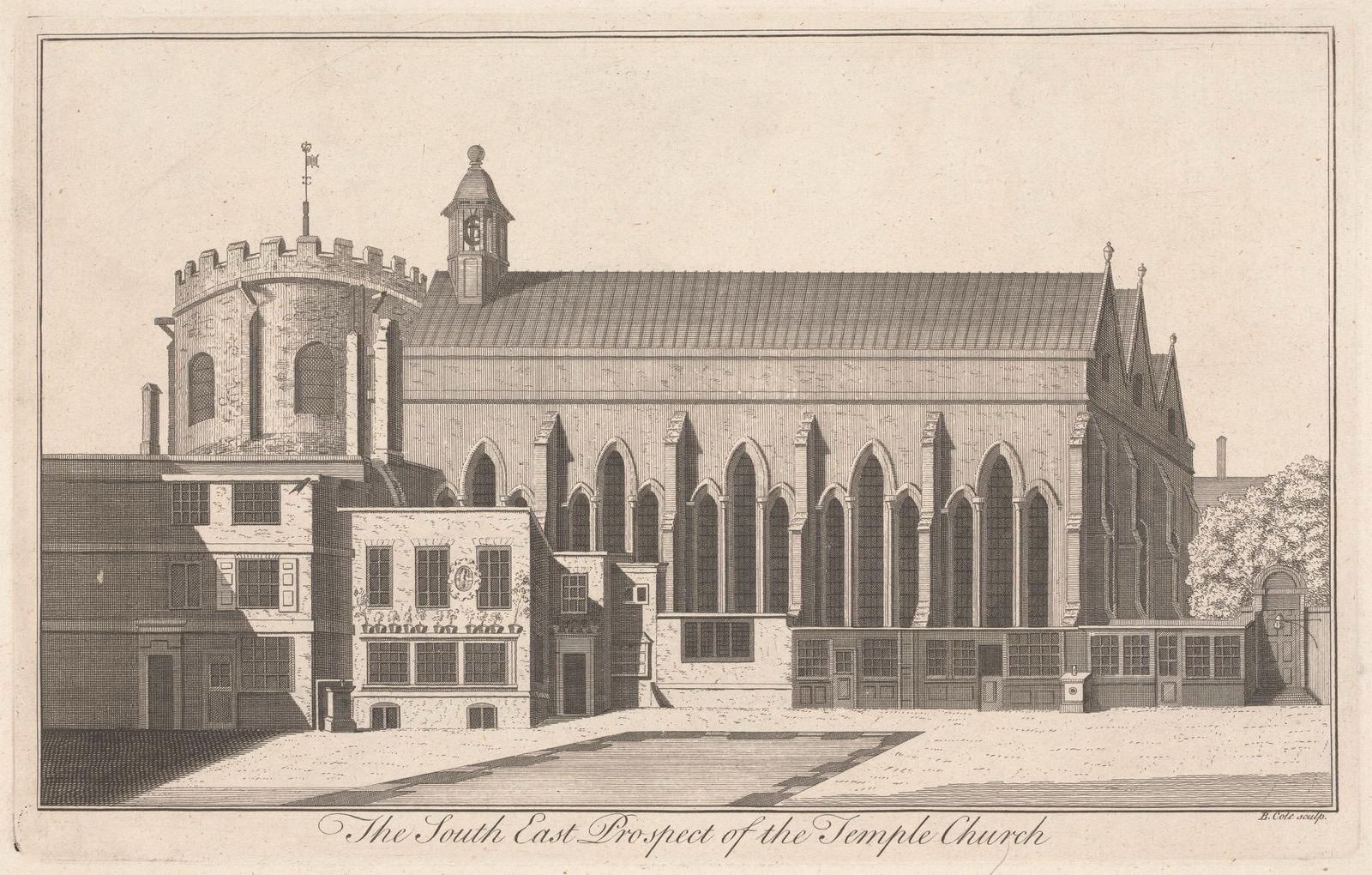
The Round's sculpture is concentrated at the great west doorway, a round-headed Romanesque portal of several orders whose shafts are carved with geometric and foliage ornament and whose jambs carry half-length figures. George Zarnecki studied it in 'The West Doorway of the Temple Church in London' (Festschrift Hans Wentzel, Berlin, 1975), and Paul Williamson returned to it in the Burlington Magazine (1985). Recent analysis of tooling and mortar, reported by the Inner Temple, separates the crisp twelfth-century stones from the decayed replacements of the 1840s. A frieze of carved heads runs through the spandrels of the Round's wall arcade. Bradley and Pevsner (London: The City Churches, 1998) record that these were largely renewed during the nineteenth-century restoration. The church's most famous works of art are the thirteenth-century effigies of armed laymen lying on the floor of the Round. Most are of Purbeck marble. Traditionally they are identified with patrons and associates of the order: William Marshal, 1st Earl of Pembroke (d. 1219), regent of England, who was received into the order on his deathbed; his sons William (d. 1231) and Gilbert (d. 1241); Robert de Ros (d. c. 1227); and, more doubtfully, Geoffrey de Mandeville, 1st Earl of Essex (d. 1144). Many of the knights are shown cross-legged, a pose that antiquaries long and wrongly took to mark crusaders. David Park and Philip Lankester discuss the figures in The Temple Church in London (2010). Park accepts the traditional identification of the earliest effigy with the elder Marshal, while Lankester is more sceptical, and both stress how hard it is to date the figures or name the men they commemorate (Saul, EHR 2012). The chancel also contains the thirteenth-century effigy of a bishop, traditionally identified as Silvester de Everdon, Bishop of Carlisle (d. 1254). The effigies have had a hard modern history. Edward Richardson restored them in 1842 and published The Monumental Effigies of the Temple Church, with an Account of their Restoration (1843); contemporaries argued over whether his work was careful conservation or, as one critic put it, simple planing-down. In 1941 they were badly damaged when the burning roof fell on them. Norma Bull's wartime drawing for the War Artists' Advisory Committee (Imperial War Museum, Art.IWM ART LD 4899) records them lying among rubble. Among earlier depictions are Benjamin Cole's eighteenth-century engraving The South East Prospect of the Temple Church (Yale Center for British Art, B1977.14.16370) and the aquatint of the Round's interior by Thomas Rowlandson and Augustus Charles Pugin, published as plate 84 of Rudolph Ackermann's Microcosm of London (1808-10). The aquatint shows lawyers and their clients using the Round as a meeting place, long after the Templars had gone.
The New Temple stood outside the City walls, on the slope between Fleet Street and the Thames, west of the River Fleet near Temple Bar. John S. Lee describes it as a headquarters in a 'suburban, semi-agricultural' setting ('The Knights Templar in English Towns,' Urban History 50, 2023). It was the order's second London site. The Templars had first settled in Holborn, probably soon after Hugh de Payns' visit to England in 1128 (VCH London, vol. 1). Eleanor Ferris quotes Dugdale's Origines Juridiciales, which places the Old Temple on the south side of Holborn where Southampton House later stood. The move to the larger Fleet Street site gave the order a riverside precinct with access to the Thames. Historians date the move differently. The Victoria County History, following Stow, gives 1184-85, while recent architectural historians argue that the order was building and using the site from about 1160-61 (Stewart 2021; Dumoulin 2023). The site's financial importance followed from where it stood: on the road between the merchant City and the Exchequer at Westminster, in an exempt religious precinct. Ferris notes that the order's houses combined 'the spiritual protection of a hallowed spot' with strong buildings and armed defenders (American Historical Review 8, 1902). Lee shows that the Templars were also urban landlords. They held tenements and a mill on the Fleet, and the London house sold timber brought down the river. Helen Nicholson's analysis of the records made after the arrest of 1308 shows how unusual the London house was: 'Although the Templars' London house of New Temple was an important financial centre, there was little sign of financial activity in other Templar houses' in England ('The Inventories, Accounts, and Records of Debts for the Templars' Estates in England and Wales, 1308-1313,' Ordines Militares 30, 2025). The precinct's later history created a new professional district. Under the Hospitallers, lawyers took leases on the domestic buildings, reportedly from about 1347. The two societies of the Inner and Middle Temple grew up there and received the freehold from James I in 1608. The Temple Church survives as their shared chapel, enclosed in a legal quarter between Fleet Street and the Embankment, next to the old newspaper street and a short walk from the Royal Courts of Justice.
The Order of the Temple, founded in Jerusalem around 1119-20 to protect pilgrims, reached England with Hugh de Payns in 1128. Lay patronage of the kind Jochen Schenk has reconstructed for France (Templar Families, 2012) built its English endowment. The New Temple became the head house of the English province and, by the early thirteenth century, one of the royal treasuries. Ferris, writing in 1902, quotes Thomas Madox's History of the Exchequer: the king's treasure was paid in chiefly at the Exchequer, 'yet it was sometimes paid and deposited... in the king's wardrobe, in the Tower of London, and in the New Temple at London.' She finds the earliest notice in an Exchequer receipt roll of Michaelmas 1185, from which the surplus was lodged at the Temple. Henry II's will of 1182 entrusted a bequest for the Holy Land to the Templars, and the ordinances of 1184 and 1188 for taxing movables to fund the crusade appointed a Templar and a Hospitaller to help with collection in each district. King John was the order's closest royal client. According to the Victoria County History, drawing on the Close Rolls, he deposited 10,000 marks at the Temple in 1212 and 20,000 marks in 1213, and lodged crown jewels and state documents there. He stayed at the Temple often in his last years, and he was in residence there in January 1215 when the barons presented the demands that led to Runnymede. The master, Aymeric de St Maur, advised John to grant Magna Carta, is named in it, and was an executor of his will (Ferris 1902). Under Henry III the Temple housed the king's Wardrobe in 1225, and Henry founded a chantry there in 1231. He once intended to be buried in the church, and he attended the dedication of the new chancel in 1240 (VCH London). Deposits were not always safe from the crown. Matthew Paris tells how in 1232 the Templars refused to surrender Hubert de Burgh's treasure without its owner's consent, until Hubert himself ordered it handed over. The Lord Edward seized £10,000 lodged at the Temple by merchants and magnates in 1263, and Stow reports that Edward I 'robbed' the treasure there in 1283. Agnes Sandys carried the study of the Temple's financial and administrative importance forward for the thirteenth century in her contribution to Essays in Medieval History presented to Thomas Frederick Tout (Manchester, 1925), pp. 147-62. After Philip IV of France had the French Templars arrested on 13 October 1307, Edward II, under papal pressure, ordered the English brethren seized on 8 January 1308. Papal inquisitors examined the English Templars between October 1309 and March 1310 (Malcolm Barber, The Trial of the Templars, 1978; 2nd ed. 2006; Nicholson, The Proceedings against the Templars in the British Isles, 2011). The VCH records that only three brothers confessed, under torture, among them John of Stoke, treasurer of the New Temple. The master, William de la More, refused to confess and died in the Tower. Clement V dissolved the order at the Council of Vienne in 1312 and assigned its property to the Hospitallers. In London the Temple passed through the hands of Aymer de Valence and Thomas of Lancaster before the Hospitallers took possession after the statute of 1324; Edward III confirmed the whole manor to them in 1338. After the Dissolution of 1540 the crown held it until James I granted it to the Inner and Middle Temple in 1608.
No exchange floor existed at the New Temple; it offered financial infrastructure: custody, a treasury, and a place where debts were settled. The fullest documentary account is still Ferris's article, which sorts the evidence into receipts and disbursements. Under receipts she places the Temple as a safe-deposit for magnates, prelates, merchants and foreign residents, and as a royal treasury into which aids, carucage, fractional taxes on movables, the tallage of London and of the Jews, Irish revenue and queen's gold were paid. She stresses that no Templar books survive for London. Private deposits come to light only when chroniclers record their seizure, for instance Falkes de Bréauté's 40,000 marks (sequestered in 1226) and the treasure left by the departing Poitevins in 1258. Under disbursements she lists trusteeship of funds held for a stated purpose, loans, the cashing of royal orders drawn on deposits, and payments between London and the Continent. The loans were real but modest. They ranged from a single gold mark John borrowed for an offering in 1213 to sums of 1,000 marks to bring Poitevin troops to England in 1215, and 500 marks lent to Henry III in 1221 against the revenues of Godmanchester. Ferris concludes that the Templars never 'financed the projects of the kings'; their most useful service was 'the handling of money derived from other sources.' Drafts on deposit worked by royal letter. The king wrote to the master ordering payment 'from our treasure entrusted to you to guard' to a named person. Thus in June 1237 Brother Hugh of Stockton, treasurer of the Temple, paid the last 10,000 marks of Isabella's marriage portion to the messengers of the Emperor Frederick II, and in 1274 Brother Warin, treasurer, paid 2,000 marks to Luke of Lucca for Edward I's use. Henry III's annual £200 for Oléron, paid to the master in England for the Count of La Marche, shows payment at a distance. Ferris infers that this rested on 'a system of money transfers by bills of exchange' between commanderies. She concedes, however, that it is 'not possible always to be sure as to just what function the Templars performed', and no negotiable Templar instrument from London survives. Modern references to the Temple issuing bills of exchange (Lee 2023), and popular stories of pilgrims' letters of credit, should be read accordingly: what is documented is settlement between Templar houses on royal or private order. Crusade finance followed the same pattern. Holy Land subsidies were deposited at the Temple in 1286, 1291 and 1300, and in 1274 the master William of Beaulieu acknowledged Edward I's repayment of more than £30,000 borrowed from the Templars in the Holy Land. The acquittance refers to principal and to 'costs, damages and interesse', a compensation clause that Ferris sees as a way around the usury prohibition. Private parties used the Temple as a place of payment. The Cahorsin papal merchants' bonds of 1235 and Florentine loans of 1257-58 to Henry III were made repayable at the New Temple. The French contrast is one of degree: Léopold Delisle's Mémoire sur les opérations financières des Templiers (1889), as Ferris summarises it, showed that from Louis IX into Philip IV's reign the Paris Temple was the chief royal treasury and its treasurer the king's treasurer; part of a day-book of 1295-96 survives. Nicholson's 1308 inventories show that the English evidence remained concentrated in London: there was little cash in the provincial houses and the recorded debts were small.