London Corn Exchange
London, UK · Established 1747

This site requires authorization to access.
To request access, contact
william.goetzmann@yale.edu
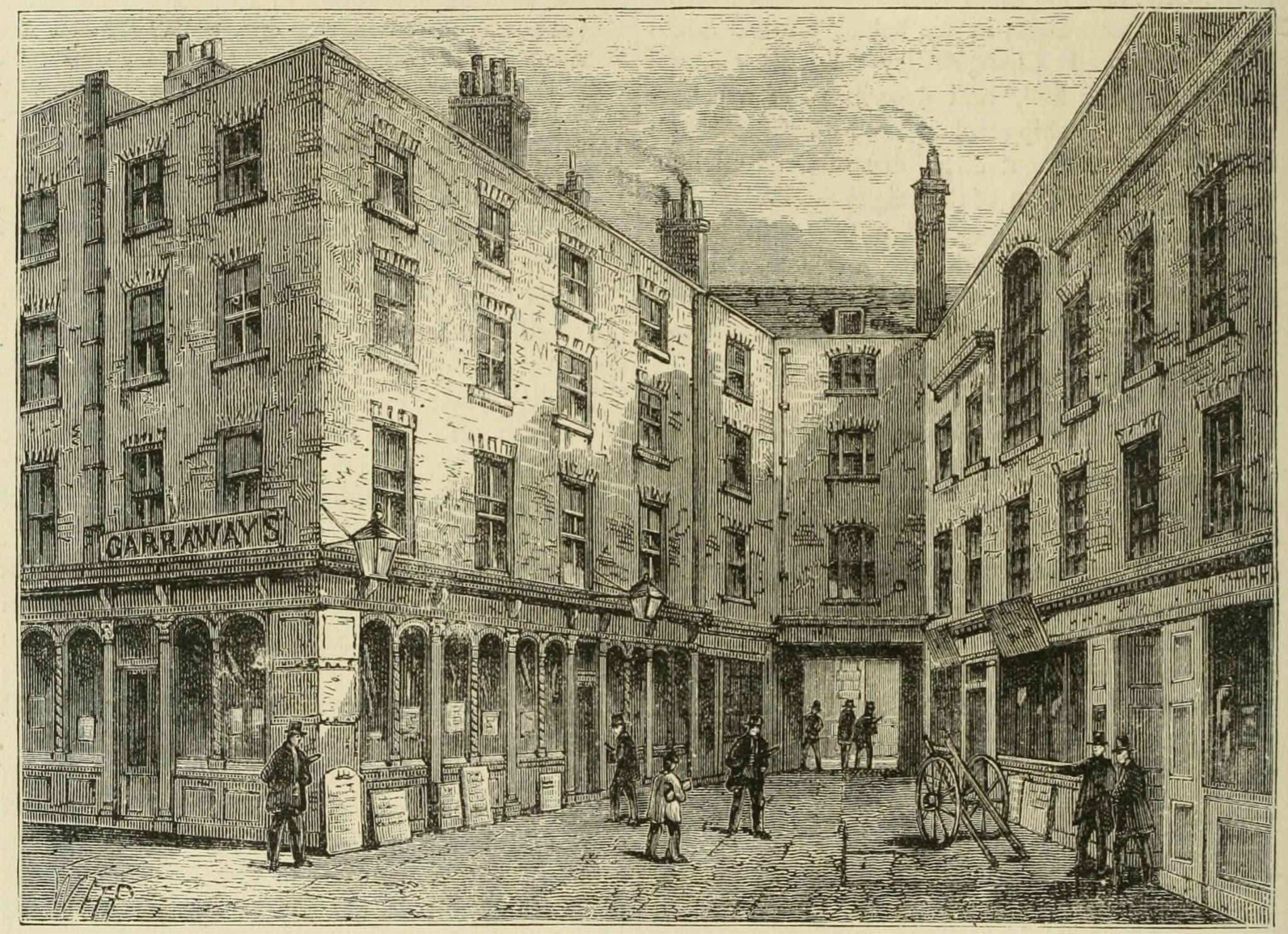
The London Corn Exchange, situated on Mark Lane in the City of London, served for nearly two and a half centuries as the central marketplace for Britain's grain trade. The original exchange was designed by George Dance the Elder and completed in 1747 on the east side of Mark Lane, built around an open courtyard where agents representing farmers across the country gathered to buy and sell wheat, barley, oats, and other cereals. As the volume of trade outgrew the original premises, architect George Smith produced a grand Greek Revival building featuring a hexastyle Doric portico. Opened in 1828, it stood immediately adjacent to the older structure.
The London Corn Exchange was among the most frequently depicted commercial buildings in Georgian and Victorian London. The most celebrated representation appears in Rudolph Ackermann's Microcosm of London (1808-10), where Plate 33 presents a hand-colored etching and aquatint of the interior, with architectural elements drawn by Augustus Charles Pugin and figures by Thomas Rowlandson, aquatinted by John Bluck. The preparatory graphite study by Pugin and Rowlandson, now in the Art Institute of Chicago (Charles Deering Collection, 1940.1059.35), reveals the open courtyard ringed with corn factors' stalls. Sir John Gilbert produced a watercolour of the interior of the old exchange, held in the V&A Prints and Drawings Collection (accession 166-1889). Thomas Hosmer Shepherd engraved George Smith's 1828 Greek Revival facade for James Elmes's Metropolitan Improvements; or London in the Nineteenth Century (1827-29), capturing the hexastyle Doric portico surmounted by the royal arms, with agricultural ornament incorporating wheat-ears and ploughs. V. Bartholomew's 1827 lithograph of the exchange survives in the Guildhall Library and Art Gallery. The Bedford Lemere photographic firm documented Edward I'Anson's 1882 interior (Historic England, BL10277/001), recording the polished grey granite columns, Portland stone arches, and the innovative wrought-iron semicircular ribs of the clerestory roof. RIBA holds photographs showing the iron-rib roof and colonnade after Blitz damage, preserving a final record of I'Anson's engineering achievement.
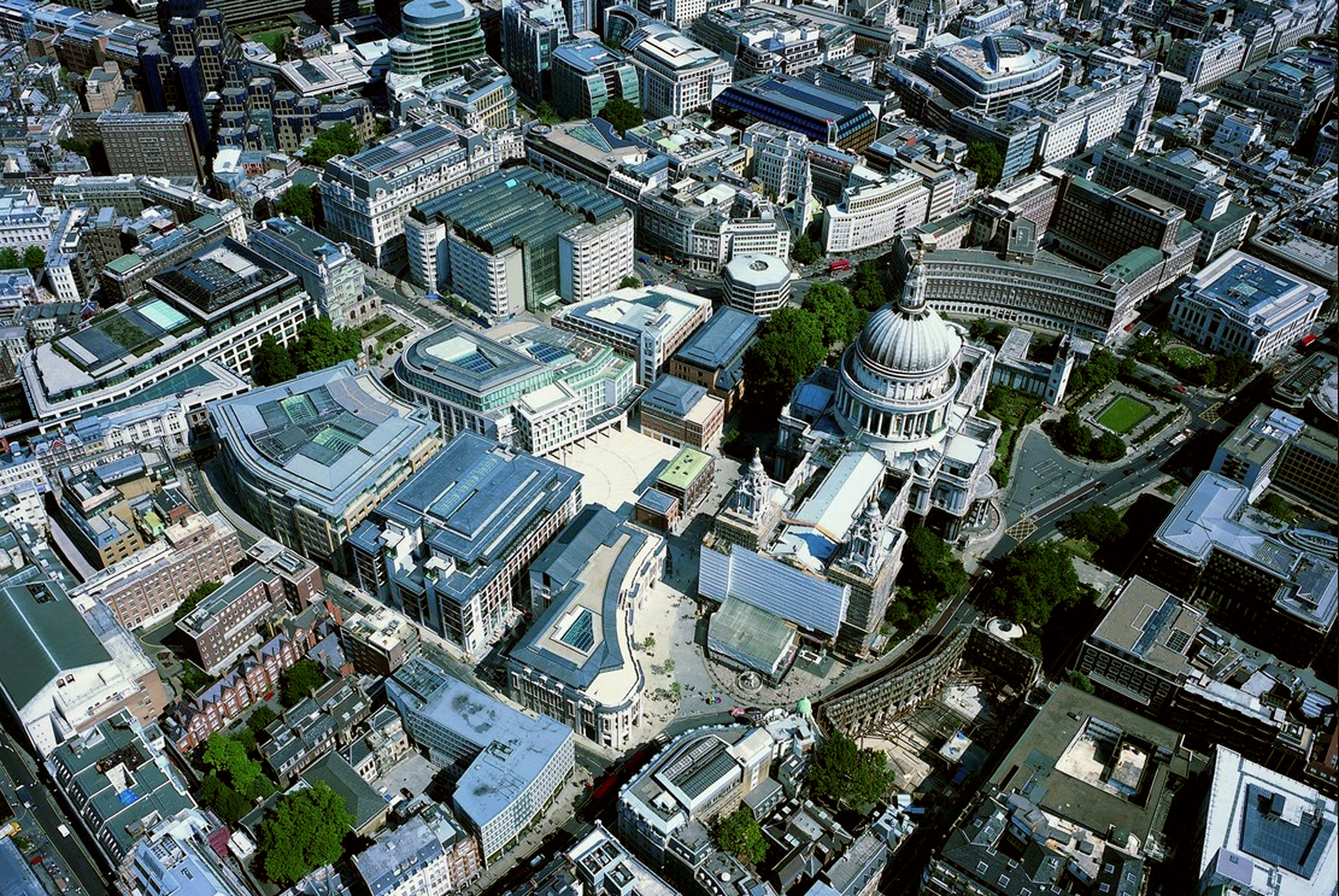
Mark Lane runs north from Great Tower Street to Fenchurch Street in the heart of the City of London, placing the Corn Exchange within a dense cluster of commodity markets shaped by proximity to the Thames. Grain arrived by river and was customarily landed at Bear Quay, one of the Legal Quays just east of the Tower of London, making the short walk uphill to Mark Lane a natural site for a trading hall. The Billingsgate ward, which extends east to Mark Lane and south to the river, housed the ancient fish market at Lower Thames Street; the Custom House stood nearby, overseeing all waterborne trade entering the Port of London. Until the early nineteenth century, all shipping passed through the Pool of London, the congested stretch of river between London Bridge and the Tower, concentrating commercial activity in the surrounding streets. Parallel to Mark Lane, Mincing Lane earned the title "Street of Tea" after the East India Company's monopoly ended in 1834, becoming the world's leading centre for tea, spice, coffee, rubber, and sugar trading at the London Commercial Salerooms. Fenchurch Street, to the north, connected this commodity quarter to the broader City. The Mark Lane Express, founded in 1832, took the street's name as a metonym for England's grain market, much as "Wall Street" signified American finance. This concentration of specialized markets — corn, fish, tea, spice, and customs — made the area between the Tower and Fenchurch Street one of the most commercially intensive districts in the world.
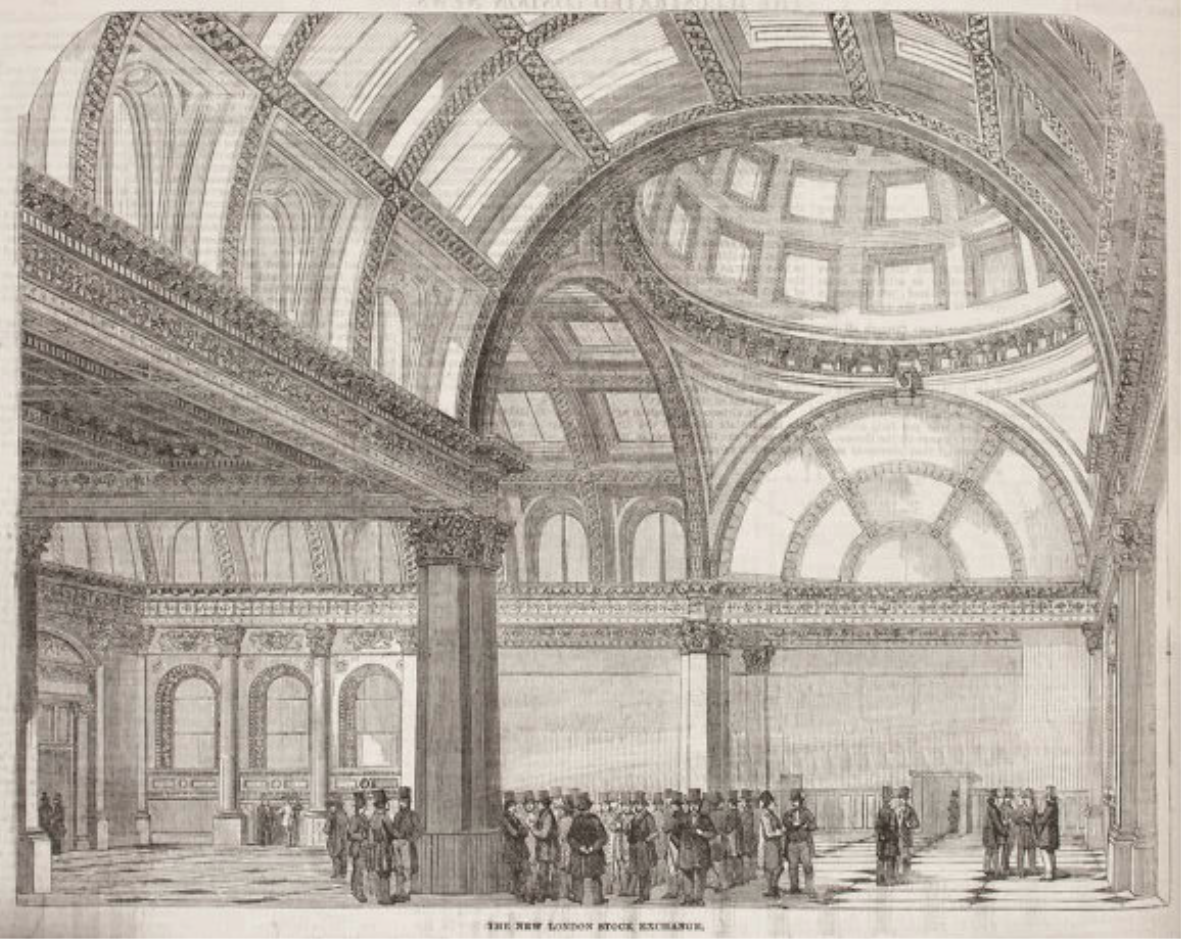
The original exchange was largely demolished in the early 1880s and replaced by a far larger building designed by Edward I'Anson in the Italianate style, completed in 1882. I'Anson's hall featured iron columns supporting a round-arched clerestory and a high timber roof, with a large glass-pierced dome that flooded the trading floor with natural light. Around the perimeter stood hundreds of stalls and counters where dealers displayed grain samples in small canvas bags, rubbing kernels between their fingers to assess moisture and quality. The prices set on the trading floor at Mark Lane reverberated far beyond London. During the nineteenth century, the Corn Exchange established benchmark prices for grain and flour throughout Britain and across European markets — the Hamburg grain market, for instance, was governed largely by Mark Lane averages. The exchange stood at the heart of the fierce political struggle over the Corn Laws, the protectionist tariffs that restricted grain imports until their repeal in 1846, after which the volume of corn traded surged dramatically.
Both exchange buildings met their end in the twentieth century: Smith's 1828 building was demolished in 1931, and I'Anson's 1882 replacement was destroyed during the Blitz in 1941, closing a chapter in the history of one of the world's most consequential commodity markets.