Lombard Street (open-air exchange of the Lombards)
London, England · Established c. 1300 (Italian merchant-bankers resident by the late 13th century; the name 'Lombard Street' first recorded 1318; street meetings ended 22 December 1568)
Lombard Street was never a building. For roughly two and a half centuries before 1568 the City of London's foreign-exchange and credit market met in the open air, in a curving street that runs from the Stocks Market (the site of the later Mansion House) east to Gracechurch Street. The 'exchange' was the street itself, its pavement and doorways, and the houses, taverns and churches along it. John Stow, who knew the arrangement at first hand, is the essential witness. In the Langbourn Ward chapter of his Survey of London (1598) he wrote: "Then haue ye Lombard streete, so called of the Longobards, and other merchantes, straungers of diuers nations assembling there twise euery day, which manner continued vntill the 22. of December in the yeare 1568. on which day the saide marchantes beganne their meeting in Cornehill at the Burse, since by her Maiestie named the Royall Exchange." Stow's 1603 edition adds that he had found no record of the custom's "originall or continuance". It also cites a grant of Edward II's twelfth year for a messuage abutting Lombard Street "for the Marchantes of Florence". C. L. Kingsford's notes to his edition (Oxford, 1908) identify this as the grant of 1318 to the society of the Bardi. It is the first recorded use of the street-name; deeds of 1285 and 1312 still call it 'Langburnestrate'.
No contemporary measurement of the meeting place survives. Stow's account of the parish of Allhallows Grasschurch at the eastern end says the street was once "far larger in breadth" where the grass-market came down. F. W. Fox Bourne (Famous London Merchants, 1869) places the merchants' gathering "especially in the open space near Grace Church", but that is a nineteenth-century gloss, not a measured fact. What the street lacked was exactly what the Antwerp Bourse (1531) supplied: a covered, enclosed, policed court. Two Greshams tried to fill the gap. Around 1538 Sir Richard Gresham reminded Thomas Cromwell that he had shown him "a platte … to make a goodely Bursse in Lombertstrette for merchauntes to repayer unto", estimated at £2,000 or more (British Library, Cotton MS Otho E.X, quoted by Stephen Alford, Gresham College lecture, 2019). The scheme failed. A generation later his son built the Bourse on Cornhill instead (see the Royal Exchange entry).
The street's physical character after 1666 came from rebuilt houses and three parish churches. Wren rebuilt St Edmund the King and Martyr (1670s) and Allhallows Lombard Street (demolished 1939). Nicholas Hawksmoor's St Mary Woolnoth (1716-27) stands at the western end. The fabric of the medieval street does not survive. As F. G. Hilton Price noted in The Signs of Old Lombard Street (1887; revised 1902), John Ogilby's post-Fire survey shows 97 houses in the street, Horwood's plan of 1799 shows 74, and by 1902 there were 66. Merged banking houses had swallowed their neighbours. The Victorian and twentieth-century bank buildings that now line the street belong to a later history and are not treated here.
The art of Lombard Street is the art of the street sign. Before house numbering, every goldsmith, banker, mercer and tavern-keeper traded 'at the sign of' a painted or carved emblem hung out over the street, and drafts and notes named the sign as the address. Hilton Price's The Signs of Old Lombard Street (Leadenhall Press, 1887; revised edition 1902, with drawings by James West) is the basic source. He located 109 signs in 1887 and 168 by 1902. Among them were the Grasshopper (No. 68), the Unicorn (No. 69), the Black Horse, the Pelican, the Cat-a-Fiddling, the Three Crowns, the Angel and the Pope's Head tavern, recorded from 1464. He relied heavily on The Little London Directory of 1677, which lists the 'goldsmiths keeping running cashes' by sign; twenty-seven of them were in Lombard Street.
The Grasshopper is the emblem most associated with the street. Hilton Price reports the tradition ("we are informed") that Sir Thomas Gresham kept his shop at this site under his family crest. The documented series of occupants begins with Clement Punge, goldsmith (1637-65), and runs through Charles and Valentine Duncombe to Andrew Stone (1700) and Stone & Martin (1703). From them the business descended to Martins Bank. The Gresham origin is a tradition that Martins later promoted; it is not established by the documents Hilton Price cites. The same grasshopper crowned the vane of Gresham's Exchange.
Most hanging signs were taken down in the 1760s. Hilton Price says removal began by order in 1762 and was complete in the principal thoroughfares by 1767-69, when signs were either taken down or fixed flat to house fronts. They returned as heritage. For the coronation of Edward VII in 1902, H. D. Anderson of the Artichoke (No. 24) proposed that the occupiers reproduce the known historic signs in ironwork. At a meeting at Martins Bank, twenty-three were agreed and hung, from the Minerva at No. 11 to the Seven Stars at No. 81, and the residents petitioned the Corporation to let them stay. Many of the signs photographed in the street today descend from that 1902 revival, not from the seventeenth century.
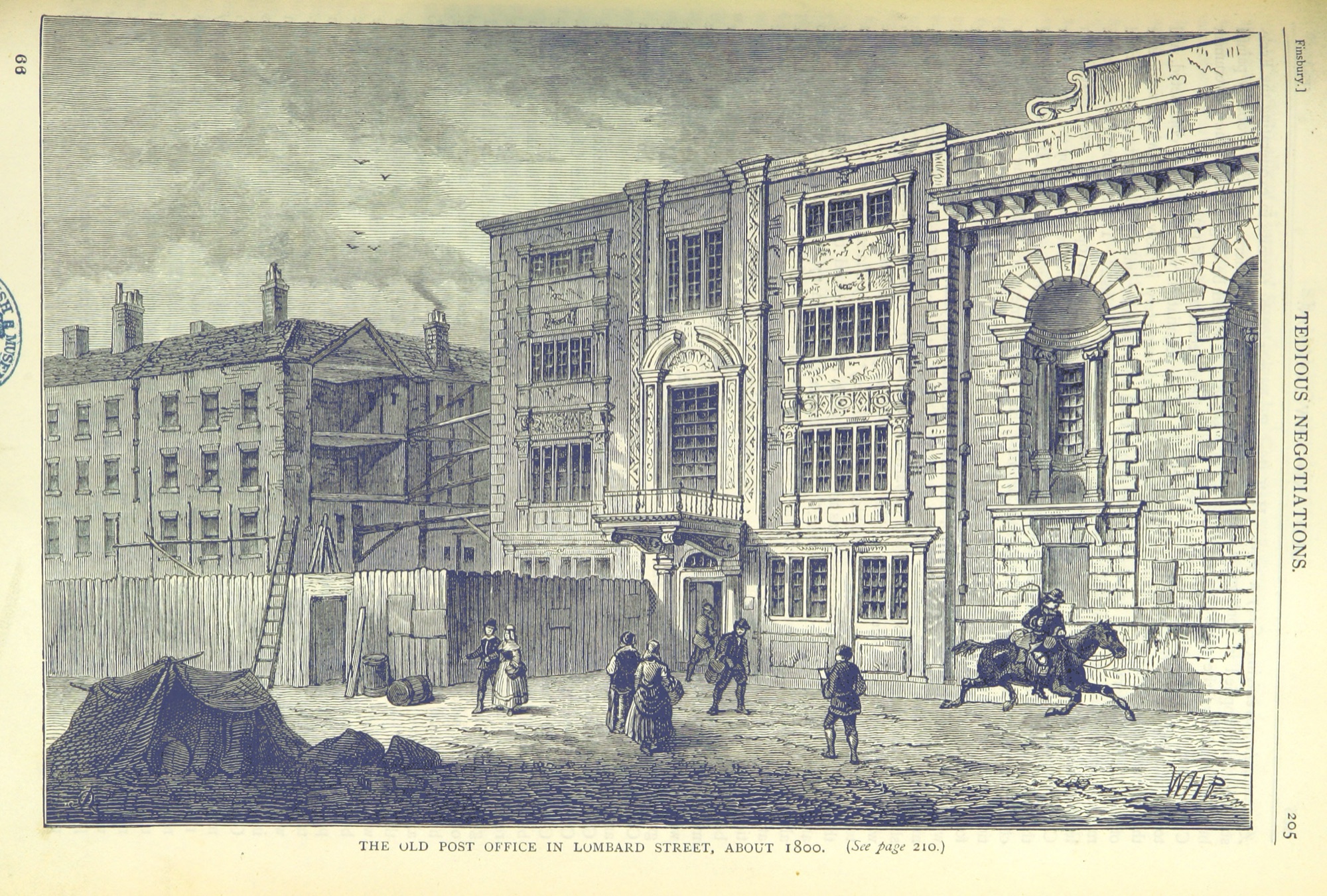
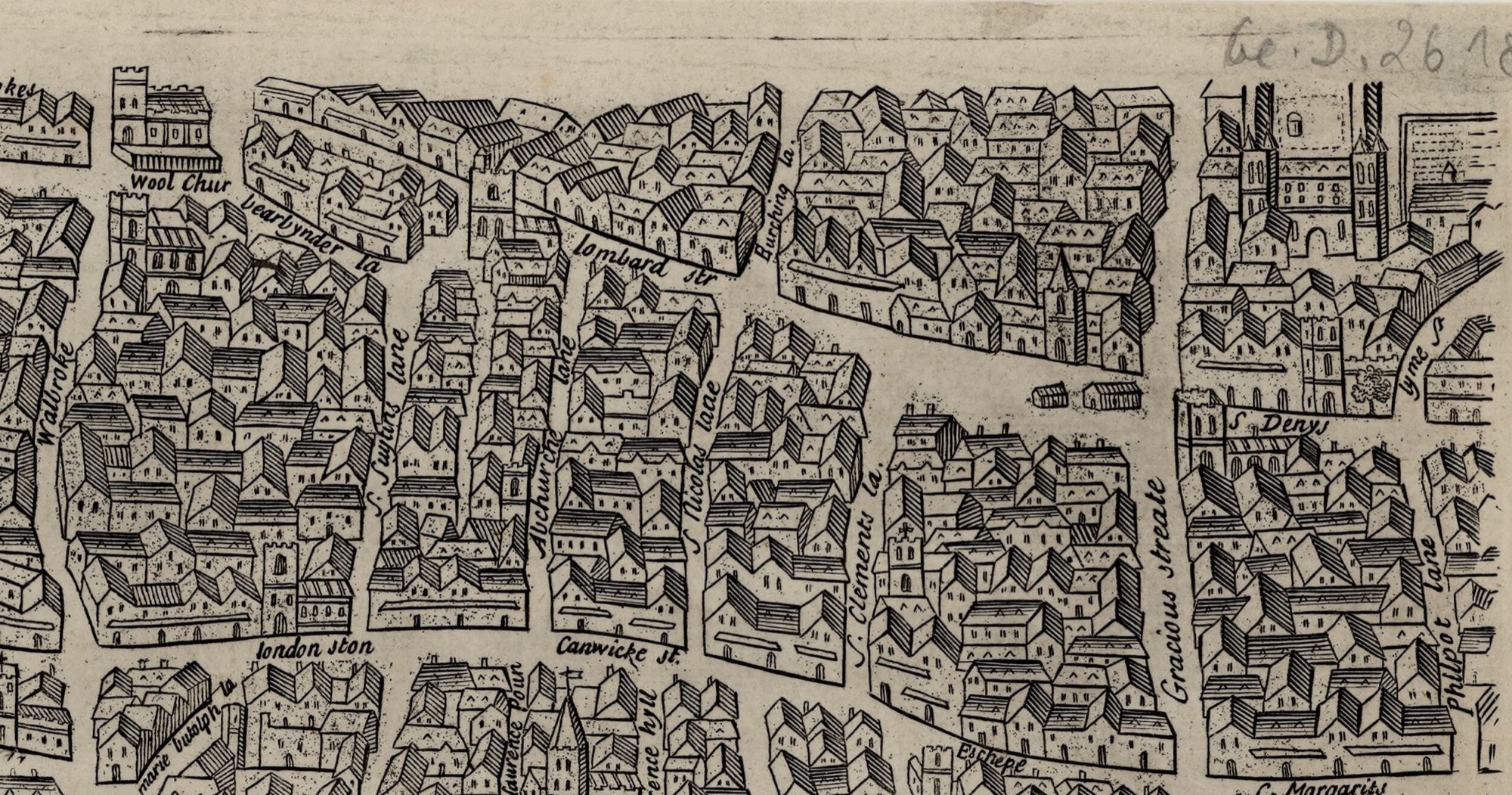
Pictorial evidence before the Fire is scant. The woodcut map-view Civitas Londinum (c. 1561; surviving impressions c. 1633), long attributed to Ralph Agas although the attribution is doubted, labels 'Lombard str.', 'Burching la.' and 'Wool Chur' (St Mary Woolnoth) and shows the street as a close-built lane of gabled houses. George Vertue's engraved facsimile for the Society of Antiquaries (1737) is the version most often reproduced. Wenceslaus Hollar left no known view of the street itself. Later images are mostly of individual institutions in it: the General Post Office, housed from 1678 in Sir Robert Vyner's former mansion, appears in Ackermann's Microcosm of London (Rowlandson and Pugin, 1809) and in W. H. Prior's wood-engraving 'The Old Post Office in Lombard Street, about 1800' in Old and New London (1873).
Lombard Street lies at the commercial centre of the medieval City. It ran east from the Stocks Market, the meat and fish market on the site of the Mansion House, to the corner of Gracechurch Street, which led down to London Bridge, the only Thames crossing. Cornhill ran parallel a few dozen yards to the north. Cheapside, the great retail street, lay to the west, and the Steelyard of the Hanseatic merchants lay south on the river at Dowgate. Within a few minutes' walk a merchant could reach the wool and customs quays downstream, the Hansards, the Mint in the Tower, and from 1568 the Royal Exchange. The Exchange was built just across Cornhill, so moving the market there in 1568 was a move of a hundred yards or so. It was not a change of district.
Stow's Survey (1598/1603) shows who lived along the street. Sir Martin Bowes, goldsmith and mayor, built a house "with a very faire forefront towards the streete". William de la Pole, "the kings merchant" who financed Edward III's wool schemes, held a house there (14 Edward III), later held by his son Michael, Earl of Suffolk. Stow names Sir Hugh Brice, mayor and "kéeper of the kings exchange at London", as a benefactor of St Mary Woolnoth. Hilton Price cites Exchequer issue rolls for a royal 'Exchange in Lumbard Strete', the office that changed coin and bullion: a grant to the goldsmith William Salesbury in 1379 and a payment in 1422 to Richard Maydeston, its controller. The street thus held two kinds of exchange. One was the king's office for minting and money-changing. The other was the informal market where merchants dealt in bills.
The Italians were not segregated. Unlike the Hanseatic Steelyard, they had no walled compound. By the fifteenth century statutes required alien merchants to lodge with English 'hosts'. Helen Bradley's edition of the Views of the Hosts of Alien Merchants, 1440-1444 (London Record Society, 2012) and her thesis 'Italian Merchants in London, 1350-1450' (Royal Holloway, 1992) show Italian houses spread through the wards around Lombard Street, Langbourn, Broad Street and Walbrook, not confined to the street. The 'Lombard' quarter was a dense mixed neighbourhood. Its parish churches became the burial places of its money trade: Stow lists goldsmiths and mayors in St Mary Woolnoth and St Edmund's, and Hilton Price notes that many Restoration goldsmiths were buried in Hawksmoor's church.
The street's later institutions kept it at the centre of the City's payments system. Lloyd's Coffee House stood at the corner of Abchurch Lane (Nos. 16-17) from about 1691 until the underwriters moved to the Royal Exchange in 1774. The General Post Office occupied the Vyner mansion from 1678 to 1829, so the inland mail arrived next door to the bankers. The Bankers' Clearing House was built in 1833 on the old Post Office yard behind the street.
Italians were in London long before the street bore their name. Kingsford's notes to Stow record "Picot the Lombard" in twelfth-century documents at St Paul's, and 'Lombard' early became a generic English word for a banker or money-dealer. The decisive phase began under Edward I. Richard Kaeuper's Bankers to the Crown: The Riccardi of Lucca and Edward I (Princeton, 1973) reconstructs how the Riccardi became the king's bankers from 1272. From 1275 they collected the new export custom on wool, woolfells and hides, and they advanced money against that revenue. A Reading (ICMA Centre) research team, in a VoxEU column on "The credit crunch of 1294", estimates that they handled about £20,000 a year, roughly half the crown's ordinary income. The Jews were expelled in 1290, but Kaeuper's chronology shows the Italians were already the crown's principal creditors by then, so the idea that the Lombards simply 'replaced' the Jews is a simplification. The Riccardi failed in 1294: war with France cut their links to Italy, Philip IV and the papacy called in funds, and they could not borrow on the interbank market, so Edward seized their assets.
The Frescobaldi of Florence succeeded them from about 1299, lending (on Britannica's figure) some £150,000 in 1302-10 against the customs and the mint. Kaeuper's 'The Frescobaldi of Florence and the English Crown' (Studies in Medieval and Renaissance History 10, 1973) traces their fall. The baronial Ordinances of 1311 forbade the farming of customs to aliens and ordered the arrest of the company's members and goods, and Amerigo dei Frescobaldi fled. The Bardi, already granted the Lombard Street tenement in 1318, and the Peruzzi then financed Edward III's opening campaigns of the Hundred Years' War. Their lending was secured on wool, licences and customs (Ephraim Russell, 'The Societies of the Bardi and the Peruzzi and their Dealings with Edward III', in G. Unwin, ed., Finance and Trade under Edward III, 1918). After Edward's payments faltered in 1339-40, the Peruzzi failed in 1343 and the Bardi in 1346. The chronicler Giovanni Villani put their English losses at about 900,000 and 600,000 florins. Edwin Hunt ('A New Look at the Dealings of the Bardi and Peruzzi with Edward III', Journal of Economic History 50, 1990; The Medieval Super-Companies, 1994) argued that Villani's figures are inflated, and that the companies' collapse owed as much to Florentine and Mediterranean conditions as to the English default.
Italian houses remained in London through the fifteenth century. J. L. Bolton and F. Guidi Bruscoli studied the Borromei ledger of 1436-39 (Economic History Review, 2008), and Raymond de Roover's The Rise and Decline of the Medici Bank (1963) describes the Medici London branch, ruined by lending to Edward IV. Anti-Italian riots broke out in 1456-57. Alwyn Ruddock's Italian Merchants and Shipping in Southampton, 1270-1600 (1951) shows how much of their trade ran through Southampton, where the galleys called.
By the mid-sixteenth century English merchants dominated the street, and its inadequacy as a meeting place had become an embarrassment. Fox Bourne (1869) quotes Richard Clough, Gresham's Antwerp factor, writing in 1561 that London "in so many years" had not "found the means to make a bourse, but must walk in the rain when it raineth, more like pedlars than merchants". The words are Fox Bourne's modernised Victorian rendering; Clough's own manuscript phrasing may differ. Gresham's Bourse opened for business on 22 December 1568, and the street meetings ended that day. Lombard Street survived as an address of money. Among its Restoration goldsmith-bankers were Sir Robert Vyner and Edward Backwell at the Unicorn. Backwell was ruined by the Stop of the Exchequer in 1672, with £295,994 lent to the crown (Hilton Price).
What changed hands in Lombard Street was credit, not goods. In the medieval period the Italian companies combined three businesses. First, they lent to the crown against customs and taxes, as described above. Second, they bought English wool, the country's great export, often years in advance. Francesco Balducci Pegolotti's merchant handbook La pratica della mercatura (c. 1340) lists English religious houses with the quality and price of their wool. Adrian Bell, Chris Brooks and Paul Dryburgh, in The English Wool Market, c. 1230-1327 (Cambridge, 2007), analysed the forward contracts by which Italian and other merchants prepaid monasteries for future clips, an early English futures-like contract. T. H. Lloyd's The English Wool Trade in the Middle Ages (1977) remains the standard narrative. Third, they remitted money across Europe by bill of exchange. A merchant in London paid sterling to an Italian house and received a bill payable in florins or groats at Bruges, and later Antwerp, Florence or Genoa, after a fixed usance. The exchange rate built in the interest that the Church's usury doctrine forbade charging openly. This is the 'exchange' that met twice daily in the street. M. M. Postan's 'Credit in Medieval Trade' (1928) showed how deeply credit ran through English trade even among non-Italians.
By the Tudor period the market was centred on the London-Antwerp exchange. Raymond de Roover's Gresham on Foreign Exchange (Harvard, 1949) reconstructs how the Crown's agent Thomas Gresham managed royal debt on the Antwerp bourse by working the rate on bills between the two cities. It also shows London as a satellite of the Antwerp market, which helps explain why a 'bourse' became a matter of civic prestige. Contemporary descriptions of Gresham's Exchange show what moved off the street in 1568. Thomas Platter (1599) saw merchants gathering "twice daily, before lunch at eleven, and again after their meal at six o'clock, buying, selling, bearing news, and doing business generally". A French account of 1576 noted the covered walk "where the merchants retire and shelter when it rains" (both in Ann Saunders, ed., The Royal Exchange, London Topographical Society, 1997).
After 1640 the street's trade became deposit banking. The goldsmiths took deposits and issued running-cash notes and accepted drafts on them. Stephen Quinn ('Goldsmith-Banking: Mutual Acceptance and Interbanker Clearing in Restoration London', Explorations in Economic History 34, 1997) shows how they cleared these claims bilaterally among themselves. Backwell's ledgers, preserved with Child & Co., show the other leading goldsmiths keeping accounts with him (Hilton Price). Clearing was then institutionalised. Philip W. Matthews' The Bankers' Clearing House (1921), quoting Holland Martin's 1910 history, records that about 1770 the bankers' walk clerks met to exchange cheques at the Five Bells in Dove Court, beside St Mary Woolnoth. Martin's Bank's books show a charge for a "clearing room" in 1773, and a purpose-built Clearing House followed in 1833. The joint-stock banks were admitted in 1854. The word 'Lombard' itself became financial vocabulary. It named the pawn bank in Dutch and French usage and the collateralised central-bank advance in German (the Lombard loan and Lombard rate). By 1873 Walter Bagehot could title his book on the money market Lombard Street "because I wish to deal, and to show that I mean to deal, with concrete realities", calling it "by far the greatest combination of economical power and economical delicacy that the world has ever seen".