Liverpool Corn Exchange
Liverpool, UK · Established 1807
This site requires authorization to access.
To request access, contact
william.goetzmann@yale.edu
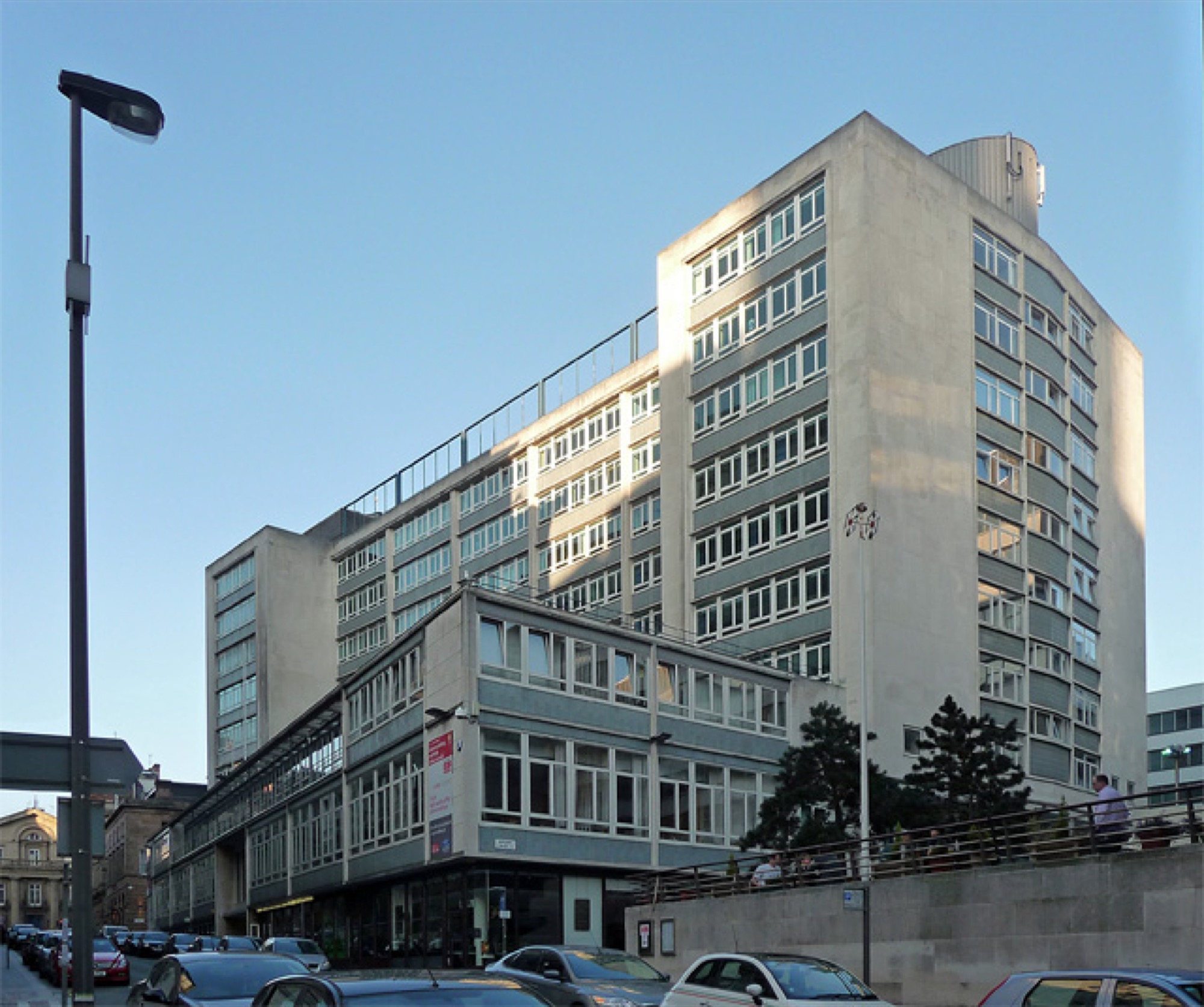
The Liverpool Corn Exchange passed through three distinct architectural incarnations across a century and a half, each reflecting the evolving ambitions of the city’s grain merchants. The first purpose-built exchange was designed by John Foster Sr. in the neoclassical style and erected on Brunswick Street between 1807 and 1808 at a cost of £10,000, raised in shares of £100 each. Constructed of white stone quarried at Runcorn, the building presented a symmetrical main frontage of four bays onto Brunswick Street. The central section featured two large openings while the outer bays contained round-headed doorways with fanlights, all flanked by Doric order columns supporting an entablature decorated with triglyphs and a central panel inscribed with the words “Corn Exchange.” The first floor was fenestrated by sash windows with triangular pediments, lending the façade a restrained Georgian dignity characteristic of Liverpool’s early commercial architecture. An engraving drawn by G. and C. Pyne about 1827 and published in Henry S. and Harold E. Young’s Bygone Liverpool (1913) records the building’s appearance in its prime. In June 1852, a serious accident occurred when the floor in the middle of the building gave way, necessitating a complete reconstruction. The exchange was rebuilt between 1853 and 1854 to designs by Sir James Allanson Picton (1805–1889), the Liverpool architect, antiquary, and civic leader who also served as the city’s foremost local historian, authoring the invaluable Memorials of Liverpool: Historical and Topographical (1873). On the night of 1–7 May 1941, during the devastating May Blitz that killed some 4,000 people across Merseyside and damaged a third of the city’s houses, the Corn Exchange was completely destroyed by German incendiary and high-explosive bombs. After the war, civic leaders resolved to rebuild. The foundation stone was laid on 19 June 1953 by Frederick Marquis, 1st Earl of Woolton, Chancellor of the Duchy of Lancaster. The third and present building, designed by Harold Hinchliffe Davies (1900–1960), was completed in 1959 on a new site at Drury Lane and Fenwick Street. Richard Pollard and Nikolaus Pevsner, in Lancashire: Liverpool and the South-West (Yale University Press, 2006), called it “probably the most imaginative of Liverpool’s early post-war office buildings.” The design comprises a three-storey podium on Drury Lane, reducing to two storeys on Fenwick Street because of the sloping site, surmounted by a seven-storey tower. The podium housed the newsroom and trading floor. The tower’s main frontages feature sections of three bays faced in alternating bands of glass and green faience panelling, flanked by canted sections faced in Portland stone, with stair windows corresponding to half-landings creating what Pevsner described as a “chequerboard pattern.” The building was designated Grade II on the National Heritage List for England (Historic England list entry 1212488). In 2016 it was converted to serviced apartments by Staycity, reopening in October 2018 as a 212-unit aparthotel.
The decorative programs of the Liverpool Corn Exchange’s successive buildings traced an arc from Georgian neoclassicism through Victorian eclecticism to postwar modernist restraint. The original 1808 building by John Foster Sr. employed the Doric order as its principal decorative vocabulary: the façade’s columns, with their fluted shafts and simple capitals, supported an entablature enriched with triglyphs—the channelled tablets of the Doric frieze—that established a rhythm of measured classical austerity. A central inscribed panel bearing the words “Corn Exchange” served as the building’s sole epigraphic ornament, a convention drawn from London precedents such as the Mark Lane Corn Exchange. The round-headed doorways with fanlights completed a decorative scheme that prioritized clarity and proportion over lavish ornamentation. The G. and C. Pyne engraving of about 1827, later published in Bygone Liverpool (Young and Young, 1913), captures the building’s neoclassical façade in fine detail, including the Doric colonnade and the animated street scene of merchants and carts that surrounded it. Picton’s 1853–54 rebuilding, while structurally necessary after the floor collapse of 1852, maintained the classical orientation appropriate to a Victorian commercial institution, though detailed records of its interior decoration were lost when the building was destroyed in the 1941 Blitz. Many of the Liverpool Corn Trade Association’s records show signs of charring from the bombing, as the National Archives catalogue notes. Harold Hinchliffe Davies’s postwar building represented a decisive break with classical ornament. The exterior’s principal decorative effect derives from the interplay of materials: the warm cream of Portland stone against the vivid green of the faience panels beneath the windows, creating a chromatic rhythm that enlivens the curtain-wall aesthetic. The canted corner sections of the tower produce shifting planes of light and shadow, lending the building a sculptural quality that Pollard and Pevsner noted as characteristic of the best postwar Liverpool commercial architecture (Lancashire: Liverpool and the South-West, 2006). The alternating bands of glass and faience on the main frontages—which Pevsner described as a “chequerboard pattern”—function as a geometric abstraction in lieu of figurative ornament. The RIBA Photographs Collection holds architectural photographs of the Fenwick Street and Drury Lane elevations that document the clean lines and material contrasts of the completed building. The podium’s lower storeys, housing the trading floor, were treated with characteristic modernist restraint, allowing the materials themselves—stone, glass, and faience—to carry the decorative burden.
Liverpool’s Corn Exchange stood at the commercial heart of what was, for much of the nineteenth century, the British Empire’s second city and the world’s preeminent transatlantic port. As the UNESCO World Heritage inscription for Liverpool – Maritime Mercantile City (2004) recognized before its controversial delisting in 2021, the city’s mercantile district bore witness to the development of one of the world’s major trading centres, encompassing shipping offices, produce exchanges, marine insurance offices, banks, and inland warehouses. The original Corn Exchange on Brunswick Street was sited within the dense web of commercial streets radiating from the Town Hall and Exchange Flags—the open plaza where Liverpool’s cotton merchants congregated from 1808 onward. Before 1807, corn merchants had transacted their business in the open space in front of the Town Hall, and the decision to erect a dedicated exchange reflected the growing volume and specialization of Liverpool’s commodity trades. Joseph Sharples’s essay “The Visible Embodiment of Modern Commerce: Speculative Office Buildings in Liverpool, c. 1780–1870” (Architectural History, Cambridge University Press) documented how the creation of Exchange Flags and the first Exchange Buildings (1803–08) spurred rapid concentration of business activity in surrounding streets, with the Corn Exchange forming part of this broader commercial infrastructure. Liverpool’s grain trade was inseparable from its role as Britain’s gateway to the Atlantic. The city’s Mersey docks—which by 1857 stretched for seven miles along the waterfront—received grain from Ireland, North America, and the Baltic, while exporting manufactured goods to the colonies. For periods during the nineteenth century, Liverpool’s Custom House was the single largest contributor to the British Exchequer, and at least forty percent of the world’s entire trade passed through the port. The Corn Exchange sat alongside the far larger Liverpool Cotton Exchange on Old Hall Street, which handled the raw cotton destined for Lancashire’s mills. Together these commodity exchanges, along with the Liverpool Metal Exchange and the Produce Exchange, made the city a global center for commodity price discovery. The postwar Corn Exchange at Drury Lane and Fenwick Street remained within the commercial district but occupied a new site necessitated by bomb damage, reflecting the broader replanning of Liverpool’s center after the devastation of the May Blitz. Today the Port of Liverpool remains the UK’s leading gateway for imports of grain and animal feed, moving two million tons per year through the Royal Seaforth Grain Terminal.
The institutional history of the Liverpool Corn Exchange spans nearly two centuries, from the Napoleonic era through the age of free trade to the postwar managed economy. In 1807, a group of Liverpool corn merchants who had previously conducted business in the open space before the Town Hall resolved to form a company, the “Liverpool Corn Exchange Limited,” to finance and commission a purpose-built exchange. The building opened in August 1808, and in its first year of operation the quantities traded were already substantial: 114,000 quarters of wheat, 460,000 quarters of oats, and 13,000 bags and 170,000 barrels of flour, as recorded in contemporary accounts republished in Bygone Liverpool (Young and Young, 1913). The Corn Laws of 1815–1846, which imposed protective tariffs on imported grain, shaped the exchange’s early decades by restricting foreign competition and maintaining high domestic grain prices. The dramatic repeal of the Corn Laws by Sir Robert Peel’s government in 1846, driven in part by the catastrophe of the Irish Famine, transformed Liverpool into the nation’s principal gateway for cheap imported grain. In 1853, six years after repeal, the Liverpool Corn Trade Association was formally established to develop standards of trade conduct and fair dealing amid the surge of foreign imports that accompanied Britain’s population doubling from ten to twenty million between 1801 and 1851. The Association’s records, held at National Museums Liverpool’s Maritime Archives and Library and spanning 1825–1983, document a sophisticated institutional structure encompassing directors’ meetings, arbitration committees, futures committees, grading standards, and the publication of the Corn Trade News (1923–1968). The Great Depression of British Agriculture (c. 1873–1896), caused by the flood of cheap American prairie wheat—transport costs from Chicago to Liverpool fell from £3 7s. per ton in 1873 to £1 4s. by 1884—diminished the domestic corn trade but paradoxically cemented Liverpool’s position as the largest market for foreign wheat in the world. By 1912, wheat imports through Liverpool had grown from 114,000 quarters in 1809 to over 5.8 million quarters. During both World Wars the government assumed control of grain supply, with wartime controls lifted in 1921 and 1953 respectively. The May Blitz of 1–7 May 1941—the most concentrated series of air attacks on any British city outside London, involving 681 Luftwaffe bombers—destroyed the Corn Exchange and much of the Association’s archive. Frederick Marquis, 1st Earl of Woolton, laid the foundation stone for the new building on 19 June 1953, declaring that “The history of the Liverpool Corn Exchange is the history of the corn trade of the United Kingdom.” Harold Hinchliffe Davies’s modernist replacement was completed in 1959. The Corn Trade Association continued to operate into the 1980s before dissolving, and the building was converted to serviced apartments in 2016–2018.
The Liverpool Corn Exchange served as a marketplace for the full range of cereal grains and animal feedstuffs that flowed through Britain’s greatest Atlantic port. In British usage, “corn” encompassed all cereal grains—wheat, oats, barley, rye, and later maize—along with flour, meal, and animal feeds. The exchange’s earliest recorded volumes, from 1809, show the predominance of oats (460,000 quarters) over wheat (114,000 quarters), reflecting both Irish supply patterns and the importance of oats as a staple food and animal feed in the industrial north. Liverpool’s grain trade was shaped by the city’s position at the terminus of the Irish Sea routes: the Irish provision trade, analyzed by Liam Brunt and Edmund Cannon in “The Irish Grain Trade from the Famine to the First World War” (Economic History Review, 2004), was a central element of the exchange’s business. Ireland supplied vast quantities of oats, wheat, and barley to Liverpool, even during the catastrophic Famine years of 1845–1852 when, as historians have documented, grain continued to flow from Ireland to English ports while the Irish population starved. The repeal of the Corn Laws in 1846 opened British markets to foreign grain, and Liverpool became the principal entry point for wheat from North America. Paul Sharp’s research on “The Long American Grain Invasion of Britain” (Explorations in Economic History, 2010) demonstrated that transatlantic wheat market integration between Liverpool and American ports began earlier than traditionally assumed, with price convergence evident from the late eighteenth century. Aashish Velkar’s study of “Deep Integration of 19th Century Grain Markets” (LSE Working Papers, 2010) showed that Liverpool’s commodity exchanges played a crucial role in developing centralized grading systems that made grain fungible and tradeable on a global scale. The Liverpool Corn Trade Association’s committees—including dedicated Futures, Grading, and Arbitration committees documented in the National Archives—established standardized contract terms and quality specifications that facilitated forward trading. By the late nineteenth century, Liverpool quoted prices for over a dozen American and European wheat varieties alongside Indian, Australian, and South American grades. George Broomhall’s Corn Trade News, published from Liverpool and subtitled “An Organ of the European Grain and Flour Trades,” disseminated market intelligence including official crop reports, weather forecasts, and monthly trade statistics. The exchange also handled maize (imported increasingly from the Americas for animal feed), barley for the brewing industry, and oilseed products. The Port of Liverpool remains to this day the UK’s leading gateway for grain and animal feed imports, handling some two million tons annually through the Royal Seaforth Grain Terminal.
Images will be added as the project develops. Photographs by Larry Ng and from research sources.