Linzi Commercial Quarter (State of Qi)
Linzi, China · Established c. 700 BCE
This site requires authorization to access.
To request access, contact
william.goetzmann@yale.edu
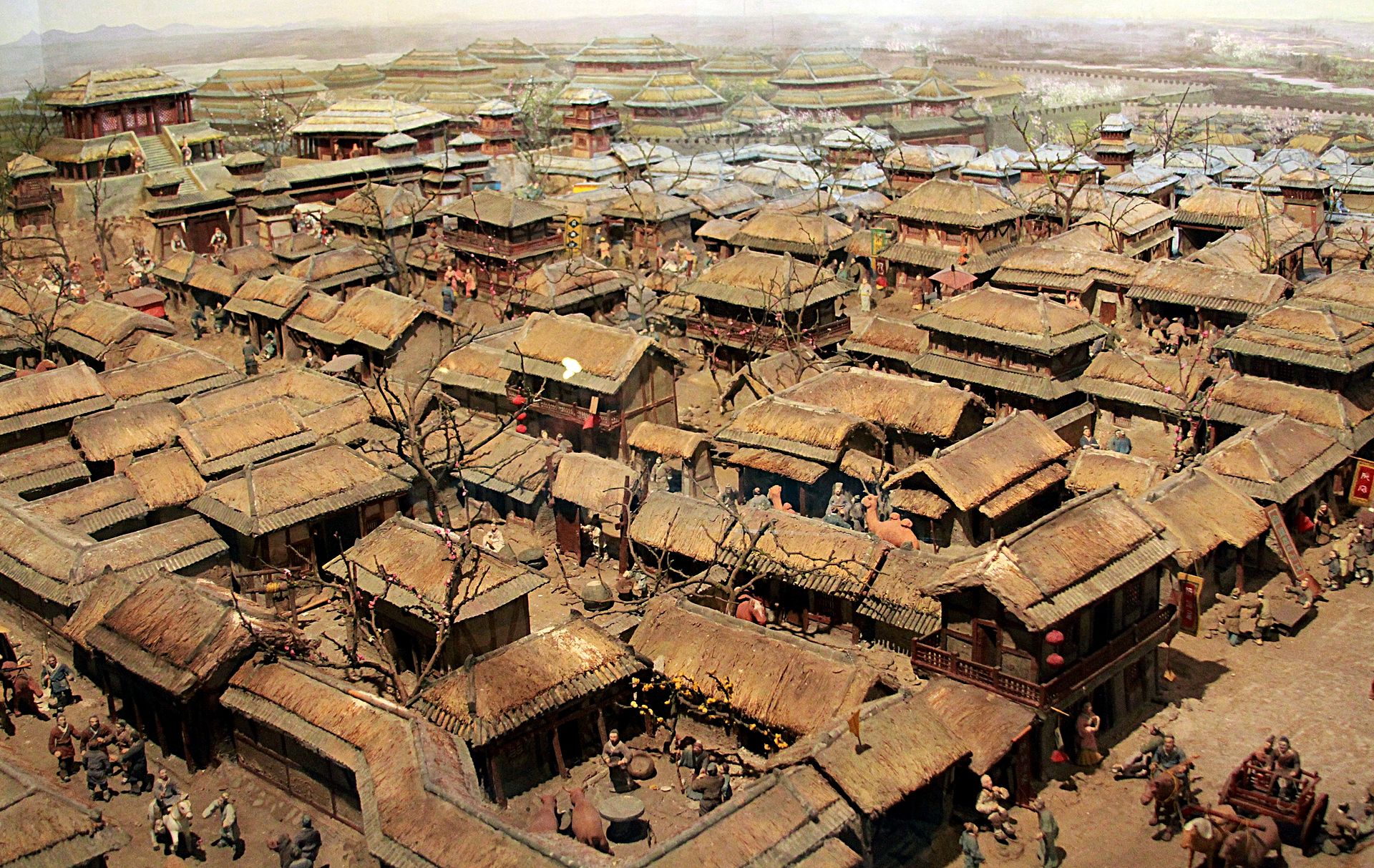
Linzi, the capital of the State of Qi, was one of the largest cities in the ancient world during the Warring States period (475–221 BCE). Archaeological surveys by the Shandong Provincial Institute of Cultural Relics have revealed a walled city enclosing approximately fifteen square kilometers, divided into a larger outer city for commerce and residential use and a smaller inner city containing the ducal palace complex. The city was situated at the confluence of the Zi River (淄水) and the Xi River (系水), and the river frontage along the Zi served as the city’s commercial zone, with archaeological evidence of drainage systems, roads, and dense settlement patterns consistent with intensive market activity. The outer city walls, built of rammed earth (hangtu), stretched over twenty kilometers in circumference, with gates that opened onto major inter-state roads. Within the outer city, archaeologists have identified specialized craft production districts: bronze-casting workshops, bone-working facilities, and coin-minting operations have been excavated across multiple seasons of fieldwork. Large quantities of Qi’s distinctive knife-money (刀币) have been found throughout the site, indicating a highly monetized urban economy. The spatial organization of Linzi followed principles later codified in the Kaogong ji (考工记, Record of Trades), an appendix to the Zhouli that describes the ideal Zhou-dynasty capital with a grid of streets, market areas positioned to the north of the palace, and residential wards organized by function. While Linzi’s plan was less regular than this ideal, the placement of market and craft districts along the river and near the city gates reflects a deliberate commercial logic: goods arriving by water or overland road could be unloaded, traded, and distributed without penetrating the administrative core of the city. As Li Feng documents in Early China: A Social and Cultural History (Cambridge University Press, 2013), the cities of the Eastern Zhou period represented a new urban phenomenon in which commercial activity, previously subordinate to aristocratic ritual functions, became a primary driver of urban form.
The material culture of Linzi’s commercial quarter reflects the extraordinary wealth and sophistication of Qi’s monetized economy. The most distinctive artifacts are Qi’s knife-money (刀币), cast bronze coins shaped like stylized knives with ring handles, which circulated as currency throughout the state and beyond. These coins, produced in state-controlled mints excavated within Linzi’s outer city, bear inscriptions including the character qi (齐) and place names, making them both instruments of exchange and markers of state authority. Their elegant curved profiles and carefully controlled weights demonstrate sophisticated metallurgical technique and attention to standardization — qualities essential for a currency intended to facilitate long-distance trade. Beyond coinage, excavations at Linzi have yielded bronze ritual vessels (ding, gui, hu) from aristocratic tombs that reflect the intertwining of wealth, ritual, and political power in Qi society. Lacquerware, jade ornaments, and gold and silver inlay work testify to luxury craft production serving an elite market. Ceramic production was extensive, with kilns producing both utilitarian wares for the urban population and finer vessels for trade. Seal impressions found at the site indicate administrative control over commercial transactions, with officials using carved seals to authorize and record exchanges — a bureaucratic technology that connected the material culture of the marketplace to the apparatus of state governance. As Lothar von Falkenhausen discusses in Chinese Society in the Age of Confucius (1000–250 BC) (Cotsen Institute of Archaeology Press, 2006), the Eastern Zhou period saw a dramatic expansion of material culture associated with the emergence of new social groups, including merchants, whose wealth challenged the traditional aristocratic monopoly on luxury goods.
Linzi’s position at the confluence of the Zi and Xi rivers gave it natural advantages as a commercial center. The Zi River connected Linzi to the broader waterway system of the Shandong region, while overland routes linked the city to the other major Warring States capitals. The city’s gates were critical nodes in this commercial geography: markets and merchant quarters clustered near the gates where inter-state trade goods entered and exited, a spatial pattern described in Su Qin’s famous account in the Zhanguo ce (Stratagems of the Warring States), which portrays Linzi’s streets as so crowded that cart axles rubbed together, people’s shoulders touched, and their sweat fell like rain. Sima Qian’s Shiji (Records of the Grand Historian, ch. 129) describes Linzi as having 70,000 households, making it one of the largest cities in the contemporary world, comparable in scale to the great cities of the Mediterranean. The commercial quarter’s spatial typology — a riverside market district adjacent to city gates, with craft workshops and merchant residences arrayed along narrow lanes — represents an East Asian variant of the dense commercial urbanism found in other pre-modern trading centers, from the souks of the Near East to the forum districts of the Roman world. Qi’s geographic position on the Shandong peninsula gave it access to both maritime and terrestrial trade routes: the Bohai coast provided salt and marine products, while the fertile plains of central Shandong produced grain and textiles. As Mark Edward Lewis observes in The Early Chinese Empires: Qin and Han (Harvard University Press, 2007), the commercialization of the Warring States period transformed Chinese cities from administrative centers of aristocratic power into dynamic urban economies where merchants, artisans, and scholars competed for influence alongside the old nobility.
The commercial importance of Linzi is inseparable from the political and intellectual history of the State of Qi. The foundational figure is Guan Zhong (管仲, d. 645 BCE), chief minister to Duke Huan of Qi (齐桓公, r. 685–643 BCE), who transformed Qi into the first hegemon (ba) of the Spring and Autumn period through a program of economic and military reform. The Guanzi (管子), a text compiled over several centuries but attributed to Guan Zhong, contains some of the earliest systematic writing on economic policy in any civilization. Its chapters on qingzhong (轻重, “light and heavy”) articulate a proto-quantity theory of money: when currency is plentiful it becomes “light” and goods become “heavy” (expensive); when currency is scarce it becomes “heavy” and goods become “light” (cheap). The state, the Guanzi argues, should actively manipulate the money supply, stockpile and release commodities, and operate monopolies to stabilize prices and generate revenue — a vision of statecraft in which the market is not merely regulated but instrumentalized as a tool of governance. As W. Allyn Rickett translated and analyzed in Guanzi: Political, Economic, and Philosophical Essays from Early China (Princeton University Press, 1985 and 1998, 2 vols.), these doctrines represent a remarkably sophisticated engagement with monetary and fiscal theory. Guan Zhong is credited with establishing state monopolies on salt and iron, Qi’s two most valuable commodities. Qi’s coastal position on the Bohai Sea gave it a natural advantage in salt production, and the Guanzi argues that controlling salt is superior to direct taxation because it captures revenue through market transactions rather than coercive extraction. This model was later adopted empire-wide under the Han dynasty, as documented in the Yantie lun (Discourses on Salt and Iron, 81 BCE). The Jixia Academy (稷下学宫), established in Linzi in the mid-fourth century BCE under King Xuan of Qi, gathered scholars from across the Warring States — including Mencius, Xunzi, and Zou Yan — under state patronage. The Academy’s proximity to Linzi’s thriving markets meant that economic theorizing was grounded in observable commercial reality, a parallel worth noting to the later relationship between European universities and exchanges.
Qi’s most important export commodity was salt, produced along the Bohai coast through solar evaporation and traded across the Warring States world. The state salt monopoly, attributed to Guan Zhong’s reforms, channeled the production and distribution of this essential commodity through government-controlled channels, generating enormous revenue for the Qi treasury. Silk and textiles formed the second pillar of Qi’s commerce: Qi silk (qi wan 齐纨) was renowned throughout the Zhou world for its quality, and textile production employed large segments of Linzi’s population. Fish, both freshwater from the rivers and marine from the Bohai coast, was a significant commodity. Iron, smelted in state-supervised foundries, supplied both military and agricultural implements. Lacquerware and luxury craft goods — bronze vessels, jade ornaments, and gold and silver inlay work — served elite markets within Qi and were traded to other states. The monetary system itself was a form of traded commodity: Qi’s knife-money circulated beyond the state’s borders, and the Guanzi’s qingzhong chapters describe sophisticated strategies for manipulating exchange rates between different states’ currencies to Qi’s advantage. Inter-state grain trade was critical, particularly as Qi’s population grew and local agriculture could not always meet demand. The Guanzi describes a system of state granaries that purchased grain when prices were low and sold when prices were high — an “ever-normal granary” concept that predates the Han dynasty’s changping system by several centuries. Trade routes connected Linzi to the other major Warring States through both river systems and overland roads: to Chu in the south, Qi exported salt and silk and received rhinoceros horn, ivory, feathers, and lacquerware; to Wei and Zhao in the west, grain and metals flowed along the Yellow River corridor; to Yan in the northeast, furs and frontier goods were exchanged. As Sima Qian records in the Huozhi liezhuan (Biographies of the Money-Makers, Shiji ch. 129), the people of Qi were skilled in “weaving fine silks and embroideries, producing fish and salt,” and “all the world’s goods gathered” at Linzi.
Images will be added as the project develops. Photographs by Larry Ng and from research sources.