Old Stock Exchange of Lille (La Vieille Bourse)
Lille, France · Established 1652–1653 (built); securities exchange opened 1861
This site requires authorization to access.
To request access, contact
william.goetzmann@yale.edu
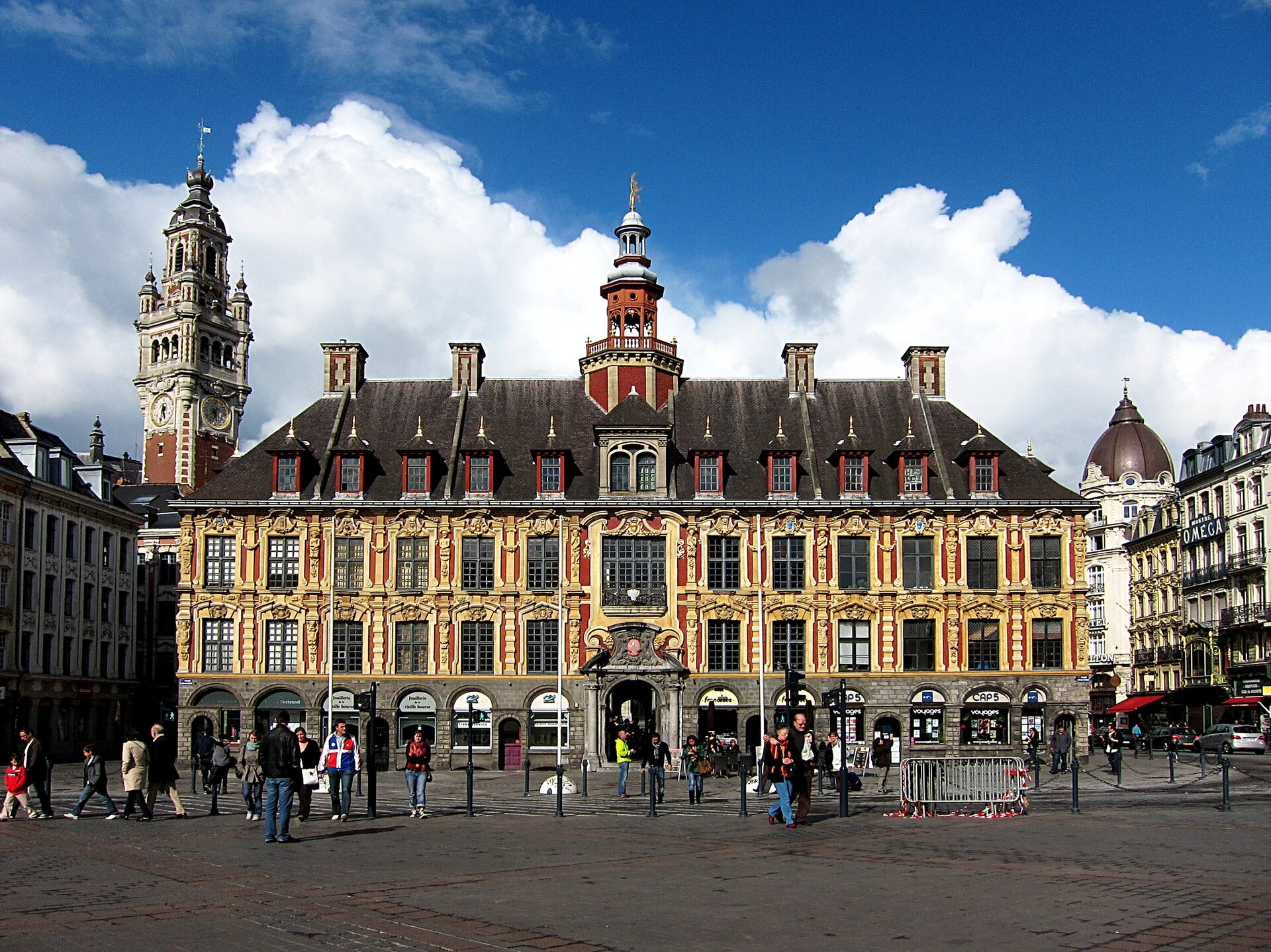
The Vieille Bourse was designed by the architect Julien Destrée, who was commissioned to draw up the plans in April 1652 and oversaw a remarkably compressed campaign of works that ran from the spring of 1652 to the autumn of 1653. Rather than a single monumental hall, Destrée conceived the bourse as an urban quadrangle: twenty-four identical merchant houses, sold off as building plots to individual traders, ranged around a single arcaded inner courtyard, with Destrée imposing strict uniformity of façade, height and fittings to bind the whole into one composition. The architecture is a textbook example of seventeenth-century Flemish Renaissance, as it developed under Spanish Habsburg rule in the southern Netherlands. The ground floor, reserved for merchants' shops, is built of heavily rusticated (bossage) sandstone with deeply recessed joints in the manner of a Florentine palazzo, while the two upper storeys combine brick with white stone dressings and dissolve into pilasters, mullioned windows, scrolls and broken pediments. A tall central campanile rises above the courtyard, crowned by a gilded statue of Mercury, the god of commerce and emblem of the exchange. After serving for decades as the city's chamber of commerce, the building was vacated when a new bourse opened around 1921; a major restoration campaign led by the Mécénas association ran from 1989 to 1998, as documented by the building's Base Mérimée notice (Ministère de la Culture, ref. PA00107569) and the architectural survey on Structurae.
The Vieille Bourse is celebrated less for paintings or sculpture in the round than for the extraordinary density of carved ornament that covers its façades, a programme studied in detail by Jacqueline Dion in 'Reconnaître et comprendre les sculptures de la Vieille Bourse de Lille' (Revue du Nord, vol. 71, no. 281, 1989, pp. 363–375). Between the upper-storey windows, pilasters alternate with shafts wound in flower garlands from which caryatids emerge, while cherubs, cornucopias, fruit clusters, drapery and cartouches crowd every available surface; Dion notes that no two caryatids, garlands or mascarons are exactly alike, so that the apparent uniformity of the quadrangle conceals an inexhaustible variety of detail. The decorative vocabulary is frankly mercantile and commemorative, mixing emblems of abundance and trade with allusions to the city's prosperity, and the whole is gathered up symbolically in the figure of Mercury atop the campanile. The arcaded courtyard, today filled with secondhand booksellers, florists and chess players, also carries inscriptions and reliefs honouring scientists and worthies added in later centuries, layering civic memory onto Destrée's original commercial iconography.
The Vieille Bourse occupies the very heart of Lille, wedged between the Grand'Place (Place du Général-de-Gaulle) and the Place du Théâtre, with its protected façades and interiors fronting onto those squares as well as the rue des Manneliers and the rue des Sept-Agaches, according to the Base Mérimée listing. Built when Lille was a wealthy textile and trading town of the Spanish Netherlands — it would pass to France only with Louis XIV's conquest in 1667 — the bourse was deliberately sited at the commercial crossroads of the city, its richly ornamented bulk answering the belfry of the Chamber of Commerce that now rises beside it and the nineteenth-century opera house across the square. Its quadrangle of houses turned a working marketplace into a piece of civic theatre, and it remains, in the words of the Lille tourist office (lilletourism.com), one of the defining landmarks of the city centre, its courtyard still a place of public congregation more than three and a half centuries after it was raised.
Lille's merchants had long lacked a dedicated exchange when, in 1651, the city obtained from King Philip IV of Spain authorisation to build 'a bourse for the use of merchants,' explicitly intended to rival the great exchange of Antwerp; Destrée's building, completed in 1653, was the result. For two centuries it functioned chiefly as a commercial bourse and meeting place, and only after the railway, coal mining and the mechanised textile industry transformed the regional economy did Lille acquire a securities market: a formal stock exchange opened in the building in 1861. As David Le Bris shows in his study of the Lille exchange (see his doctoral thesis, Université d'Orléans/HAL, tel-00608060), this provincial bourse remained thin and illiquid, with on the order of only a few per cent of listed capital changing hands each year. When a new, larger bourse and chamber of commerce opened around 1921, this structure was retired from active trading and became known as the 'Vieille Bourse' — the Old Exchange — and was listed as a monument historique on 25 May 1921, a protection extended by decree on 9 June 1923 (Base Mérimée PA00107569).
In its first two centuries the Vieille Bourse was a merchants' exchange in the older sense: a place to negotiate the sale of goods, commercial bills, and shares in trading ventures among the dealers of a major Flemish textile city, conducted face to face in the shops and courtyard rather than across a formal trading floor. The securities exchange that opened in 1861 reflected the industrialisation of the Nord: as David Le Bris documents, the Lille market came to specialise in instruments tied to the local economy, above all the bonds of the city of Lille and the shares of the coal-mining and metallurgical companies of the surrounding coalfield, alongside railway and regional industrial issues. Trading was modest and turnover low, so that the Lille bourse never rivalled Paris or even Lyon; its significance lies less in the volume of business than in its role as a regional capital market channelling local savings into the mines, mills and municipal infrastructure that powered the industrialisation of northern France.
Images will be added as the project develops. Photographs by Larry Ng and from research sources.