Alte Handelsbörse (Old Trade Exchange)
Leipzig, Germany · Established 1884
This site requires authorization to access.
To request access, contact
william.goetzmann@yale.edu
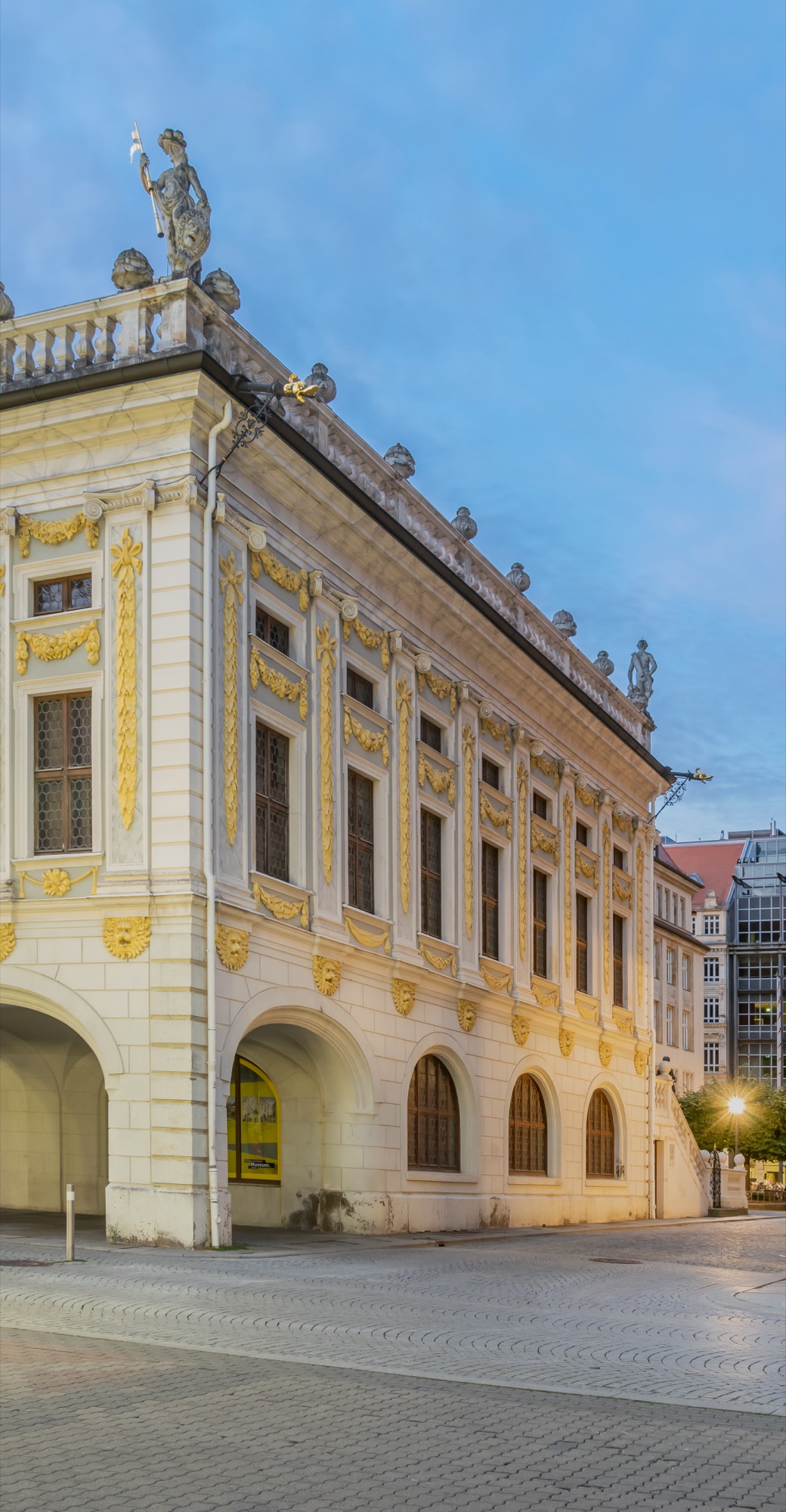
The Alte Handelsbörse is a freestanding two-story structure situated at Naschmarkt 2 in the historic center of Leipzig. Probably designed by Johann Georg Starcke (c. 1640–1695), a master builder at the court of John George II, Elector of Saxony, the building was erected under the direction of Leipzig council master mason Christian Richter (c. 1625–1684), with stonemasons Andreas Junghans of Rochlitz, Hans Caspar Beck of Laucha, and Melchior Bock of Zeitz. Construction began on 30 May 1678 and the exchange was first used by merchants in October 1679, though interior decoration was not completed until 1687. The plaster facade is embellished on all sides with flat pilasters bearing Ionic capitals and festoons, while a sandstone balustrade frames round-arched portals, and the building is accessed by an open two-way staircase with high rectangular windows on every elevation. The building combines elements of both Dutch and Italian Baroque, making it Leipzig's oldest surviving Baroque structure. During the Allied bombing of 4 December 1943, the Börse burned completely, destroying the interior; the exterior was restored between 1955 and 1962, and a comprehensive renovation from 1992 to 1995 painstakingly recreated the seventeenth-century facade coloration and window glazing.
The original interior of the Börsensaal featured elaborate decorative programs completed in 1687, most notably a stucco ceiling by the Italian stuccatore Giovanni Simonetti and seven allegorical ceiling paintings by Johann Heinrich am Ende, which together celebrated commerce, prosperity, and civic virtue in the manner typical of late-seventeenth-century Baroque commissions. On the exterior, four allegorical statues adorn the building: the front facade displays figures of Apollo and Mercury—the latter an apt symbol as the Roman god of merchants and commerce—while the rear elevation presents Minerva and Venus. Above the open staircase, winged putti hold the Leipzig city coat of arms, reinforcing the civic pride embedded in the building's decorative scheme. The catastrophic fire of December 1943 resulted in the irretrievable loss of the Simonetti stucco ceiling and all seven of the am Ende paintings, a destruction that removed some of the finest surviving examples of late-seventeenth-century decorative art in Saxony. The postwar restorations of 1955–1962 and 1992–1995 reconstructed the exterior ornamentation in historically faithful fashion, but the interior ceiling program could not be recovered. In front of the building on the Naschmarkt stands a bronze statue of the young Johann Wolfgang von Goethe, created by sculptor Carl Seffner and unveiled on 28 June 1903; the 2.65-meter figure depicts Goethe as a student in Rococo costume during his Leipzig years of 1765 to 1768.
The Alte Handelsbörse stands at the eastern end of the Naschmarkt, a narrow rectangular plaza approximately 90 meters long and 20 meters wide that was created in 1556 during the construction of the Altes Rathaus (Old Town Hall), one of the finest Renaissance civic buildings in Saxony. The Naschmarkt—whose name derives from the sweet goods ('Nascherey') once sold there—runs directly behind the Old Town Hall, connecting Grimmaische Strasse and Salzgässchen. Leipzig's historic core is remarkably compact: the Thomaskirche, where Johann Sebastian Bach served as Thomaskantor from 1723 to 1750, lies only a few minutes' walk to the west, while the Nikolaikirche, the starting point of the 1989 Peaceful Revolution, is a similar distance to the east. The exchange's location was no accident: it sat at the commercial heart of a city whose trade fair tradition dates to 1165, when Margrave Otto the Rich first established regular markets at the crossroads of the Via Regia (the east-west route linking Paris to Kyiv) and the Via Imperii (the north-south route from the Baltic to Italy). By the seventeenth century, Leipzig's three annual fairs—New Year, Jubilate, and Michaelmas—drew merchants from across Europe, and the Börse provided them a permanent institutional anchor between the Rathaus, the weighing house, and the market square.
The initiative to build the Alte Handelsbörse originated in 1667, when thirty of Leipzig's leading merchants petitioned the city council after foreign traders complained about the lack of a dedicated, neutral venue for concluding business during the great trade fairs. The council formally approved the project on 6 May 1678 and construction began just twenty-four days later; by October 1679, though the interior remained unfinished, merchants were already conducting transactions in the new hall, and full completion came in 1687 with the installation of the ceiling decorations. The ground floor contained rooms rented to individual merchants, while the upper-floor Börsensaal served as the exchange hall proper, hosting auctions, the trading of bills of exchange, and formal civic gatherings. For approximately two hundred years the Börse functioned as the commercial nerve center of one of Europe's most important trading cities: Leipzig's imperial trade fair privilege, granted by Maximilian I in 1497 and extended in 1507, had created a market of continental significance. With the enormous growth of trade in the second half of the nineteenth century, the Chamber of Commerce commissioned a larger Neue Handelsbörse on Tröndlinring, completed in 1886; upon its opening the original building received the name 'Alte Handelsbörse.' The building was gutted by fire in December 1943 during Allied bombing, restored between 1955 and 1962, and comprehensively renovated from 1992 to 1995 after German reunification. Today the Alte Handelsbörse is administered by the Stadtgeschichtliches Museum Leipzig and serves as an event venue hosting concerts, literary readings, academic lectures, and conferences.
The Alte Handelsbörse was the institutional setting for the financial processing of Leipzig's vast trade fair commerce, serving as the venue where auctions were conducted, commercial transactions concluded, and bills of exchange—the principal instruments of long-distance credit in early modern Europe—were traded among German, Polish, Russian, English, and other foreign merchants. Leipzig's trade fairs, which by the seventeenth century ran for two to three weeks three times annually, dealt in an extraordinary range of commodities: books and printed works (Leipzig displaced Frankfurt as Europe's leading book-trade center by the late 1600s), silk, jewels, furs sourced from Russian and Polish suppliers, linen and woolen textiles, and a variety of luxury goods demanded by Central European courts. The 1497 Reichsmesseprivileg granted by Emperor Maximilian I, which banned competing fairs within a wide radius, ensured that Leipzig functioned not merely as a goods market but as a financial clearinghouse where the settlement of accounts, extension of trade credit, and exchange of currencies took place in structured fair-time sessions. The establishment of a commercial court in 1681, just three years after the Börse opened, further institutionalized dispute resolution and credit enforcement, making the exchange building part of a broader legal and financial infrastructure that reduced transaction costs for long-distance traders.
Images will be added as the project develops. Photographs by Larry Ng and from research sources.