Leeds Corn Exchange
Leeds, UK · Established 1864
This site requires authorization to access.
To request access, contact
william.goetzmann@yale.edu
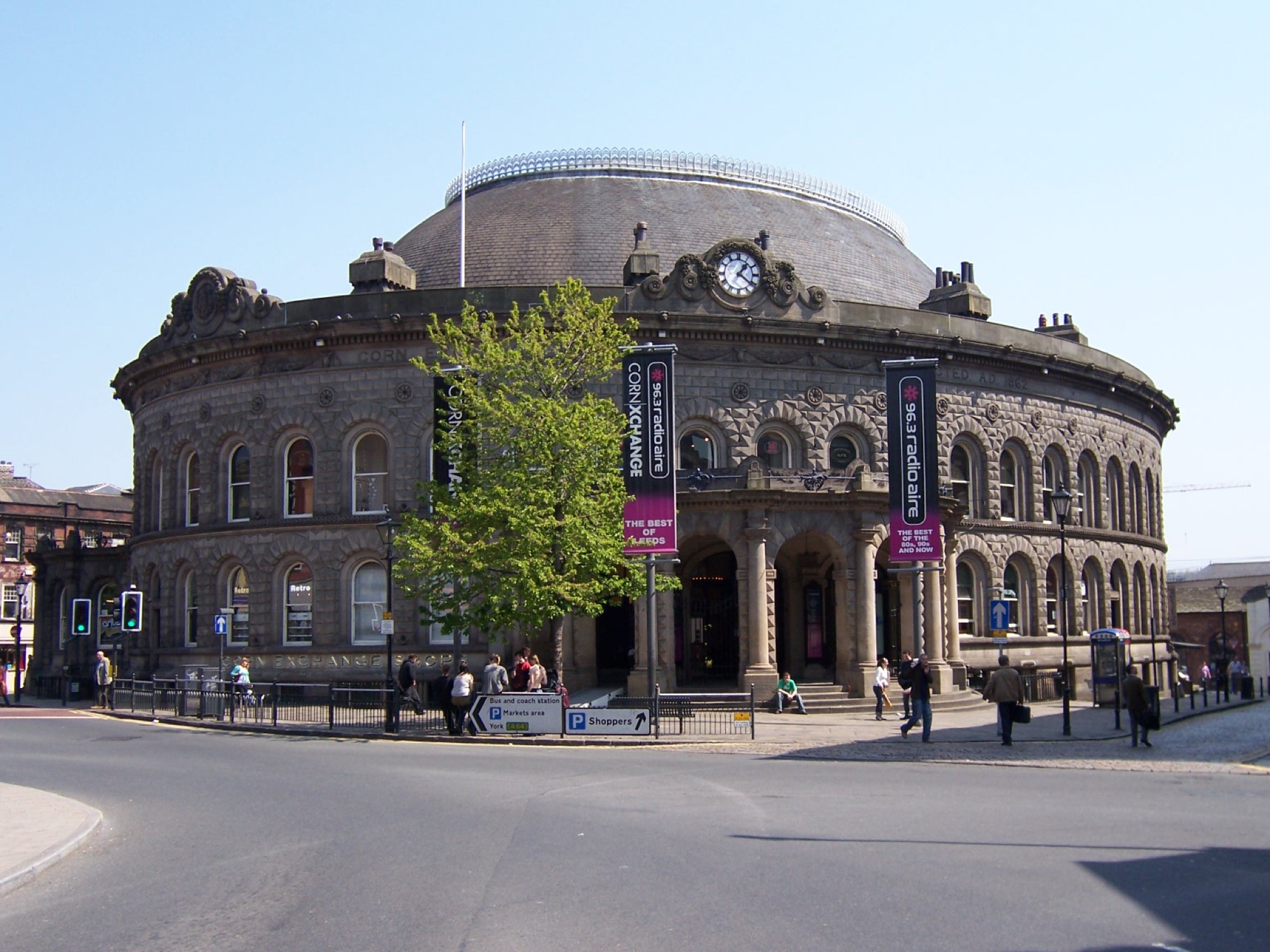
The Leeds Corn Exchange, completed in 1863 and opened for trade in 1864, is one of the most striking commercial buildings of Victorian England. It was designed by Cuthbert Brodrick (1821–1905), the Hull-born architect who had already transformed the Leeds skyline with his competition-winning Town Hall of 1858. As Derek Linstrum documents in Towers and Colonnades: The Architecture of Cuthbert Brodrick (Leeds Philosophical and Literary Society, 1999), Brodrick drew directly on his 1844 Grand Tour experiences in France, modeling the Corn Exchange’s elliptical plan on the Halle au Blé in Paris and its domed roof on the Bourse de Commerce by François-Joseph Bélanger and François Brunet (completed 1811). The building occupies an awkwardly shaped site at the junction of Call Lane and Crown Street, its oval footprint measuring approximately 190 feet long, 136 feet wide, and 86 feet high from the basement. Externally it is faced in rough local sandstone with distinctive diamond-pointed rustication and millstone grit banding, lending it a robust, almost fortified presence. Two projecting semicircular entrance porches, flanked by Tuscan-order columns supporting cornices, provide access at ground and upper levels. The crowning glory is the elliptical dome—clad in dark grey slate and crested with iron finials—whose 19 semi-elliptical wrought-iron main ribs span longitudinally while lighter semicircular ribs cross transversely, creating what engineers have recognized as a very early space-frame structure. A large glazed oculus on the north side was designed to admit maximum natural, shadowless light for the inspection of grain samples, as the Historic England Grade I listing (entry 1255771, listed 1951) emphasizes. Nikolaus Pevsner, in Yorkshire: The West Riding (1959; revised by Peter Leach, Yale University Press, 2009), praised the design as “remarkably independent and functional.” Linstrum himself called it “a building of national, maybe international importance.” In 1988 Leeds City Council granted a 999-year lease to Speciality Shops plc, and the firm Alsop, Lyall and Störmer oversaw a sensitive conversion that won a Europa Nostra Diploma in 1991 for its sympathetic adaptation of the Grade I listed structure into a retail center while preserving its architectural character.
The decorative program of the Leeds Corn Exchange, though restrained compared to continental bourses, is richly articulated for a Victorian commercial building. Brodrick’s characteristic rosette motifs—a hallmark also found at Leeds Town Hall, as noted in Linstrum’s Towers and Colonnades (1999)—appear above the upper tier of arched windows, lending a rhythmic ornamental unity to the curved facade. Above the rosettes runs a classical frieze of garlands and bucrania (ox skulls), ancient symbols of sacrifice and agricultural abundance long associated with market buildings since Roman antiquity. An inscribed band reads “CORN EXCHANGE ERECTED A.D. 1862,” integrating lettering into the decorative scheme. The carved stone keystones over the arched windows on both stories depict stylized heads representing different nations, reflecting Leeds’s aspirations as an international grain-trading center. Inside, the sweeping elliptical dome—likened by the RIBA Journal to “the inverted hull of a ship”—creates a dramatic overhead canopy whose wrought-iron longitudinal ribs converge behind a large cast-iron lunette. The gallery level features ornate cast-iron railings and balustrades that separate the upper offices from the main trading floor below. Coloured brickwork lines the interior walls, providing a warm counterpoint to the ironwork. During World War II, photographer George Bernard Wood documented the interior for the National Buildings Record, capturing the dome’s clock, ironwork, and spatial grandeur in images now preserved in the Historic England Archive and accessible through Google Arts and Culture. Following the 1989–1990 restoration, the original merchants’ desks and sample trays were retained, preserving material artifacts of the exchange’s commercial past alongside its architectural ornamentation.
The Corn Exchange stands at the heart of Leeds’s historic commercial core, situated at the convergence of Call Lane, Kirkgate, Crown Street, and Duncan Street—a dense network of thoroughfares that has served as the city’s mercantile center since medieval times. As Linstrum describes in Historic Architecture of Leeds (Oriel Press, 1969, with a preface by John Betjeman), the building arose within a district already defined by centuries of textile and agricultural trade. Immediately to the northeast lies Kirkgate Market, one of the largest covered markets in Europe, whose origins date to 1822 and whose Victorian halls (rebuilt from the 1850s onward) housed hundreds of traders in provisions, textiles, and household goods. To the west, Briggate—Leeds’s principal commercial street since the town’s medieval foundation—was the site of the first Corn Exchange (designed by Samuel Chapman, opened 1829) and the cloth markets that preceded it. The White Cloth Hall, first built on Kirkgate in 1711 for the sale of undyed broadcloth, established this quarter’s identity as a mercantile zone long before Brodrick’s building appeared. The city’s rise as a grain-trading center was made possible by its position at the junction of the Aire and Calder Navigation (established 1699) and the Leeds and Liverpool Canal (completed to Leeds in 1816), which connected the West Riding to both the Humber ports and the Lancashire manufacturing towns. The arrival of railways from the 1830s—beginning with the Leeds and Selby Railway in 1834—further consolidated the city’s role as a distribution hub. Brodrick’s Corn Exchange thus crowned a commercial district already anchored by his own Town Hall (1858) to the west on The Headrow, creating an axis of civic and mercantile grandeur that defined Victorian Leeds.
The institutional history of the Leeds Corn Exchange reflects the arc of British agricultural trade from pre-industrial open-air markets to Victorian commercial grandeur and twentieth-century decline. For centuries, farmers and corn merchants gathered on Tuesdays near the Market Cross at the top of Briggate to conduct their trade in the open air. The first purpose-built corn exchange in Leeds, designed by Samuel Chapman, opened at the north end of Briggate in 1829, incorporating a hotel, tavern, shops, and warehouse alongside the trading floor. By the 1850s this facility had become inadequate for the city’s expanding grain commerce, which had grown substantially following the repeal of the Corn Laws in 1846—a watershed in British trade policy that opened the market to foreign imports and stimulated domestic distribution networks. In 1860, the Leeds Corporation held an architectural competition for a new exchange; Brodrick won and construction proceeded from 1861 to 1863, with the building formally opening in 1864. The exchange rapidly fulfilled its promoters’ ambition to make Leeds one of the principal corn markets in northern England. Grain imported from America, Canada, and continental Europe flowed through Leeds’s rail and canal connections, and every Tuesday corn factors, millers, and merchants convened beneath the dome to inspect samples and negotiate prices. The Great Depression of British Agriculture (conventionally dated 1873–1896), driven by cheap American prairie grain and steamship transport, gradually eroded the domestic corn trade, though Leeds’s exchange continued to function into the mid-twentieth century. By the 1960s, the number of active traders had dwindled sharply. The building was granted Grade I listed status by the Ministry of Works on 19 October 1951, recognizing its exceptional architectural significance. In 1988 Leeds City Council leased the building for 999 years to Speciality Shops plc, and after an extensive restoration directed by architects Alsop, Lyall and Störmer, it reopened on 28 July 1990 as a specialty retail center. The restoration won a Europa Nostra Diploma in 1991, with the jury citing “the sympathetic conversion of a unique structure to accommodate new uses while retaining the character and part of the function of the original.” Corn traders were allocated space and continued to meet on Tuesdays until approximately 1994, when trading ceased after 131 years of continuous operation.
The Leeds Corn Exchange was built specifically for the inspection and sale of grain—primarily wheat, barley, oats, and other cereals—by sample rather than by bulk. The method of trade was characteristic of Victorian corn exchanges throughout England: farmers and dealers brought small samples of their grain to the exchange on designated market days (Tuesdays in Leeds), displayed them on individual desks or stands arranged across the trading floor, and buyers—millers, maltsters, bakers, and wholesale merchants—circulated among the stalls, examining the quality, color, and condition of each sample under the carefully calibrated natural light admitted through the dome’s north-facing glazed oculus. The entire architectural program of the building, as the Historic England listing notes, was shaped by this need for “natural, undazzling, shadowless north light throughout the year to facilitate the viewing of the minute kernels.” Transactions were concluded by verbal agreement, often sealed with a handshake, with formal contracts following. Before the purpose-built exchange, the same trade had been conducted in the open air at Briggate and then in the 1829 Chapman exchange, where a sack market also operated alongside the sample trade. The repeal of the Corn Laws in 1846 expanded the volume and variety of grain flowing through Leeds, as foreign imports—American wheat, Canadian barley, European rye—entered the domestic market via the Humber ports and the Aire and Calder Navigation. By the late nineteenth century, Leeds had become a grain-trading center of national importance, handling both domestically grown and imported cereals for redistribution across the industrial north. No financial instruments or commodity futures were traded at the exchange; it remained a physical commodity market where the goods themselves—in sample form—were the medium of transaction. This distinguished it from the commodity exchanges emerging in Liverpool and London, where forward contracts and speculative trading were becoming common by the 1880s.
Images will be added as the project develops. Photographs by Larry Ng and from research sources.