Commodity Exchange of Le Havre (Bourse de commerce du Havre)
Le Havre, France · Established 1784 (first exchange); futures markets from 1871
This site requires authorization to access.
To request access, contact
william.goetzmann@yale.edu
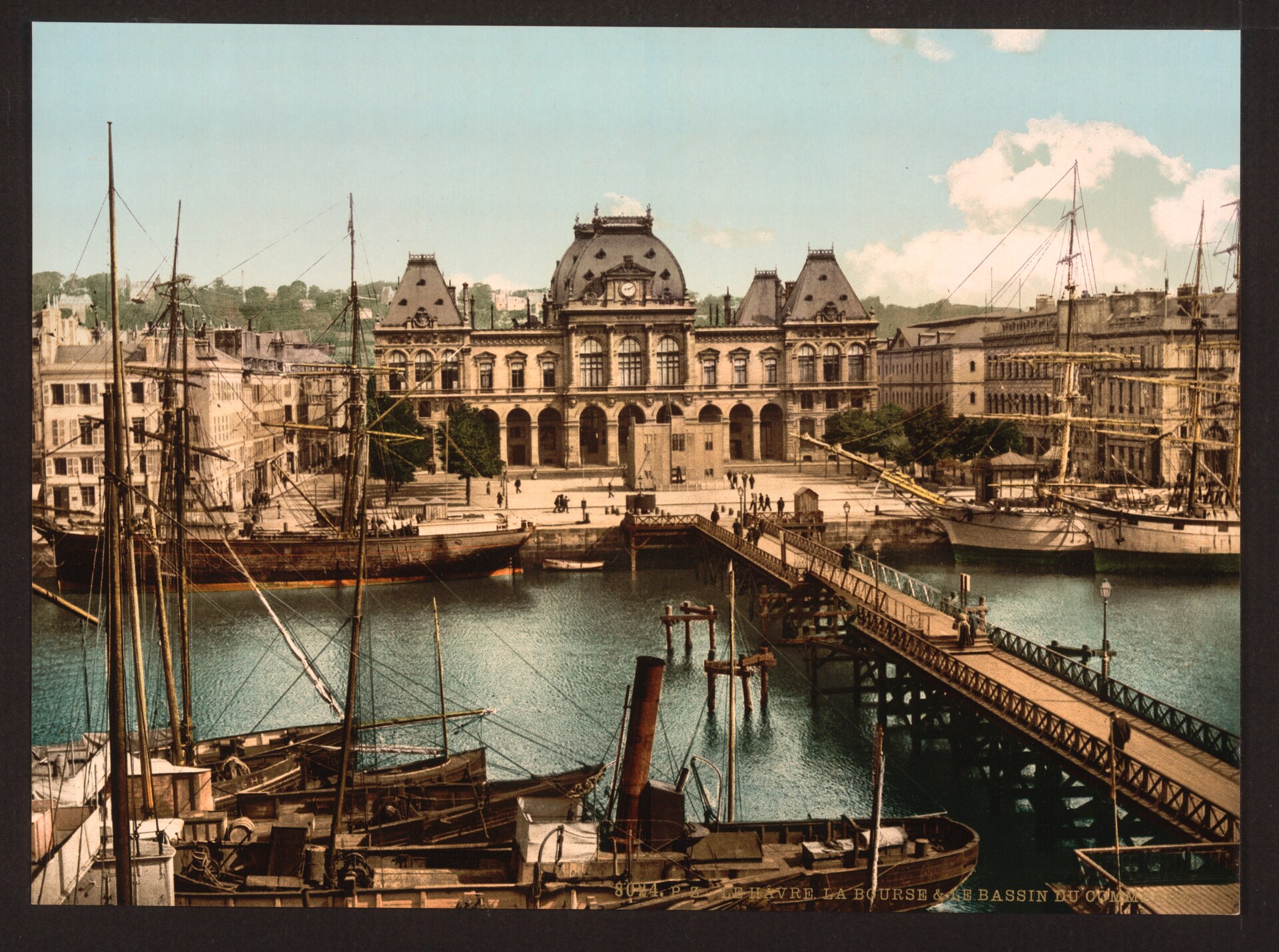
The Le Havre commercial exchange occupied three successive structures, each lost in turn to redevelopment or war. The first, a modest peristyle building authorised by the merchants' assembly of 24 October 1774 and finally erected in 1784 after the American War of Independence had delayed the project, stood between the Tour François Ier and the Logis du Roy on the old Place d'Armes (fr.wikipedia.org, 'Bourse de commerce du Havre'). It was abandoned from about 1840, when traders took to gathering on the parvis of Notre-Dame, and the precinct was cleared with the demolition of the Tour François Ier in 1862. Its grander successor, the Palais de la Bourse, was built to designs by the architect Louis Lemaître (with M. Huchon and M. Rodet); the foundation stone was laid on 2 March 1878 and the building, in an imposing Renaissance and Beaux-Arts manner, was inaugurated on 29 September 1880 at a cost of roughly 2.24 million francs. This is the building shown, with the adjoining docks, in the Library of Congress photochrom of c.1890-1900. It was gutted in the Allied bombardment of September 1944 that destroyed most of central Le Havre, its last walls pulled down on 1 July 1949. The exchange's functions passed to the new Chamber of Commerce and Industry building raised on the Place du Commerce (now Place Jules Ferry) at the head of the Bassin du Commerce. Designed from a competition-winning scheme by the local architects Jean Louvet and René Déchenaud, and carried out under the Parisian architect Otello Zavaroni as chief architect between 1953 and 1957, it is a monumental reinforced-concrete composition whose sixteen colossal pillars form a peristyle on both principal facades (R. Saint-Pierre, 'Otello Zavaroni: la chambre de commerce et d'industrie du Havre, 1947-1957, une variante dans la reconstruction Perret', Livraisons de l'histoire de l'architecture, 15, 2008). Though it employs the classical vocabulary of Auguste Perret's reconstructed city, its stricter geometry and absence of decorative allusion mark it as a variant rather than a strict exercise in Perret's structural classicism.
The artistic programme is concentrated in the 1957 Chamber of Commerce building, whose luxurious interiors were intended to project the prosperity of the rebuilt port. The fresco painter Nicolas Untersteller executed a roughly 60-metre maritime composition, and Paul Lemagny a long fresco of underwater life; the sculptor Henri Lagriffoul supplied travertine reliefs, while the decorator Jean Royère furnished the principal rooms in a sumptuous Consular-revival idiom (R. Saint-Pierre, Livraisons de l'histoire de l'architecture, 15, 2008). These works survive because the building, listed as part of the UNESCO World Heritage reconstruction of Le Havre, was carefully restored when the Partouche group converted it into a casino in 2005-2006. The earlier exchanges left little in the way of fixed artwork: the 1784 peristyle was a utilitarian merchants' shelter, and the 1880 Palais de la Bourse, for all its Renaissance pretension, is remembered chiefly through photographs rather than any surviving decorative ensemble.
The exchange has always belonged to the working waterfront rather than to a banking quarter. The 1784 building sat hard against the medieval Tour François Ier guarding the harbour mouth, amid the warehouses and quays of one of France's principal Atlantic ports. The 1880 Palais de la Bourse stood in the commercial district between the Place de la Sous-Prefecture and the Place du Commerce, close to the docks that the photochrom view sets directly behind it, so that traders could watch the very basins through which their cargoes moved. After 1944 the institution was re-sited at the north end of the Bassin du Commerce, on the Place Jules Ferry, within Auguste Perret's gridded concrete city centre - inscribed by UNESCO in 2005 as 'Le Havre, the City Rebuilt by Auguste Perret' (whc.unesco.org, World Heritage List 1181). The building thus faces the old commercial basin while forming part of one of the twentieth century's most coherent exercises in urban reconstruction.
Le Havre's importance lay less in securities than in commodities, and above all in the organisation of futures trading. A futures market in cotton opened in 1871, following the pioneering American exchanges and the Liverpool trade, and was supported by the Caisse de Liquidation des Affaires en Marchandises (CLAM), established at Le Havre in 1882 to guarantee settlement between buyers and sellers. The CLAM is now recognised as the first central clearing counterparty in financial history, created in response to the global disruption of the coffee trade after the destabilising Brazilian harvests of the early 1880s (G. Bignon and others, 'The real effects of mitigating counterparty risk: evidence from 19th-century France', CEPR/VoxEU, drawing on CEPR Discussion Paper 13230). With clearing in place, a coffee futures market was inaugurated on 25 August 1883 - essentially in step with the Coffee Exchange of New York and the London terminal market - and further terminal markets followed for wool, indigo, pepper, cocoa, rubber, hides and copper between 1887 and 1912 (fr.wikipedia.org, 'Bourse de commerce du Havre'). Contemporaries credited the CLAM with boosting Le Havre's trade so markedly that within a decade nine other European futures exchanges had adopted central clearing of their own. The bombardment of 1944 and the contraction of Europe's colonial commodity trade ended this era; the institution endured as the Chamber of Commerce and Industry until that body's premises were converted to a casino in the 2000s.
Le Havre was France's leading coffee-import port and the principal European entrepot for warehousing and re-exporting coffee, and it was on this physical commodity base that its futures markets were built. The exchange dealt in standardised forward contracts for cotton and, from 1883, coffee, alongside wool, indigo, pepper, cocoa, rubber, hides and copper - the produce of the Atlantic and colonial trades funnelled through the port's docks (books.openedition.org, Le Havre colonial de 1880 a 1960). Trading was conducted on the terminal-market model: buyers and sellers exchanged contracts for delivery at future dates, with the Caisse de Liquidation des Affaires en Marchandises standing between them to net obligations, hold margin and guarantee performance (CEPR/VoxEU, 'The real effects of mitigating counterparty risk'). Because Le Havre warehoused and redistributed coffee across Europe, its quotations carried weight far beyond France: it was the one continental exchange able to rival New York in the formation of world coffee prices, a role that made the bourse, in its decades of importance, a genuine node of the global commodity economy rather than a merely regional bourse.
Images will be added as the project develops. Photographs by Larry Ng and from research sources.