Lausanne Stock Exchange
Lausanne, Switzerland · Established 1873
This site requires authorization to access.
To request access, contact
william.goetzmann@yale.edu
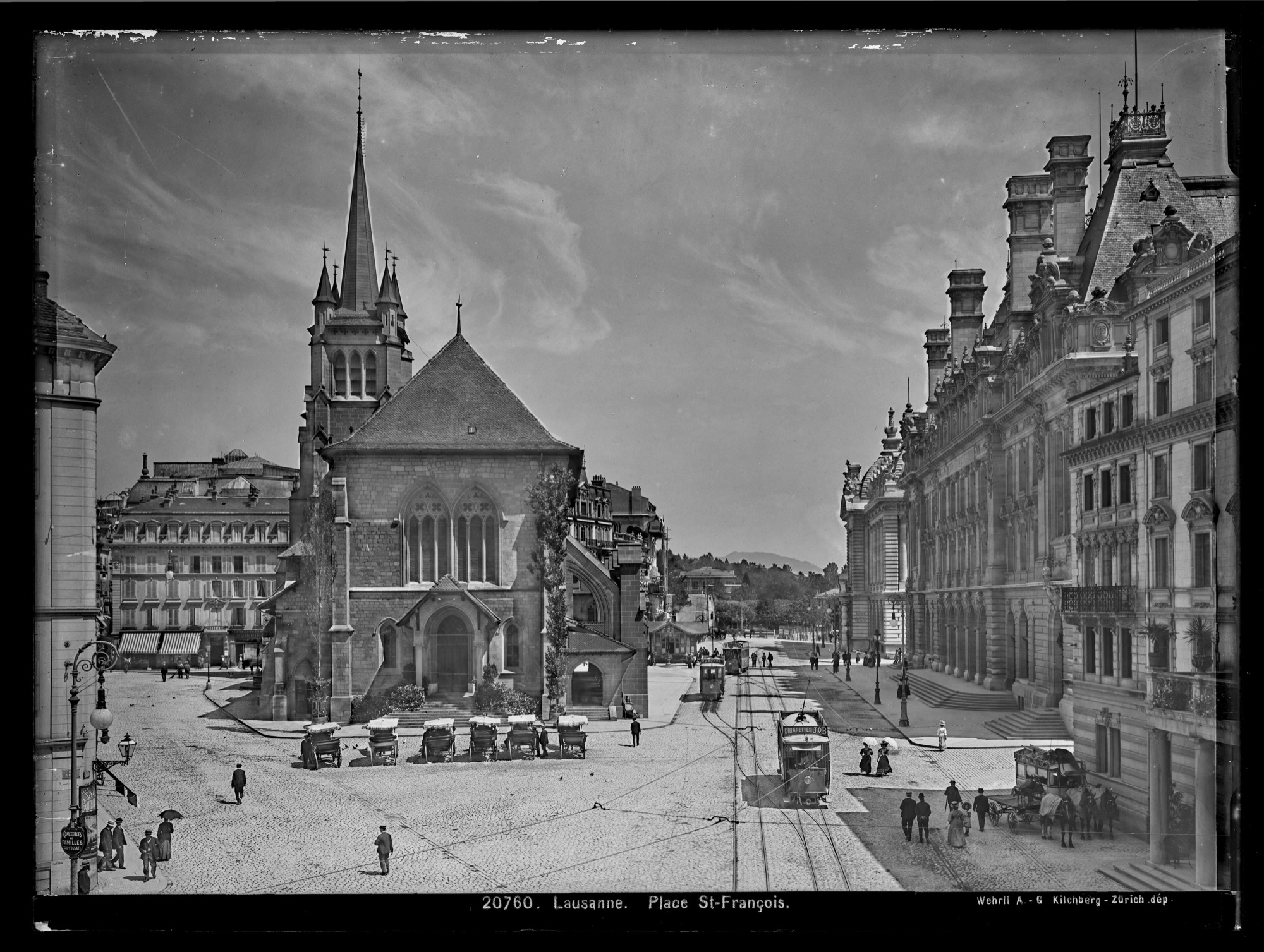
The Bourse de Lausanne operated not from a purpose-built exchange palace but from commercial premises in the banking quarter clustered around Place Saint-François, the financial heart of the city since the late nineteenth century. Unlike the grand corbeille halls of Geneva or Zurich, the Lausanne exchange functioned as a smaller cantonal institution whose trading activities were housed within the district’s monumental bank buildings. The most architecturally significant of these was the Société de Banque Suisse (SBS) building, designed by the Lausanne architects Maurice Schnell and Charles Thévenaz in a neoclassical style and constructed between 1920 and 1923. As Dominik Gehl documents in his architectural survey of Lausanne landmarks, the SBS building replaced the Hôtel Gibbon—the city’s first luxury hotel, built in 1839—and presented eight imposing columns facing the square, its stone façade projecting the gravitas befitting a major Swiss banking institution. Thévenaz, trained at the École des Beaux-Arts in Paris under Pascal’s atelier and the first Swiss architect to receive the French government’s diploma (as recorded in the EPFL Morphé database), brought Parisian Beaux-Arts sensibilities to Lausanne’s financial architecture. Across the square, the Union de Banques Suisses erected a rival edifice with Ionic columns on the Saint-François façade, creating an architectural dialogue of neoclassical banking temples. The exchange’s trading rooms, like those of other Swiss cantonal bourses, featured the ring configuration—a circular barrier around which brokers gathered to call prices aloud—adopted from the Paris Bourse model, as the Swiss Finance Museum’s permanent exhibition documents.
The decorative programs of Lausanne’s financial quarter reflected the ambition of Swiss Romande banking culture to rival the grandeur of Parisian and Genevan financial architecture. As the 24 heures newspaper’s architectural survey recounts, the bank buildings encircling Place Saint-François displayed façades “alternately neoclassical, austere, historicizing, and inspired by French or German architecture,” their ornamental vocabularies signaling the “power and seriousness” of early Vaudois banking institutions. The SBS palace, inaugurated on 22 December 1923, featured the Florentine palazzo motifs that Thévenaz favored—rusticated stone bases, pedimented windows, and classicizing sculptural programs typical of early twentieth-century Swiss bank architecture. The interior trading and banking halls employed the materials conventional to the era: marble floors, coffered ceilings, and brass fixtures that demarcated the commercial spaces from public lobbies. Within the exchange ring itself, the decorative program was deliberately restrained—the functional corbeille required clear sightlines and acoustic projection for the à la criée trading system. The Lausanne Palace hotel, inaugurated in 1915 near Place Saint-François with its Belle Époque façade (as Lausanne Tourisme’s architectural guide describes), contributed to the ensemble of ornamental civic grandeur surrounding the exchange quarter. Financial instruments themselves—engraved share certificates of Vaudois railway companies, cantonal bond coupons, and the embossed seals of the Banque Cantonale Vaudoise—constituted a parallel decorative tradition, their elaborate typography and allegorical vignettes embodying the visual culture of Swiss regional capital markets.
Lausanne’s stock exchange was embedded in the city’s distinctive topography—a terraced landscape rising from the shores of Lake Geneva (Lac Léman) to the medieval Cité quarter above. Place Saint-François, where the financial district crystallized in the late nineteenth century, occupied a strategic position at the convergence of the Grand-Pont (completed 1844, linking the city’s eastern and western halves across the Flon valley) and the elegant Rue de Bourg. As Lausanne Tourisme’s historical guide documents, the square—named for the thirteenth-century Franciscan church at its center—transformed into a banking precinct as “imposing monuments were adorned with historical styles and welcomed new infrastructures: a post office, new institutions, the Federal Tribunal, banks and large stores.” The Federal Supreme Court (Tribunal Fédéral), permanently established in Lausanne by the Swiss Constitution of 1874, anchored the city’s identity as a center of law and institutional governance. Within the broader Swiss Romande financial geography, Lausanne occupied a secondary but complementary position to Geneva’s dominant international bourse—serving the cantonal economy of Vaud while Geneva attracted cosmopolitan capital. Sébastien Guex, in “The Emergence of the Swiss Tax Haven, 1816–1914” (Business History Review, 2022), demonstrates that Vaud was among the earliest cantons to exempt wealthy foreigners from taxation, a policy that drew French capital fleeing the Franco-Prussian War to the Banque Cantonale Vaudoise. The city’s selection as headquarters of the International Olympic Committee in 1915 further cemented its international profile alongside its financial and judicial roles.
The Bourse de Lausanne was established in 1873, the same year as the Zurich exchange and two decades after Geneva’s pioneering Société des agents de change réunis (1850). As the Dictionnaire historique de la Suisse (Historisches Lexikon der Schweiz) records, Swiss stock exchanges were created locally under cantonal authority, reflecting the Confederation’s radically decentralized political structure. The Lausanne bourse served the capital needs of Canton Vaud during a period of rapid railway construction—the Railway Act of 1852 having placed rail development in cantonal hands—and growing industrialization across the Lake Geneva arc. Alongside the larger exchanges of Basel (1866), Bern (1884), St. Gallen (1887), and Neuchâtel (1905), Lausanne formed part of a network of seven Swiss bourses operating under cantonal regulation, each with its own ring-trading floor where brokers conducted transactions à la criée. The Lausanne School of economics, founded at the University of Lausanne by Léon Walras in 1870 and continued by Vilfredo Pareto, developed general equilibrium theory in the very city where provincial securities trading occurred daily—a remarkable convergence of financial theory and practice, as explored in Maneschi and Thweatt’s “Economics in Lausanne: Vilfredo Pareto and the Lausanne School” (Springer, 2020). By the late twentieth century, advances in telecommunications rendered the cantonal exchanges unviable; in 1991, the bourses of Lausanne, Neuchâtel, and St. Gallen were discontinued. The three surviving exchanges—Zürich, Geneva, and Basel—merged in 1993 to form the SWX Swiss Exchange, and the Federal Stock Exchange Act (SESTA) of 1995 replaced cantonal jurisdiction with national regulation. SWX became part of SIX Group in 2008.
The Lausanne exchange traded the range of instruments characteristic of Swiss cantonal bourses in the late nineteenth and early twentieth centuries: government bonds (obligations), cantonal bonds issued by Vaud and neighboring cantons, railway securities that financed the expanding Swiss rail network, and equity shares of regional enterprises. As the Springer volume Swiss Equity Markets (2023) explains, the need for organized securities markets in Switzerland arose when “huge financing needs of the second half of the nineteenth century—particularly for large infrastructure projects, such as railways—overwhelmed traditional private financing sources.” The Banque Cantonale Vaudoise, founded in 1845 to support the canton’s agricultural, industrial, and commercial sectors (as its corporate history records), was among the institutions whose securities circulated on the Lausanne ring. Shares of Vaudois enterprises—including companies in the Vallée de Joux watchmaking industry, the Vevey food sector anchored by Nestlé (founded 1866), and the regional tobacco firms such as Rinsoz & Ormond—found local listing and liquidity. Trading followed the ring system adopted from the Paris Bourse via Geneva: brokers gathered in a circular corbeille and exchanged bids aloud, with sessions running from approximately 9:30 a.m. to noon, as the Swiss Finance Museum documents. Cantonal exchanges were subject to cantonal value-added taxes on transactions, creating regulatory fragmentation that ultimately drove consolidation. When electronic trading commenced on 16 August 1995—making the SWX Swiss Exchange the world’s first fully automated trading, clearing, and settlement system—the era of physical ring trading that Lausanne had practiced for over a century came definitively to its end.
Images will be added as the project develops. Photographs by Larry Ng and from research sources.