Kraków Cloth Hall (Sukiennice)
Kraków, Poland · Established 13th century (brick hall 1358)
This site requires authorization to access.
To request access, contact
william.goetzmann@yale.edu
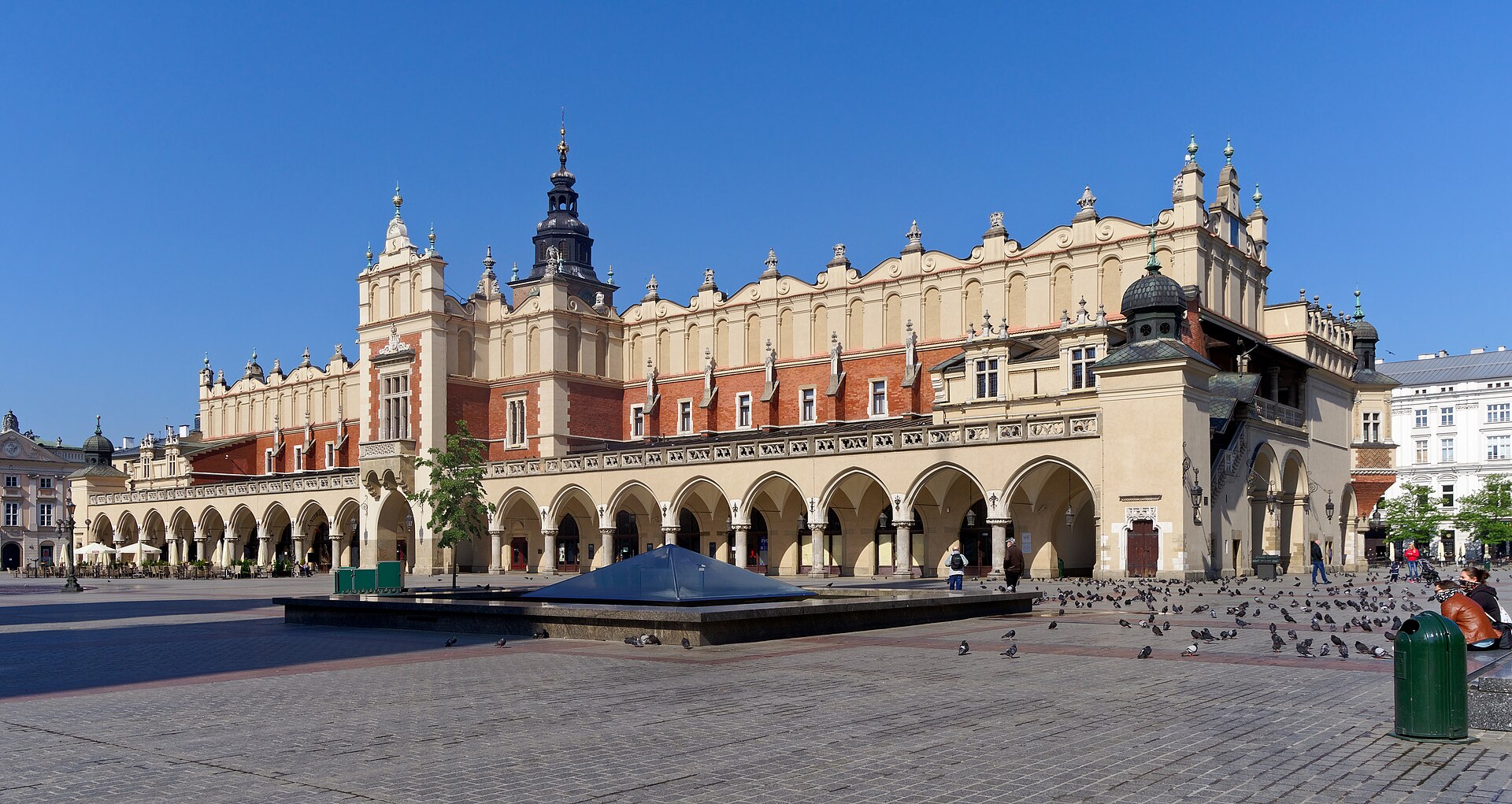
The Sukiennice is the elongated, free-standing market hall that bisects Kraków's Main Market Square (Rynek Główny) on a north–south axis, measuring roughly 104 metres long. The present structure descends from a brick Gothic hall funded by King Casimir the Great around 1358, which consisted of two rows of stalls covered by single-pitched roofs flanking a roofed central passage some 108 metres long and 10 metres wide (heritage register, Narodowy Instytut Dziedzictwa / zabytek.pl). After a fire in 1555, the building was rebuilt in Renaissance style between 1556 and 1559; the project is associated with the Italian-trained sculptor-architect Giovanni Maria Padovano (Gian Maria Mosca), who is credited with the arcaded loggias, and with Santi Gucci, who carved the ornamental masks of the attic, the work being overseen by the mason Master Pankracy (Medieval Heritage; zabytek.pl). The Renaissance campaign raised barrel vaults with lunettes over the trading hall and added upper chambers, while crowning the long roofline with a distinctively Polish parapet attic. The building took its present silhouette in a thorough restoration of 1875–1879 directed by the architect-conservator Tomasz Pryliński (1847–1895), recommended by the painter Jan Matejko and commissioned under Mayor Mikołaj Zyblikiewicz, who demolished the cramped outer stalls and wrapped the hall in neo-Gothic colonnaded loggias, ogival side galleries and projecting avant-corps (T. Pryliński, Wikipedia; whitemad.pl). The result is a Renaissance core in brick and stone, dressed in nineteenth-century historicist arcades, that reads coherently as one of the great monuments of central-European market architecture.
As a working hall of trade rather than a temple of finance, the Sukiennice was never richly decorated inside, but its exterior carries a notable Mannerist program: the crowning attic, attributed to Santi Gucci, is studded with grotesque carved mascarons and crested with comb-like ornament that became a defining motif of sixteenth-century Polish Renaissance building (zabytek.pl; Medieval Heritage). The most significant artistic dimension of the building came in 1879, when the newly created upper floor was given over to the National Museum in Kraków, founded by decree of the City Council on 7 October 1879. The Gallery of 19th-Century Polish Art now occupies four grand rooms there — the Bacciarelli, Michałowski, Siemiradzki and Chełmoński Rooms — and holds some 195 paintings and 19 sculptures, the largest permanent display of nineteenth-century Polish art (National Museum in Kraków, mnk.pl). Its centrepiece is Henryk Siemiradzki's monumental Nero's Torches, donated to the city at the inaugural ball of 3 October 1879, alongside major works by Jan Matejko, Jacek Malczewski, Józef Chełmoński and Piotr Michałowski. The arcades below have likewise become a setting for civic life and souvenir trade rather than a gallery of fixed artworks.
The Cloth Hall stands at the very centre of Kraków's Main Market Square, the largest medieval town square in Europe, laid out under the Magdeburg-law charter granted by Duke Bolesław the Chaste in 1257. From the outset the hall anchored the square's commercial geometry, sitting astride the Via Regia trade route between the town hall tower to one side and St Mary's Basilica to the other, with the cluster of market structures — weigh-house, scales and stalls — gathered around it (Britannica, 'Kraków'). Its location made it the literal and economic heart of the medieval capital of the Polish crown, a few hundred metres downhill from the royal seat on Wawel Hill. The entire ensemble of Old Town and Wawel, with the Sukiennice at its core, was among the first twelve sites inscribed on the UNESCO World Heritage List in 1978 as the 'Historic Centre of Kraków' (UNESCO World Heritage Centre, ref. 29). Today the ground-floor arcades remain a covered bazaar while the surrounding square functions as the city's principal public space.
Commerce on this spot began with wooden stalls authorized under the 1257 charter and was monumentalized when Casimir the Great erected the brick hall around 1358 to concentrate the cloth trade in a single regulated building. By royal privilege, visiting merchants bringing cloth into Kraków could offer it for sale only here, making the Sukiennice the obligatory clearing-house for the textile trade and a principal source of municipal revenue (Medieval Heritage; Kraków Cloth Hall, Wikipedia). The hall reached its golden age in the fifteenth century, when Kraków's membership in the wider Hanseatic-era network of long-distance trade channelled goods east and west through its arcades. The 1555 fire that destroyed the Gothic structure prompted the Renaissance rebuilding of 1556–1559, and the hall's commercial primacy waned only as Kraków lost its capital status and political weight in the seventeenth and eighteenth centuries. Under Austrian rule in the Kingdom of Galicia, the dilapidated building was rescued by the Pryliński restoration of 1875–1879, which both modernized its fabric and repurposed its upper storey as a national museum — a deliberately patriotic act of cultural assertion during the partitions. The Sukiennice has remained continuously in use as a market hall to the present day.
The hall's defining commodity was cloth — the woollen and linen textiles for which it is named — sold by the bolt in the arcaded stalls under tight municipal regulation of quality, measure and price. During its fifteenth-century heyday the Sukiennice handled a far wider international traffic: from the east came spices, silk, leather and wax, while Kraków exported its own textiles, lead from the surrounding mines, and salt extracted at the nearby Wieliczka mine (Kraków Cloth Hall, Wikipedia; Britannica). The building thus sat at the junction of the long-distance trades that crossed Poland between the Black Sea, the German lands and the Baltic. Trading was conducted face-to-face in the central hall and arcades, with weighing and measuring controlled by civic officials, and the merchants' privilege to sell cloth only here ensured the hall's role as a monopoly market. After the nineteenth-century restoration the ground-floor stalls turned to retailing folk crafts, amber, leather goods and souvenirs, a function the arcades retain today.
Images will be added as the project develops. Photographs by Larry Ng and from research sources.