Königsberg Stock Exchange (Königsberger Börse / Neue Börse)
Königsberg (now Kaliningrad), Russia · Established 1619 (institution); 1875 (present building)
This site requires authorization to access.
To request access, contact
william.goetzmann@yale.edu
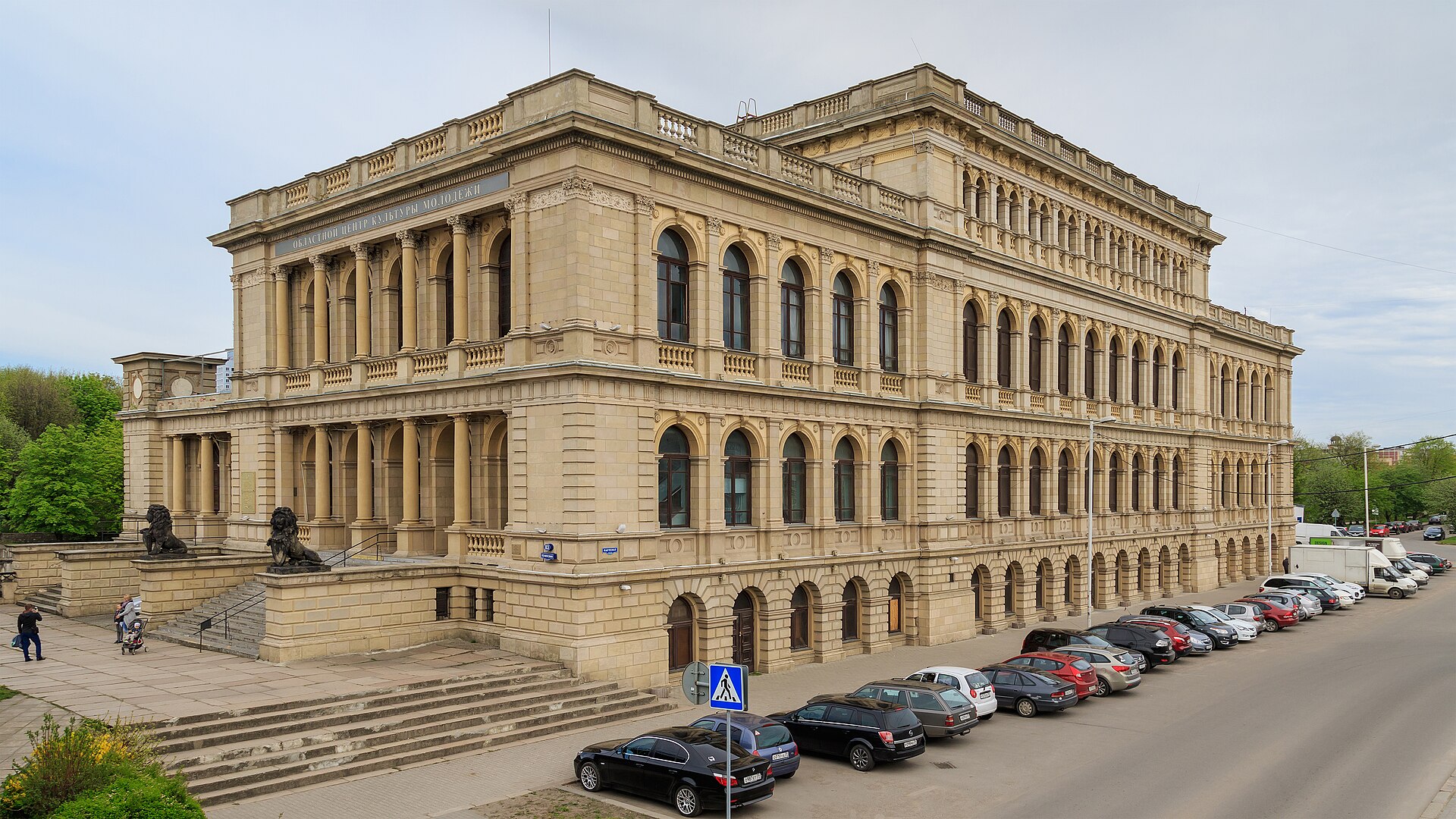
The exchange that survives today is the fourth and grandest of Königsberg's commercial halls, designed by the Bremen architect Heinrich Müller (1819-1890) and built between 1870 and 1875 in the Upper-Italian Neo-Renaissance manner then favoured for German mercantile palaces. Müller, who had trained in Munich under Friedrich Bürklein and at the Berlin Bauakademie under Heinrich Strack before becoming Bremen's leading historicist architect, conceived a two-storey palazzo whose entire facade was clad in ochre-coloured Obernkirchen sandstone (Obernkirchener Sandstein), the same prized Lower Saxon stone documented by the quarry's own building register (Obernkirchener Sandstein, 'Stock Exchange Kaliningrad'). Because the chosen site on the marshy south bank of the Pregel could not bear the load, the foundation was driven onto roughly 2,200 oak piles of twelve to eighteen metres' length, as recorded in the German account of the building (de.wikipedia.org, 'Neue Börse (Kaliningrad)'). Internally the structure was divided, after the museum's own building history, into a northern wing with a colonnaded gallery beneath a glazed roof and a large southern hall used for trading, concerts and exhibitions, with a post office, telegraph office and the 'Börsenkeller' restaurant in the basement (Kaliningrad Museum of Fine Arts, 'History of the Museum Building'). Long reckoned the most magnificent secular building in the province of East Prussia, it was among the very few structures in the city centre whose masonry shell outlasted the destruction of 1944-45.
The building's artistic interest is concentrated in its sculptural programme, executed by Emil Hundrieser. Along the roofline he set four monumental allegorical groups personifying the continents of Europe, Asia, Africa and America - an iconography of global commerce appropriate to a Baltic entrepôt - while two large shield-bearing lions guarded the foot of the ceremonial entrance stair (Kaliningrad Museum of Fine Arts, 'History of the Museum Building'; en.wikipedia.org, 'Königsberg Stock Exchange'). The continental figures were lost when the building burned in the bombardment of August 1944, but the pair of lions survived and remain in situ, the principal piece of original ornament still visible today. Beyond this exterior sculpture the decoration was relatively modest by the standards of a great exchange; the most notable lost interior feature was a fresco in the basement restaurant depicting Königsberg's Upper Fish Market, recorded only in the museum's building history. The Soviet reconstruction preserved the external form but redesigned the interiors, so little of the original decorative scheme remains.
The exchange stands in the Vordere Vorstadt on the southern shore of the Pregel, directly opposite the island of Kneiphof and beside the Grüne Brücke (Green Bridge), one of the famous seven bridges of Königsberg. The location placed it at the commercial heart of the old city, within sight of the cathedral and the warehouse and lighter district through which Königsberg's grain passed. Its predecessors had clustered nearby on Kneiphof itself - the documented exchange of 1619 moved into a new Kneiphof building in 1623 - so the 1875 hall continued a long association between the city's trade and this stretch of riverbank (en.wikipedia.org, 'Königsberg Stock Exchange'). Königsberg, a Hanseatic member from 1340 and a chartered city whose three settlements formally united in 1724, had grown by the nineteenth century into the principal Baltic outlet for Russian and East Prussian produce, a role greatly amplified once railways linked the port to the Russian interior (Encyclopaedia Britannica, 'Kaliningrad'). The building today carries the address 83 Leninsky Prospekt and remains, after the wholesale Soviet rebuilding of the city, one of the few visible survivors of pre-war Königsberg's monumental architecture (Wilson Center, 'Building a Soviet City: the Transformation of Königsberg').
Organised exchange trading in Königsberg is documented as early as 1619, and a dedicated bourse stood on Kneiphof from 1623; successive buildings followed - a second Kneiphof exchange around 1798-1800, destroyed by fire, and a further structure of 1801 - before the merchants outgrew their quarters and commissioned Müller's new hall, opened in 1875 (en.wikipedia.org, 'Königsberg Stock Exchange'). The building served as the seat of the Königsberg Chamber of Commerce and the focus of East Prussian and Russian-Baltic trade until the Second World War. In the bombing of August 1944 and the Battle of Königsberg in 1945 the timber structures burned out, but the sandstone shell stood. Under Soviet administration the ruin was used as a film location, listed as an architectural monument in 1960, and reconstructed from 1967; it reopened around 1973 as the Palace of Culture for Seamen, later became a regional centre of youth culture, and from 2018 has housed the Kaliningrad Museum of Fine Arts (de.wikipedia.org, 'Neue Börse (Kaliningrad)'; Kaliningrad Museum of Fine Arts, 'History of the Museum Building').
Despite the name 'stock exchange', the Königsberg Börse was overwhelmingly a commodities and produce exchange. Its core business was the domestic and international trade in grain, seed and fodder (Getreide-, Saaten- und Futtermittelgeschäft), the staple traffic of an East Prussian port whose hinterland and Russian railway connections made it a leading outlet for cereals, legumes, flax, hemp and timber (de.wikipedia.org, 'Neue Börse (Kaliningrad)'; Encyclopaedia Britannica, 'Kaliningrad'). The exchange's warehouse quarter held some of the largest grain stores on the European mainland, and the institution administered not only price-setting in these commodities but the associated services of freight, forwarding (shipping), warehousing and insurance that bound the port's merchant community together (en.wikipedia.org, 'Königsberg'; Obernkirchener Sandstein, 'Stock Exchange Kaliningrad'). In this it resembled the great Baltic and North-Sea produce exchanges more than a securities bourse, functioning as the clearing-house of East Prussia's export economy down to 1944.
Images will be added as the project develops. Photographs by Larry Ng and from research sources.