Calcutta Stock Exchange (CSE)
Kolkata, India · Established 1908
This site requires authorization to access.
To request access, contact
william.goetzmann@yale.edu
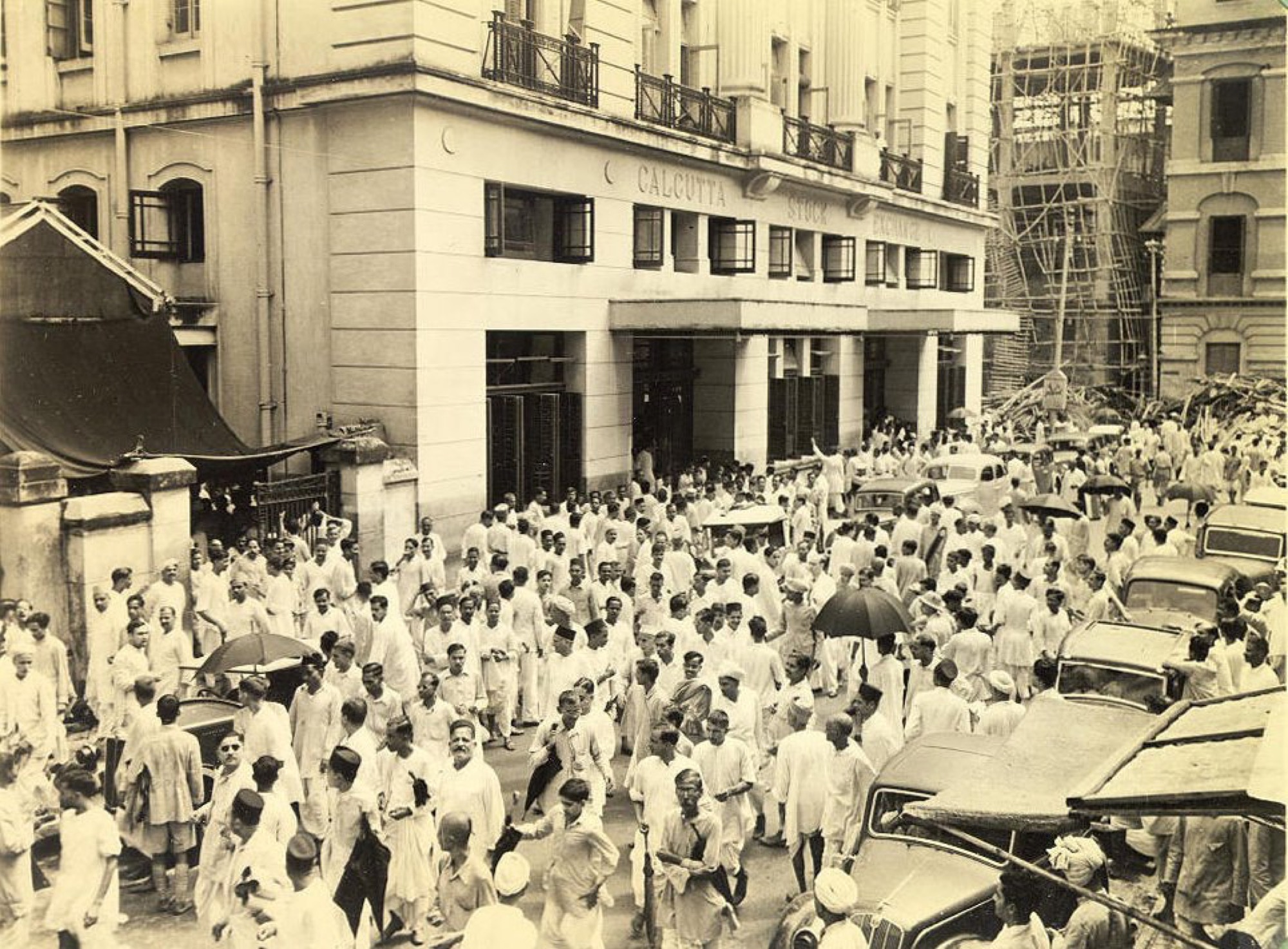
The Calcutta Stock Exchange traces its physical origins to one of the most evocative gathering spaces in Asian financial history—a neem tree near the present-day offices of Standard Chartered Bank on Netaji Subhas Road, where brokers began congregating as early as the 1830s to announce bids and offers in the open air. As Ranald Michie notes in The Global Securities Market: A History (Oxford University Press, 2006), such informal outdoor assemblies were a common precursor to formalized exchanges across the colonial world. The CSE’s institutional life began at 2 China Bazar Street in May 1908, when the Calcutta Stock Exchange Association was constituted with approximately 150 members. The defining architectural moment came in 1928, when the exchange relocated to a purpose-built structure at 7 Lyons Range in the heart of Dalhousie Square. As the urban historian Swati Chattopadhyay observes in Representing Calcutta: Modernity, Nationalism, and the Colonial Uncanny (Routledge, 2005), the commercial buildings along Lyons Range and Clive Street displayed the confident Neoclassical and Edwardian idiom characteristic of late-colonial Calcutta—an architectural language shared with comparable bourse buildings in Shanghai, Rangoon, and Ipoh across the British imperial network. The 1928 CSE building, with its classical detailing and monumental proportions, embodied Calcutta’s status as the commercial capital of British India and the premier financial center of the subcontinent until Bombay’s ascendancy in the mid-twentieth century. The exchange remained at its historic Lyons Range premises through its final years of operation before trading ceased in 2013.
The decorative program of the Calcutta Stock Exchange building reflected the broader aesthetic vocabulary of colonial commercial architecture that defined the Dalhousie Square precinct. The 1928 Lyons Range façade employed classical pilasters, corniced window surrounds, and rusticated stonework consistent with what the architectural historian Jon Lang, in A Concise History of Modern Architecture in India (Permanent Black, 2002), describes as the “commercial classical” idiom favored by European trading houses across British India. The interior trading floor, where the open outcry system operated for nearly ninety years until the introduction of the C-STAR electronic platform in February 1997, was dominated by the functional geometry of the trading ring—a cleared pit where jobbers matched buy and sell orders through voice and hand signals amid an intensity that participants recalled as almost theatrical. Before these formal premises existed, however, the exchange’s most distinctive aesthetic element was arguably the neem tree itself: a living commercial landscape around which brokers gathered in the manner that Debjani Bhattacharyya, in “Provincializing the History of Speculation from Colonial South Asia” (History Compass, 2019), identifies as characteristic of vernacular market-making practices in South Asian cities, where commerce unfolded in shaded outdoor spaces rather than enclosed European-style halls. The neighboring Royal Exchange building of 1917, housing the Bengal Chamber of Commerce, and the Indo-Saracenic Chartered Bank Building of 1908 provided an ornamental streetscape of carved keystones, iron balustrades, and decorative parapets that framed the CSE’s commercial activity within a larger visual program of imperial financial confidence.
The Calcutta Stock Exchange occupied a pivotal position within one of the most concentrated financial districts in colonial Asia. Situated at 7 Lyons Range, the exchange stood just meters from Netaji Subhas Road (formerly Clive Street)—a thoroughfare that the historian Partho Datta has called Calcutta’s “Wall Street of the East,” lined with the headquarters of major banks and managing agencies. To the south lay Dalhousie Square (now B.B.D. Bagh), the administrative and commercial heart of the Bengal Presidency, anchored by the Writers’ Building of 1776, which housed the East India Company’s secretariat. The imposing General Post Office, completed in 1868, the Currency Office, and the Reserve Bank of India all clustered within this precinct, creating what Swati Chattopadhyay, in Representing Calcutta (2005), characterizes as a landscape of imperial governance inseparable from its commercial functions. The city’s geographic position at the head of the Ganges delta, spread along the eastern bank of the Hooghly River, made it the natural gateway for the subcontinent’s export trades in jute, indigo, opium, and tea. As Gordon T. Stewart demonstrates in Jute and Empire: The Calcutta Jute Wallahs and the Landscapes of Empire (Manchester University Press, 1998), the jute mills and warehouses lining the Hooghly’s banks upstream constituted an industrial hinterland whose financial transactions converged upon the exchange floors at Lyons Range. Armenian, Chinese, Jewish, and Scottish merchants had all established trading houses in this compact district.
Informal share broking in Calcutta dates to at least 1836, when traders gathered under a neem tree to exchange securities tied to East India Company ventures, indigo plantations, and the burgeoning opium trade that, as Tirthankar Roy documents in Trading Firms in Colonial India (Harvard Business School Working Paper, 2014), provided significant Company revenue throughout the nineteenth century. The speculative boom and bust of 1865, driven by cotton price volatility during the American Civil War, rippled through Calcutta’s informal markets. The Calcutta Stock Exchange Association was formally constituted on 6 May 1908 at 2 China Bazar Street with 150 members, incorporating under the Companies Act in 1923. During the interwar years, the jute mill sector dominated trading, with firms controlled by managing agencies such as Andrew Yule, Bird & Heilgers, and McLeod & Co. commanding the lists. Thomas A. Timberg’s landmark study The Marwaris: From Jagat Seth to the Birlas (Penguin, 2014) traces how Marwari merchant-bankers progressively moved from brokerage and banking into industrial ownership, engineering a “transfer of economic power in corporate Calcutta” between 1950 and 1970 that a seminal Business History Review article by Omkar Goswami documented. Ritu Birla, in Stages of Capital: Law, Culture, and Market Governance in Late Colonial India (Duke University Press, 2009), further shows how colonial legal regimes attempted to regulate these “vernacular capitalists” by distinguishing gambling from legitimate speculation. The CSE listed over 3,500 companies at its peak, but the Harshad Mehta securities scandal of 1992 and the rise of the National Stock Exchange eroded confidence in regional bourses. Trading was suspended in 2013.
The securities traded on the Calcutta Stock Exchange reflected the commodity-export economy of eastern India and the evolving structure of colonial and post-colonial capitalism. In its earliest informal phase, brokers exchanged shares in East India Company-linked ventures, indigo agency houses, and opium consignment firms. As Omkar Goswami details in Industry, Trade, and Peasant Society: The Jute Economy of Eastern India, 1900–1947 (Oxford University Press, 1991), jute mill stocks became the dominant asset class by the early twentieth century, with European managing agencies like Andrew Yule (controlling six jute mills, eleven collieries, and ten plantations by 1911) and Bird & Heilgers (ten jute mills and eighteen collieries) listing their constituent companies on the CSE. Tea plantation shares from estates across Assam, Darjeeling, and the Dooars represented another major category, alongside coal mining equities from the Raniganj and Jharia fields. Banking securities—including shares in the Bank of Bengal (established 1806), later reorganized into the Imperial Bank of India in 1921—traded actively, as did government securities and debentures. Cotton textile stocks, shipping company shares, and engineering firm equities rounded out the listings. By the 1940s, the CSE listed over 100 companies; at its peak, listings exceeded 3,500, spanning insurance, cement, paper, and modern manufacturing. The transition from open outcry to the electronic C-STAR system in 1997 modernized execution, but the CSE’s inability to compete with national platforms ultimately ended active trading by 2013.
Images will be added as the project develops. Photographs by Larry Ng and from research sources.