Karachi Stock Exchange (Pakistan Stock Exchange)
Karachi, Pakistan · Established 1947
This site requires authorization to access.
To request access, contact
william.goetzmann@yale.edu
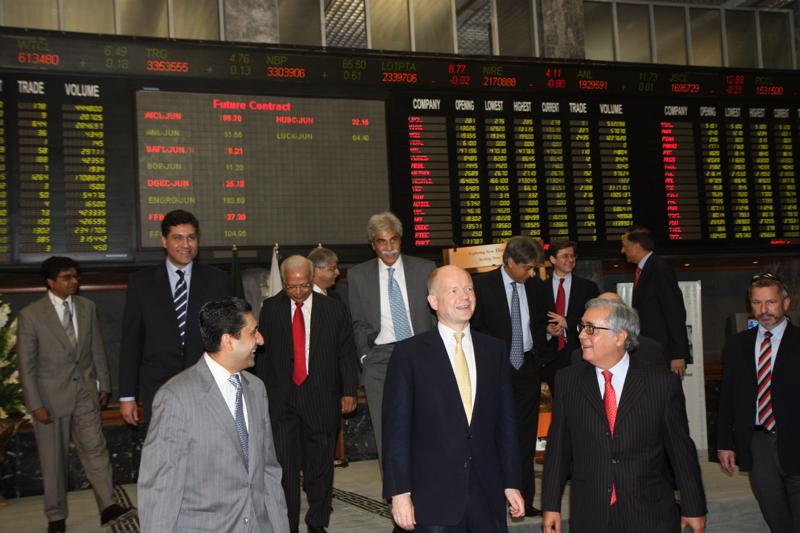
The Karachi Stock Exchange was housed in the Stock Exchange Building (SEB) on Stock Exchange Road, a short lane running perpendicular to I.I. Chundrigar Road—Karachi’s principal financial artery, known colloquially as “Pakistan’s Wall Street.” The original structure, occupied from the exchange’s founding on 18 September 1947, was a utilitarian mid-century building reflecting the pragmatic construction priorities of the immediate post-independence era. As Javed Iqbal noted in his MPRA working paper “Stock Market in Pakistan: An Overview” (2008), the exchange began modestly with just five listed companies and a paid-up capital of Rs 37 million, and its physical premises matched that humble scale. The building was gradually expanded and modernized over the decades as trading volumes grew and membership was capped at two hundred card-holding brokers. Unlike the grand European bourses with their neo-classical porticos, the KSE building adopted a functional modernist aesthetic—reinforced concrete frame, glass-and-aluminum curtain walling—suited to Karachi’s tropical climate and the practical demands of an active trading floor. The open-outcry trading hall, where buyers shouted “La-oo” and sellers responded “Ley,” was the physical heart of the building until the introduction of the Karachi Automated Trading System (KATS) in 1997, which gradually rendered the floor obsolete. On 29 June 2020, the Pakistan Stock Exchange building was attacked by four militants of the Balochistan Liberation Army (BLA), who arrived armed with automatic rifles and grenades, as documented by the Rajaratnam School of International Studies in its post-incident analysis. Three security guards and a police sub-inspector were killed before all four attackers were neutralized within minutes by responding Rangers and police. The building sustained damage to its entrance and façade but was rapidly restored, and trading resumed the same day—a fact widely noted as symbolic of institutional resilience. The PSX today operates from the same Stock Exchange Road compound, though by 2023 the old KATS platform was replaced by a New Trading and Surveillance System (NTS) purchased from the Shenzhen Stock Exchange for $2.85 million, reflecting the Chinese consortium’s strategic partnership.
The Karachi Stock Exchange building, unlike many of its European and even South Asian counterparts, was never conceived as a monumental civic structure with an elaborate decorative program. Where the Bombay Stock Exchange boasted the ornamental Italianate flourishes of its Dalal Street headquarters, or where Victorian exchanges in London and Liverpool employed allegorical sculpture and painted ceilings to dignify the acts of commerce, the KSE building was resolutely utilitarian—a product of the austere post-Partition moment when the nascent Pakistani state directed its limited resources toward infrastructure and institutional survival. The interior spaces were characterized by functional finishes: terrazzo floors, plain plaster walls, and suspended acoustic-tile ceilings in the trading hall designed for noise management rather than aesthetic effect. The visual culture of the exchange was instead expressed through the material artifacts of trading itself. Membership cards, each representing one of the two hundred seats, were coveted objects whose market value fluctuated dramatically—rising from just over one million rupees before 1990 to nearly forty million in the mid-1990s, as the PSX’s own historical blog records. The “badla” financing chits, share certificates, and handwritten trading slips constituted the primary documentary art of the exchange floor. Outside the building, the broader I.I. Chundrigar Road corridor offers a contrasting visual narrative: the Habib Bank Plaza, designed by the American architect Leo A. Daly and completed in 1963, was briefly Asia’s tallest building and expressed through its emphatic vertical lines a modernist confidence in Pakistan’s post-independence financial ambitions. The State Bank of Pakistan building and the Colonial-era Customs House in the Georgian style further contributed to the architectural tableau framing the exchange. If the KSE itself lacked a decorative program, it was embedded in a streetscape that constituted a collective visual statement about the centrality of finance to the Pakistani national project.
Karachi’s emergence as the financial capital of Pakistan was shaped by its deep-water port at the mouth of the Indus River system and its historic role as a gateway connecting the subcontinent’s interior to global maritime networks. The Harvard Mellon Urban Initiative’s research project “Wheat City: Karachi in the Commodity Revolution, 1880s–1920s” documents how, by 1910, Karachi’s port handled greater quantities of wheat than any other port in the British Empire, nearly all of it produced in the canal-irrigated tracts of Punjab and transported overland for export to Britain, Western Europe, and Japan. During the American Civil War, Sindhi cotton replaced American supplies for British textile mills, and by 1899 Karachi was South Asia’s largest wheat and cotton exporting port. The city’s financial infrastructure coalesced along what was then McLeod Road—named for John McLeod, the Deputy Collector of Customs in Karachi during the 1850s—which was renamed I.I. Chundrigar Road in 1969 in honor of Pakistan’s brief-serving Prime Minister (1957). This corridor became the spine of the national banking system, hosting the State Bank of Pakistan, Habib Bank, United Bank, National Bank, and Standard Chartered’s Pakistani subsidiary. The Stock Exchange Building sits on Stock Exchange Road, a short tributary off I.I. Chundrigar Road, placing it within a few hundred meters of the central bank, the major commercial banks, and the historic Karachi Port Trust. The Colonial-era Customs House—a Georgian-style structure dating to the British period—and the Burns Garden area (named for the British officer James Burnes) further anchor this precinct’s connection to Karachi’s imperial trading past. The 1963 completion of Habib Bank Plaza, designed by Leo A. Daly and then briefly Asia’s tallest building, signaled the district’s modernist reinvention. Today, the I.I. Chundrigar Road corridor continues to function as Pakistan’s pre-eminent financial district, though Karachi’s sprawling growth has dispersed some corporate headquarters to Clifton and other southern neighborhoods.
The Karachi Stock Exchange was established on 18 September 1947, barely a month after Pakistan’s independence on 14 August—making it one of the earliest institutions of the new state. It was formally incorporated on 10 March 1949 as the Karachi Stock Exchange (Guarantee) Limited under the Companies Act, 1913, as a company limited by guarantee. The exchange inherited the traditions of colonial-era share trading in Karachi, itself influenced by the practices of the Bombay Stock Exchange (founded 1875), from which many of its founding brokers had migrated at Partition. Initially listing just five companies with a combined paid-up capital of Rs 37 million, the exchange grew rapidly through the 1950s as Pakistan’s industrialization drive, particularly in textiles and jute processing, generated new corporate listings. The Securities and Exchange Ordinance of 1969 provided the first comprehensive regulatory framework for Pakistan’s capital markets, mandating exchange licensing and prescribing penalties for unauthorized trading. Zulfikar Ali Bhutto’s nationalization program, launched on 2 January 1972 under the Nationalization and Economic Reforms Order (NERO), devastated private-sector confidence; as scholars at the National Institute of Historical and Cultural Research have documented in the Pakistan Journal of History and Culture (2018), private investment fell from 8.5 percent of national output in 1969–70 to 5.4 percent, and prominent industrial families—the Saigols, the Habib group—relocated capital abroad. The exchange stagnated through the 1970s. Liberalization under General Zia ul-Haq in the 1980s and more decisively in the 1990s—when foreign investors were permitted to purchase listed securities and monetary policy was deregulated—revitalized the market. The Securities and Exchange Commission of Pakistan (SECP) was created by Act of Parliament in 1997 and became operational on 1 January 1999, replacing the Corporate Law Authority under an Asian Development Bank capital-market reform program. A second exchange, the Lahore Stock Exchange, had been established in October 1970, and a third, the Islamabad Stock Exchange, in October 1989. The March 2005 boom-and-bust cycle was a watershed: the KSE-100 Index surged sixty-five percent from December 2004 to a peak of 10,303 in March 2005, fueled by “badla” (carry-over) financing and newly introduced futures trading, before collapsing and wiping out an estimated $13 billion in market value, as Mustufa Hanif analyzed in his MPRA paper “Overview of the Crash of KSE” (2023). The 2008 global financial crisis brought another severe episode: a price floor was imposed at 9,144 points on 25 August 2008 and maintained for 110 days, a controversial intervention that a subsequent SECP inquiry blamed on its then-chairman’s unilateral decision-making. The Stock Exchanges (Corporatisation, Demutualisation and Integration) Act of 2012 set the legal framework for transforming the member-owned exchanges into for-profit entities, as Saqib Sharif detailed in “From Mutualized Exchange to Investor-Owned Demutualized Entity: The Case of Pakistan Stock Exchange” (International Journal of Experiential Learning & Case Studies, 2017). On 11 January 2016, the three exchanges merged to form the Pakistan Stock Exchange (PSX). Later that year, a forty-percent strategic stake was sold for Rs 8.96 billion ($85 million) to a Chinese consortium led by the China Financial Futures Exchange, with the Shanghai and Shenzhen Stock Exchanges, Pak-China Investment Company, and Habib Bank Limited. The PSX self-listed on 29 June 2017.
Karachi’s commodity-trading heritage long predates the stock exchange. The Karachi Cotton Association, founded in 1933, was Pakistan’s oldest commodity exchange, with its own Cotton Exchange Building inaugurated in 1940; cotton, along with wheat, jute, and oilseeds, had been the mainstay of Karachi’s port commerce since the late nineteenth century. When the Karachi Stock Exchange opened in 1947, its five initial listings reflected Pakistan’s narrow industrial base, dominated by textile mills and trading houses. Through the 1950s and 1960s, listed companies expanded to include jute manufacturers, cement producers, and commercial banks—sectors that remain pillars of the exchange today. As Javed Iqbal documented in his MPRA overview (2008), ordinary shares constituted the most actively traded security, followed by preference shares, redeemable certificates, and term-finance certificates (corporate bonds). Government bonds, particularly Pakistan Investment Bonds (PIBs) and Treasury Bills, were traded through the secondary market but principally in the interbank domain rather than on the exchange floor. Trading was conducted by open outcry from the exchange’s founding until 27 May 1998, with buyers calling “La-oo” and sellers responding “Ley” in a system of verbal matching. The introduction of the Karachi Automated Trading System (KATS) in 1997, supported by a US$125 million Asian Development Bank loan for capital-market reforms, brought electronic execution and nationwide connectivity. Settlement followed a T+2 procedure through the exchange’s Clearing House, which netted member obligations for each clearing period. The “badla” system—an informal collateralized lending mechanism where financiers provided credit against share purchases at market-determined premiums—functioned as a de facto margin-trading mechanism and was a persistent feature of KSE trading until regulatory reforms curtailed it after the 2005 crash. Futures trading was formally introduced in October 2004. The KSE-100 Index, established on 1 November 1991 with a base value of 1,000 points, became the benchmark for the Pakistani equity market, comprising one hundred stocks selected by sector representation and free-float capitalization, and representing approximately eighty-five percent of total market capitalization. Textile composite, textile spinning, cement, commercial banking, oil and gas exploration, and fertilizer sectors have historically dominated the index’s composition. By 2023, the PSX listed 524 companies on its Main Board with a combined market capitalization exceeding Rs 9.31 trillion and more than 313,000 registered investors, as reported by the PSX’s official data portal.
Images will be added as the project develops. Photographs by Larry Ng and from research sources.