Kansas City Board of Trade
Kansas City, United States · Established 1856
This site requires authorization to access.
To request access, contact
william.goetzmann@yale.edu
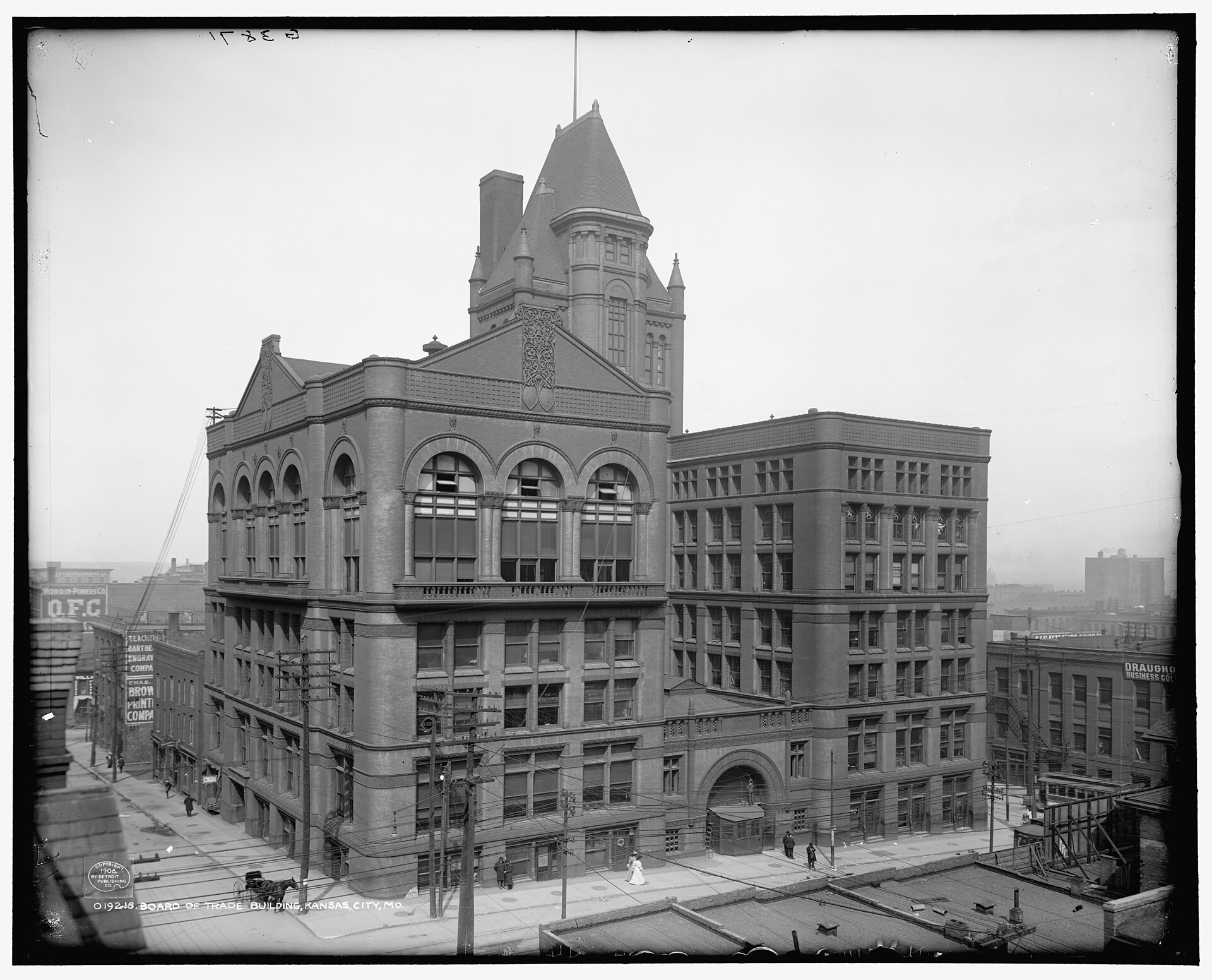
The exchange's celebrated home, built between 1886 and 1888 at the northwest corner of Eighth and Wyandotte Streets, was the prize-winning design of John Wellborn Root of the Chicago firm Burnham & Root, chosen from roughly fifty entries in a national architectural competition conducted under the Western Association of Architects' new rules; the firm submitted anonymously under the motto 'Utilissimus' (Donald Hoffmann, 'The Architecture of John Wellborn Root,' Johns Hopkins University Press, 1973). Root organized the seven-story structure on an H-shaped plan -- two parallel office wings flanking an exterior light court that opened southward -- a scheme the judges praised as 'plainly the best of all for light and ventilation of offices.' The exterior combined pressed red brick with red semi-glazed ornamental terra-cotta, both chosen for fireproofing and durability, and the two wings were joined by a monumental triumphal entrance arch. The interior centered on a skylighted concourse and a fifth-floor grain trading hall measuring roughly 59 by 115 feet, lit by tall triple-arched windows, with marble stairways and mezzanine offices above. Root boldly expressed the chimney and ventilation shafts on the north side of a tall elevator tower placed where daylight access was poorest -- a frank, utilitarian gesture that architectural historians read as a step in his evolution toward the Monadnock Building (1892). The British architect James Stirling later called it 'the toughest building of its period on either side of the Atlantic.' Long obsolete and vacant after the exchange departed, the building was demolished in 1968, a loss widely deplored in the literature on American commercial architecture.
Decoration at the Board of Trade was, in keeping with Root's pragmatic creed of 'practical utility,' restrained and architectural rather than pictorial -- the building had no program of murals or allegorical sculpture comparable to the painted ceilings of older European bourses. Its principal artistic interest lay in the craftsmanship of its materials: the ornamental terra-cotta of the facade and arch, and above all the ornamental ironwork of the skylighted concourse, executed in the dark 'bower-barff' rust-proofed finish by the Winslow Brothers of Chicago, the same firm whose metalwork distinguished Root's contemporaneous Rookery Building (Hoffmann, 'The Architecture of John Wellborn Root,' 1973). The expressive massing of the brick-and-terra-cotta tower, with its frankly displayed flues, was itself treated as a sculptural composition, anticipating the stripped monumentality of Root's later work. What ornament there was served the structure rather than narrative, and the building is remembered as a work of architecture rather than as a setting for the decorative arts.
The 1888 building rose in the heart of the rapidly expanding downtown of a city that had been incorporated only in 1853, at a moment when Kansas City was transforming itself from a Missouri River outfitting town into the principal rail and grain entrepot of the southwestern Great Plains. The exchange had grown out of humbler quarters near the Union Depot in the West Bottoms and, from 1877, a three-story building at 502 Delaware Street designed by Asa Beebe Cross; the move to Eighth and Wyandotte placed it squarely among the new commercial towers of the central business district (pendergastkc.org, 'Kansas City Board of Trade,' Kansas City Public Library). The Burnham & Root block stood within a cluster of late-nineteenth-century office buildings near the city's banks, railroads, and grain elevators, its tall tower a landmark on the downtown skyline. When the exchange outgrew it after the First World War, the institution moved successively north and then south -- to a fourteen-story building at Tenth and Wyandotte in 1925 and finally, in 1966, to a modern facility at 4800 Main Street beside the Country Club Plaza district, where it remained until its trading floor closed.
The Kansas City Board of Trade was organized in 1856 by a group of local merchants, shortly after the city's incorporation, and was formally chartered in 1876 -- the same year it established a 'grain call' that marked the beginning of organized futures trading and listed its first hard-red-winter-wheat futures (Kansas City Board of Trade entry, Wikipedia; MarketsWiki, 'Kansas City Board of Trade'). Over the following century the KCBT became the world's dominant market for hard red winter wheat, the bread-wheat of the central and southern Plains, complementing the soft-red-winter contract traded at the Chicago Board of Trade. It survived the consolidation of American futures exchanges into the late twentieth century as one of the last independent regional exchanges. On October 17, 2012, CME Group announced it would acquire the KCBT for $126 million in cash, completing the purchase on December 3, 2012 and folding the benchmark hard-red-winter-wheat contract into its CBOT division (CME Group press release, October 17, 2012; PR Newswire, December 3, 2012). The historic open-outcry trading floor in Kansas City was maintained only briefly before operations were consolidated in Chicago, bringing more than a century and a half of independent institutional life to a close.
From its chartering in 1876 the Board of Trade was first and foremost a cash and futures market for grain, and specifically for hard red winter wheat, the high-protein bread wheat grown across Kansas, Oklahoma, Nebraska, and the surrounding plains that fed the region's mills and elevators (MarketsWiki, 'KC Hard Red Winter (HRW) Wheat Futures'). Trading was conducted by open outcry in the trading hall, where members bought and sold both physical grain delivered through the city's elevators and standardized futures contracts that allowed farmers, millers, and merchants to hedge price risk across the harvest cycle. The KCBT hard-red-winter-wheat future became a global benchmark, typically quoted at a premium to the Chicago soft-red-winter contract because of its superior milling and baking qualities, and it remains traded under CME Group as the KC HRW Wheat (KE) contract. Alongside its flagship wheat business the exchange at various times listed other grains and, in its later decades, financial instruments such as the Value Line stock-index futures it pioneered in 1982, but it was always identified above all with the wheat of the American breadbasket.
Images will be added as the project develops. Photographs by Larry Ng and from research sources.