Old Johannesburg Stock Exchange ("Between the Chains")
Johannesburg, South Africa · Established 1887
This site requires authorization to access.
To request access, contact
william.goetzmann@yale.edu
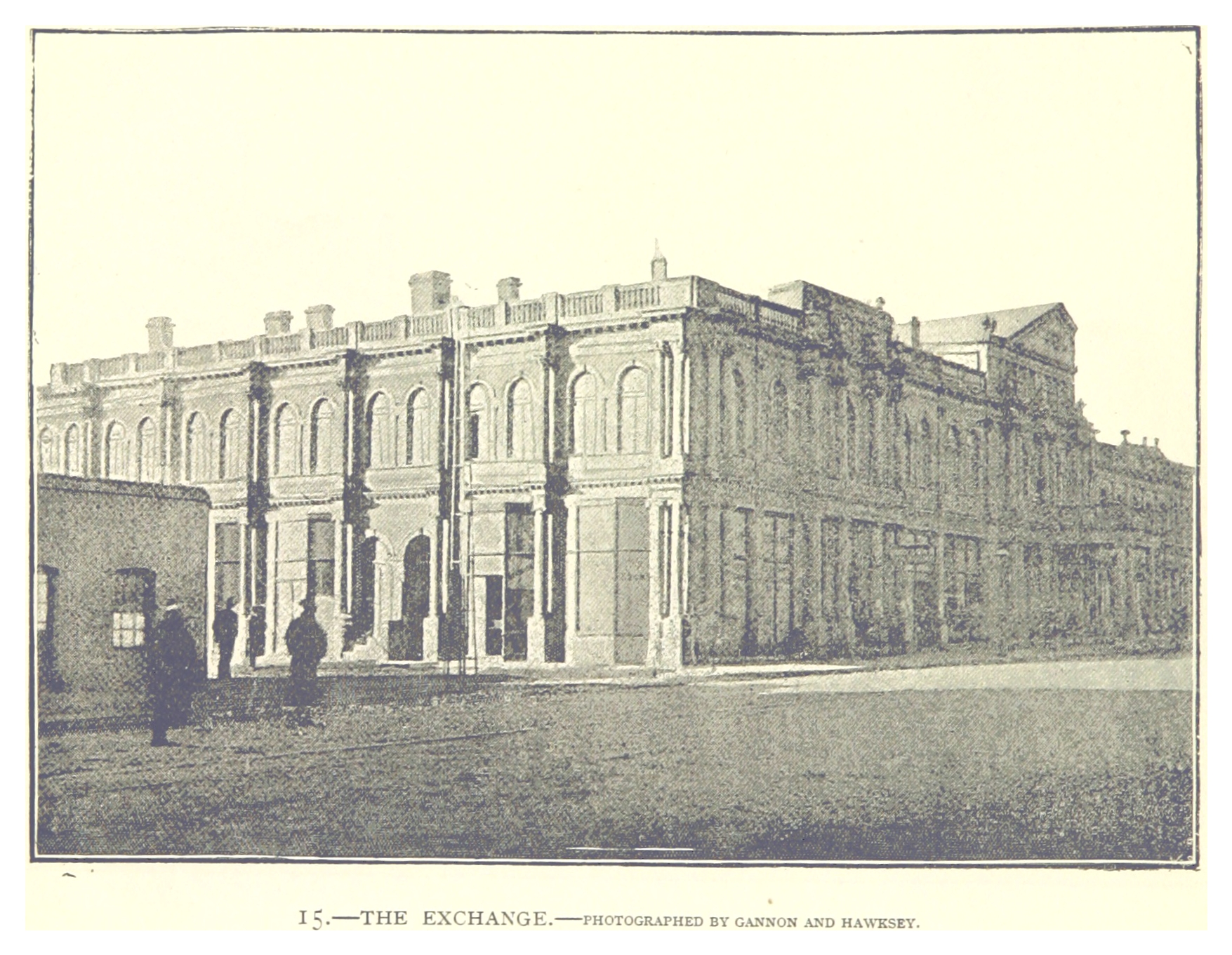
The Johannesburg Stock Exchange grew through three successive buildings in its first two decades, each a measure of the explosive growth of the Witwatersrand goldfields. The First Exchange, designed by Frederick Holman and completed in 1886–1887 at the corner of Commissioner and Simmonds Streets, was a modest hall serving the year-old mining camp (The Heritage Portal, "Johannesburg Stock Exchange Buildings over the Decades"). It was quickly outgrown; a foundation stone for a larger Second Exchange was laid in November 1889 and the building, designed by the firm Lennox, Canning & Goad with an eastern section added by Arthur Henry Reid, opened in 1890, its impressive facade fronting a large trading hall (artefacts.co.za, building record 691). When even this proved too small, the grand Third Exchange was raised on a new site in Hollard Street and completed in 1903–1904 by the prominent partnership Leck & Emley: an Edwardian classical pile filling its block, with a temple-front portico, arched pediments, cornices and rusticated work, 210 offices, and a two-storey main hall some 28.3 m by 22 m lined with marble columns (The Heritage Portal). The Hollard Street building was demolished in 1958 and replaced by a successor exchange on the same site, opened in 1961.
The architecture of the early exchanges spoke the confident commercial classicism of the late-Victorian and Edwardian British empire rather than relying on fine art. The 1903–04 Hollard Street hall was its most ornamental expression: a temple facade with arched pediments and rusticated masonry outside, and within, a great double-height trading floor articulated by marble columns and pilasters and furnished with rows of carved wooden members' chairs (The Heritage Portal, "Johannesburg Stock Exchange Buildings over the Decades"). The visual culture of the institution, however, is best remembered through the surviving photographic record of the open-air market — the chained-off section of Simmonds Street thronged with top-hatted brokers — which became the iconic image of speculative Johannesburg and survives in published illustrated reviews of the 1890s (see the 1893 view of the Exchange digitised by the British Library).
The old exchange sat at the heart of Marshalltown, the original financial quarter of Johannesburg laid out within the rigid grid of the young mining town founded in 1886. The First and Second buildings stood at the Commissioner-and-Simmonds-Streets corner, and when brokers and mining-company men spilled into the roadway to keep trading after hours, the Mining Commissioner Carl von Brandis closed off the block of Simmonds Street between Market and Commissioner Streets with thick iron chains, creating the celebrated open-air market "between the chains" (African Economic History Network, "From Market to Exchange," 2021). The move of the exchange to Hollard Street in 1904 pulled the financial district westward and made Hollard Street "the Wall Street of Johannesburg" for more than seven decades, until the JSE migrated to Diagonal Street in 1978 and finally to Sandton in 2000 (Wikipedia, "JSE Limited"). The site lies in the present-day Johannesburg central business district around latitude -26.2055, longitude 28.0421.
The exchange was founded by the London-born, Kimberley-trained mining speculator Benjamin Woollan, who established the Johannesburg Exchange & Chambers Company; it opened on 8 November 1887 and was formally registered in the South African Republic on 28 February 1888 (African Economic History Network, 2021). It rode the gold-share mania of the early 1890s — by January 1890 more than 200 companies appeared on the Official List — through booms and busts including the speculative collapse that delayed the Second Exchange's completion and the disruption of the Jameson Raid and the South African War. Governance passed through competing interests, including the Johannesburg Estate Company associated with Barney Barnato, who took control of operations in 1889. The institution that began "between the chains" became the dominant securities market of southern Africa; after the eras at Simmonds Street and Hollard Street it moved to 17 Diagonal Street in 1978 and to its present Sandton home in 2000, today trading as the JSE (Wikipedia, "JSE Limited"). This entry concerns the historic 1887–1904 buildings and street market, distinct from the modern Sandton exchange.
From the outset the Johannesburg exchange was overwhelmingly a market in mining shares — chiefly the deep-level gold companies of the Witwatersrand — together with the equity of the banks and finance houses that capitalised them (African Economic History Network, 2021). The "between the chains" street market and the trading halls floated and re-floated the gold-mining ventures whose share prices swung violently with assay reports, the gold-rush speculation of 1888–1895, and the political shocks of the period. Banking and insurance equity, and later the shares of the great mining-finance groups (the "houses") that consolidated control of the goldfields, filled out the Official List, making the exchange the financial engine of the gold-mining capital and one of the most important securities markets of the colonial and early-twentieth-century world (The Heritage Portal; Property24, "Johannesburg Stock Exchange history").
Images will be added as the project develops. Photographs by Larry Ng and from research sources.